NEAR Surges Over 50% in a Week: How Can an Old Public Chain Tell a New Story?


- Core Viewpoint: NEAR has risen over 50% in the past week and is transforming from a high-performance public chain into a "universal cross-chain trading hub." Through diversified initiatives including cross-chain swaps, privacy transactions, perpetual contracts, and AI Agent settlement, it aims to capture capital and user demand from multiple trending sectors simultaneously.
- Key Elements:
- Launch of the "options-style airdrop" NEAR@3.33 program, with a first-round prize pool of 333,333 NEAR. Token unlocking is tied to both a $70 million TVL target and a token price of $3.33, with a total value of approximately $1.11 million.
- NEAR Intents has connected to over 30 public chains, processing cumulative cross-chain trading volume exceeding $30 billion. The protocol layer charges a 0.0001% fee per transaction, and Ledger, Brave Wallet, THORSwap, and others have already integrated.
- Launch of the Confidential Intents privacy feature, which sends transaction requests to private shards, hides quotes and execution processes, and prevents front-running and MEV attacks. Zodl wallet has integrated support for swapping BTC, USDC, and more into the privacy pool ZEC.
- near.com integrates Hyperliquid perpetual contracts, supporting over 50 markets with up to 40x leverage, and adds a privacy mode to hide deposit paths, collecting front-end service fees through Builder Code.
- Building AI Agent settlement infrastructure, leveraging NEAR AI private inference, IronClaw trusted execution environment, Chain Signatures cross-chain signing, and NEAR Intents settlement — though this direction remains in its early stages.
Original | Odaily (@OdailyChina)
Author | Asher (@Asher_ 0210)
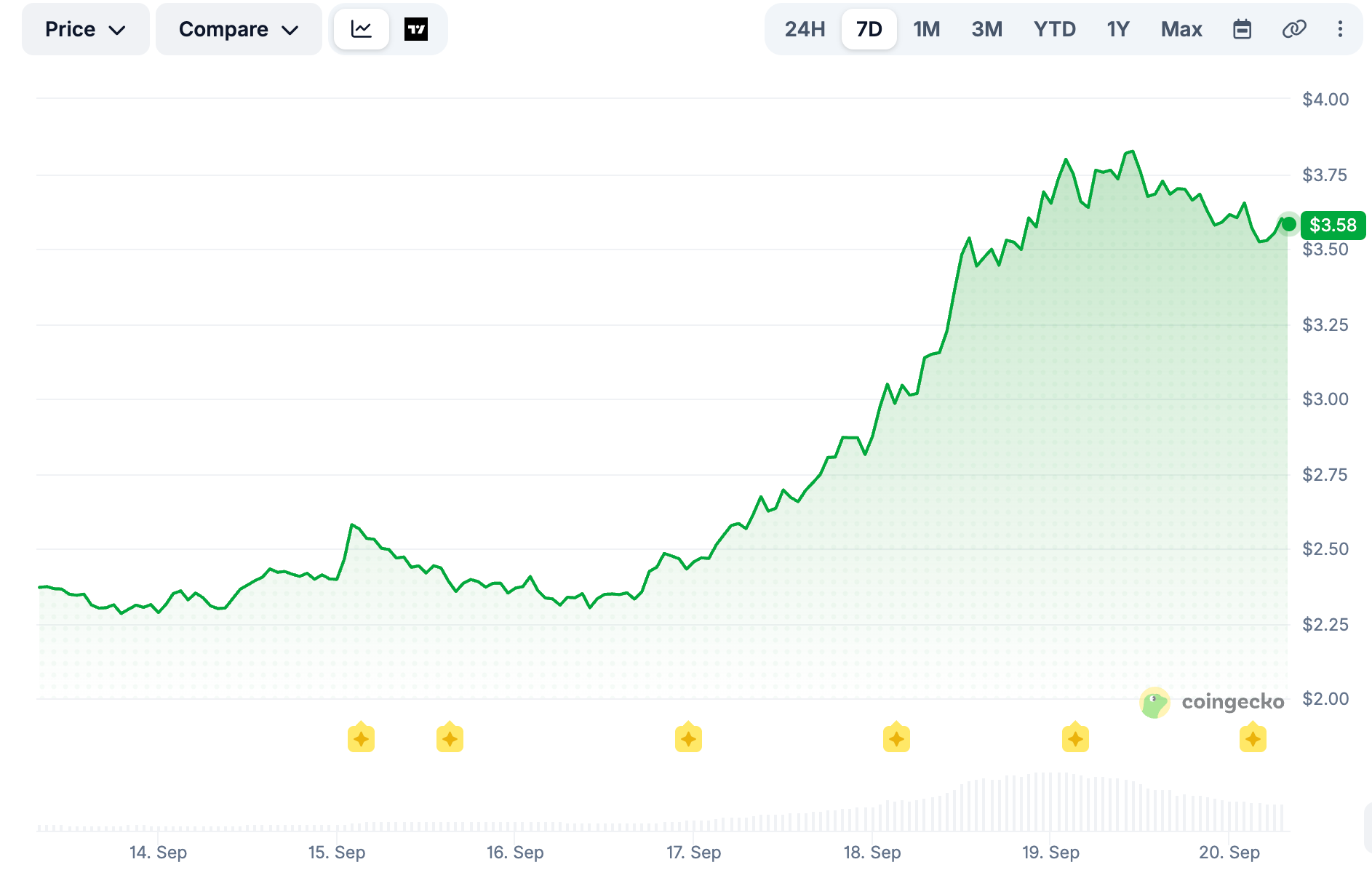
Over the past week, NEAR surged from around $2.3 to above $3.9, briefly gaining more than 50% and becoming one of the best-performing and most discussed mainstream altcoins in recent memory.
Unlike its past narrative centered on sharding and high-performance public chains, NEAR is now trying to tell a new story that is more closely tied to real trading demand. From cross-chain to privacy transactions, and from perpetual contracts to AI Agents, this public chain is attempting to capture capital and user demand across multiple hot sectors simultaneously.
Launching an "Options-Style Airdrop": Token Unlock Tied to Both TVL and Token Price
In June of this year, NEAR launched the NEAR@3.33 milestone incentive program, rewarding users who use the privacy transaction feature on near.com, with an initial prize pool of 333,333 NEAR tokens that unlocks upon meeting two targets.
Target One: The asset scale within near.com privacy accounts reaches $70 million. On September 17, this metric was officially met, triggering the first snapshot. Accounts that continuously held more than $100 in privacy assets at the time of the snapshot and completed at least one privacy swap are eligible to participate in the reward distribution. The final share will be calculated based on a combination of fund holding duration, holding amount, and trading activity, with a single wallet capped at 2% of the prize pool to prevent rewards from being overly concentrated among a few large holders.
Target Two: NEAR's three-day volume-weighted average price exceeds $3.33. After the snapshot is completed, users still receive NEAR@3.33 milestone tokens that cannot be traded or transferred; only when NEAR's three-day volume-weighted average price reaches or exceeds $3.33 will these tokens convert 1:1 into circulating NEAR. At $3.33, the total value of the first-round rewards is approximately $1.11 million. NEAR has stood above $3.33 for two consecutive days since September 18, and September 20 is the final day of the three-day price assessment. If today's volume-weighted average price remains above $3.33, the unlock condition will be met.
Shifting from an Ordinary Public Chain to a "Full-Chain Trading Gateway"
NEAR's product positioning has also undergone a significant transformation.
In the past, the market's perception of NEAR primarily centered on sharding, high TPS, and low gas fees, but these capabilities struggled to differentiate it meaningfully from other public chains. Now, NEAR is shifting its development focus to NEAR Intents and near.com, attempting to become a unified trading gateway connecting different blockchains, with trading scope no longer limited to its own ecosystem.
NEAR Intents is a trading method that "only specifies the outcome, not the execution process." In traditional cross-chain swaps, users must select a cross-chain bridge themselves, transfer assets to the target chain, prepare the corresponding gas tokens, and then go to a DEX to complete the trade; in NEAR Intents, users only need to state what they are willing to give and what they wish to receive. For example, after a user submits "swap ETH on Ethereum for ZEC," the system sends the request to multiple market makers, who compete on price, speed, and execution quality. Users do not need to know which bridges or liquidity pools the transaction passes through, nor do they need to hold the target chain's gas in advance; as long as the final amount of assets received is no less than the quote accepted at signing, the transaction can be executed.
NEAR Intents does not only serve near.com; it can also be integrated into other wallets and applications through the 1Click API and trading components. Currently, products such as Ledger, Brave Wallet, Infinex, THORSwap, and HOT Wallet have all adopted its cross-chain trading services, and Stargate has also integrated NEAR Intents into some of its cross-chain routes. As a result, some users may use quotes and settlement services provided by NEAR Intents through other products even without visiting near.com.
Currently, NEAR Intents has connected over 30 public chains and processed cumulative cross-chain trading volume exceeding $30 billion. Its protocol layer charges a 0.0001% fee per transaction, and wallets and applications integrating the 1Click API can additionally set their own platform fees on top of this. From this perspective, NEAR no longer requires all assets and applications to migrate to its own chain, but instead hides in the trading backend, providing routing and settlement services for assets on other chains.
Privacy Transactions Become a New Differentiation Direction
After NEAR Intents enabled cross-chain trading, NEAR further added privacy features on top of NEAR Intents, launching Confidential Intents, to solve the problem of traditional on-chain transactions exposing order information in advance.
Once ordinary on-chain transactions enter the public mempool, wallet addresses, traded assets, amounts, and timing may all be observed externally. For large transactions, this information can expose users' holdings and trading strategies, and easily attract MEV activities such as front-running and sandwich attacks. Confidential Intents sends transaction requests to NEAR's private shard, where quotes and execution processes do not appear in the public mempool. This shard also does not provide a public RPC or block explorer, so outsiders cannot directly see what orders users submitted or what quotes different market makers offered. After the transaction is completed, assets are still transferred to the public chain address specified by the user, but it is difficult for outsiders to fully correlate the deposit address, trading direction, and final receiving address. Users can also proactively generate viewing keys to disclose transaction records to auditors or other designated parties.
ZEC is a typical case of NEAR combining cross-chain trading with privacy demand. The Zodl wallet has integrated NEAR Intents, allowing users to directly swap BTC, USDC, or Solana ecosystem assets into ZEC in the privacy pool, without first transferring assets to a centralized exchange and then withdrawing to a Zcash privacy address. ZEC provides privacy assets and shielded addresses, while NEAR Intents aggregates funds from other chains, providing users with a cross-chain channel into the Zcash privacy ecosystem.
Alex Shevchenko, head of NEAR Intents, stated, "Privacy is rapidly becoming a core need of the industry, and NEAR is becoming the infrastructure that makes privacy transactions the default choice. By combining cross-chain liquidity with capabilities such as anti-front-running and preventing trading strategy leakage, institutions and DeFi users can complete large transactions while preserving privacy."
As ZEC trading activity rises, user demand for swaps into Zcash from BTC, ETH, Solana, and other ecosystems may also bring more trading volume and fees to NEAR Intents. NEAR itself is not a privacy coin, but by providing a cross-chain gateway for privacy assets and hiding transaction paths and execution information, it can also be considered a privacy-concept coin.
Integrating Hyperliquid, Extending from Cross-Chain Swaps to Perpetual Contracts
In June of this year, near.com integrated Hyperliquid perpetual contracts, allowing users to directly trade over 50 perpetual contract markets provided by Hyperliquid on near.com, with leverage support of up to 40x. On September 17, this feature further added a privacy mode.
Typically, users entering Hyperliquid need to first prepare the margin assets it supports, then deposit through designated networks. near.com integrates cross-chain deposits into the trading process, allowing users to deposit various assets from over 30 public chains, with NEAR Intents completing cross-chain swaps in the background to convert them into USDC margin accepted by Hyperliquid, then transferring them to the trading account.
The privacy mode primarily hides the funding path through which users enter Hyperliquid. Orders and positions are still recorded on Hyperliquid, but it is difficult for outsiders to correlate the trading account and deposit process with the user's main wallet. Therefore, this feature does not hide the perpetual contracts themselves, but rather reduces the possibility of users' funding sources and main wallets being tracked.
In this partnership, Hyperliquid provides perpetual contract markets, order books, liquidity, and trade execution, while near.com handles account access, cross-chain deposits, and privacy processing. near.com can also charge additional front-end service fees during user trades through Hyperliquid's Builder Code, thereby expanding itself from a cross-chain swap tool into a trading gateway capable of continuously earning trading fees. Compared to one-time cross-chain swaps, perpetual contracts have higher trading frequency, which not only increases the potential for near.com to continuously collect fees, but also extends NEAR's trading gateway from cross-chain swaps further into the derivatives market.
AI Agents Provide Longer-Term Imaginative Space
In addition to cross-chain, privacy, and derivatives trading, NEAR also positions itself as settlement infrastructure for AI Agents, enabling AI to securely manage assets and independently complete transactions, payments, and tool invocations.
NEAR co-founder Illia Polosukhin believes, "Only when Agents are sufficiently secure can the Agent economy truly take shape." Around this goal, NEAR has already built a set of mutually reinforcing products. NEAR AI provides private inference capabilities; IronClaw isolates tools and account credentials within a trusted execution environment, preventing private keys and user data from being directly exposed to models; Chain Signatures allow Agents to sign transactions on different blockchains; and NEAR Intents handles cross-chain swaps and settlement. With these capabilities combined, Agents can mobilize assets across multiple chains according to user instructions without having to handle cross-chain bridges and gas one by one.
However, compared to NEAR Intents, which has already generated tens of billions of dollars in trading volume, NEAR's layout in AI Agents is still at an early stage. Whether Agents can generate scaled on-chain payment and trading demand, and whether these activities can ultimately translate into protocol revenue for NEAR, still requires more real-world data to verify.