From asset tokenization to real-world payments: Stablecoins and RWA are piecing together the next-generation financial infrastructure


- Core Viewpoint: RWA and stablecoins are moving from independent narratives toward convergence. Traditional institutions and crypto platforms are jointly building a complete on-chain financial chain covering issuance, trading, settlement, and offline payments, driving crypto infrastructure to truly enter the real world.
- Key Elements:
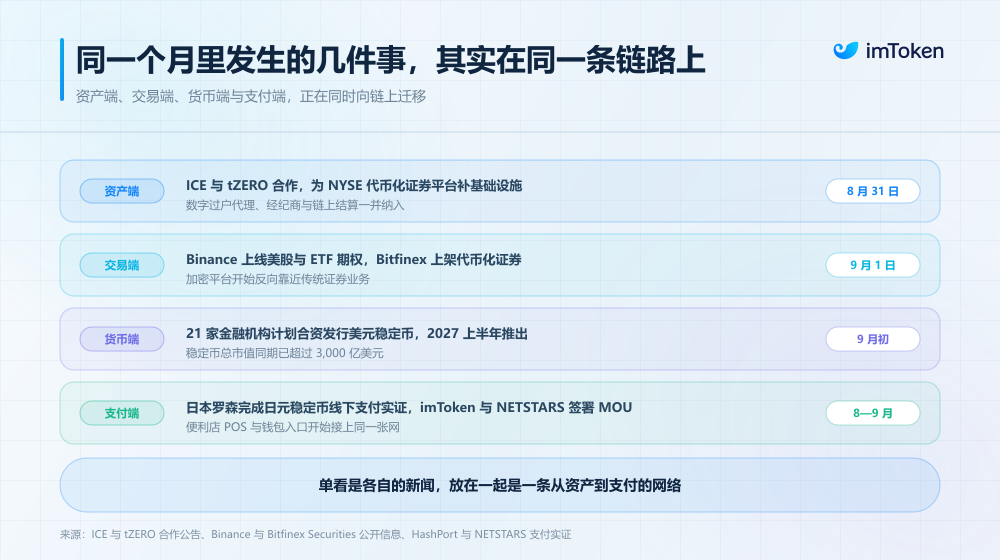
- NYSE is developing a tokenized securities platform, bringing in Securitize and tZERO, with the goal of giving tokenized stocks real shareholder rights and supporting 7×24 trading and instant settlement.
- 21 institutions including Goldman Sachs, Citi, and Deutsche Bank plan to launch a USD stablecoin by 2027, marking stablecoin issuance entering the banking system itself.
- RWA competition is upgrading from "asset tokenization" to building an on-chain capital market capable of issuance, trading, custody, and settlement, with stablecoins becoming the symmetric "cash layer."
- Japan's Lawson convenience stores have successfully implemented offline payments with JPY stablecoins, with Stablecoin Pay charging merchants a 0.98% fee, validating multi-currency, multi-chain connectivity with existing POS systems.
- HashPort launched Wallet MCP, exploring AI Agents connecting to wallets to complete payments, with stablecoins potentially becoming the native payment tool for machine use.
Over the past few years, RWA and stablecoins have arguably been the tracks in the crypto industry least short of "grand narratives."
On one side, there is the effort to bring US Treasuries, stocks, funds, and even private credit onto the blockchain, giving real-world assets programmable, composable, and globally circulating capabilities; on the other side, there is the effort to turn fiat currencies such as the US dollar and the euro into on-chain cash that can circulate 24/7.
This narrative has been told for quite a while, to the point of becoming somewhat tiresome. But if you piece together the moves made by traditional institutions and crypto platforms over the past few months, you'll find that they are no longer independent, isolated experiments, but rather interlocking pieces forming a complete financial chain (Further reading: From "Speculative Asset" to "Next-Generation Financial Infrastructure": Is Crypto Growing a New TradFi World?).
1. The Second Half of RWA: No Longer Just About "Issuing Tokens"
In the early days, when people talked about RWA, their thinking was straightforward: turn assets into tokens.
A US Treasury fund that used to exist in a traditional financial account now has its shares turned into tokens; a piece of gold that used to be traded through funds, warehouse receipts, or brokers can now generate on-chain digital certificates.
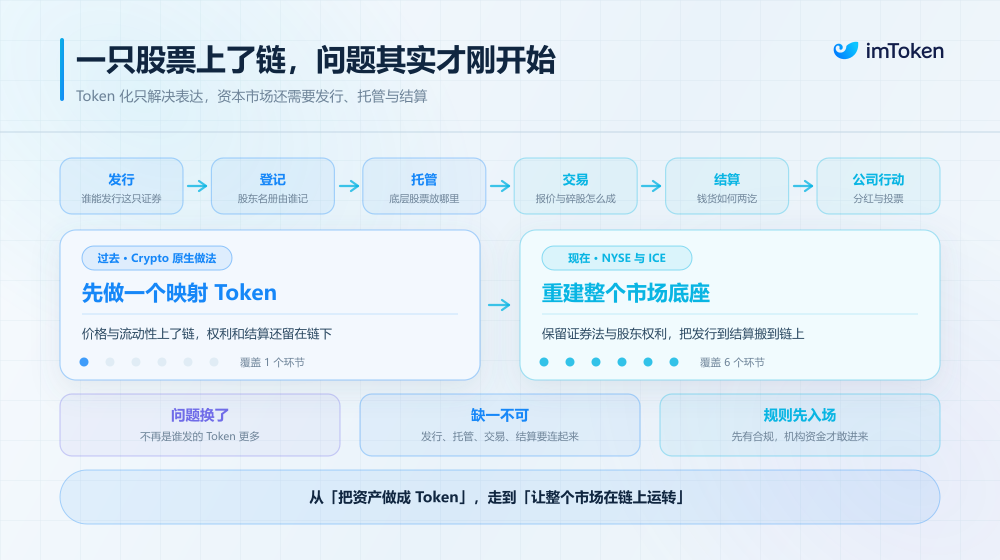
This does solve the "digital representation" of assets, but in the real financial world, a token alone simply doesn't work.
If a stock is merely a token mapping on-chain, it often carries no real shareholder rights; and if it detaches from regulation and existing trading and settlement rules, institutions won't dare touch it.
You must answer a series of tedious yet critical institutional questions: who custodies the underlying stock, how dividends are paid, who keeps the transfer records, and how after-hours settlement is handled.
That's why what NYSE is doing deserves attention.
In January of this year, NYSE announced it was developing its own tokenized securities platform. According to the public plan, it is not simply issuing a few "stock-mapped tokens," but rather aims to give tokenized stocks the genuine shareholder rights of traditional securities, while supporting 24/7 trading, fractional shares, instant settlement, and stablecoin funding settlement.
Since then, NYSE has brought in Securitize and tZERO to continue building out infrastructure around digital transfer agents, broker-dealers, securities registration, and on-chain settlement. This is fundamentally different from the logic of crypto-native platforms issuing their own tokenized stocks in the past.
What traditional finance is trying to solve is how to make blockchain the new technological foundation of the securities market without abandoning securities law, investor rights, and existing financial market rules.
On the other side, crypto platforms are also moving in reverse toward traditional finance.
Leading trading platforms have successively rolled out US stock, ETF, and even options trading products. In the past, users needed to buy BTC on a crypto exchange, buy Nvidia in a securities account, and then trade gold in yet another account. Now, more and more crypto platforms are trying to consolidate these assets back into a single account and funding system.
For example, Bitfinex Securities recently listed five products that allow qualified investors to gain economic exposure to listed companies such as Strategy and Metaplanet through tokenized securities, trading in USD, USDT, and BTC.
Ultimately, competition in RWA is upgrading from "who can turn assets into tokens" to "who can build an on-chain capital market that can truly issue, trade, custody, settle, and operate continuously."
And once you reach the settlement stage, stablecoins naturally become the next piece of the puzzle.
2. After Assets Go On-Chain, Stablecoins Begin to Become the "Cash Layer"
Once you have assets that can go on-chain, the immediate question is: what money do you use to settle?
For a long time, stablecoins were more like "fiat tokens" in a giant crypto casino. People bought USDT/USDC mainly to trade coins on exchanges, and fund flows were almost entirely closed-loop within the industry.
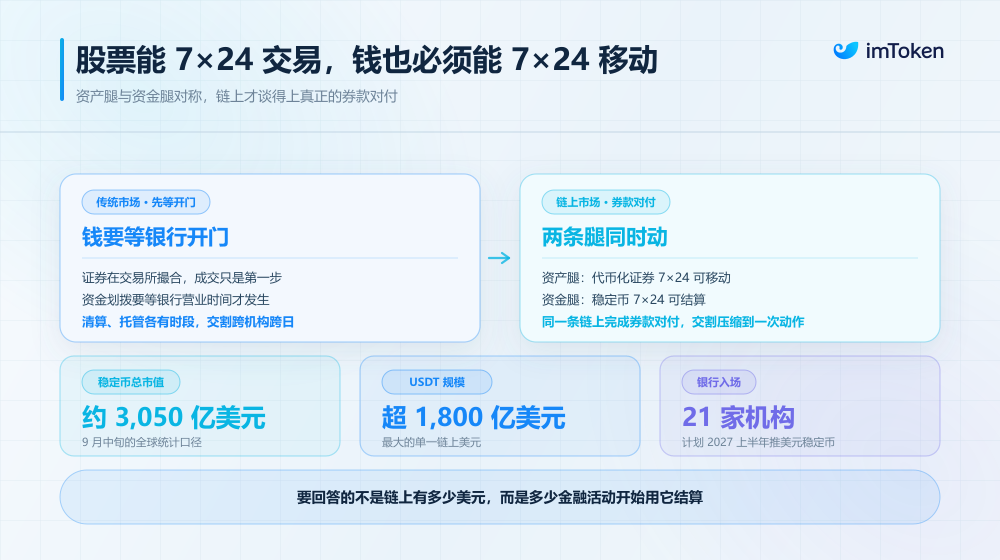
But when the asset side begins operating 24/7, the shortcomings of the traditional banking system are immediately exposed.
Why doesn't the traditional securities market open on weekends? Largely because the banks, custodians, clearinghouses, and funding systems behind it all have their own business hours.
That's why stablecoins must step up.
In early September, 21 financial institutions—including Goldman Sachs, Bank of America, Citi, and Deutsche Bank—announced plans to jointly form a company and launch a US dollar stablecoin in the first half of 2027, with possible expansion to other G7 currencies such as the euro thereafter.
This also means that stablecoin issuance is gradually moving from competition among crypto companies into the banking system itself. Circle CEO Jeremy Allaire used an interesting analogy to describe today's market: current on-chain finance and stablecoins are roughly equivalent to the internet in 2002.
What he's really saying is not that stablecoin scale will simply grow many times over, but that infrastructure has crossed a critical threshold—technology is maturing, regulation is beginning to accept it, and institutions finally have the conditions for truly large-scale adoption.
In its latest report, Circle likewise defines stablecoins as entering the regulated financial system, rather than remaining a crypto product operating independently outside the banking system. This also explains why RWA and stablecoins are increasingly difficult to discuss separately.
Suppose that in the future a US stock can truly trade on-chain 24 hours a day. Merely tokenizing the "stock" does not really solve the traditional market's problems—what stablecoins provide is precisely a form of money symmetrical to security tokens. After all, if assets can move 24/7, money can move 24/7 too.
On one side are tokenized securities, on the other is the stablecoin cash leg, with blockchain completing near-real-time delivery versus payment in between. Securities settlement processes that once required multiple institutions, multiple accounts, and even several days can potentially be compressed into a single system.
From this perspective, as securities, funds, bonds, and other RWAs gradually go on-chain, stablecoins have the opportunity to evolve from a pricing currency in the crypto market into the cash layer of the entire on-chain capital market.
This is also why regulation is becoming increasingly important.
To some extent, regulation is not the opposite of stablecoin expansion. Rather, it is only after regulatory boundaries gradually become clear that stablecoins can truly move from a crypto-native asset into a larger-scale financial system.
3. When Stablecoins Leave the Exchange: The Last Mile Begins to Connect to the Real World
However, even after completing asset tokenization, compliant issuance, and on-chain settlement, stablecoins are still one step away from truly becoming "money": spending it in the real world.
Recent moves in the Japanese market are highly representative.
In August, HashPort and Lawson convenience store completed a live yen stablecoin payment at a Tokyo Takanawa Gateway City location. Customers took out their wallets to pay, and the merchant side was directly connected to the convenience store's existing POS terminal. The whole process was no longer a Web3 event with a QR code on-site letting two wallets transfer to each other, but rather an attempt to bring stablecoins into ordinary retail systems.

At the same time, NETSTARS also completed its own Stablecoin Pay proof of concept at another Lawson store, verifying multi-currency, multi-chain payments—including yen stablecoins, USDC, and USDT—and their connection to existing POS systems.
Stablecoin Pay, officially launched in July of this year, charges merchants a 0.98% fee. Its goal is also very clear: merchants do not need to understand each blockchain, each wallet, and each stablecoin separately, but can integrate through the same payment infrastructure.
This may be more important than "convenience stores can finally sell coffee for stablecoins." The reason credit cards, Alipay, or transit cards achieved mass adoption was never because every convenience store understood Visa's clearing network, QR code protocols, or interbank systems.
On the contrary, the most important feature of a mature payment network is that it hides the underlying complexity.
For stablecoins to truly enter offline scenarios in the future, they will most likely need to go through the same process: consumers only need to choose a wallet, merchants continue using familiar POS terminals, and payment service providers handle the chains, currencies, exchange rates, confirmations, compliance, and settlement in between.
Blockchain may ultimately exist behind every transaction, but there is no need for it to appear in front of every consumer.
What's more interesting is that the other end of the payment terminal is also beginning to change. HashPort simultaneously announced the launch of Wallet MCP, hoping to let AI agents such as ChatGPT and Claude connect to wallets and, with user authorization, complete balance inquiries, transfers, swaps, and even payments for external services.
This means the stablecoin payment network being built today may not only face "humans." If agents in the future can book hotels, purchase APIs, procure cloud computing resources, or even manage corporate expenses on their own, then stablecoins—natively digital, globally circulating, and programmable money—are naturally more likely than traditional bank cards to become the payment tool used by machines.
Thus, from consumer wallets to agent wallets; from on-chain tokens to convenience store POS terminals; from US dollar stablecoins to yen stablecoins, a new payment network is slowly emerging.
And the wallet's position within it will change accordingly.
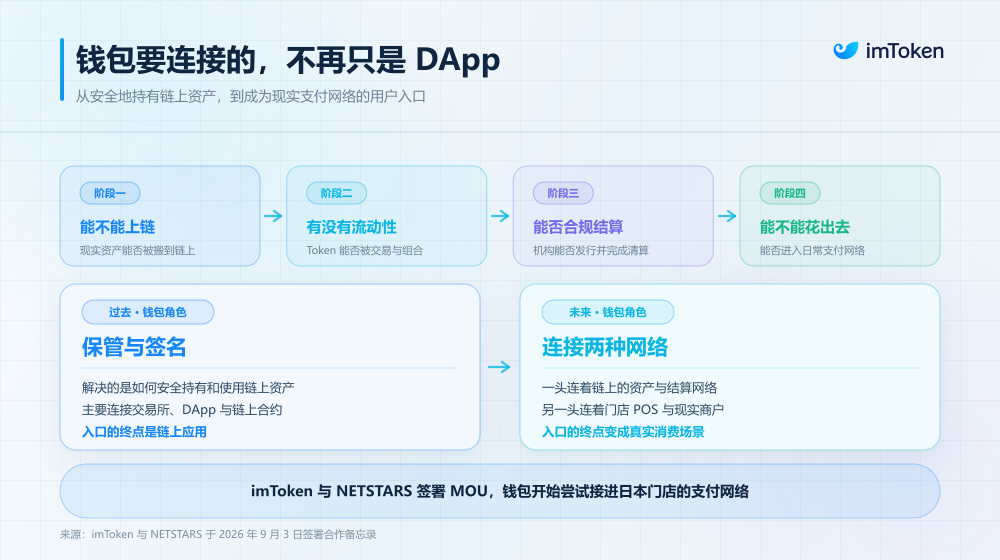
In the past, wallets mainly solved "how to safely hold and use on-chain assets." In the future, wallets may need to take on another role: becoming the user entry point between on-chain financial networks and real-world commercial networks.
This is also what makes imToken's latest partnership with NETSTARS noteworthy. On September 3, the two sides signed an MOU, planning to explore connecting imToken's wallet infrastructure with Stablecoin Pay, giving stablecoins in wallets the possibility of further entering offline physical merchants in Japan.
This is still at the partnership exploration stage, and does not mean that specific payment services have officially launched. But directionally, it precisely represents the change in the wallet's role: extending from connecting on-chain assets and DApps toward becoming a real-world payment entry point.
Final Thoughts
Looking back at the path of recent years, it is actually very clear:
At first, everyone discussed "whether assets can go on-chain"; later, they found that after going on-chain there was no liquidity, so they struggled with "whether DeFi can lend"; and today, the entire narrative has finally landed on practical ground: Can traditional institutions issue compliantly? Can they use on-chain money to complete settlement? Can it be spent in daily life at convenience stores or even in AI scenarios?
When NYSE clearing, Wall Street stablecoins, convenience store POS machines, and user wallets interlock on the same chain, so-called RWA is no longer just about moving real-world assets into Web3.
By then, it may be that Crypto's financial infrastructure is truly beginning to enter the real world.
Let's wait and see.