Crypto Stocks Plunge Then Surge Over 20%: Clarity Act Stalls, SEC Drops Major Positive News to Reverse the Tide


- Key Takeaway: After the CLARITY Act failed in the Senate, the SEC bypassed Congress to issue a five-year "innovation exemption" order, opening a compliance pathway for onchain trading of tokenized U.S. equities and sending crypto-related stocks soaring.
- Key Elements:
- On September 15, the CLARITY Act failed a procedural vote 49:50, with 11 Republican lawmakers defecting; Coinbase fell over 10% in two days, while Circle dropped more than 11%.
- On September 17, the SEC issued Order No. 34-106402, granting exchange-status exemptions to tokenized securities trading venues and market-maker status exemptions to AMM liquidity providers, valid for five years.
- Securitize closed up 14%, at one point rising nearly 24% intraday; the crypto-related stocks sector rallied 4.38% overall.
- Major tokens rebounded modestly, with BTC up less than 1% at around $76,400; privacy coin Zcash surged 17%–23% in a single day, hitting an all-time high.
- Nasdaq invested $100 million in Kraken's parent company and plans to launch tokenized stock trading by 2027; South Korea released a three-phase security tokenization roadmap.
Fresh off the brutal sell-off triggered by the failure of the CLARITY Act, U.S. crypto-related stocks staged a stunning comeback overnight.
On September 15, the U.S. Senate held a procedural motion vote on the CLARITY Act, which ultimately failed with 49 votes in favor and 50 against. Eleven Republican senators defected, and the crypto sector crashed in response. Within just two trading days, Coinbase fell more than 10% cumulatively, while Circle plunged over 11%.
Yet just as the market was mired in despair, the U.S. Securities and Exchange Commission chose to bypass the congressional deadlock and take the initiative. On September 17, it issued an "innovation exemption" policy, directly opening a five-year compliance sandbox window for on-chain trading of tokenized U.S. equities. Fueled by this blockbuster positive news, crypto-related stocks surged collectively in an instant, with Securitize climbing more than 20% intraday at its peak.
1. What Exactly Did the SEC Approve?
On September 17, the SEC officially released Order No. 34-106402, granting temporary conditional exemptions to qualifying Tokenized Securities Venues (TSVs). The order took effect immediately upon issuance, carries a five-year term, and simultaneously solicits public comment on the formulation of subsequent formal rules. The core of this order contains two key exemptions:
1. Exchange status exemption: Qualifying TSVs may be exempt from being deemed an exchange under the definition of the Securities Exchange Act of 1934, and therefore need not register and operate under the traditionally cumbersome model of a national securities exchange.
2. Market maker status exemption: Liquidity providers who supply funds to automated market maker (AMM) liquidity pools are exempt from the definition of "dealer" under Section 3(a)(5).
On-chain matching and on-chain market making thus obtained a temporary green channel—a breakthrough that had been extremely difficult to bring into compliance under the U.S. legal system in the past. SEC Chairman Atkins framed it as a transitional bridge toward durable rulemaking, rather than an endgame solution.
2. Which Crypto-Related Stocks Stand to Benefit?
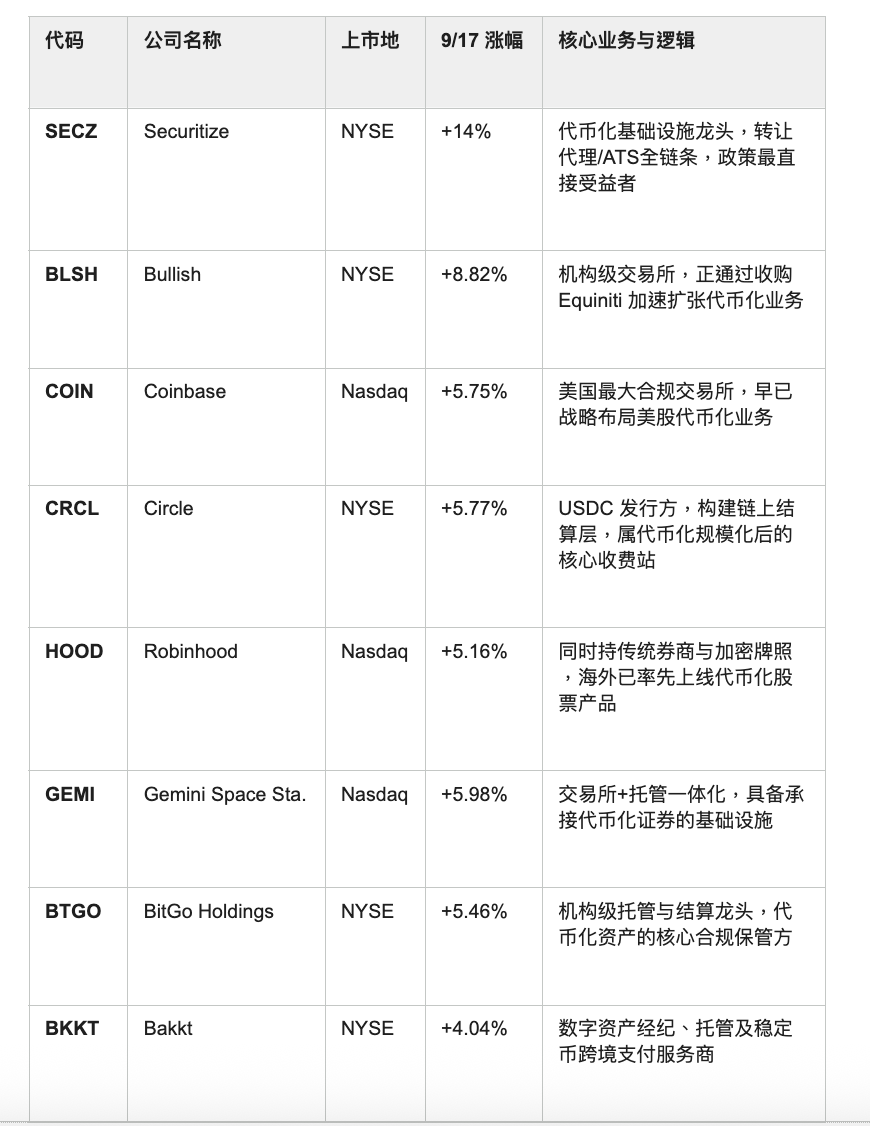
In trading on September 17, the "crypto concept stocks" sector rose 4.38% overall. The "on-chain financial infrastructure" sector, which benefits directly from the policy, performed particularly well.
The standout gainer was NYSE-listed tokenization infrastructure leader Securitize, which closed up 14% yesterday, with intraday gains at one point approaching 24%, finishing at about $9.36. Securitize provides full-chain services including transfer agency, brokerage, ATS trading, and fund management, with clients including BlackRock, Apollo, and KKR, making it the most direct beneficiary of this rule exemption. Its CEO said the framework finally paves a compliant path for trading genuine tokenized stocks.
Overview of On-Chain Financial and Compliance Infrastructure Stocks
Overview of Bitcoin Mining and Hashrate Transition Stocks
Mining and hashrate-related stocks rose across the board. Beyond the policy tailwind, their performance was also driven by the dual narratives of a recovery in Bitcoin's price and the transition toward AI and HPC high-performance computing hashrate.

3. Crypto Native Tokens Show Restraint, Digital Asset Treasury Stocks Surge
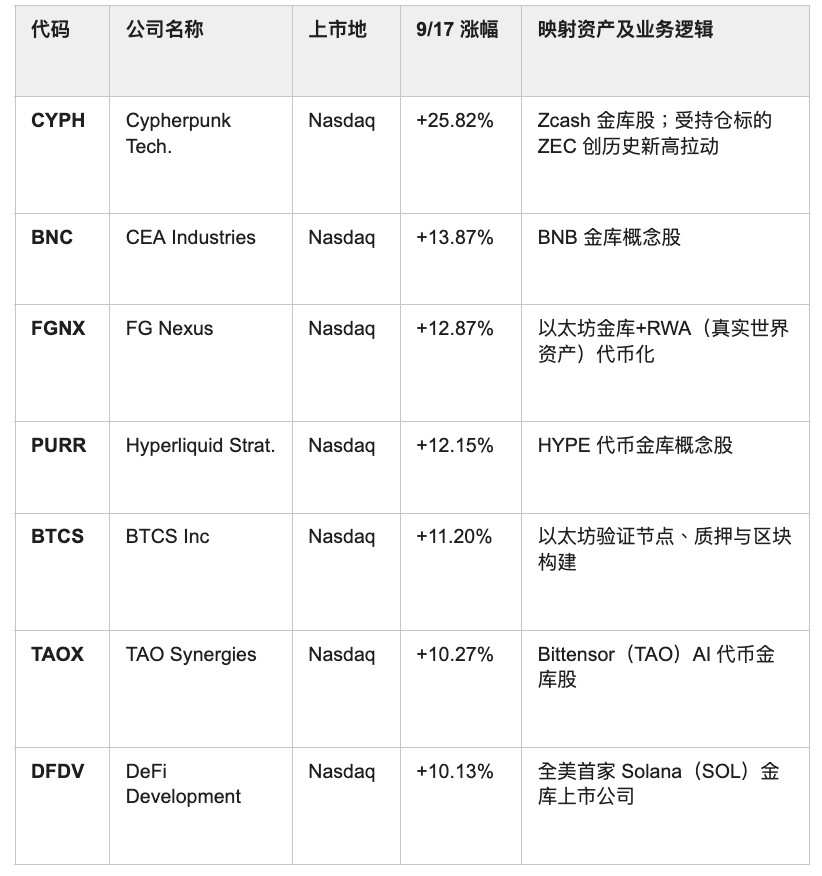
Although the policy tailwind hit the market, the rebound in mainstream tokens themselves on September 17 was relatively restrained. BTC traded at around $76,400–$76,600, up less than 1% on the day, while ETH traded at $2,444, up about 1.1%. Mainstream tokens had already produced an overly negative reaction to the earlier failure of the CLARITY Act, so they absorbed this positive news relatively smoothly. By contrast, in the altcoin market, privacy coin Zcash (ZEC) surged 17%–23% in a single day, touching a historic high of $1,369. Paradigm co-founder Matt Huang publicly disclosed his holdings and called it a "privacy complement to Bitcoin," spurring a 37.8% surge in open interest.
Against this backdrop, stocks tied to the digital asset treasury company concept also demonstrated strong explosive power. Because their share prices are essentially a leveraged reflection of the token assets they hold, they staged sharp rallies in tandem with the underlying tokens.
Overview of Digital Asset Treasury Concept Stocks
4. Global Coordination: Nasdaq's Entry and South Korea's Tokenization Roadmap
The SEC's exemption order is by no means an isolated policy accident. If one broadens the view to global developments over the past half month, two heavyweight pieces of news pointing in exactly the same direction also deserve attention.
Nasdaq makes a major bet on the Kraken channel: On September 10, Nasdaq invested $100 million in Kraken's parent company Payward through its venture capital arm, lifting its post-money valuation to $21 billion, surpassing the $20 billion valuation Citadel gave in November 2025. Nasdaq's move is not about pursuing purely financial returns, but about locking in a key distribution channel. Nasdaq plans to officially launch tokenized stock trading in 2027, with Kraken set to become its core distribution platform. Nasdaq likewise insists on the approach of "granting full shareholder rights and one-to-one interchangeability with traditional exchange shares," strictly avoiding synthetic derivative packaging.
South Korea unveils a three-phase securities tokenization roadmap: On September 4, South Korea's Financial Services Commission (FSC) and Financial Supervisory Service (FSS) jointly released a three-phase roadmap for tokenized securities: the first phase will launch in February 2027, covering money market funds, institution-facing bonds, trust-structured unlisted shares, and publicly offered fractionalized investment securities. The second phase will then fully expand to all publicly offered stocks and publicly offered bonds. The third and final phase will connect to stablecoin-linked on-chain payment and settlement infrastructure, gradually laying out the groundwork for compliant and orderly trading in its market.
Risk disclaimer: This article is merely a compilation of market information and policy interpretation, and does not constitute any investment advice. The exemptions mentioned are temporary and conditional arrangements, subject to restrictions on product types and trading volume, and the direction of the regime after five years remains uncertain; the relevant individual stocks are highly volatile, so please verify independently and make your own judgments.