






MSX US Stocks Daily Observation: Fed Raises Rates for First Time in Three Years! Dot Plot Signals Another 25bp Hike This Year, Higher-for-Longer Rates Reemerge as the Core of US Equity Pricing


- Key Takeaway: The Fed has restarted rate hikes with a 25bp increase and revised up its rate path projections, marking a shift in policy focus from "when to cut" to "how long rates stay high," with the market's pricing framework facing a restructuring.
- Key Elements:
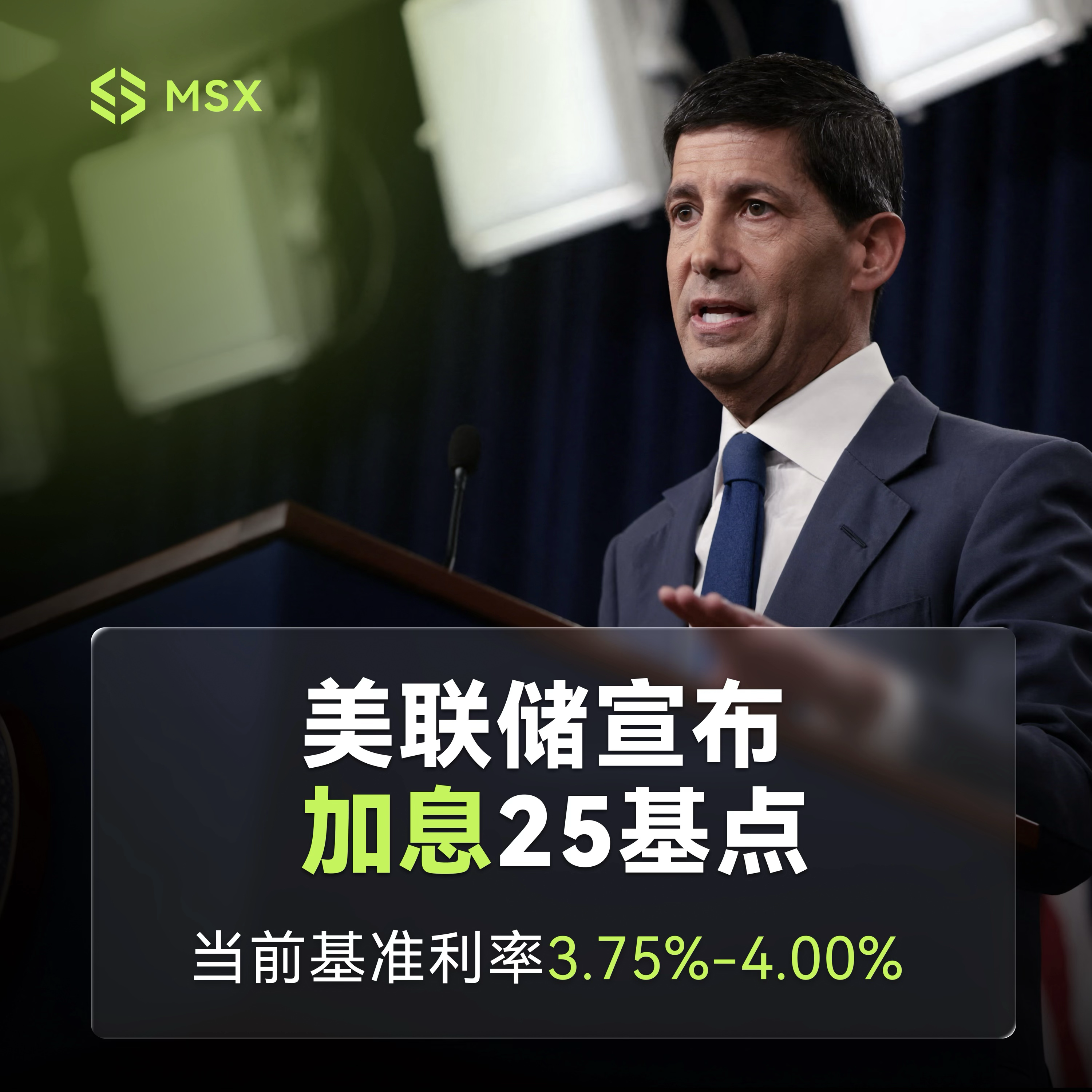
- The Fed unanimously raised rates by 25 basis points in a 12-0 vote, bringing the federal funds rate to 3.75%–4.00%, the first hike since 2023.
- The dot plot shows the median rate projection for end-2026 revised up from 3.8% to 4.1%, with 16 policymakers expecting at least one more hike this year and no room for cuts next year.
- The Fed simultaneously raised its GDP growth forecast to 2.3%, lowered its unemployment rate projection to 4.1%, and raised core PCE to 3.4%, indicating that economic resilience supports higher rates.
- The S&P 500 fell 0.44%, the Dow dropped 1.21%, and the Nasdaq was roughly flat; the two-year Treasury yield rose to 4.73%, the ten-year held near 5%, and the dollar climbed to a seven-week high.
- Warsh noted that expanding AI and data center capex is driving up funding demand and long-term rates, creating a feedback loop of "AI investment—growth—higher yields—valuation pressure."
- Companies reliant on external financing, not yet profitable, or with cash flows concentrated in the distant future face the greatest pressure; large tech companies can temporarily absorb higher funding costs thanks to AI demand and low debt levels.
[MSX Research Institute · Daily U.S. Stock RWA Observation] is a flagship daily report produced by MSX Maitong, a leading RWA trading platform. Leveraging strong macro research capabilities, we capture the core pulse of global traditional U.S. stocks, liquidity changes, and the RWA tokenization market, helping you position ahead for quality assets.
Today's Observation
The Federal Reserve officially restarted rate hikes.
On September 16, the Federal Reserve unanimously decided by a 12-0 vote to raise rates by 25 basis points, lifting the federal funds rate target range to 3.75%–4.00%. This was the first rate hike since 2023 and the first policy adjustment after Kevin Warsh took over as Fed Chair.
The hike itself largely met market expectations. What truly affected asset prices was the Fed's judgment on the future rate path. The latest dot plot shows the median federal funds rate projection for end-2026 was raised from 3.8% in June to 4.1%, implying one more 25 basis point hike may come within the year; the median rate projection for end-2027 is also 4.1%, indicating that under the Fed's current baseline scenario, there may be no rate cuts next year. Of the 18 policymakers, 16 expect at least one more hike this year.
This is also the most important message from the meeting: the Fed is not conducting an isolated "preventive hike," but re-establishing a tighter rate path.
U.S. stocks briefly rose after the decision was announced, but as Warsh emphasized that inflation remains too high and the economy is strengthening, major indexes subsequently turned lower. The S&P 500 fell 0.44%, the Dow Jones dropped 1.21%, and the Nasdaq was roughly flat. The two-year Treasury yield rose to about 4.73%, the ten-year yield remained near 5%, and the dollar climbed to around a seven-week high.
It is worth noting that the Fed's rate hike is not because the economy suddenly deteriorated, but because both growth and inflation are stronger than previously expected. The Fed raised its 2026 real GDP growth forecast from 2.2% to 2.3% and lowered its unemployment rate forecast from 4.3% to 4.1%; at the same time, it raised its PCE inflation forecast from 3.6% to 3.7% and its core PCE forecast from 3.3% to 3.4%.
This is a relatively complex combination for U.S. stocks: economic growth and corporate earnings still have support, but inflation makes it difficult for rates to fall, and equity valuations will continue to be constrained by high discount rates.
Data in a Minute
- · The Fed raised rates by 25 basis points, lifting the federal funds rate target range to 3.75%–4.00%;
- · The decision passed unanimously by a 12-0 vote, the first rate hike since 2023;
- · The median policy rate projection for end-2026 rose to 4.1%, compared with the June forecast of 3.8%;
- · Of the 18 policymakers, 16 expect at least one more rate hike in 2026;
- · The median policy rate projection for end-2027 remains 4.1%, leaving no room for rate cuts next year under the current baseline scenario;
- · The 2026 GDP growth forecast was raised from 2.2% to 2.3%;
- · The 2026 unemployment rate forecast was lowered from 4.3% to 4.1%;
- · The 2026 PCE inflation forecast was raised from 3.6% to 3.7%, and core PCE from 3.3% to 3.4%;
- · The S&P 500 fell 0.44%, the Dow dropped 1.21%, and the Nasdaq was roughly flat;
- · The two-year Treasury yield rose to about 4.73%, and the ten-year Treasury yield remained near 5%;
- · The dollar index rose to around a seven-week high, and the market further priced in the possibility of another rate hike within the year;
- · Warsh believes rising long-term yields stem not only from inflation, but also from a strengthening U.S. economy, expanding AI and data center capital expenditures, and large tech companies competing for financing.
MSX View
To understand this rate hike, one must look beyond the 25 basis points and examine what has changed in the Fed's assessment of the U.S. economy.
For some time, the market's core assumption was that inflation would eventually fall, and even if the Fed did not cut rates immediately, it would not re-enter a hiking cycle. But the latest economic projections broke that assumption. The Fed simultaneously raised growth, lowered unemployment, and raised inflation and policy rate projections, indicating that policymakers believe the U.S. economy can withstand higher rates and that the current rate level is still not enough to bring inflation back to 2% in a timely manner.
At the press conference, Warsh said inflation has been "too high for too long," and that summer data did not prove a substantial improvement in underlying inflation trends. At the same time, he believes the U.S. economy has strengthened further since mid-year, with the job market essentially at full employment.
Therefore, this rate hike is not aimed at rescuing the economy, but at prioritizing bringing down inflation while the economy remains strong. For the stock market, this is easier to absorb through earnings growth than an emergency rate hike during a recession, but it also means valuations can hardly continue to expand on rate-cut expectations.
Market reaction already reflects this contradiction. The Dow fell more than 1%, but the Nasdaq was nearly flat. High rates are usually bad for tech stocks because future cash flows must be discounted at higher rates; however, large tech companies are currently still benefiting from AI capital expenditures, cloud computing demand, and relatively strong profitability, temporarily offsetting some valuation pressure.
This does not mean the AI trade can ignore interest rates.
Warsh specifically mentioned that hyperscale cloud service providers are raising funds in the market, and AI and data center capital expenditures are increasing competition for capital. In the past, the market mainly viewed AI investment as a revenue source for Nvidia, cloud computing, and data center companies. But when capital expenditures become large enough, they also drive up overall economic demand for capital and long-term interest rates.
This forms a feedback loop worth watching:
AI investment drives economic growth and productivity expectations while increasing demand for power, chips, construction, and financing; stronger growth and capital demand push up long-term yields; higher yields in turn raise data center financing costs and lower the fair valuations of high-valuation tech companies.
Therefore, the ten-year Treasury yield may be more important than the federal funds rate itself. The policy rate rose only 25 basis points, but the ten-year yield is already near 5%, close to its highest level since 2007. It directly affects mortgages, corporate bonds, M&A financing, and equity valuations, and is the true source of current financial condition tightening.
For U.S. stocks, this meeting does not amount to a comprehensive turn toward pessimism. The Fed expects 2.3% economic growth and only 4.1% unemployment in 2026, and has not made a recession its baseline scenario. If corporate earnings can keep growing, large tech companies with ample cash flow and low debt still have the capacity to absorb higher funding costs.
The real pressure may be on companies that rely on external financing, are not yet profitable, or have cash flows concentrated far in the future. Real estate, homebuilding, highly leveraged companies, and data center projects requiring continuous financing will also be more sensitive. Banks, meanwhile, must contend with higher short-term rates, changes in the yield curve, and potential credit costs, so it cannot be simply understood as "rate hikes are necessarily good for banks."
The political dimension is also worth watching. Warsh was nominated by Trump, but this rate hike runs counter to Trump's persistent calls for lower rates, and it received unanimous FOMC support. In the short term, this reinforces the signal that the Fed is safeguarding its anti-inflation credibility, but it may also increase policy friction between the White House and the central bank.
What the market really needs to watch next is not whether the Fed will mechanically hike one more time, but whether the three conditions supporting this hiking path continue to hold: whether inflation remains above 3%, whether the labor market remains stable, and whether the ten-year Treasury yield stays persistently near 5%.
If inflation does not improve significantly and the economy remains resilient, another rate hike within the year will become the baseline scenario, and high rates may extend into 2027. Conversely, if energy prices fall, core inflation cools, or employment suddenly weakens, the Fed may still adjust its path.
So what this rate hike truly changes is not the rate level itself, but the market's pricing framework. In the past, investors discussed "when rate cuts will come"; now they need to reassess "how long high rates will last, and whether AI-driven earnings growth can outpace financing costs and valuation compression."
Economic growth is still there, and AI investment has not stopped, but cheap money is no longer the default condition. Companies that can continue to outperform the market in the next phase need to prove not only revenue growth, but also the ability to generate sufficiently high returns on capital in a long-term rate environment near 5%.
About MSX Maitong
MSX is a leading RWA trading platform dedicated to providing secure, efficient, and transparent access to global financial markets. As one of the world's earliest on-chain U.S. stock trading platforms, MSX has always been at the forefront of the industry, leading market change through continuous innovation.
The platform deeply integrates blockchain technology with a compliance framework, offering comprehensive spot and derivatives trading for nearly 400 tokenized stocks and Pre-IPO assets, perfectly bridging the gap between traditional finance and the digital asset industry.
Centered on the core mission of "enabling quality assets to circulate freely," MSX has now built a diversified digital financial services system covering U.S. stock spot and perpetual contracts, crypto-to-crypto trading, Pre-IPO, and the Maitong Research Institute, aiming to provide global investors with all-hours, high-performance access to quality assets.
Official Website: https://msx.com/
Chinese TG: https://t.me/MSXOfficial
Global TG: https://t.me/MSXGlobal
The global App Store / Google Play are now available simultaneously.

Risk Disclaimer: Macroeconomic and U.S. stock market conditions are highly volatile. This content is provided solely for academic and research observation reference by the Maitong Research Institute and does not constitute any investment advice.


