BiyaPay Market Watch: Fed Rate Hike Expectations Heat Up — Why Are Gold and the Dollar Moving Global Assets Simultaneously?


- Key Takeaways: As the Fed's September FOMC meeting approaches, rising rate hike expectations have pushed Treasury yields above 5%, strengthened the dollar, and pressured gold. Interest rate changes are transmitting through liquidity channels to global markets including U.S. equities, Hong Kong stocks, and digital assets.
- Key Factors:
- The 10-year Treasury yield briefly broke above 5%, the 30-year rose to about 5.4%, the dollar remained strong, and gold faced sustained pressure.
- Rising oil prices combined with lingering inflationary pressures and no signs of employment faltering have cooled rate cut expectations, with the possibility of a rate hike re-entering market pricing.
- Fed Governor Waller stated that if inflation improvements continue, he could support holding rates steady, but if the improvement proves temporary, a September rate hike is not ruled out.
- A stronger dollar raises the cost of holding non-dollar assets and tightens global liquidity, putting pressure on U.S. equities, Hong Kong stocks, and BTC, ETH.
- Gold is suppressed in the short term by rising real rates, but fiscal deficits and geopolitical risks may still provide safe-haven support.
- High-valuation tech stocks face valuation pressure from rising discount rates, while digital assets are affected by both tightening liquidity and the macro hedging narrative.
- The market will subsequently focus on the rate decision, economic projections, press conference statements, and inflation and employment data.
The September Federal Reserve meeting is approaching, and global markets are re-entering a phase of high volatility.
As of press time on September 16, the Federal Reserve has not yet announced the outcome of this meeting. Market expectations for a rate hike have clearly intensified, with the 10-year U.S. Treasury yield briefly breaking above 5%, and the 30-year U.S. Treasury yield also rising to about 5.4%. The dollar has remained relatively strong, while gold has come under sustained pressure.
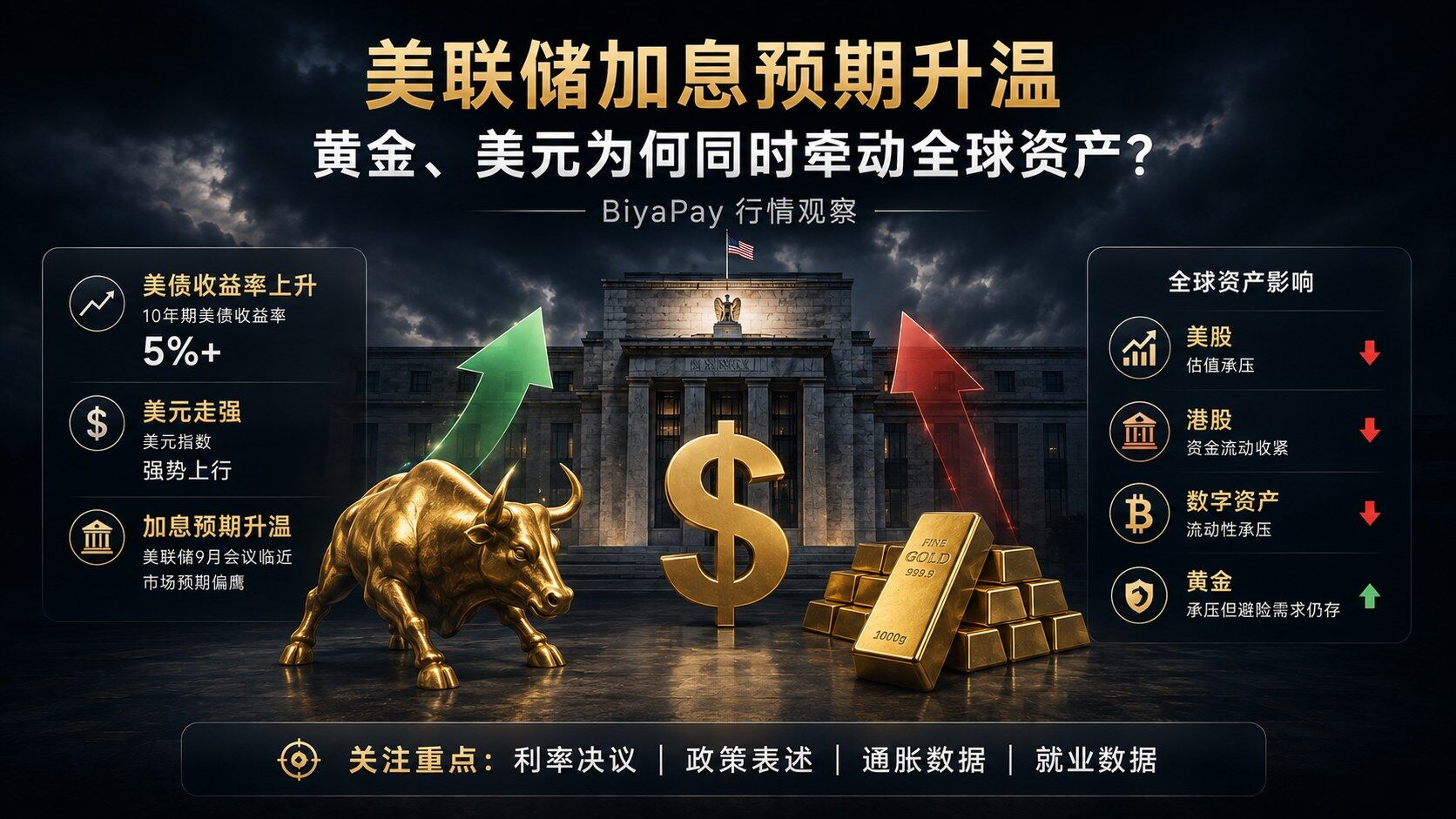
On the surface, this is a shift in expectations for Federal Reserve policy. In reality, interest rates, the dollar, and gold are influencing U.S. stocks, Hong Kong stocks, digital assets, and other global markets through different channels.
When observing this kind of macro market movement, I use BiyaPay to simultaneously track price changes in assets such as U.S. stocks, Hong Kong stocks, BTC, and ETH, and then combine that with the dollar and U.S. Treasury yields to judge what capital is trading. As a global one-stop asset allocation platform, BiyaPay supports exchanges between digital currencies and assets such as the U.S. dollar and Hong Kong dollar, and also supports trading in U.S. stocks, Hong Kong stocks, crypto, and other markets. For market conditions before and after an interest rate meeting, viewing the reactions of different assets in one place helps clarify how changes in interest rates are transmitted to various markets.
Why rate hike expectations have reignited
The market had originally expected the Federal Reserve to gradually shift toward easing, but recent higher oil prices, lingering inflation pressure, and the absence of a clear slowdown in U.S. employment and economic activity have cooled expectations for rate cuts.
Rising energy prices do not only affect gasoline and transportation costs; they may also pass through production, logistics, and consumption links into other goods and services. If oil prices remain elevated for an extended period, the pace of inflation decline may slow.
Federal Reserve Governor Waller previously said that if subsequent data continue to show improvement in inflation, it could support keeping rates unchanged; if the improvement in inflation is only temporary, a rate hike at the September meeting cannot be ruled out.
This shows that what the market now faces is not a already-determined policy outcome, but a policy range that depends on changes in inflation, employment, and oil prices.
Why the dollar moves global assets
The dollar is not only the currency of the United States, but also an important currency for global trade, financing, and commodity pricing.
When the market expects the Federal Reserve to raise rates, the interest rate appeal of dollar assets increases, and capital may flow back into the dollar. After the dollar strengthens, the cost of holding non-dollar assets rises, and emerging market currencies and some risk assets also tend to come under pressure.
For U.S. stocks, a stronger dollar affects the translation of multinational companies' overseas revenue and also increases the pressure on overseas companies to repay dollar debt. For Hong Kong stocks and other overseas markets, tighter dollar liquidity often means a tighter funding environment.
BTC and ETH are also affected in similar ways. Although digital assets have their own supply and demand logic, short-term prices still depend heavily on global liquidity and risk appetite. When the dollar strengthens and real interest rates rise, capital typically reduces exposure to highly volatile assets.

Why gold and the dollar are drawing attention at the same time
Gold and the dollar sometimes move in opposite directions, but during periods of rising policy uncertainty, they may also simultaneously become the focus of market attention.
If rate hikes push real interest rates higher, gold, because it does not generate interest, faces a higher opportunity cost of holding, and its price is prone to being suppressed. At the same time, a stronger dollar also raises the cost for non-dollar investors to buy gold.
But gold is not purely an interest rate asset. When the market worries about fiscal deficits, geopolitical conflicts, recurring inflation, and monetary credibility, gold may again gain safe-haven and hedging demand.
Therefore, short-term pressure on gold does not mean that safe-haven demand has disappeared. What the market really needs to observe is whether real interest rates are rising faster than inflation expectations. If real interest rates continue to rise, gold may face more pressure; if fiscal and geopolitical risks intensify, gold may regain support.
How U.S. stocks and digital assets may be priced
U.S. stocks will first face valuation pressure. For high-valuation tech stocks, AI, and cloud computing companies, share prices often already embed relatively high future growth expectations. When the risk-free rate rises, the discounted value of future cash flows declines, and the market's demands on high-valuation companies increase.
This does not mean that all tech stocks will weaken in unison. What really needs to be observed is whether corporate revenue, profit margins, and cash flow can offset the valuation pressure brought by rising rates. Companies that can consistently deliver on performance are usually more likely to gain market recognition; companies that rely on distant stories and have yet to realize profits may see greater volatility.
The pricing logic of digital assets is more complex. High interest rates and a strong dollar suppress liquidity, but when the market begins to discuss U.S. fiscal deficits, debt scale, and monetary credibility, Bitcoin may again be included in the discussion framework of macro hedging assets.
Therefore, gold, the dollar, stocks, and digital assets do not operate independently of one another. They all react to interest rates, liquidity, and risk appetite, but the direction and timing of their reactions are not entirely consistent.
What the market will watch next
The outcome of this Federal Reserve meeting is certainly important, but the policy statement is equally critical.
If the Federal Reserve raises rates while also signaling that policy is nearing its end, the market may not trade simply on the basis that "a rate hike is bearish." Conversely, if the Federal Reserve does not raise rates this time but emphasizes inflation and oil price risks, or hints that further tightening may still be possible in the future, the dollar and U.S. Treasury yields may still remain elevated.
Next, the key things to watch are the Federal Reserve's rate decision, economic projections, press conference remarks, and subsequent inflation and employment data.
In a high interest rate environment, global assets all have to answer one question again: whether current prices have already fully reflected future growth expectations.