When the bull and bear markets remain undecided, how do you build a steady wealth-management full suite?


- Core view: In a market environment where the bull and bear trend is still undecided, Gate offers stablecoins a tiered yield solution through six wealth-management products with different positioning, helping users earn steady wealth-management returns while waiting for market direction and avoid leaving funds idle with zero yield.
- Key elements:
- The USD1 holding-and-earning activity is estimated at about 7% annualized, requires no subscription or lock-up, starts from as little as 1 USD1, pays returns daily in WLFI tokens, and does not affect trading or collateral use.
- Idle Fund Treasure enables both trading and yield generation, automatically snapshotting stablecoin balances in trading accounts and mapping them to U.S. Treasury asset yields, with returns mainly from low-risk sources such as U.S. Treasuries, money market funds, and RWA.
- Flexible Savings covers nearly a thousand assets, with USDT demand deposits reaching 7.26% annualized including rewards; Dual Investment BTC offers an annualized range of 1.09%–739.41%, suitable for users with a clear price view.
- GUSD is backed by U.S. Treasury RWA, with a reference annualized rate of 3.60% and total subscriptions reaching 220 million tokens; on-chain earn USD1 staking annualized yield once reached 13.41%.
- Gate’s USD1 holdings once exceeded $900 million and have long remained above $400 million, placing it in the first tier of exchange USD1 yield products.
- The product matrix covers different liquidity preferences and risk tolerances, with differentiation coming from portfolio layering rather than reliance on a single hit product.

By September 2026, Gate has delivered results across multiple products.
Standing at this point in September 2026, Bitcoin has once again surged on heavy volume. Many institutions judge that the bear market consolidation has essentially ended, and sentiment on the trading floor has turned noticeably optimistic. Yet many analysts and retail traders still hold to one view: before the bull market officially kicks off, there may still be one last dip and one last window to buy the bottom.
As a result, the market's attention is entirely focused on BTC. A large number of positions choose to wait in place, holding stablecoins on the sidelines, but they are also paying an opportunity cost for this, because this portion of capital is essentially earning zero returns.
Macro uncertainty is amplifying this wait-and-see sentiment. The Federal Reserve will hold its sixth FOMC meeting of the year on September 17. Unlike the consensus "rate-cut trade" of recent years, market pricing for this year's meeting is quite conflicted: after August's nonfarm payrolls came in surprisingly weak, the market briefly slashed the probability of a rate hike, but as the meeting approaches and inflation data remains erratic, the implied probabilities from the CME FedWatch tool have seesawed repeatedly. Currently, market pricing is mainly betting on either a rate hike or holding steady, with the possibility of a rate cut extremely small. Regardless of the final outcome, as long as rates remain in a high range, the interest returns on dollar assets will remain attractive, and the value of holding stablecoins themselves will still hold.
Precisely for this reason, the market has warmed slightly, but whether it is a bull or bear market remains undetermined, and the probability and frequency of up-and-down swings may be very high. When the direction of certainty is unclear, we do not necessarily have to stay fully in cash. Trading reserves, funds set aside for adding to positions, and stablecoins temporarily not betting on any direction—there is really no need to let this money waste the steady returns it could otherwise earn. Let's take a look at what stable returns this portion of capital can earn.
Let's look at the solutions offered by exchanges represented by Gate. Beyond helping users earn the Alpha from BTC, US stocks, and Pre-IPO, Gate also wants to help users steadily capture the Beta returns from stablecoins.
Getting Straight to the Point: What Are Gate's Wealth Management Returns?
The improvement in market sentiment since the second half of this year has also driven up the yields on stablecoin products.
Starting July 29, 2026, Gate's USD1 holding-and-earning campaign went live. Users holding USD1 (a compliant dollar stablecoin issued by World Liberty Financial and fully collateralized by U.S. short-term Treasuries and cash equivalents) in their asset accounts can earn yield without subscribing, without locking up, and with a minimum of just 1 USD1—and they can trade or withdraw at any time.
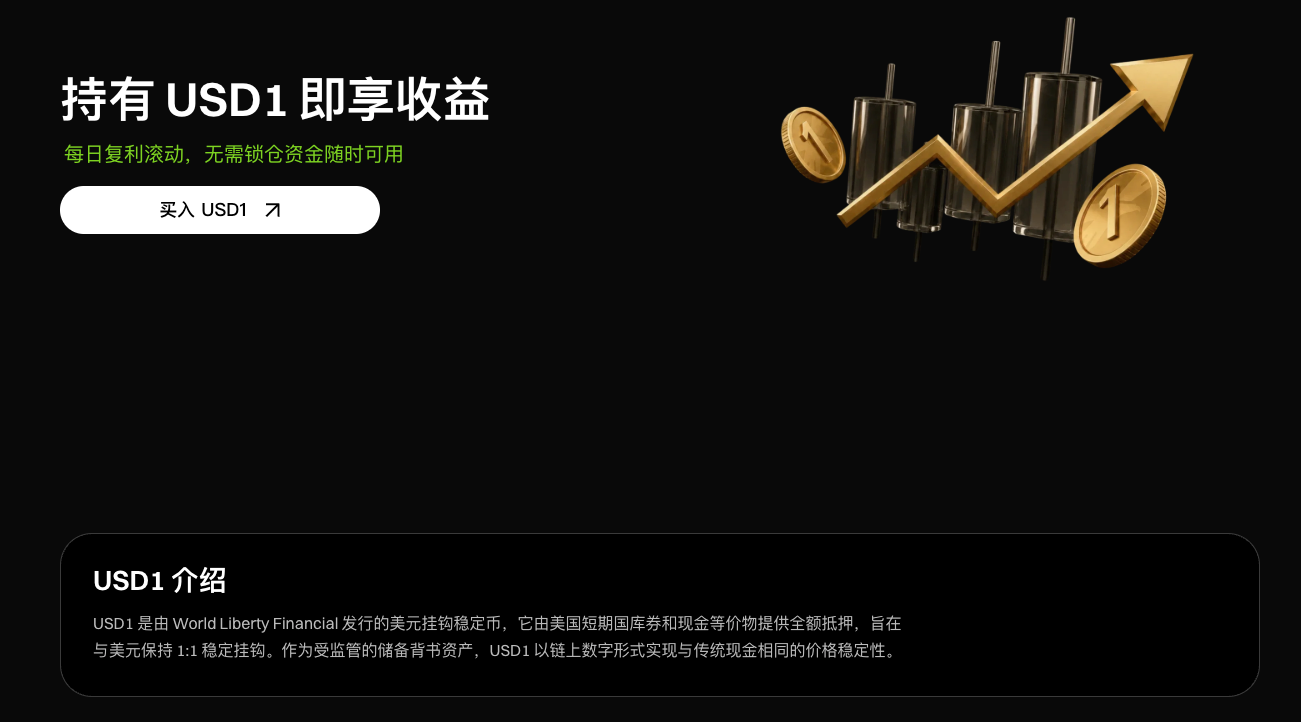
According to the latest disclosure on Gate's official campaign page, the estimated annualized rate for this campaign is currently around 7%, having previously reached 8%, and even 15%-20% at its peak in the first half of this year. Although it has pulled back from the peak, it is still significantly higher than the dollar risk-free rate.
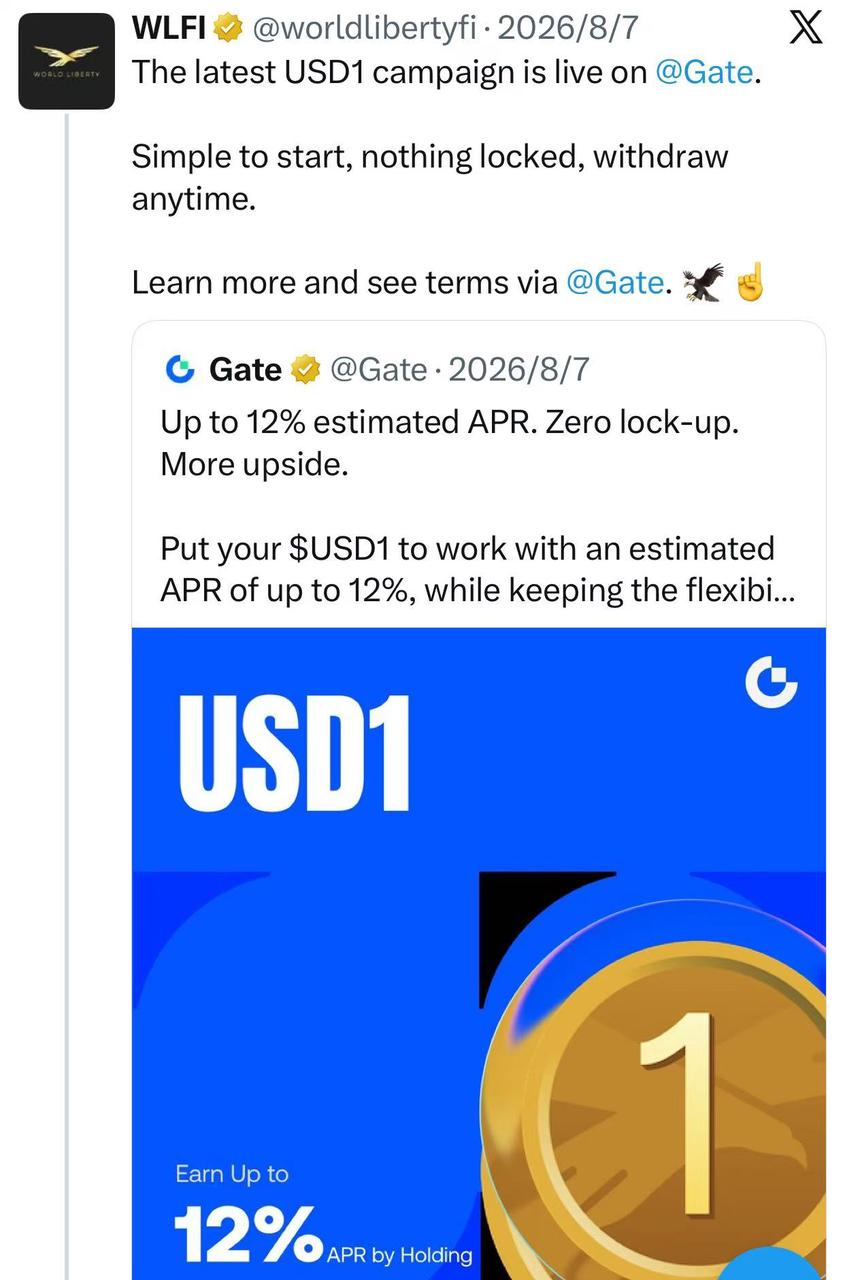
The interest calculation logic is as follows: the system takes a snapshot of the account every hour, 24 times a day, and calculates the day's average holdings based on these snapshots. Interest is distributed according to "daily return = average holdings × annualized yield / 365," credited the next day after activation, and settled daily thereafter. Returns are distributed in WLFI tokens, valued at the official market price at 15:00 (UTC+8) on the distribution day. Beyond earning this yield, the USD1 held can also be used directly for spot trading, Gate Alpha on-chain trading, wealth management allocation, and collateralized lending—equivalent to an extra return that "does not affect usage."
Beyond USD1, the rates on several other key products are also worth noting:
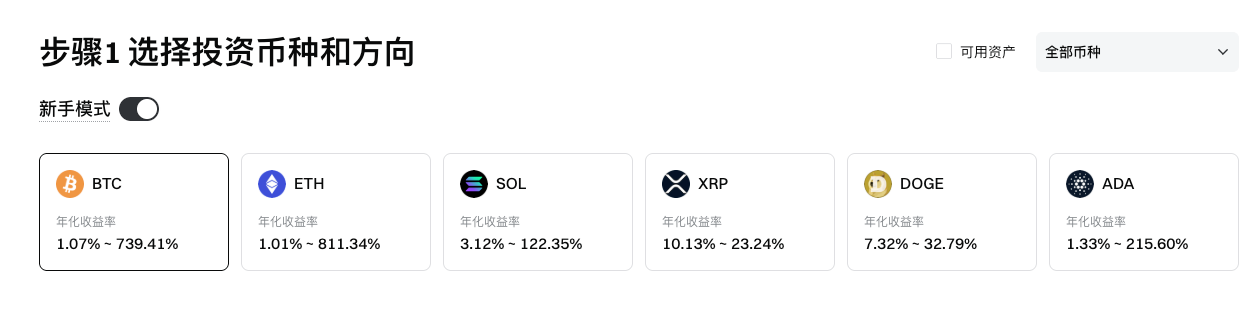
- Dual-Currency Investment: The annualized range fluctuates with different strike prices and tenors. Taking the current real-time quotes in the App as an example, in the token section, BTC's annualized range is 1.09%~739.41%, ETH is 1.01%~811.34%, SOL is 3.12%~122.35%, XRP is 10.13%~23.24%, and DOGE is 7.32%~32.79%. The closer the strike price is to the current price, the more conservative the expected annualized rate; the further from the current price, the higher the annualized rate, but the lower the probability of execution (i.e., triggering the "buy low, sell high"). Users can choose a range based on their own judgment of short-term trends.
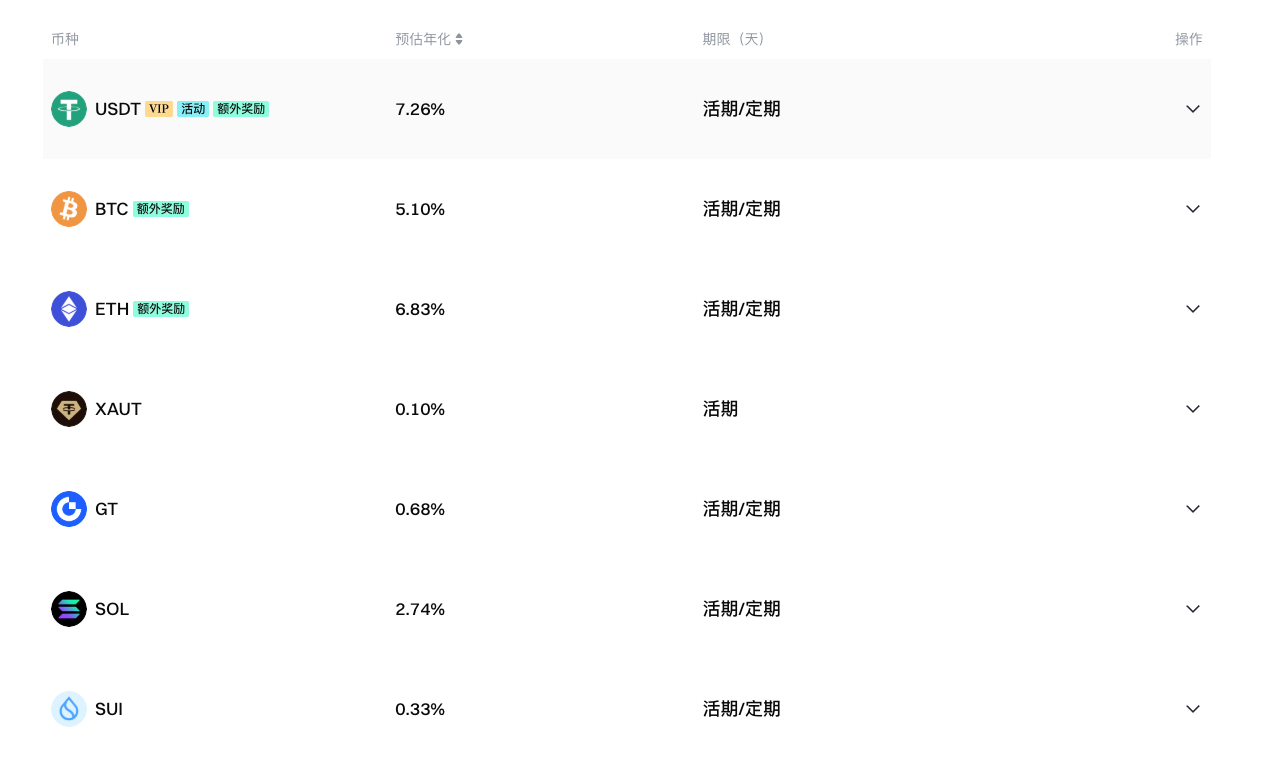
- Simple Earn: As a flexible wealth management entry point covering nearly a thousand assets, current real-time data in the App shows USDT flexible annualized (including extra rewards) at 7.26%, 30-day fixed at 4%, 14-day fixed at 3.9%, and 7-day fixed at 3.8%; BTC at 5.1%, ETH at 6.83%, SOL at 2.64%, and TRX at 4.91%. Most mainstream coins can find a "deposit and withdraw anytime" yield tier here.
- Idle Funds: The App currently shows a base annualized rate of 1.50% for USDC and 3% for USDT, with actual returns higher after stacking trading volume bonuses. This rate tier is not the highest, but its advantage lies in "not tying up capital"—we will elaborate on this logic below.
What Types Are in the Wealth Management Combo?
Gate's product design logic for wealth management boils down to one sentence: let capital with different uses, different liquidity preferences, and different risk tolerances all find a place of its own.
For ordinary users, the interest rate level of stablecoin wealth management is certainly important, but whether the product range is comprehensive enough and covers different liquidity needs is often the key factor in deciding "where to put the money."
Let's start with Idle Funds, which is the most noteworthy innovation in this "combo." It solves a very fundamental contradiction for crypto users: wealth management and opening positions have long been an either-or choice. Putting stablecoins into wealth management products to earn interest means this money cannot be used at any time to buy the dip or top up margin; keeping it in the trading account ready to go means giving up returns.
Idle Funds' approach is to make trading and earning interest compatible: the system takes a snapshot of users' available stablecoin balances in each trading account (spot, futures, etc.) at a scheduled time every day, with funds never needing to be moved or locked up throughout the process; qualifying assets captured in the snapshot are mapped 1:1 in the system backend into asset certificates, directly connected to real-world U.S. Treasury asset returns. The next day, based on the previous day's valid snapshot balance and stacked with the user's trading volume bonus for the day, interest is automatically distributed to the spot account—completely seamlessly, with no manual claiming required. In other words, this money is both "ammunition" ready to pull the trigger at any time and an automatic interest-bearing demand deposit. Users do not need to choose between "can I buy the dip right away" and "should I give up these few points of interest."
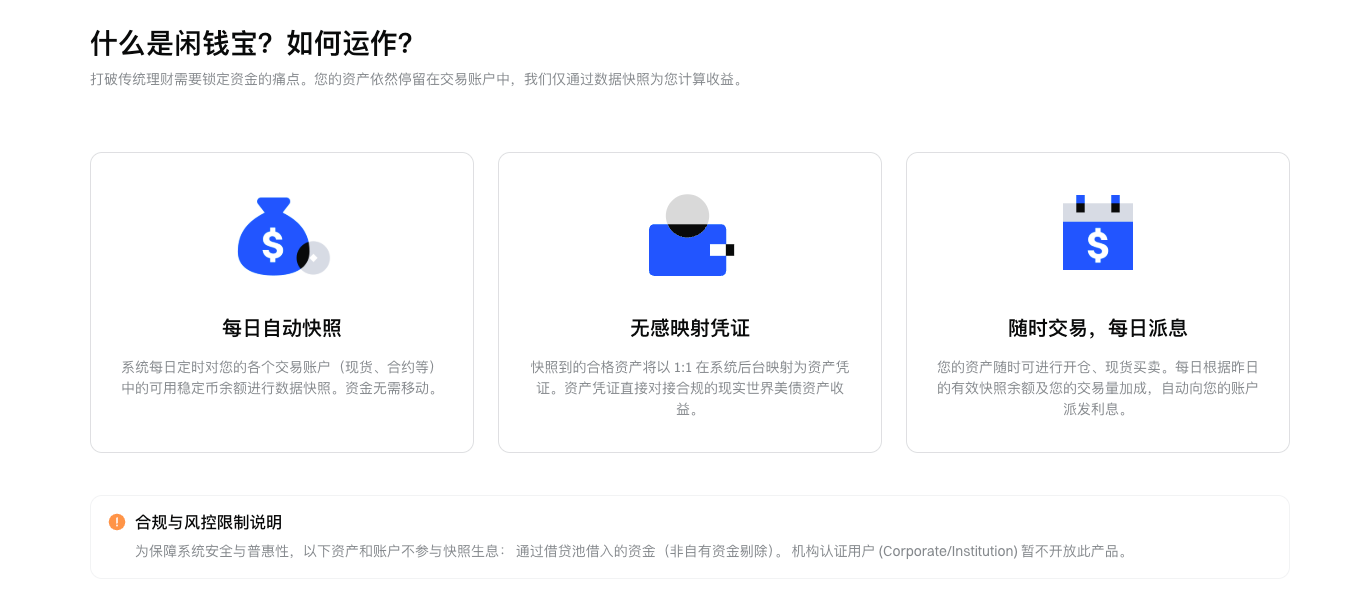
Where do the returns come from? According to official explanations, returns mainly come from low-risk wealth management yields such as U.S. Treasuries, money market funds, on-chain staking, and RWA. It does not participate in any high-risk quantitative strategies, high-risk on-chain products, or any algorithmic stablecoins. The platform bears the principal protection risk for users and regularly publishes transparency reports on underlying assets. Users who complete personal KYC verification can enable the feature and participate, with funds remaining in the account and no subscription lock-up required.
Beyond Idle Funds, Gate's wealth management product matrix is quite extensive.
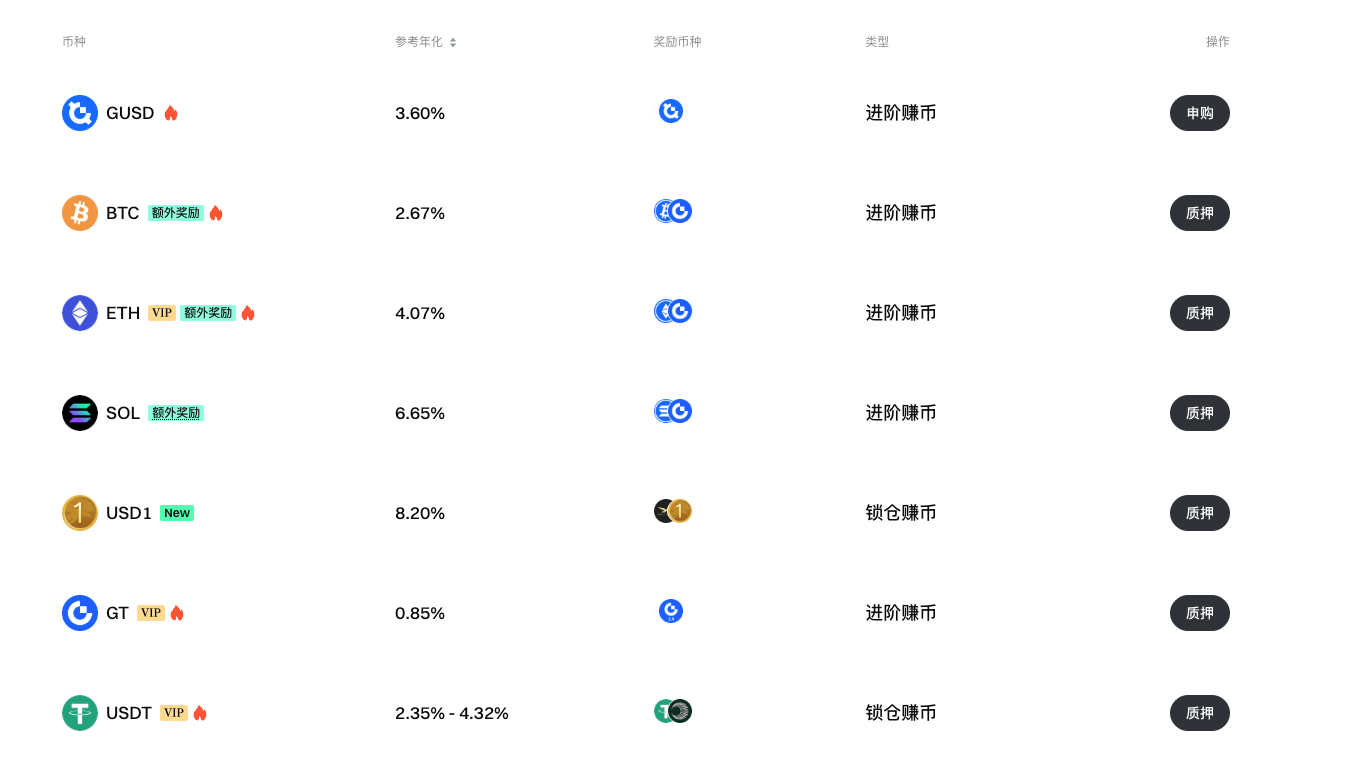
On-Chain Earn pushes assets directly into on-chain staking scenarios. USD1 on-chain staking reference annualized rate once reached 13.41%, while also covering multiple coins including GUSD, BTC, ETH, SOL, and USDT, with annualized ranges from a steady 2%-3% tier to an aggressive tier around 8%. Capital willing to bear certain on-chain risks in pursuit of higher returns can move in this direction.
Dual-Currency Investment essentially productizes the question of "whether to buy/sell at a certain target price." It suits users who already have a clear judgment but are just unsure about timing. It covers the token section (BTC, ETH, SOL, GT, XAUT, GUSD, etc.) and the stock section (covering GOOGL, CRCL, DRAM, LITE, MRVL, and other underlying assets), and also features a Beginner Mode that lowers the barrier to understanding structured products. Beginner Mode only requires selecting the investment currency and direction, with parameters such as strike price and tenor presented in a simplified manner, lowering the understanding threshold; Advanced Mode returns variables such as strike price and tenor to users to set themselves, suitable for those who already have more refined judgments and want to customize combinations. It should be noted that Dual-Currency Investment is essentially a non-principal-protected, floating-return structured product that trades a certain amount of principal risk for higher potential returns. Its risk is somewhat higher than relatively steady products like Simple Earn and Idle Funds, making it more suitable for users who can accept the outcome of "passively buying/selling at the agreed price upon maturity."
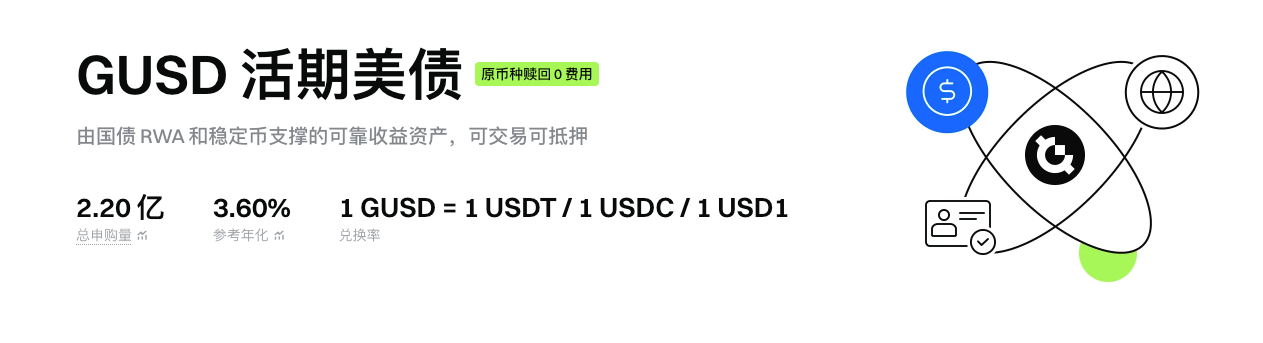
GUSD U.S. Treasuries are jointly supported by U.S. Treasury RWA and stablecoin assets. The current reference annualized rate in the App is 3.60%, with total subscriptions reaching 220 million GUSD. It supports subscription with USDT, USDC, and USD1 at a 1:1 exchange ratio, with all three sharing a unified reference annualized rate of 3.60%. The original subscription currency can be redeemed losslessly with no fees, making it suitable as a medium-to-long-term "ballast" for this money—not seeking explosive returns, but seeking both stability and flexible exit.
Simple Earn, meanwhile, targets users willing to let their capital "move" in exchange for higher returns. It covers nearly a thousand assets including USDT, BTC, ETH, SOL, and TRX. After stacking VIP and extra rewards, USDT annualized can reach 7.26%, making it an intermediate state between Idle Funds' "demand deposit" and Dual-Currency Investment's "game."
Stacked together, these product categories actually cover capital with different uses, different liquidity preferences, and different risk tolerances: money needed at any time goes to Idle Funds, money willing to bear volatility goes to On-Chain Earn, money with clear judgments goes to Dual-Currency Investment, money seeking convenience and stability goes to GUSD, and money willing to let capital move for returns goes to Simple Earn. Each has its own place—there is no need to cram all stablecoins into one basket, either all lying flat earning demand-deposit interest or all betting on a single product.
Wealth Management Products: Scale Determines the Margin of Safety
For wealth management products, scale itself is also a form of trust endorsement. The larger the scale, the deeper the liquidity pool and the better the liquidity, and the relatively smaller the redemption pressure in extreme market conditions.
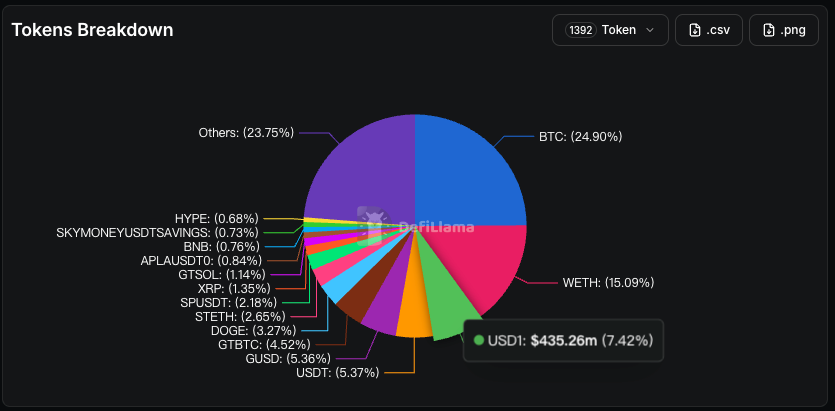
According to statistics from third-party data platform DefiLlama, Gate's USD1 holdings once exceeded $900 million, and thereafter stabilized above $400 million amid market fluctuations, long ranking in the top tier of USD1 interest-bearing products across exchanges.
On GUSD, according to monthly report data officially disclosed by Gate, total subscriptions in July of this year grew from about 182 million at the beginning of the month to about 215 million by month-end, at one point exceeding 230 million. As of now, real-time data in the App shows GUSD total subscriptions have reached 220 million, with the growth curve remaining fairly steady. At the Simple Earn level, Gate official data shows its listed products cover nearly a thousand cryptocurrencies, with assets under management once exceeding $2 billion at a previous peak.
Comparing horizontally across the industry, most exchanges' stablecoin wealth management products tend to focus on a single hit product. If an exchange has only one entry point for demand-deposit wealth management, the rate may be eye-catching, but users' funds must either all go in or all come out, lacking intermediate tiered choices. The differentiation of Gate's "combo" lies precisely in using six products with different positioning—USD1, Idle Funds, Simple Earn, On-Chain Earn, Dual-Currency Investment, and GUSD—to cover capital of different tenors and risk preferences in combination, rather than relying on one hit product to conquer the world.
Conclusion
As the market returns to a warm spring, the first reaction is always to crowd into BTC and Alpha assets. But a truly mature crypto account is not measured solely by whether it can make big money: how to allocate stablecoins, whether to participate on-chain, how to arrange capital tenors, and whether to set a clear target-price strategy for oneself—these seemingly inconspicuous allocation actions are precisely the key to whether an account can survive bull and bear cycles and live long enough.
At a moment when bull and bear are undetermined, rather than repeatedly flip-flopping between "staying in cash waiting for the last dip" and "going all-in betting on a rebound," it is better to first settle the stablecoins in hand: demand deposits where they should be demand deposits, fixed terms where they should be fixed terms, on-chain games where on-chain games are warranted, and leave the rest to time and compounding.