Not running away, not selling the shell: Why did CoinEx, after nine years of operation, choose to voluntarily shut down?


- Core Viewpoint: CoinEx has announced it will cease operations, becoming another mid-sized exchange to exit amid the crypto market downturn and regulatory pressure, yet it concludes in rare fashion with a "dignified exit" through fully reserved assets and an orderly wind-down.
- Key Elements:
- CoinEx will officially close on December 22, 2026, phasing out registration, trading, and withdrawals, with all user assets backed by reserves exceeding 100%, and no redemption crisis has occurred.
- The platform operated for nine years, once boasting over 10 million users, and weathered the 2023 New York State regulatory lawsuit ($1.8 million fine) and a $70 million hack (suspected to be the Lazarus Group).
- Investigations show CoinEx had over $2.7 billion in fund flows with Iran's largest exchange Nobitex, and was caught up in investigations into the flow of stolen funds from Bybit, with compliance risks rising significantly.
- New user growth in the crypto market is shrinking, attention is shifting to AI and other sectors, exchange competition is concentrating among the top players, and the survival space for small and mid-sized platforms is being severely squeezed.
- Founder Yang Haipo refused to sell the platform, choosing to voluntarily wind down while assets could still be fully redeemed, stating that "bearing unlimited risks for limited revenue is no longer rational."
Original | Odaily (@OdailyChina)
Author | Asher (@Asher_ 0210)

The crypto bull market never arrived, and another long-operating exchange, CoinEx, has shut down.
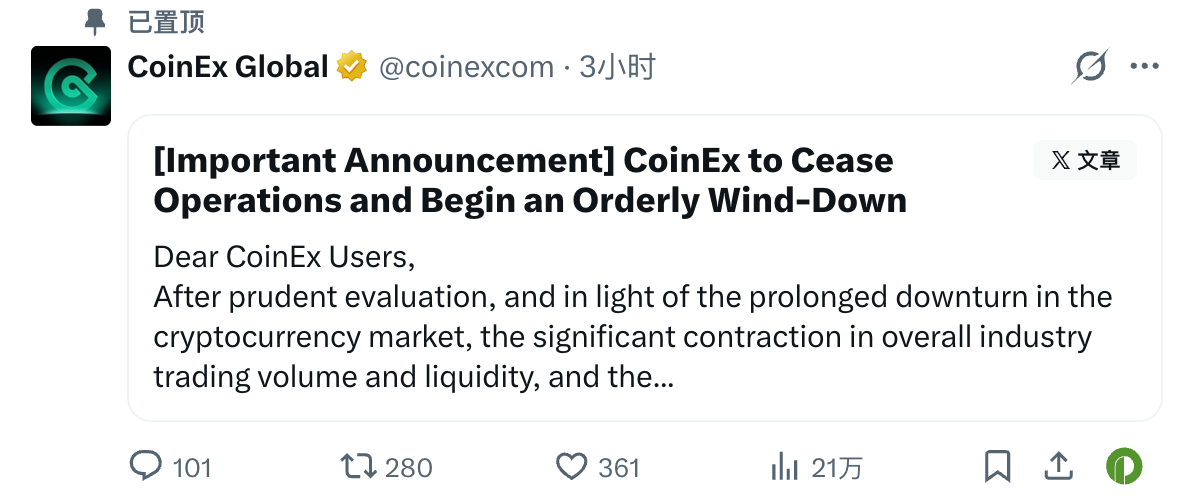
At 10 AM today, CoinEx officially announced that, affected by the prolonged downturn in the crypto market, a sharp contraction in overall industry trading volume and liquidity, and continuously rising regulatory requirements and compliance costs, it has decided to cease operations and will enter an orderly wind-down process starting September 15.
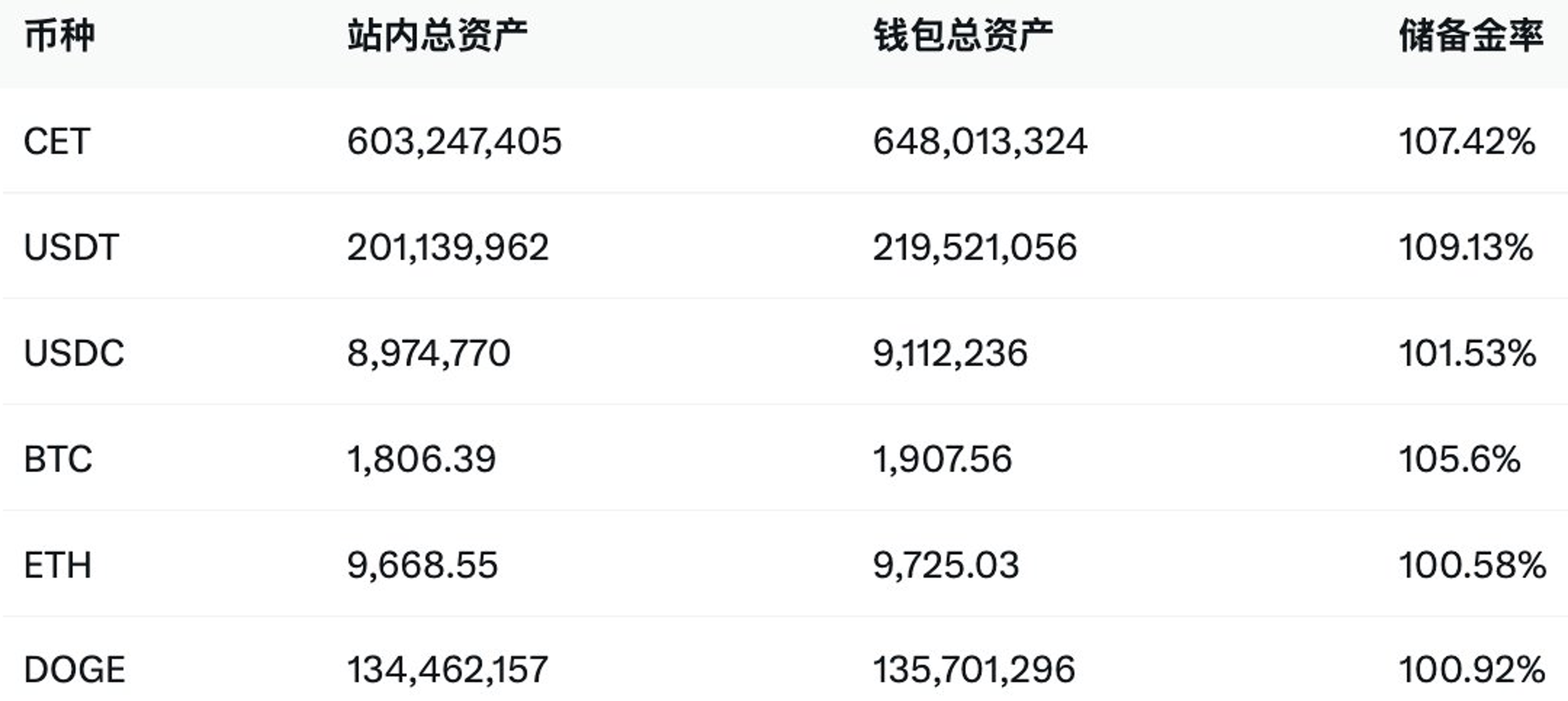
Unlike platforms such as FTX that suddenly collapsed due to funding gaps, CoinEx has not declared bankruptcy this time, nor has it experienced inability to redeem or suspension of withdrawals. According to the latest public data, CoinEx's total wallet asset market value is approximately $430 million, with reserve ratios for major currencies all exceeding 100%, and user assets are fully backed by reserves:
According to the arrangement, CoinEx's specific exit plan is as follows:
- September 15: Stop new user registrations; stop referral commissions and reward distributions; contracts enter Reduce-Only mode; fiat, leverage, lending, wealth management, staking, and strategy trading no longer accept new orders/subscriptions.
- September 22: All non-spot businesses stop; on-chain deposits stop (CET deposits can be extended to September 29).
- September 29: All spot trading stops; non-USDT assets begin processing; remaining CET in user accounts will be automatically repurchased at 0.005 USDT/CET with unlimited quantity (during the previous window period, users could manually sell with zero fees); CoinEx Smart Chain (CSC) and OneSwap cease operations.
- December 22: Withdrawal channels close, and the trading platform officially ceases operations.
After Nine Years of Operation, CoinEx Endured Regulatory Lawsuits and Hacker Attacks
CoinEx launched on December 22, 2017, founded by Yang Haipo, the founder of ViaBTC mining pool. In its early days, influenced by ViaBTC's business background, CoinEx was closely tied to the BCH ecosystem, and later expanded its market by listing a large number of small- and mid-cap and niche coins, gradually developing into a comprehensive exchange serving global users.
According to previously disclosed data from CoinEx, the platform has accumulated more than 10 million users, covering over 200 countries and regions, and supporting more than 1,000 crypto assets. In addition to spot trading, CoinEx gradually launched contracts, leverage, lending, wealth management, and staking services, and built ecosystem products such as CoinEx Smart Chain and OneSwap around its platform token CET.
However, during its global expansion, it repeatedly encountered regulatory and security issues. In February 2023, the New York Attorney General's office sued CoinEx, alleging that it failed to register as a securities and commodities broker-dealer while still providing services to local users. In June of the same year, CoinEx agreed to pay approximately $1.8 million in fines and refunds and exit the U.S. market.
Three months later, CoinEx suffered its most serious security incident since its founding. In September 2023, abnormal transfers occurred in multiple hot wallets on the platform, ultimately resulting in losses of approximately $70 million. Based on fund flows, several on-chain security firms determined that the attacker was most likely the North Korean hacker group Lazarus. CoinEx immediately suspended deposits and withdrawals, rebuilt its wallet system, and promised that the platform would bear all losses without affecting user asset redemption. About a week later, the platform gradually resumed deposit and withdrawal services.
CoinEx survived regulatory lawsuits and hacker attacks, but ultimately chose to exit against the backdrop of contracting market trading volume and liquidity and continuously rising compliance costs. Yang Haipo admitted that after nine years of operation, CoinEx still had not become the industry-leading exchange he had hoped for, and that "bearing unlimited risk for limited revenue is no longer a rational choice."
Yang Haipo also considered selling CoinEx but ultimately gave up. He believed that users deposited assets into CoinEx based on trust in the platform and in him personally, and transferring that trust to a new buyer would not be the right way to end things. Therefore, CoinEx chose to wind down in an orderly manner while assets could still be fully redeemed, and set the official closure date for December 22, 2026, exactly nine years after the platform launched.
CoinEx's cessation of operations does not mean all businesses under Yang Haipo have ended. According to the official announcement, the operations being halted simultaneously are mainly those built around the CoinEx exchange, including CoinEx Smart Chain and OneSwap. CoinEx Wallet and CoinEx Vault for institutional users will continue to operate and are not directly affected by the trading platform's shutdown. In addition, ViaBTC mining pool, founded by Yang Haipo, has not announced any business adjustments.
In a crypto industry where exchange collapses are often accompanied by misappropriation, bank runs, and lengthy recovery efforts, CoinEx at least chose a rare dignified exit: no running away, no shell sale, and voluntarily ending operations while still able to redeem user assets.
As Yang Haipo said in his open letter: "A clean ending is the right ending."
From Stolen Bybit Funds to Iran's Central Bank, CoinEx Was Drawn into a Sanctions-Related Fund Investigation
CoinEx's announcement attributed the shutdown to the market, liquidity, and compliance costs, but a fund investigation that occurred earlier also made the "unlimited risk" it faced more concrete.
In February 2025, the North Korean hacker group Lazarus stole approximately 400,000 ETH from Bybit, worth about $1.5 billion at the time. In June 2026, The Wall Street Journal reported that while tracking the stolen assets, investigators found that some funds entered two wallets controlled by Iran's central bank and, after passing through multiple layers of addresses, some eventually flowed into CoinEx.
CoinEx's ties to the Iranian crypto market go far beyond this single tranche of funds. According to TRM Labs data, since 2018, fund flows between CoinEx and Iran's largest exchange, Nobitex, have exceeded $2.7 billion. In 2025 alone, flows between the two sides reached $763 million, making CoinEx Nobitex's largest overseas counterparty, about nine times the size of the second-largest. Over the past seven years, cumulative fund flows between CoinEx and more than 60 Iran-related entities exceeded $3.84 billion.
CoinEx denied having commercial cooperation with the Iranian government, Iran's central bank, or the Islamic Revolutionary Guard Corps, saying it had already restricted Iranian users' access and would conduct an internal review of transactions involving the stolen Bybit funds. There is currently no direct evidence proving that CoinEx intentionally assisted money laundering, nor can it be confirmed that this investigation directly led to the platform's shutdown. But for a mid-sized exchange whose revenue and liquidity are contracting, being simultaneously linked to North Korean hackers, Iran's central bank, and U.S. sanctions clearly further increased the uncertainty and compliance costs of continuing operations.
What Yang Haipo called "bearing unlimited risk for limited revenue" is not merely a lament about a sluggish market.
The Survival Space for Small and Mid-Sized Exchanges Is Being Squeezed Out
CoinEx's exit is related to the overall decline in attention to the crypto market. In the past, rising coin prices and wealth-creation effects could continuously attract new users, but today investors' attention has shifted more toward hot fields such as AI. Although the crypto market still has pockets of activity, there are fewer and fewer new users truly willing to trade long term and stay in the market. The era in which exchanges expanded by relying on incremental users is over.
At the same time, competition in the exchange industry is increasingly concentrating at the top. Spot, contracts, wealth management, and other businesses long ago ceased to have high barriers to entry. Even if small and mid-sized exchanges offer a full suite of features, it is still difficult for them to compete with major exchanges in liquidity, brand, security investment, and user scale; and if they try to find new growth points through innovation, it is hard to consistently produce products capable of changing users' choices.
More importantly, top exchanges have not remained confined to traditional trading businesses. New directions such as on-chain wallets, DEXs, stock tokenization, and prediction markets are being gradually incorporated into major exchanges' product portfolios. Niche opportunities that might originally have belonged to smaller platforms are also being rapidly covered by leading platforms leveraging capital, traffic, and resources.
For CoinEx, in addition to these industry pressures, the earlier investigation involving stolen Bybit funds, Iran's central bank, and sanctions-related funds further increased the uncertainty of continuing operations.
Externally, there are not enough new users; internally, it is difficult to seize market share from major exchanges. The survival space for small and mid-sized exchanges is being further compressed. For CoinEx, the returns from continuing to operate could no longer cover the rising costs and risks, and voluntary shutdown instead became the more realistic choice.