When Polymarket and Others Move "Behind the Scenes": The Next Phase of Prediction Markets, Outside the Exchanges?


- Core Thesis: Prediction markets are evolving from user-facing trading platforms into underlying financial infrastructure embedded in front-end products such as brokers and wallets. The industry's focus has shifted from replicating Polymarket to building upper-layer capabilities like aggregation, routing, and derivatives, driving "probability" toward becoming a composable, tradable standardized asset class.
- Key Elements:
- Major players are strategically pivoting "behind the scenes": Binance and Coinbase provide liquidity by integrating third-party markets (e.g., Kalshi, Predict.fun) via APIs; Interactive Brokers (IBKR) aggregates multiple markets through a unified interface; Robinhood is building its own clearing and trading layer (Rothera), aiming to productize prediction market capabilities.
- The rise of the liquidity aggregation layer: Early-stage projects represented by Fortune (having raised over $4 million) are integrating liquidity, prices, and depth from different markets such as Polymarket and Predict.fun through a unified entry point (Fortune Markets). They are also planning derivatives (Prediction Derivatives) and an AI Agent execution layer (Fortune Agent), attempting to construct a complete trading infrastructure.
- Cross-market integration and financialization are becoming trends: The industry's evolution is viewed as a mirror of the DeFi trajectory—moving from single markets toward aggregators, professional market making, and derivatives. Apex is integrating Kalshi contracts into brokerage APIs, and Paradigm is developing professional trading terminals, indicating the market is moving toward more diverse and complex financial structures.
- AI Agents will deeply participate in the trading chain: The "information-probability-price" characteristic of prediction markets aligns closely with AI capabilities. Future sources of Alpha will shift from information advantages to model and execution advantages—using AI Agents to understand events faster and execute trades across platforms.
- Key challenges remain: Industry maturity is constrained by liquidity depth, the credibility of event resolution mechanisms, regulatory classification across different jurisdictions (derivatives/gambling/new instruments), and whether AI Agents can bridge the gap from "summarizing information" to "consistently generating Alpha."
There's an interesting shift happening in the prediction market space right now.
From Binance and Coinbase to Interactive Brokers (IBKR) and Robinhood, the major players are moving their focus upward, no longer fixated on replicating another Polymarket.
Everyone is figuring out ways to push Polymarket, Kalshi, and their peers further "into the background," transforming them into underlying capabilities that other financial products can directly integrate.
This is actually very similar to how stock trading works today. When users buy TSLA through Futu, Tiger Brokers, or Robinhood, most don't care which Market Maker ultimately receives the order or which clearing system it passes through.
The prediction market could look the same in the future.
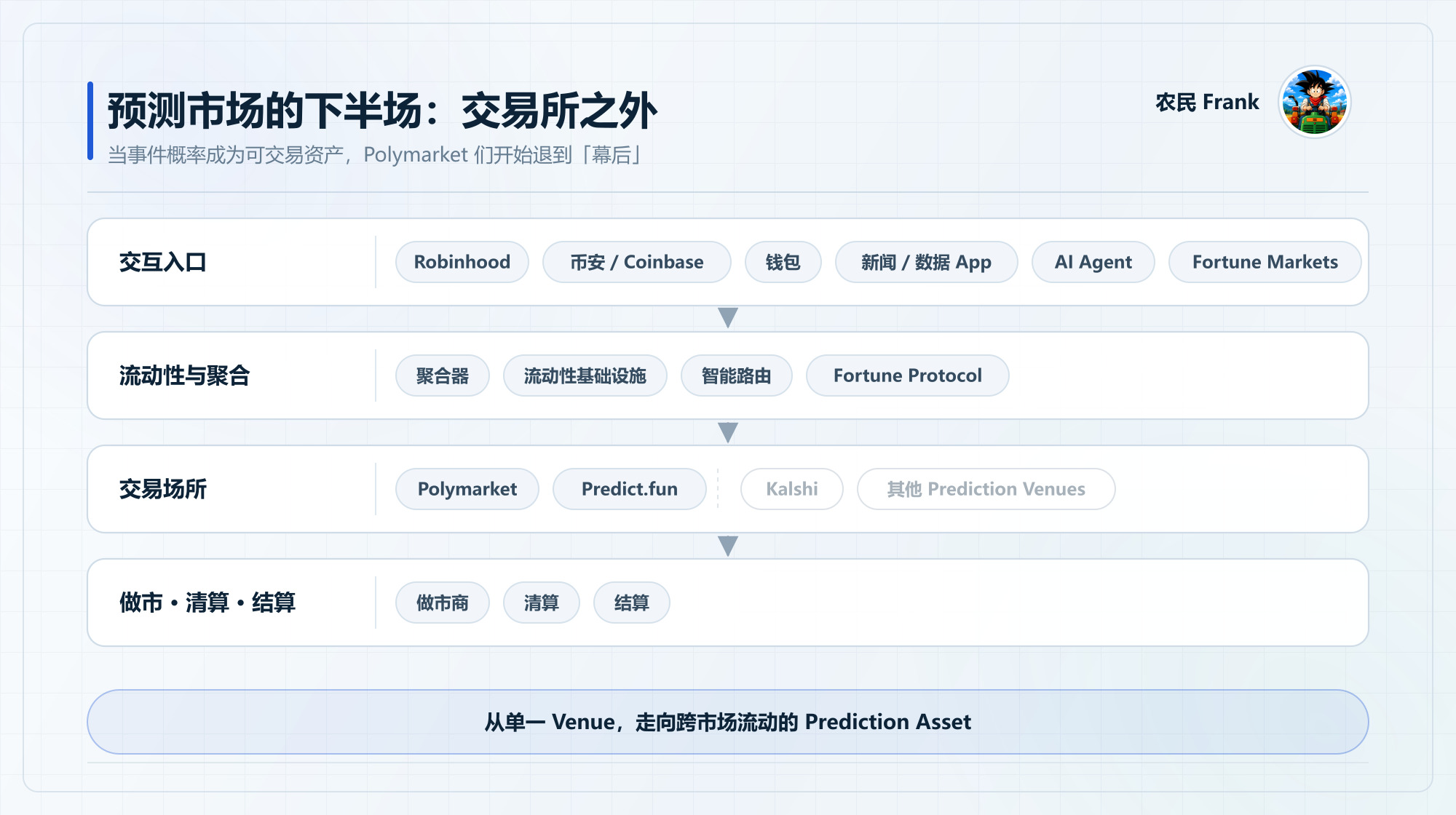
The front end might be a brokerage, wallet, news app, or even an AI Agent. In the middle would be Aggregators and Routers, while Polymarket, Kalshi, and others providing the actual markets, liquidity, and settlement increasingly resemble the financial infrastructure hidden underneath.
Looking back at DeFi—from AMMs to aggregators, derivatives, professional market making, and smart execution—this path has already been trodden once.
The prediction market might also be entering its own similar second half.
1. Prediction Markets Are Increasingly Moving "Behind the Scenes"
Over the past few years, prediction markets have proven that "uncertainty" in the real world can indeed become a tradeable asset with a price and liquidity.
From the U.S. presidential election to sports events like the World Cup, and further into crypto, macroeconomics, and entertainment culture, many questions that could previously only be discussed have been compressed by platforms like Polymarket and Kalshi into Event Contracts that can be bought, sold, and used to generate profit or loss.
That was a crucial step, and as this layer of demand has gradually been validated, the strategies of the major players have also begun to shift noticeably.
In April this year, Binance integrated Predict.fun, leveraging third-party prediction market infrastructure for market capabilities while providing its own front-end entry point, allowing users to trade on probability events directly within the app. Two months later, it further opened up its Prediction Markets API, enabling quantitative strategies, trading bots, and third-party products to directly access market data and trading capabilities.
Coinbase is taking a similar route. It has included Prediction Markets in its "Everything Exchange," but the initial market liquidity comes entirely from Kalshi, with explicit plans to support more Prediction Market Venues in the future.
On the traditional finance side, IBKR has already gone a step further.
In May this year, IBKR placed three Prediction Markets—Kalshi, CME Group, and ForecastEx—into a single unified interface. Users can search for events, compare prices and liquidity across different exchanges, and execute trades within the same account without needing separate accounts at each venue.
Robinhood, meanwhile, is extending its reach into the trading and clearing layer. It partnered with Susquehanna to operate Rothera, which took over the CFTC-registered exchange and clearing infrastructure of the former MIAXdx/LedgerX. In June, it began routing some World Cup and professional baseball Event Contracts to this affiliated exchange.
The actions of these major players all point to the same thing: prediction markets are transforming from a "destination" users actively seek out into a financial capability that other products can call upon.
In the past, if we wanted to trade on the upcoming U.S. midterm elections, we might have needed to open Polymarket first and then find the corresponding market. In the future, it might be an event card on Binance's homepage or a live-updating probability displayed next to a financial news article on Robinhood.
Users might not even realize they are trading in a prediction market, and it matters even less whether the order ultimately comes from Predict.fun, Kalshi, CME, or gets split across multiple markets by a Router.
This also means Prediction Markets are becoming increasingly invisible, while Prediction Assets are becoming more important.
Once we reach this stage, the truly interesting questions for the industry change—how can the liquidity scattered across Polymarket, Kalshi, Predict.fun, and even more markets be organized?
For example, regarding the U.S. midterm elections, where is the best price? Where is the deepest liquidity? Is there a probability discrepancy between two markets?
This set of questions is very similar to the early days of DeFi. After Uniswap proved tokens could be traded on-chain, the market didn't stop at "creating ten more Uniswaps." What actually emerged next were liquidity aggregators like 1inch, smart execution networks like CoW Swap, derivatives infrastructure like Hyperliquid, and the market makers and quantitative trading systems that grew around them.
The prediction market is gradually reaching a similar stage.
Fortune is a very typical early-stage example of this trend. As of August this year, it has completed multiple funding rounds including Seed and Pre-A, with cumulative funding exceeding $4 million. These funds are being used for the Fortune Agent upgrade, integrating more prediction markets, and expanding liquidity and related infrastructure.
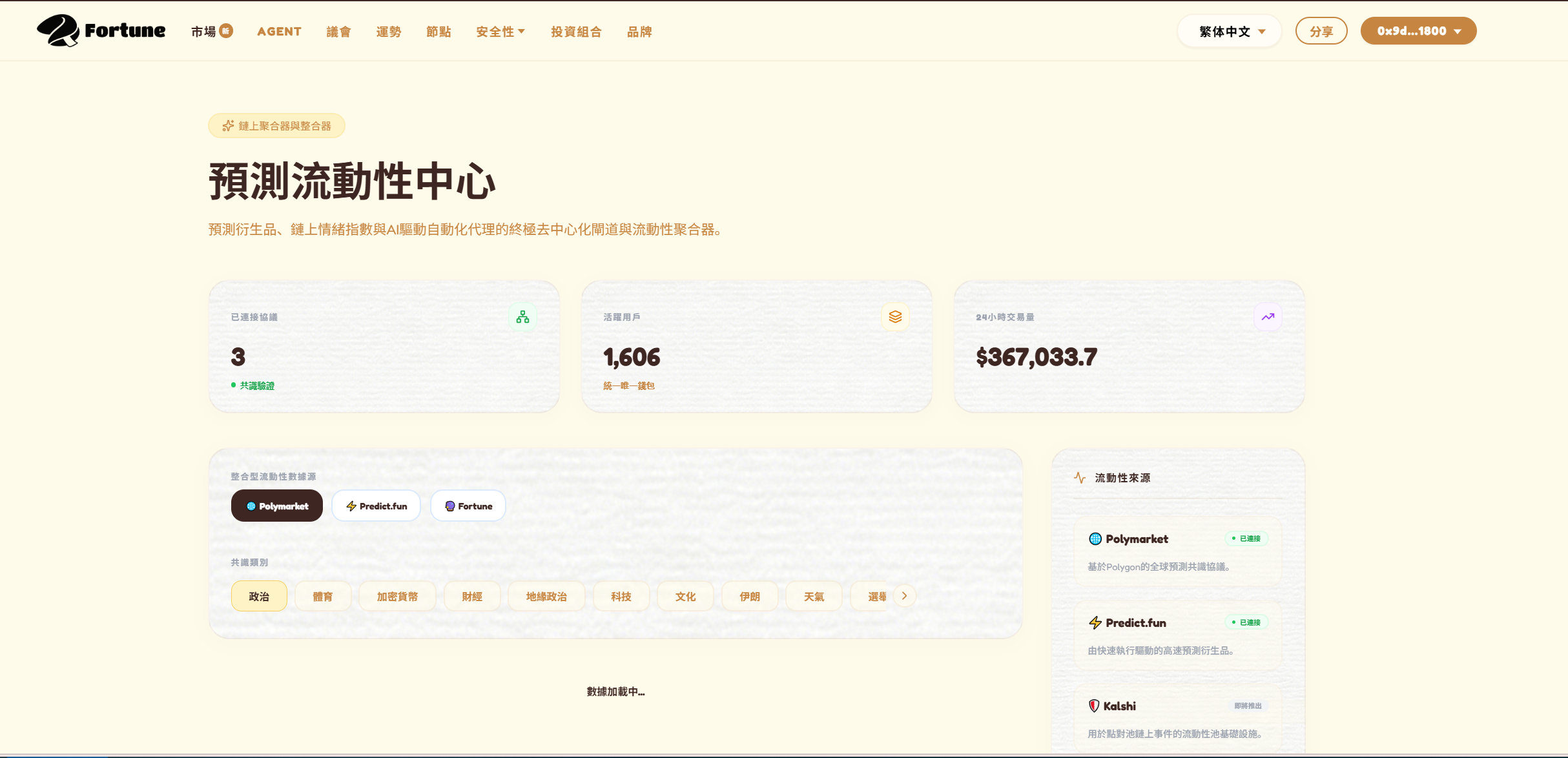
The layer it aims to tap into is "The Liquidity Infrastructure for Prediction Markets." Recently, it also integrated liquidity from Polymarket, adding it to the unified entry point of Fortune Markets alongside the previously supported Predict.fun.
Users can now view markets, trading volumes, liquidity, and implied probabilities from different sources in one place, without having to switch back and forth between different Prediction Markets.
This is just a very early form, but it already hints at what Fortune intends to do—gradually abstracting the previously fragmented Prediction Markets into a unified liquidity layer.
2. More Than Just a "1inch for Prediction Markets"—What Else Is Possible?
Of course, simply dismissing new players like Fortune as "a 1inch for prediction markets" would be missing the point entirely.
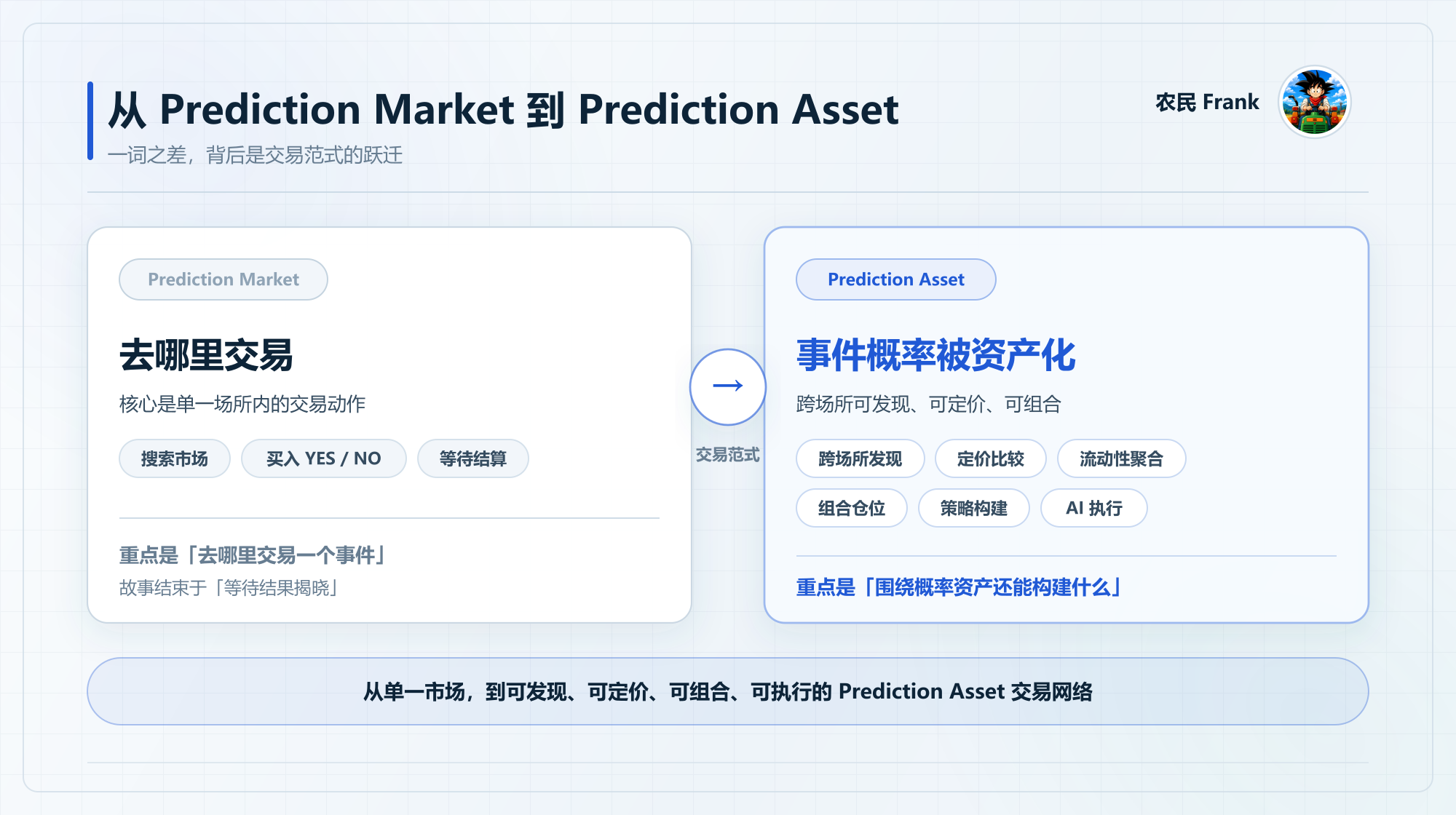
The prediction market may not necessarily replicate the DeFi development path in full. New players like Fortune are primarily attempting to shift their perspective from the Prediction Market to the Prediction Asset.
It looks like just a single word change, but the underlying logic is worlds apart: a Market concerns "where to trade," while an Asset focuses on "what exactly is being traded, and what else can be built around it."
Just as BTC doesn't belong to Binance, Tesla isn't exclusively tradeable on Robinhood, U.S. stocks involve more than just spot trading, and crypto isn't limited to spot either—once Prediction Assets can be searched, priced, combined, and traded across different markets, real opportunities for infrastructure above the markets will finally emerge.
Taking Fortune as an example, the system new players are trying to build can be roughly broken down into several interconnected layers.
1. Bringing Dispersed Prediction Assets "Together" First
As we all know, prediction markets today remain highly fragmented.
The same type of event can exist simultaneously on Polymarket, Predict.fun, and other platforms, and these different platforms each maintain their own independent market structures, liquidity, and pricing.
As early as April this year, Fortune's native Prediction Market went live. By August, it further integrated Polymarket's CLOB v2, bringing it into the Fortune Markets unified entry point alongside the previously supported Predict.fun.
Users can now browse event markets from different liquidity sources directly on Fortune Markets, comparing their liquidity, trading volume, and implied probabilities before building a position.
The updated trading flow also introduced features like Outcome Selection, Position Preview, and Portfolio, gradually connecting the processes of discovering markets, building positions, and subsequent management.
Previously, a user wanting to trade on the same type of political, sports, or crypto event might need to visit several platforms separately to search, then manually compare prices and depth. Now, Fortune Markets compresses this entire process into "Discover Event → Compare Platforms → Select Price & Liquidity → Build Position → Manage Unified Portfolio."
Theoretically speaking, aggregating prediction markets is actually far more complex than typical DEX Aggregators.
1 ETH on Uniswap and Curve is still the same ETH. But two prediction markets that look nearly identical could be entirely different assets simply because of subtle differences in expiration time, event definition,判定 conditions, or settlement rules.
From this perspective, Fortune's first task isn't to create more markets, but to gradually turn the Prediction Assets scattered across different platforms into a single asset pool that is easier to search, compare, and trade.
2. Moving from "Buying YES / NO" to More Complete Financial Products
Once assets are connected, the next set of questions naturally changes.
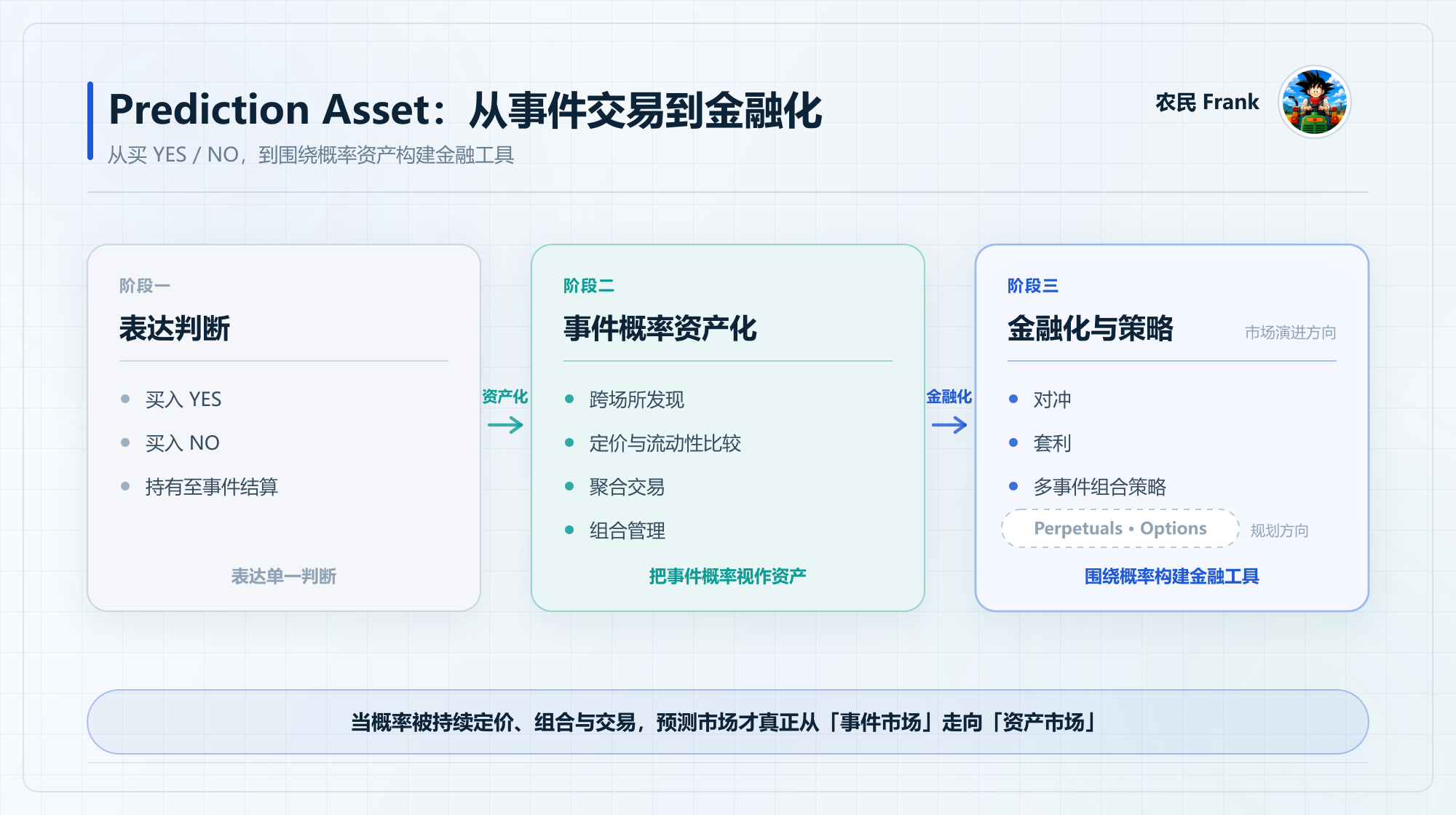
The most common way to trade in prediction markets today remains straightforward: if you're bullish on an outcome, you buy YES; if bearish, you buy NO. Then you wait for the event to resolve.
This is very reminiscent of crypto's early days when only Spot existed.
But if Prediction Assets eventually develop into an asset class of sufficient scale, trading demand theoretically won't remain stuck at binary betting forever. When the underlying asset base becomes large enough, markets typically develop leverage, options, portfolios, hedging, and structured products.
This is why Fortune has included Prediction Derivatives in its overall product direction—it aims to further transform Event Contracts from a binary "waiting for the final answer" instrument into Prediction Assets that can be combined, managed, and used strategically.
This step is quite critical.
Because an asset class truly matures not when its spot market is lively, but when a sufficiently rich financial structure can form around it.
BTC only formed its complete trading system today after progressing from spot to Perpetuals, Options, and structured products. Stock markets similarly have futures, options, ETFs, and various portfolio tools.
What Fortune is betting on now is that Prediction Assets will undergo a similar financialization process.
However, this also raises another question. If a user in the future is faced not with a few markets, but with hundreds or thousands of Prediction Assets, or even different combinations and strategies, will humans still be capable of completing all the research and execution themselves?
This is precisely where the Fortune AI Agent should come into play.
3. Letting AI Enter the Trading Pipeline Directly
To be honest, prediction markets might be one of the most easily understandable financial use cases for AI Agents.
Because they possess a naturally clear transmission chain: Real-world change occurs → New information emerges → Event probabilities shift → Markets re-price → Trading opportunities arise.
The catch is that traditional trading requires manually completing the entire process: reading news, scanning social media, analyzing market sentiment, judging whether a piece of information will actually change an event's probability, and finally locating the corresponding market, comparing prices, determining position size, and executing the trade.
What the Fortune Agent aims to compress is precisely this chain.
The currently launched Trading Agent is designed as a Multi-Agent System, continuously scanning for opportunities across three types of signals—News, Sentiment, and Arbitrage—and then further validating the conditions. Users, after connecting their wallets, can set their own single-trade amounts, risk levels, and decide whether to enable Automated Trading.
Looking deeper into Fortune's subsequent descriptions of the Agent, there are also mentions of 24/7 Market Intelligence, Structured Decision-making, Risk Management, and Execution. Put together with the previously discussed Fortune Markets, the entire product logic becomes completely connected.
For example, suppose a new policy signal suddenly emerges from a macro event.
The Agent first captures the information and assesses whether it might change the true probability of a certain event. Fortune Markets can then simultaneously provide relevant Prediction Assets, prices, and liquidity from different Venues. If market quotes haven't fully reflected the new information, the Agent then searches for more suitable trading opportunities and execution paths.
At this point, what Fortune is trying to build is no longer just an "AI predictor." It's closer to connecting the information layer, asset layer, liquidity layer, and execution layer together.
And on the outermost edge, there's an Incentive Layer responsible for cold-starting the network. Fortune has already established an incentive system centered around F Points, including Daily Check-ins and an invitation mechanism. When users invite other participants, they receive 10% of their F earnings.
These might look like the typical Points, NFTs, and Referral mechanics common in traditional Web3 projects, but when placed back into the overall product architecture, they address a very practical question:
Where will the earliest liquidity, trading users, and ecosystem participants for a new Prediction Asset network come from?
More user participation brings more trading and liquidity. Deeper liquidity improves the trading experience, which in turn attracts new users and strategies. As Agents and more financial products come on board, trading frequency and strategy complexity are also likely to increase.
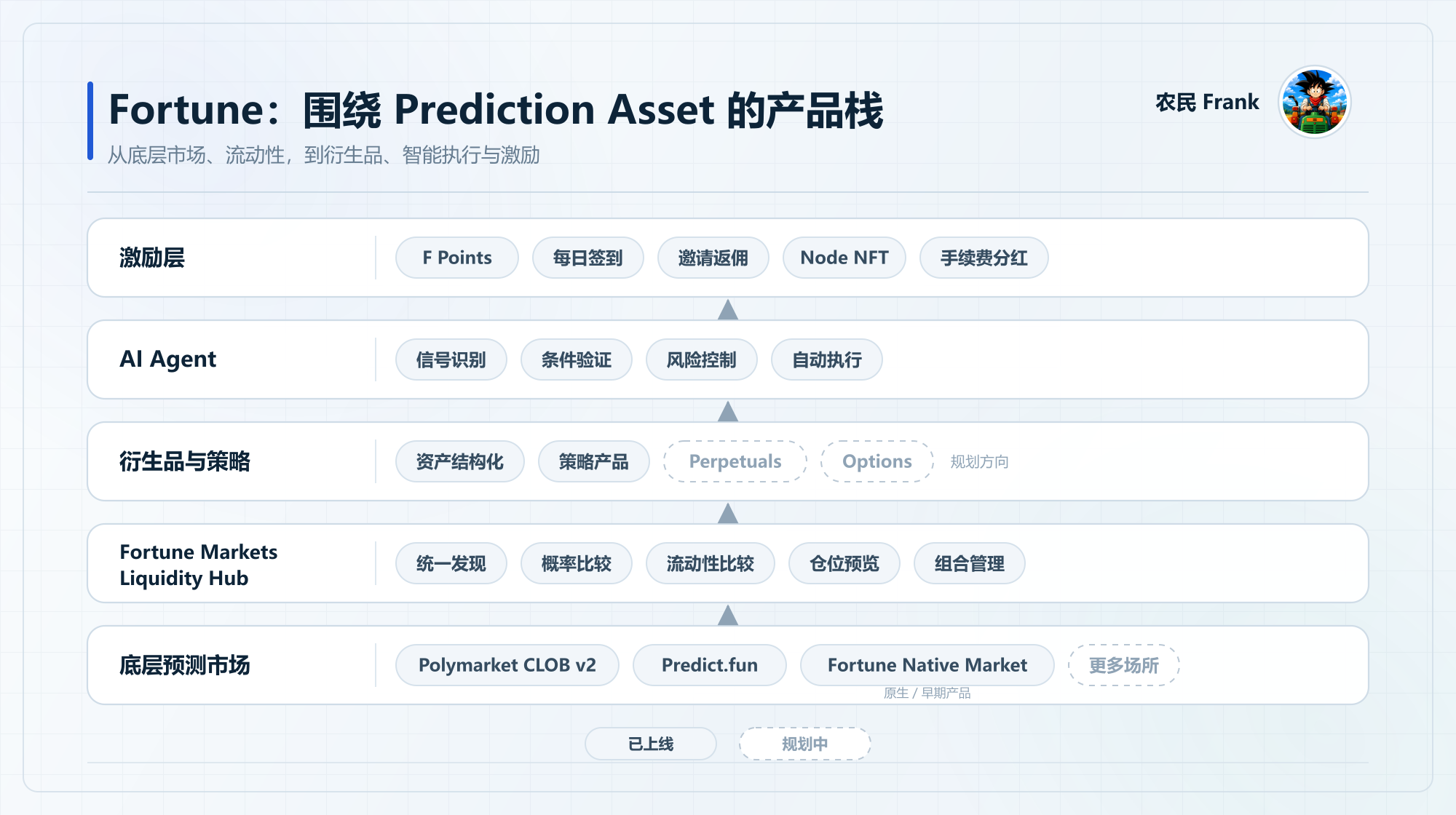
So, stringing Fortune together from start to finish, what it's truly trying to build isn't a standalone feature, but a relatively complete chain:
- Prediction Markets provide the underlying event assets;
- Fortune Markets connects these assets with liquidity;
- Prediction Derivatives expands the financial expression of the assets;
- Fortune Agent handles information processing and trade execution;
- The Incentive Layer then provides early growth momentum for the entire network;
Therefore, if one must assign Fortune a label, it is neither just a Prediction Market nor simply a "1inch for prediction markets."
More accurately, what it aims to build is a trading and execution infrastructure centered around Prediction Assets.
3. When "Probability" Truly Becomes an Asset
Of course, whether Fortune can ultimately turn this roadmap into reality is still difficult to conclude at this point.
It remains an early-stage project.
The Polymarket liquidity integration and the Agent are already visible as working products, but unified order routing, mature Prediction Derivatives, and a sufficiently deep cross-market liquidity network are still far from their final form.
But zooming out to the industry as a whole, the direction Fortune is betting on isn't isolated. Apex has already started integrating Kalshi's Event Contracts into brokerage infrastructure via API. Paradigm is also developing a Prediction Market Terminal for professional traders and researching internal market making and Prediction Market Indices.
Prediction markets are increasingly resembling genuine financial markets, and genuine financial markets will never consist solely of exchanges.
Looking ahead, at least three layers of change are worth observing.
1. From Bet to Portfolio: Deep Financialization
Many people today still understand their first encounter with a Prediction Market as "betting on whether something will happen."
But for more sophisticated traders, it's actually possible to create a series of asset portfolios that express a complete viewpoint.
For instance, if a trader believes U.S. inflation is reaccelerating and the Fed is turning hawkish, they wouldn't necessarily only trade on "whether the next FOMC meeting will raise rates." They could simultaneously build positions across different events like "whether the Fed will maintain higher rates," "whether BTC will break a certain price level by year-end," and "whether the U.S. will avoid a recession."
Individually, each of these is an Event Contract. Combined, however, they can express a complete Higher for Longer macro thesis.
If this stage truly materializes, Portfolio Management, Correlation analysis, Hedging, and Risk Management will naturally follow. If projects like Fortune can genuinely complete the Derivatives and portfolio layer by then, their value will no longer be just about helping users "open fewer browser tabs."
2. From Single-Market Trading to Cross-Market Aggregated Execution
This is fairly intuitive: the larger the market, the less critical any single platform might become.
Crypto ultimately did not settle into a structure where "one exchange holds all liquidity," and Prediction Markets most likely won't either.
Different regulatory regimes, user groups, market makers, event categories, and geographies will persistently create market fragmentation. And market fragmentation itself is an opportunity for infrastructure, after all, arbitrageurs need prices, market makers need order flow, institutions need depth, everyday users need the best execution price, and Agents need enough Venues to scan and execute across.
So as Prediction Markets genuinely mature, the trading entry point might actually become more "invisible." For example, on a brokerage app, you might see a news headline: "Fed probability of a rate hike next month: 72%"
Next to it, there's a button to buy. It doesn't matter whether the underlying order ultimately comes from Polymarket, Kalshi, or is split across three markets by a Router.
This is the real change that API-ization might bring.
3. From Human Trader to AI Trader
I've always maintained that prediction markets could become one of the most natural financial application scenarios for AI Agents.
Because it's inherently structured as "Information → Probability → Price → Trade,"