






CZ Watches Robinhood CEO, CASHCAT Hits New High: How to Understand the Current On-Chain Market


- Core View: The current on-chain market is lagging behind the broader market performance, with capital still in a testing phase. However, meme coins have been repositioned as core assets for exchanges and public chains to attract new user growth. Combined with the rise of the US stock meme narrative and the potential cooperation between Binance and Robinhood, the strongest market playbook may be brewing.
- Key Elements:
- Robinhood's on-chain leader $CASHCAT hit a new all-time high market cap of $240 million. The strength of BTC and ETH has boosted on-chain attention, and Brother Machi (Machibigbrother) turned a $150,000 principal into $12.72 million in 3 days by going long on ETH.
- Since last week, the rally has been concentrated in old assets (such as "cat" coins on various chains like $BASECAT, $CATE, etc.), with a lack of new fast-track tokens. This shows that sentiment and capital have not yet fully transmitted to on-chain new launches—the market is actually lagging behind the broader market.
- The current positioning of meme coins has been upgraded: from the early niche narrative within the crypto circle (the $DOGE and $SHIB era), through the underlying gameplay innovation of pump.fun (chasing attention for profit), they have now become the asset class universally recognized by exchanges and public chains as the best way to attract mainstream user growth. Solana CPO Vibhu called them "the source of the vast majority of crypto profits."
- The US stock meme playbook received positive recognition from Robinhood CEO Vlad, who stated that it connects meme coins with tokenized US stocks as a "unique asset class," and plans to increase US stock ownership rates from 65% to 95% through tokenization. CZ also described it as "novel and interesting," but noted that issuers must fulfill their obligations.
- CZ's attention to Vlad, along with Vlad's comments on Musk's Mars tweet, has sparked imagination: if Binance and Robinhood open up mutual listing channels (such as Binance listing $CASHCAT and Robinhood listing $MarsCoin), it could become the strongest playbook since the Trump coin.
- After more than a year of bear market, surviving tokens have withstood the test of community and narrative. The market is not short of good assets—it only lacks the spark to ignite the market. The altseason will undergo dramatic changes, and this uncertainty ironically brings highly optimistic expectations for the return of a golden age.
Today, $CASHCAT, the leading token on the Robinhood chain, hit an all-time high market cap of $240 million, and more and more people are starting to pay attention to on-chain market movements.
To be fair, with BTC and ETH performing so strongly—even Machi Big Brother, who has long been the subject of jokes, managed to turn $150,000 into $12.72 million in three days by going long on ETH—it's hardly surprising that on-chain market activity is drawing increasing attention.
Therefore, this article aims to provide a summary and analysis of the recent on-chain situation—what stage is the current on-chain market actually in? What are the possible reasons behind certain phenomena? And should we be optimistic about the on-chain market going forward?
The On-Chain Market Is Actually Lagging Behind the Broader Market
If you're a player who has stuck with on-chain trading, you've probably noticed significantly more opportunities since last week. These widespread opportunities include "cat" coins rising across various chains—Robinhood's $CASHCAT, Base's $BASECAT, Solana's $CATE, and so on. Good opportunities have also appeared on less prominent chains, such as $FOLD, the privacy project backed by Vitalik on the ETH mainnet, and $egg, a meme coin on HyperEVM.
There are more opportunities, but that doesn't mean it's easy to make money, because the tokens mentioned above aren't exactly fresh plays. In fact, the rally since last week has mostly revolved around relatively "older" tokens, and no explosive new fast-track tokens have emerged. So the experience of whether it's easy to make money really depends on each player's specific holdings.
For instance, is $MarsCoin on BSC a good play? Yes, the US stock meme concept is solid, and the support from being listed on Binance Alpha is positive, but its price performance since last week hasn't been great.
How do we explain why "older" tokens are outperforming new listings? I believe this indicates that the on-chain market is still lagging behind the broader market at this stage. Because the strength of BTC and ETH's rally has caught almost everyone off guard, sentiment and capital haven't fully transmitted to on-chain new launches. However, for tokens that have historically enjoyed strong communities and financial backing, capital may be starting to test market sentiment with some initial moves. Combined with the fact that these tokens already have market recognition, it's these older tokens that are beginning to rise.
This situation where consensus hasn't yet formed isn't limited to on-chain meme coins—it applies to other altcoins as well. That's why we see BTC and ETH holding up strongly, some coins giving the impression of using the opportunity to dump, and others posting decent gains—but nothing too dramatic, still a ways off from all-time highs, more like a tentative probe.
The Strongest Playbook May Be in the Making
If the broader market continues to hold steady or even show strength, the on-chain market can hardly be said to have "already begun." Bitcoin at $80,000 isn't particularly high yet, and it still needs to be tested over a longer time horizon.
Under the current market conditions, optimism about the on-chain market going forward mainly comes from the following aspects.
First, meme coins have been repositioned at this stage. During the $DOGE and $SHIB era, meme coins were a novel narrative within the crypto space—essentially like NFT's CryptoPunks. At first, no one understood why they could skyrocket beyond belief, and it wasn't until they reached their peaks that everyone finally caught on. Then came the pump.fun era, where the asset issuance and trading models for meme coins underwent massive changes, and the innovation in underlying mechanics allowed everyone to profit from capturing attention.
Now, exchanges and public chains are gradually realizing that meme coins are the asset class most capable of attracting incremental users. As Solana's CPO Vibhu put it, "Meme coins are the best and only crypto use case that attracts the mainstream, and they create the vast majority of cryptocurrency profits."
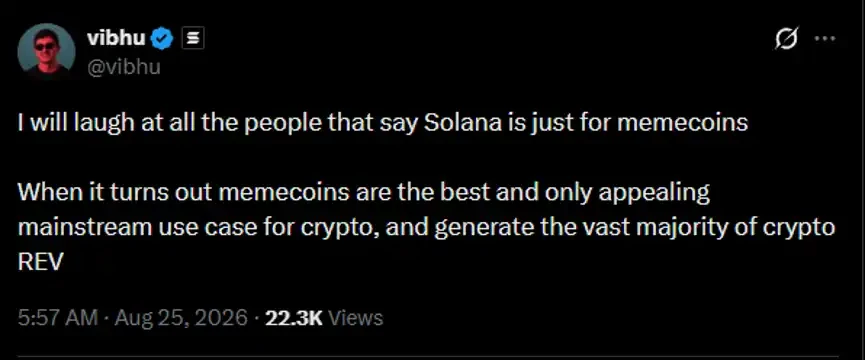
Although crypto, driven by compliance efforts, has public chains and exchanges all trying to do bigger business by bringing traditional finance on-chain, to grow the business, you first need to attract attention. In this context, meme coins—which have already become a stable crypto business—have turned into a sector that no player can afford to ignore.
The old days were slow; it took a long time for a major "golden dog" to emerge because the meme coin industry wasn't mature enough. Now, everything has changed.
Second, meme coins have never received this level of positive validation, especially after the emergence of the US stock meme playbook. Robinhood CEO Vlad recently mentioned and affirmed US stock memes again on The Iced Coffee Hour podcast: "If you hold a certain meme coin, you get a tokenized US stock airdrop. This unique mechanic ties meme coins and US stocks together—it's a unique asset class we never thought of before."
Vlad also noted that before Robinhood, about 50% of American households held stocks, and Robinhood has raised that figure to 65%. Going forward, tokenization is the key to pushing stock ownership to 95%, while also making top-tier US stocks and other RWA assets easier to distribute globally.
Although Vlad didn't say US stock memes would be the vehicle to push ownership to 95%, this still upgrades the US stock meme narrative—a hybrid asset with higher acceptance among younger generations, allowing people to accumulate US equity holdings while having fun. Even now, there are already many on-chain players who have never traded US stocks but now hold US equities through trading meme coins.
When CZ was asked about his views on US stock memes, he also gave a fairly positive assessment: "US stock memes are a novel and interesting play, but it needs to be ensured that issuers can actually fulfill their obligations."

A sector that can earn validation from both Vlad and CZ, yet hasn't produced a single token exceeding $100 million in market cap—there's simply too much potential here.
Finally, CZ followed Vlad yesterday, and Vlad commented on one of Musk's Mars-related tweets yesterday, ending with "See you on Mars." This move gives us enormous room for imagination—what if, going forward, Binance and Robinhood open up listing channels with each other, Binance lists $CASHCAT, and Robinhood lists $MarsCoin?
The strongest playbook since Trump coin may be in the making. After over a year of bear market torment, the market isn't short of good tokens—whether in terms of community or narrative, the tokens that have survived have all passed enough tests. All that's missing is a spark to ignite things.
This cycle's altcoin season will undergo massive changes compared to the past. We can see the changes happening at the meme coin level, but there are many more changes that can't yet be anticipated or captured. It's precisely this uncertainty that makes me highly optimistic about the market ahead—regardless of whether you and I succeeded or failed in the multiple cycles over the past years, this time, we may very soon find ourselves back at the starting line of a golden era.


