Can a U.S. Treasury bond buyback rescue the market? Arthur Hayes predicts BTC trends under three scenarios


- Core View: U.S. Treasury Secretary Bessent is facing pressure as Treasury yields approach 5%, and his strategy of expanding Treasury bond buyback scale is aimed at indirectly releasing dollar liquidity. Based on former Treasury Secretary Yellen's experience in 2023 of successfully stimulating the market through short-term Treasury bill operations, the article concludes that Bessent will replicate a similar money-printing path, thereby driving a new round of gains for crypto assets like Bitcoin.
- Key Elements:
- The 5% Treasury yield is a key psychological threshold; breaking through it would raise financing costs for households and businesses, forcing the Treasury to intervene in the market.
- When Yellen increased the supply of short-term Treasury bills in late 2023, it prompted money market funds to shift assets out of the Federal Reserve's Reverse Repo Program (RRP), injecting approximately $2.4 trillion in liquidity into the market and helping Bitcoin bottom out and rebound.
- When Bessent took office in 2025, the RRP balance had already fallen to $100 billion, and the previously released liquidity had driven sharp gains in the Nasdaq 100 and Bitcoin.
- Bessent recently announced an increase of $20 billion in long-end bond buybacks, but the scale is too small (against $40 trillion in total debt), only briefly suppressing yields. The market expects him to scale up efforts further.
- Potential tools include deploying approximately $1 trillion from the Treasury General Account (TGA), or following the Bank of Japan's approach of unlimited bond market intervention.
- The Federal Reserve faces political constraints that make it difficult to directly cut rates or implement unlimited QE, as voters focus on the cost of living, forcing the Treasury to adopt indirect easing measures.
Original Author: Arthur Hayes, former co-founder of BitMEX
Original Translation: Saoirse, Foresight News
Editor's Note: As U.S. Treasury yields approach the sensitive 5% threshold, global risk assets are coming under pressure. This article opens with the bond market completing the first act of the narrative, then shifts focus to the crypto market, reviewing past experiences where declining reverse repo balances fueled bull runs. Combining current market correlation dynamics, it analyzes the actual effectiveness and constraints of the Treasury's bond buyback policy, using this to project potential market movements for Bitcoin and other crypto assets amid a liquidity shift.
Please set aside your rational thinking for a moment, let your imagination run wild, and follow my narrative.
Act One
On a Saturday night, the newly renovated Brooklyn Mirage, now known as New York's Pacha Club, serves as the true heart of the American hegemonic order. An assemblage of top power brokers, dressed in finery, gathers here, swaying to the rhythms of Keinemusik.
The protagonist, U.S. Treasury Secretary Scott Bessent (whom the author jokingly refers to as "Buffalo Bill"), swaggers over to the VIP booth behind the DJ table. A wicked grin curls at the corner of his mouth as a thought flashes through his mind: "Since Elvis stole Southern gospel music for his appearance on The Ed Sullivan Show, I haven't seen a group of white people with this kind of rhythm."
Citadel's Kenny G is present, celebrating his crushing defeat of Leopold Aschenbrenner, the San Francisco-based, high-leverage market bettor. Bessent can't help but take a second look. He'd always heard Kenny G was based in Miami and figured he preferred Latina women. "Who is that stunning woman next to Kenny G... Wait, on closer inspection, it's Leopold's wife." There's nothing more satisfying than humiliating a pretentious, high-leverage speculator from the West Coast. Even if she's only average-looking by Bay Area standards, so what? Live in the moment.
Much to Bessent's surprise and annoyance, seated beside Kenny G is his predecessor, former Treasury Secretary Janet "Bad Gurl" Yellen. She waves at him before continuing her conversation with Hunter Biden. Bessent inwardly scoffs, wondering what in the world this party has become. He even suspects Yellen plans to let loose tonight. A wave of indignation washes over Bessent: How can she afford a $20,000 table? He quickly figures it out—simply holding office in the U.S. government inherently presents massive profit opportunities. Bessent himself is already immensely wealthy, so he hasn't engaged in such graft; but for ordinary politicians like Ro Khanna or Nancy Pelosi, such maneuvers are standard operating procedure.
Yellen shouts across the noise to Bessent: "Hey, kid, how's the market treating you these days?"
Bessent's body visibly twitches with rage. His week has been a nightmare; the U.S. Treasury market has performed terribly. He was forced to abruptly announce that the Treasury would double its buyback of long-dated bonds in an attempt to suppress yields. Unfortunately, the market's relief rally lasted only a single trading day. By the weekend, yields had already climbed back to pre-announcement levels. He longs to call his true mentor, George Soros, for advice, wondering if Druck will even pick up his call.
Yellen pours fuel on the fire: "Didn't you think you were better than me? Smarter than the academics when it comes to markets?" She lets out a cackle mimicking former Vice President Kamala Harris: "You're just Trump's puppet, hahaha. We're essentially no different, you arrogant fool. Have fun!"
With that, Yellen fully lets loose. A procession of male companions wearing diamond dog collars custom-made by Jacob the Jeweler follows behind her. She leans into one of their ears, whispering Cardi B lyrics: "I want you to park that big Mack truck right in this little garage." It certainly is a "little garage" now, and she's still holding onto some Reta on the side.
Fuming, Bessent walks past the booth of Arthur and Ansem, where a group of crypto gamblers are deep in animated discussion. Arthur beckons Bessent over and, once he's close, says: "I just saw everything. Don't mind the haters. The crypto crowd is on your side. You have no choice—we support you, keep going! Don't ever stop printing money. If the market crashes, the rich won't get their free dividends, and the average Americans who naively believe capitalism will make them rich will get nothing. Without those dividends, AOC will raise our taxes, my god."
At that moment, Bessent makes up his mind to be the most diligent Treasury Secretary possible. If Trump needs ten trillion dollars to prop up the market, he will find a way.
Scene Transition
No matter how different their rhetoric was before taking office, Bad Gurl Yellen and Buffalo Bill Bessent are essentially the same breed. They are both beholden to politicians—politicians who can't control themselves, endlessly spending on absurd causes. But both believe the price is worth paying for holding the highest financial power in America. So whenever the bond market experiences severe turbulence, they deploy their sophisticated money-printing strategies.
When the Treasury suppresses bond yields by printing money, it releases dollar liquidity into the market, and that liquidity eventually flows into Bitcoin and the crypto market. I will compare two historical periods: Yellen and Bessent changing the market landscape, followed by Bitcoin rallies. The first was in late 2023, when Yellen massively issued short-term Treasury bills, reducing the supply of long-term bonds; the second is right now, as Bessent intervenes in the USD/JPY exchange rate and expands Treasury buybacks. After Yellen deployed her money-printing scheme back then, Bitcoin rebounded strongly from its lows; my assessment is that once Bessent commits to following in his predecessor's footsteps and unleashes massive dollar liquidity, Bitcoin will replay the same scenario.
The 5% Threshold
For some reason, both Yellen and now Bessent are deeply terrified of the 10-year Treasury yield approaching 5%. The 10-year Treasury yield is the most important pricing anchor in the American financial order. Rates for 30-year fixed-rate mortgages (with prepayment options), corporate bonds, and various consumer credit products are all anchored to the 10-year Treasury. Once yields break above 5%, financing costs for households and corporations become unbearably high, cooling economic activity. That's why regulators will fight desperately to defend this level.
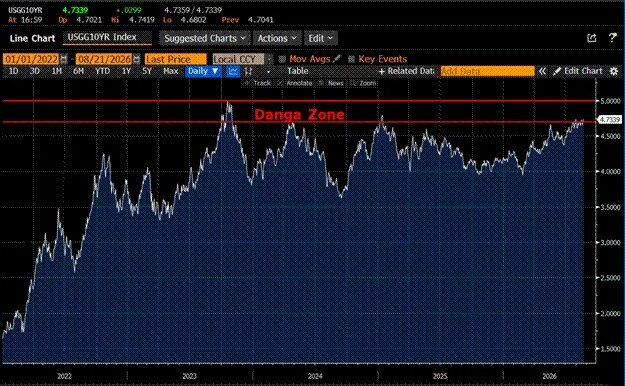
This chart shows the 10-year U.S. Treasury yield from 2022-2026. The 5% red line marks the policy "danger zone," where approaching it forces the Treasury to flood the market with liquidity.
T-Bills vs. Long-Dated Bonds
T-Bills have maturities of less than one year, while bonds have longer maturities. The shorter the maturity, the closer to cash, and the more liquid and attractive they are to institutions like money market funds (MMFs). MMFs want the highest possible yield while assuming minimal interest rate risk and counterparty risk. Depositing funds with the Federal Reserve is the safest option—the Fed can print money to settle debts without congressional approval. The Fed offers the Reverse Repo Program (RRP), where eligible institutions can park funds and earn a yield close to the federal funds rate.
Theoretically, lending to the U.S. government in dollars is risk-free because the government can print money; but in reality, repaying debt requires congressional approval. That's why the debt ceiling drama rattles the market: investors cannot hold securities with uncertain repayment upon maturity. If politicians refuse to pass spending bills, bondholders don't get their principal and interest. Therefore, for MMFs to hold T-Bills, their yields must be slightly higher than the RRP rate to compensate for this policy risk.
The environment in late 2023 was very similar to today, with the cost of living being voters' biggest concern. The then-Biden administration knew full well that ordinary people understood what rate cuts or balance sheet expansion would bring, so that path was off the table. With the 2024 election looming, the government had to address voters' living pressures. Yellen understood that her boss needed liquidity to prop up the market, but without the appearance of blatant money printing that would fuel inflation. So she devised a clever backdoor money-printing operation.
At that time, roughly $2.5 trillion was parked in the RRP. The problem with this money was that sitting on the Fed's balance sheet, it couldn't be rehypothecated by banks to create credit—the money multiplier was zero. But if MMFs shifted funds out of the RRP and bought higher-yielding T-Bills, the banking system could rehypothecate those assets. Liquidity then flooded into the bond market, suppressing yields while pushing stock prices higher; for us crypto players, this also created the bottom for Bitcoin after the FTX collapse.
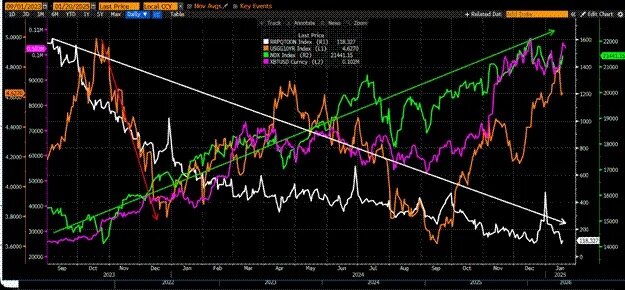
The chart clearly illustrates this transmission logic. As the Treasury expanded T-Bill supply, bill prices fell and yields rose to levels significantly above the RRP rate, prompting profit-seeking MMFs to migrate funds from the reverse repo facility. By the time Bessent took office on 2025-01-20, the RRP balance had shrunk from $2.5 trillion to $100 billion. This represented a $2.4 trillion liquidity injection (funds originating from pandemic stimulus programs), flooding financial markets, sending the Nasdaq 100 and Bitcoin soaring, and quickly pulling the 10-year Treasury yield back from the dangerous 5% level, all while the federal funds rate remained unchanged near 5.3%.
Crypto traders, study this chart carefully—this is the root of the market's optimistic expectations. If you can't understand why Bitcoin and risk assets rallied strongly while the Fed maintained the highest interest rates since 2008 and was simultaneously shrinking its balance sheet, you'll miss the new bull market that has just begun. Academia has even coined the term Activist Treasury Issuance (ATI) to describe Yellen's magical maneuvering.
Now Bessent faces the exact same dilemma as Yellen. His boss is fond of spending lavishly, and this time the spending spree is justified by an unwinnable Middle East war. But it doesn't matter where the President spends the money; the Treasury Secretary's job is to borrow for the government at an affordable cost.
Operation Twist
Everyone loves interest-bearing cash-like assets. T-Bills are the highest-yielding, safest quasi-cash instruments in the dollar system. So everyone wants to hold T-Bills; even the crypto industry holds their derivatives, such as stablecoins like USDT and USDC. Bessent knows full well that the market can absorb an enormous amount of T-Bills if he's willing to supply them. But the problem is T-Bills mature within a year; the higher the proportion of short-term debt, the faster the compounding rollover of the debt. Every week, the Treasury must issue more and more debt, both to cover new fiscal spending and to refinance maturing old debt, causing the total U.S. debt to accelerate.
By increasing the share of T-Bills in total debt, Bessent can leverage the most important marginal buyer—the Federal Reserve. Currently, the Fed creates bank reserves through its Reserve Management Program (RMP), printing money to buy T-Bills. The monthly purchase size under the RMP is determined by New York Fed President Williams, who leans toward easing—what the Fed calls a "dove." If Williams judges the market is short on dollar liquidity, he orders traders to create reserves and buy T-Bills in the open market. In essence, the Fed prints money to foot the politicians' fiscal bills.
With the Fed absorbing T-Bills, Bessent can issue massive amounts of short-term debt and use the proceeds to buy back medium- and long-term bonds. Bessent toys with the yield curve like a tone-deaf child playing the cello. Following last year's "Liberation Day" event, he hinted at wielding the powerful weapon of Treasury buybacks. At the time, Trump briefly attempted to radically rewrite global trade with aggressive tariffs, but balked after markets plunged. Bessent warned the market not to test his policy toolkit. Over a year later, Bessent has indeed acted, announcing large-scale buybacks to forcibly suppress long-end yields.
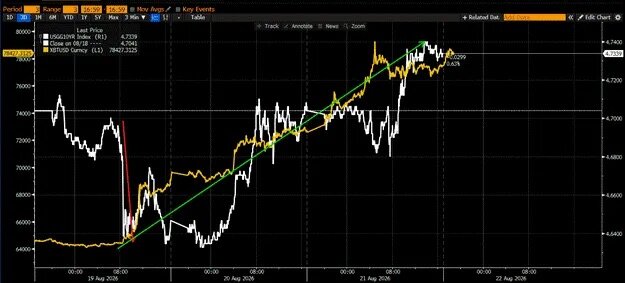
The white line is the 10-year Treasury yield, the yellow line is Bitcoin. After Bessent announced expanded long-dated bond buybacks, both rose in tandem short-term, confirming the market's tendency to buy on expectations. However, Treasury yields later rebounded again, indicating this round of buybacks was insufficient to suppress rates.
On August 19, Bessent unexpectedly announced a paltry additional $20 billion increase in long-dated bond buybacks for the next fiscal quarter. Following the news, the 10-year yield briefly dipped, but only marginally. Bitcoin stirred from its slumber, rallying strongly for two consecutive days. But this is precisely why Bessent was so glum at the party: just one trading day later, the 10-year Treasury yield was back above pre-announcement levels. Why?
First, Bessent's move was far too small. With total debt at $40 trillion, a $20 billion buyback is a drop in the bucket. Second, the market smelled panic. Just weeks earlier, Bessent had proposed removing the cap on the FIMA facility, allowing Japan and other major U.S. debt holders to use their Treasury holdings as collateral to borrow dollars directly from the Fed, rather than selling bonds into the open market. Third, and most importantly: the market believes that by pushing the 10-year yield higher, it can force Bessent to replicate Yellen's playbook and find ways to inject trillions of dollars of liquidity into the market. Bitcoin is the smoke alarm for global liquidity, and it acutely sensed this signal. If Bessent is indeed Yellen 2.0, then Bitcoin is poised for a ferocious rally from its lows.
Bessent's Next Move
Several scenarios could unfold next.
For an asset as sensitive to dollar liquidity as Bitcoin, the worst-case script is: U.S. politicians led by Trump choose to cut fiscal spending. But I think the probability of this happening is very low, with the next election cycle already approaching. The Democratic socialist wing of the party, spiritually led by AOC, is gaining momentum with their utopian vision: no rent, free food. Trump and the Republicans must offer a corresponding "prosperity narrative": printing money to give assets to wealthy donors, while weaving a dream that ordinary people can get rich simply by believing in "socialism for the rich, capitalism for the poor." You'll see these supporters—men in full Philipp Plein regalia channeling Miami Vice, women getting filler treatments at the most expensive med-spas in Coconut Grove.
Away from this apocalyptic fantasy, back to reality, let's look at the levers Bessent can pull to crank up the money printing machine.
The best-case scenario for Bitcoin: Bessent emulates the Bank of Japan's bond market intervention model, announcing that if yields on 10-year and longer bonds rise above 5%, he will buy back bonds without limit. Initially, long-dated bond prices would surge, yields would fall quickly, and the market would temporarily hold Bessent in awe. But all interventions that defy market economic laws eventually face tests; the market will probe Bessent to see if he's truly willing to back his promises with dollar firepower.
The most likely middle path (unless the MOVE volatility index breaks above 130, indicating acute market stress): Bessent will incrementally increase buybacks while seeking out other unconventional tools to indirectly release liquidity.
There's also an obvious lever: depleting the Treasury General Account (TGA) to fund buybacks. Buffalo Bill Bessent has already leaked this proposal to CNBC. The TGA holds approximately $1 trillion.
In my view, unless the AI credit bubble truly bursts in the coming years, it will be politically difficult for the Fed to directly cut rates or restart unlimited QE. Don't forget, voters still care most about the cost of living; nowadays, even teenagers scrolling short videos understand that rate cuts and QE mean printing money.
The Bull Market Is Here
Whether Bessent acts quickly or gradually, Bitcoin will ultimately keep rising. Volatility will amplify; even with an upward trend, vicious short-term pullbacks will occur. Therefore, unless you're a full-time trader, avoid leverage. Buy Bitcoin or your preferred altcoins, hold them, and wait patiently for Bessent's policies to take effect.
At the Maelstrom fund internally, we are already fully allocated to risk assets. Bitcoin, Ether, Ethena, and Ether.fi are our core positions, and we're expecting them to run hard.