每周编辑精选 Weekly Editor's Picks (0822-0828)


- Key Takeaways: This week, the crypto market was driven by a confluence of macroeconomic policy and capital inflows. BTC returned to $80,000, and the total market cap of altcoins surged by $215 billion in just three days. Gold broke through $4,600, with market attention focused on shifts in U.S. Treasury issuance structure and the leverage effect of crypto-related stocks.
- Key Elements:
- Wall Street expects the U.S. Treasury to increase short-dated debt issuance and expand buybacks in November to alleviate pressure on long-term yields. Some investment banks believe the likelihood of the more aggressive option—cutting long-dated issuance—is rising.
- Goldman Sachs maintains its forecast of gold at $4,900/oz by the end of 2026, noting that the resonance between options-driven capital and fundamental buying could amplify short-term volatility, with both Chinese and Western macro funds increasing their positions.
- Arthur Hayes views the crypto market as a relief valve for central bank money printing, predicting ETH will reach $30,000. He identifies war as the biggest risk, and notes that the trigger point for BTC breaking its previous high is the Fed removing the counterparty cap on FEMA repurchase agreements.
- MSTR is seen as the top pick for leveraged Bitcoin bond exposure, COIN suits balanced investors, miners carry the highest leverage and are the most vulnerable, and Circle's stock surged but over 85% of its revenue depends on reserve interest.
- The altcoin market is clearly recovering, with 92% of tokens posting gains. Capital is concentrating toward top projects, and tokens are increasingly driven by their own fundamentals. ZEC hit an eight-year high, catalyzed by Grayscale Trust's conversion to an ETF and DCG's injection of 200,000 ZEC.
- Hyperliquid's AQAv2 mechanism has launched, expected to generate $150–200 million in annual buyback capital. Ethena is buying back seed-round tokens and canceling future VC unlocks, ending supply-side selling pressure.
- Nvidia's quarterly revenue is set to surpass $100 billion, with AI demand spreading across multiple sectors and supply becoming the constraining factor. SK Hynix announced a 40 trillion KRW buyback plan but faces competition from Samsung and high volatility risks.
The information flow moves too fast, and in-depth analysis articles are easily drowned out by hot topics. This "Weekly Editor's Picks" column rescues content of true judgment value from the vast sea of information, helping you filter out the noise, retain insights, and spark inspiration.

Macro Landscape
Wall Street Speculation: What's Bessent's Next Move to "Save U.S. Treasuries"?
Currently, mainstream Wall Street institutions expect the Treasury to signal in November that future borrowing increases will be funded through short-term bills and notes of shorter maturities, while further expanding buyback operations to alleviate pressure on long-term yields. Some investment banks have even noted that the possibility of the more aggressive option—directly reducing long-term bond issuance—is rising.
With long-term Treasury yields hovering near multi-year highs, the Treasury's departure from the long-standing convention of "regular and predictable" issuance is injecting new volatility into the market. Investors are facing a brand-new era of U.S. debt management and are reassessing their portfolio risk exposure accordingly.
Goldman Sachs believes that fundamental buying in gold is resonating with options flows, and dealer hedging could act as a short-term amplifier after the price breakout. Options positioning can amplify both upside moves and exacerbate pullbacks; if inflation re-accelerates and pushes up rate hike expectations, dealer unwinding could create additional selling pressure.
Goldman Sachs maintains its gold forecast of $4,900/oz by end-2026, but this target has yet to factor in surging demand for macro policy hedging, leaving room for further upside. Goldman's trading desk has observed synchronized accumulation by Chinese and Western macro funds, with clients using options and spot trading to bet on gold rising to $4,800–$5,500.
In the silver market, there has been demand for three-month digital options with a $90 strike price, but this represents client positioning rather than Goldman's official target price.
Also recommended: Bessent's Real Game Plan: Squeezing U.S. Treasury CTAs to Drive the 10-Year Yield to 4.3%?
Investment & Entrepreneurship
Arthur Hayes In-Depth Interview: ETH to $30,000; FLOP Will Surpass ETH
Cryptocurrency is precisely the only release valve—the purest channel for central bank money printing. 2026 is replaying the script that led to 2008, retracing the very path that gave birth to Bitcoin. Arthur believes the Clarity Act is a terrible thing for the U.S.-based crypto ecosystem, genuine innovation, and useful projects with real market demand. The government merely pays occasional surface-level attention to crypto companies while placing its full bet on AI.
Arthur doesn't pay much attention to technical analysis; instead, he follows Milton Berg, who focuses on U.S. equity technical analysis, using his buy and sell rhythm to observe the correlation between Bitcoin and U.S. stocks.
Arthur believes that in this round of liquidity rebound in the crypto market, ETH will outperform all other large-cap crypto assets, as Ethereum boasts the largest developer community. The trigger for BTC breaking its previous high within the year is the Fed's decision to remove the counterparty cap on the Foreign and International Monetary Authorities (FEMA) repurchase facility.
The biggest risk to the crypto market comes from war. Investors especially need patience and focus. Arthur also introduced his latest project, Flop Network, a hashrate spot market with its own native currency.
BTC Surges 24% in a Week: Who Are the Strongest Crypto-Leveraged Stocks?
MSTR is a leveraged Bitcoin bond with the highest elasticity; COIN relies more on operational leverage, suitable for balanced investors seeking "industry growth + regulatory dividends"; CRCL's revenue has almost no direct correlation with BTC prices; HOOD has gained the least but may be the most "resilient"; miners carry the highest leverage and are the most fragile.
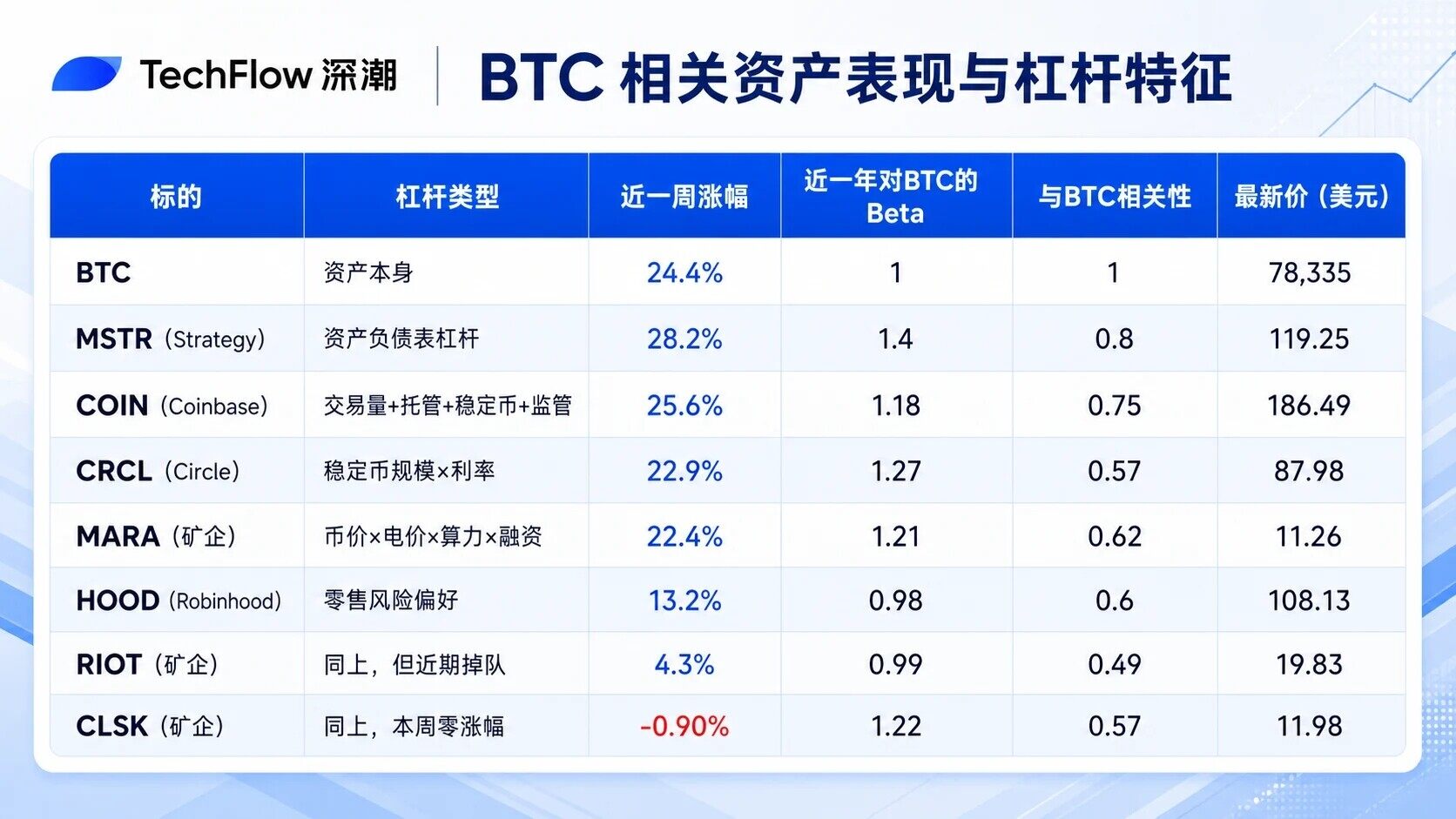
Daily data as of 2026-08-21 close
Circle Surges 17% in Two Days: What Is the Market Really Betting On?
Beyond the broad strength in crypto-related stocks, Circle's own fundamentals still hinge on two points:
1. In Q2, USDC circulation and on-chain transaction volumes continued to grow, but revenue growth has slowed, with over 85% of revenue still coming from interest generated by reserve assets. As interest rates decline, whether USDC's scale expansion can offset falling reserve yields becomes the key to short-term profitability.
2. The longer-term variables are the Arc blockchain and the Circle Payments Network (CPN).
Which valuation Circle ultimately commands (the 2030 neutral scenario of $101 or the $259 scenario) depends on whether Arc can generate real assets, transaction activity, and sustained revenue after launch.
Altcoin Season Has Just Begun: 92% of Tokens Rally, Total Market Cap Returns to $1 Trillion
The visible recovery in the altcoin market has become a market consensus. Capital will flow toward leading projects, and the trading volume of top altcoins will account for an increasingly larger share of total altcoin trading volume. Going forward, altcoins will rely more on their own fundamentals, use cases, and independent capital inflows to drive gains—this is also one of the defining characteristics of this market cycle.
Behind ZEC's New High: Grayscale Trust-to-ETF Conversion Accelerates, Is TAO on the Same Script?
As Bitcoin surged over 24% this week, privacy coin ZEC simultaneously hit an eight-year high of approximately $836–$855.
The direct catalyst is not merely a "privacy narrative revival," but rather Grayscale's latest amended filing to convert the Zcash Trust into a spot ETF, which also disclosed that a subsidiary of parent company DCG is in discussions to inject approximately 200,000 ZEC into the fund.
Around the same period, Grayscale is also pursuing the "trust-to-ETF conversion" path for Bittensor (TAO), but progress is visibly behind. Market attention to this conversion playbook remains insufficient.
Today, HYPE Activates Its Second Buyback Engine
Hyperliquid's Aligned Quote Assets v2 (AQAv2) mechanism will officially begin accruing yields. This means that, in addition to trading fees, Hyperliquid will add a new revenue stream related to stablecoin reserve yields, ultimately used for HYPE buybacks. AQAv2 could generate $150 million to $200 million in additional buyback capital annually for Hyperliquid.
The Ethena Foundation's official announcement included two surgical operations on the supply side: buying back locked tokens from seed-round investors and canceling all future monthly VC unlocks.
With this, ENA's biggest supply-side nightmare is essentially over—the market no longer needs to trade around the unlock calendar every month.
Also recommended: Robinhood CEO Interview: Meme Coin Explosion Was an Accident, My Portfolio Is Quite Diversified, Shenyue's Latest Interview: In the AI Era, Human Will Matters More; Bitcoin Is Better Gold, A Founder's Reflection: From the Same Starting Point, Why Did fomo Outrun Us?
AI & Storage
Looking at the current revenue structure, the primary driver of AI compute demand remains capital expenditures from major cloud providers. The core business not only shows no signs of slowing but is actually continuing to accelerate.
At the product level, Nvidia is transitioning from the Blackwell cycle to the Rubin cycle.
Over the past year, AI compute demand has been driven primarily by a handful of leading model companies. Now, demand is spreading to more frontier models, open-source models, enterprise AI, agents, and robotics. With demand this strong on the demand side, supply has become the constraint limiting Nvidia's further growth. To break through this bottleneck, Nvidia is extending its role toward being the "capital organizer" of AI infrastructure.
For high-beta assets, a pullback itself doesn't constitute a signal—where the pullback stops is what constitutes a signal.
Market opinions on the memory cycle are sharply divided.
From a corporate action perspective, on August 19, the company announced a 40 trillion KRW share buyback plan, one of the most important fundamental variables in this pullback.
Investors should be aware of three layers of risk: In terms of competitive landscape, Samsung Electronics has launched a new generation of high-bandwidth memory products—if a second supplier achieves scaled certification, industry pricing benchmarks will face pressure. In terms of negotiations, if the renegotiated wage package increases the cash component, the company's expenses will rise. In terms of volatility, the stock's volatility is approximately 3.31% with a beta of about 1.77, and intraday swings frequently exceed 8%. Conventional percentage-based stop-losses are significantly less effective on such instruments; position sizing matters more than stop-loss placement.
CeFi & DeFi
DeFi Sector Rebounds the Strongest: Which High-Revenue Projects Are Worth Getting On Board?
The most intuitive fundamental indicator for DeFi is revenue. Market conditions will fluctuate, and narratives will rotate, but the ability to consistently generate profits at least demonstrates that a protocol still has genuine demand.
The following high-revenue project tokens are worth finding the right opportunity to "get on board": UNI, JUP, MET, RAY, CAKE, AERO, WLFI (caution: WLFI holders currently have zero net income), AAVE, ETHFI, LDO.
Spend Without Selling: Galaxy Turns BTC, ETH, and SOL into Personal Credit Lines
Galaxy Digital has launched a Crypto Portfolio Line of Credit on its retail platform GalaxyOne. Users can use BTC, ETH, and SOL (including staked SOL) as mixed collateral to borrow USD or USDC at an 8.99% annual rate, with no account opening fees, monthly interest payments, revolving credit, and instant disbursement. The initial loan-to-value ratio is 50% (meaning $100,000 in crypto assets can borrow up to $50,000), and the service currently covers 40 U.S. states.
The core user profile for crypto-collateralized lending is: individuals holding substantial crypto assets who don't want to sell (due to long-term conviction or to avoid triggering capital gains taxes) but need short-term cash flow.
The proper way to use crypto-collateralized lending is as a short-term liquidity tool, not as a long-term leverage strategy.
Airdrop Opportunities & Interaction Guides
HYPE's Momentum Isn't Over: PerpDEX Points Second Half, These Projects Can Still Get On Board
Variational, Extended, RISEx, Lighter & Robinhood Wallet, Entropy, Arcus, Trasia, GTE, Perpl, HelloTrade.
Also recommended: Kaito's First Partnership After Its Return: Is Axis Robotics About to TGE?, Hot Interaction Roundup | Flop Labs Validator Application; TermiX Launches Points System (August 27), EASY Residency Season 4 List Announced: These 9 Projects Already Have Interaction Angles.
Meme
Trump's "Pump and Dump" Guide: Rumors Pump the Price, Massive Dumps Follow, Son Denies Everything
The full story behind the rumor that "Trump is launching a new token on Robinhood's chain."
Also recommended: BSC, Robinhood, and Base in a "Three-Kingdom Showdown": Weekend Hot Meme Coins Roundup.
Ethereum & Scaling
BitMine to Hold 5% of ETH: Risk or Catalyst?
Holding 5% of ETH does not grant BitMine any direct control over the Ethereum network. Ethereum's protocol upgrades are determined through the EIP process and rough consensus among core developers, unaffected by token holdings. Owning ETH also doesn't equate to voting rights. Ethereum has no on-chain governance mechanism.
However, a 12% share of network-wide staking is not a number to be dismissed. Over-concentration in a single entity could trigger systemic risks, and as a publicly listed company subject to U.S. securities laws, BitMine's staking activities may be influenced by the SEC, CFTC, or other regulators.
BitMine has no meaningful revenue source beyond ETH—this is a leveraged bet on a single asset, not an operating business with diversified revenue streams.
It was entirely financed through equity—no debt, no convertible bonds; Lee calls this "keeping the capital structure clean."
Buying 5% likely won't stop there, provided institutions begin treating ETH as a long-term asset; the real assessment point is 2027.
BitMine doesn't rely on selling ETH to cover expenses. Annual staking yields of approximately $300 million are sufficient to cover the roughly $30–35 million in