






七大基金13F持仓剖析:巴菲特、段永平、李录、但斌在想什么?


- 核心观点:2026年第二季度13F报告显示,头部基金在AI产业链上进行了显著的资金再配置,从高涨的硬件领域向云计算、数据中心及AI商业化受益者轮动,同时中概互联网资产获部分价值投资人回流增持,AI投资逻辑正经历结构性调整。
- 关键要素:
- 伯克希尔·哈撒韦在阿贝尔掌舵后大举增持谷歌至第三大重仓(合计约377.6亿美元),终结连续净卖出局面,单季净买入近200亿美元,标志科技股权重提升。
- 德鲁肯米勒的Duquesne清仓美光、博通及英特尔,但增持台积电、意法半导体并新建仓AMD,同时买入转型数据中心的比特币矿企及百度ADR,显示AI硬件内部轮动与中概试探性回归。
- 段永平的H&H加仓拼多多26.71%至第三大重仓,买回阿里,但减持英伟达54.63%及谷歌46.88%,体现“高抛低吸”式安全边际调整。
- 李录的喜马拉雅资本大幅增持拼多多133.53%至第二大重仓,同时一次性清仓六只金融及能源标的,组合集中度升至94.77%,显著收缩能力圈。
- Cathie Wood的ARK新进SpaceX即跻身核心仓位(447.8万股),并增持核能X-Energy及谷歌,连续三季度减持特斯拉,延续高换手颠覆性创新策略。
- 但斌的东方港湾海外基金向AI硬件“饱和攻击”,新进英特尔、闪迪、AMD等七只芯片存储标的,清仓苹果及特斯拉,硬件仓位占比超七成。
- Leopold Aschenbrenner的Situational Awareness因过早平掉看跌期权对冲,在七月AI回调中遭重大亏损,被迫折价出售组合予Citadel,凸显高杠杆风险。
Original: Odaily Planet Daily (@OdailyChina)
Author: Azuma (@azuma_eth)
In mid-August, major funds released their 13F quarterly reports, disclosing their static holdings as of June 30.
- Odaily Note: The 13F is a quarterly disclosure document required by the U.S. Securities and Exchange Commission (SEC) for funds with assets under management exceeding $100 million. The SEC requires funds meeting the disclosure threshold to file this document within 45 days after the end of each calendar quarter, disclosing their holdings of U.S.-listed stocks, call/put options, convertible bonds, and specific ETF positions as of the end of the previous quarter.
While the 13F has a certain time lag in disclosure, making it unsuitable for simply copying trades, it remains the most direct window into the positioning and moves of top funds. As such, it holds significant importance for understanding the thinking of high-level market participants — especially the consensus and divergence among different funds, which may hold clues to future market direction.
In the following sections, we will analyze the 13F reports of seven major funds: Berkshire Hathaway (Buffett, Abel), Duquesne Family Office (Stanley Druckenmiller), H&H International Investment (Duan Yongping), Himalaya Capital (Li Lu), ARK Investment (Cathie Wood), Oriental Harbor Investment Master Fund (Dan Bin), and Situational Awareness LP (Leopold Aschenbrenner), focusing on core positions and key moves, hoping to provide value for your investment strategy.
Berkshire Hathaway (Buffett, Abel)
Report Summary
As of June 30, Berkshire Hathaway disclosed a total of 29 positions in its 13F filing (the 13F only covers U.S.-listed securities required for disclosure and does not represent the fund's entire asset scale), including 1 new position, 7 increases, 6 reductions, and 1 liquidation, with a nominal portfolio value of approximately $299.3 billion.
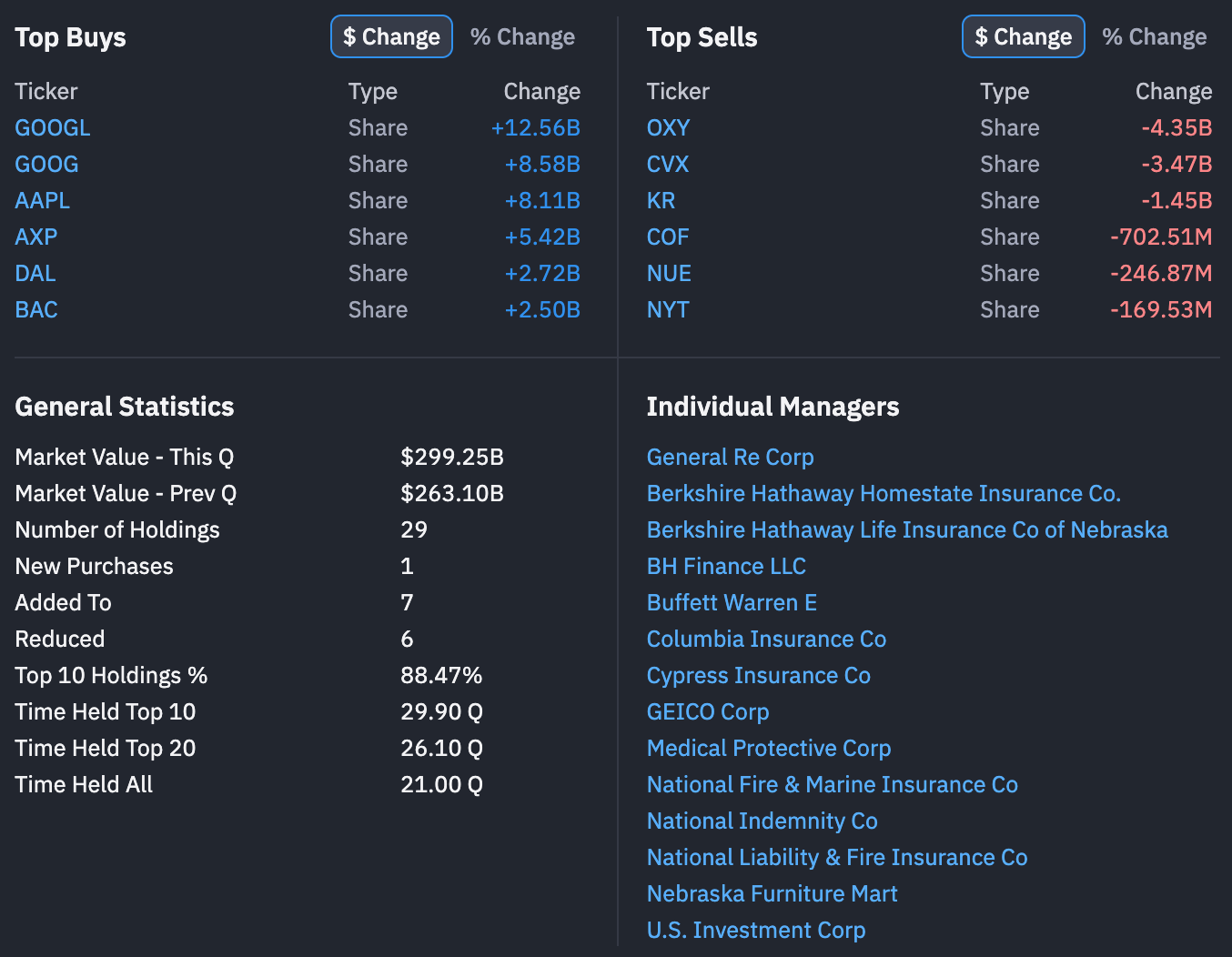
Notably, this is the second 13F report since Buffett stepped down as CEO and Greg Abel officially took the helm. It also marks the first quarter of significant net buying after Berkshire ended its 14 consecutive quarters of net stock selling, with net purchases of nearly $20 billion in the quarter.
Core Holdings
Berkshire's holdings remain highly concentrated, with the top ten positions accounting for approximately 88.47% of the portfolio:
- Apple (AAPL): Approximately $65.95 billion, firmly holding the top spot at 22.0% of the portfolio;
- American Express (AXP): Approximately $51.28 billion, accounting for 17.1%;
- Alphabet (Google, GOOGL + GOOG): Approximately $37.76 billion, including roughly $28.16 billion in GOOGL (Class A common stock, with voting rights) and $9.61 billion in GOOG (Class C common stock, without voting rights), rising into the top three positions;
- Coca-Cola (KO): Approximately $32.51 billion, accounting for 10.9%;
- Bank of America (BAC): Approximately $27.54 billion, accounting for 9.2%;
- Chevron (CVX), Occidental Petroleum (OXY), Chubb (CB), Moody's (MCO), and Kraft Heinz (KHC) rank sixth through tenth, respectively.
Structurally, Berkshire has still not significantly altered its previous portfolio framework centered on consumer, financial, and energy sectors, but the addition of Google has clearly increased the weight of tech stocks in the portfolio.
Quarterly Changes
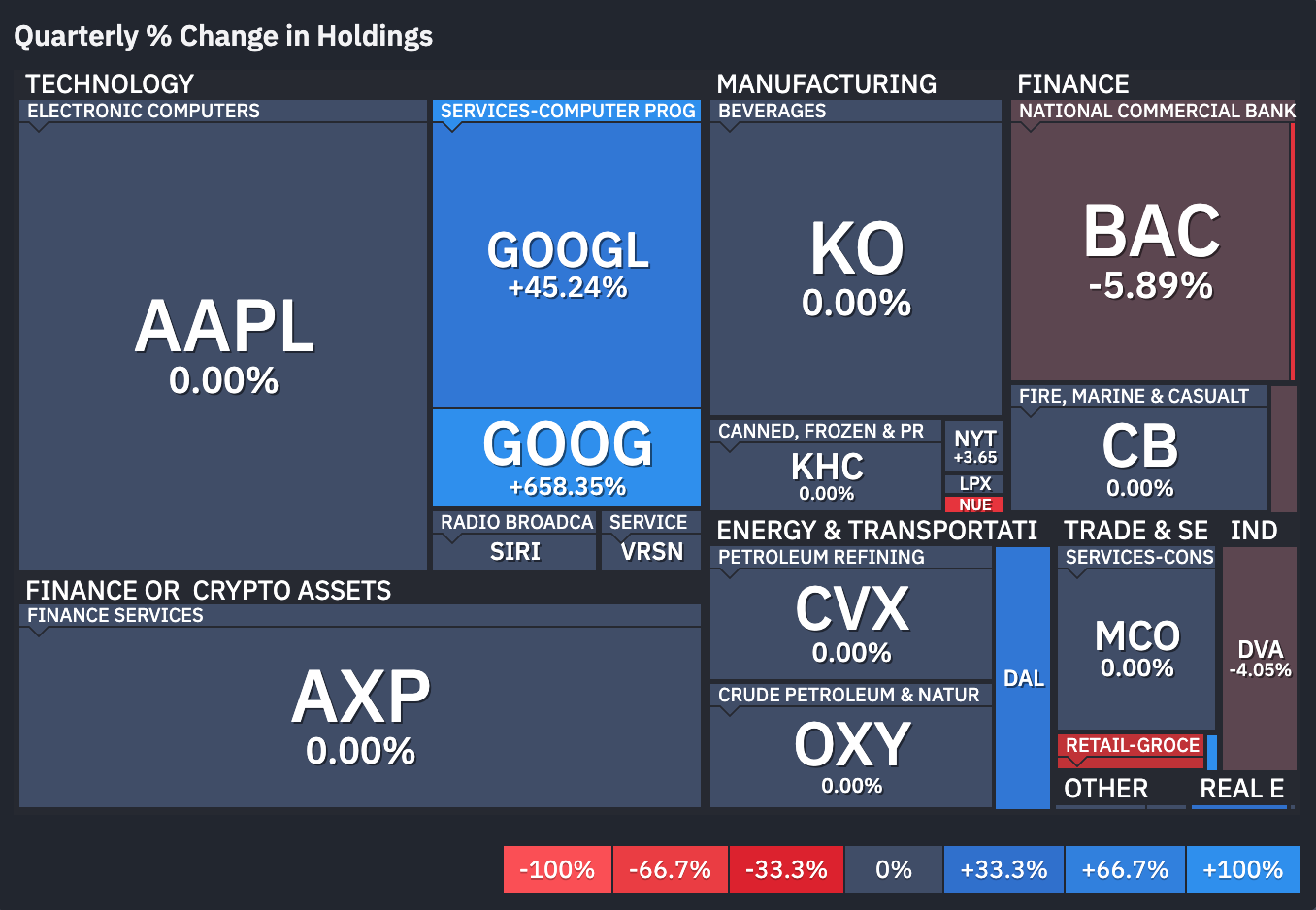
In Q2, Berkshire's most notable move was undoubtedly its major bet on Alphabet — increasing its Class A shares (GOOGL) by approximately 24.54 million shares, a 45.2% increase, while also raising Class C shares (GOOG) by roughly 23.6 million shares, a massive 658.3% surge — combined, the two classes added approximately 48.1 million shares, elevating Google into the fund's top three positions. Beyond Alphabet, Berkshire also notably added to Delta Air Lines (DAL), Lennar (LEN), and Macy's (M).
On the reduction side, cuts were primarily concentrated in financial, consumer, and cyclical sectors. Bank of America (BAC) was reduced by approximately 30.23 million shares, a 5.9% decrease, marking the second consecutive quarter of trimming; Capital One (COF) was cut by about 58%, Kroger (KR) by roughly 22%, with Ally Financial (ALLY), DaVita (DVA), and Nucor (NUE) also seeing declines.
Summary Analysis
Berkshire under the Abel era is undergoing a subtle stylistic shift, with the clearest signal in Q2 being a tilt from traditional financials and consumer goods toward tech growth. The heavy bet on Google not only further breaks the stereotype of Buffett "not touching tech stocks," but also reflects the new management's deep recognition of Google's moat in AI and search — essentially a typical "value confirmation" rather than trend-chasing.
However, Berkshire's core foundation remains unchanged: "ballast" positions like Apple, American Express, and Coca-Cola were held largely steady, and energy holdings Chevron and Occidental Petroleum were not sold off (the decline in their percentage weights was mainly due to dilution from new positions).
Overall, Berkshire's Q2 positioning reveals a logic of "heavily adding tech leaders, structurally trimming financials and consumer stocks, holding energy core positions, and tentatively exploring real estate and aviation." While maintaining extreme concentration, Abel is quietly tilting the portfolio toward a digital future, yet the Buffett hallmarks of "long-term commitment" and "heavy conviction" remain clearly visible.
Duquesne Family Office (Stanley Druckenmiller)
Though less famous than Buffett and Berkshire, Stanley Druckenmiller may be the most closely watched fund manager on Wall Street today.
Who is Druckenmiller? He is a legendary American macro hedge fund manager who served as Chief Investment Officer of Soros's Quantum Fund from 1988 to 2000, becoming Soros's most successful trader... What makes him most critical today is that both current U.S. Treasury Secretary Scott Bessent and Federal Reserve Chair Kevin Warsh are his disciples (having studied under him or maintained long-term partnerships with him).
Therefore, compared to Berkshire's more long-term-oriented 13F, the quarterly report of Duquesne Family Office, a family office, reads more like a macro trading map — especially at a time when AI, interest rates, and the U.S. economic outlook are all undergoing rapid change.
Report Summary
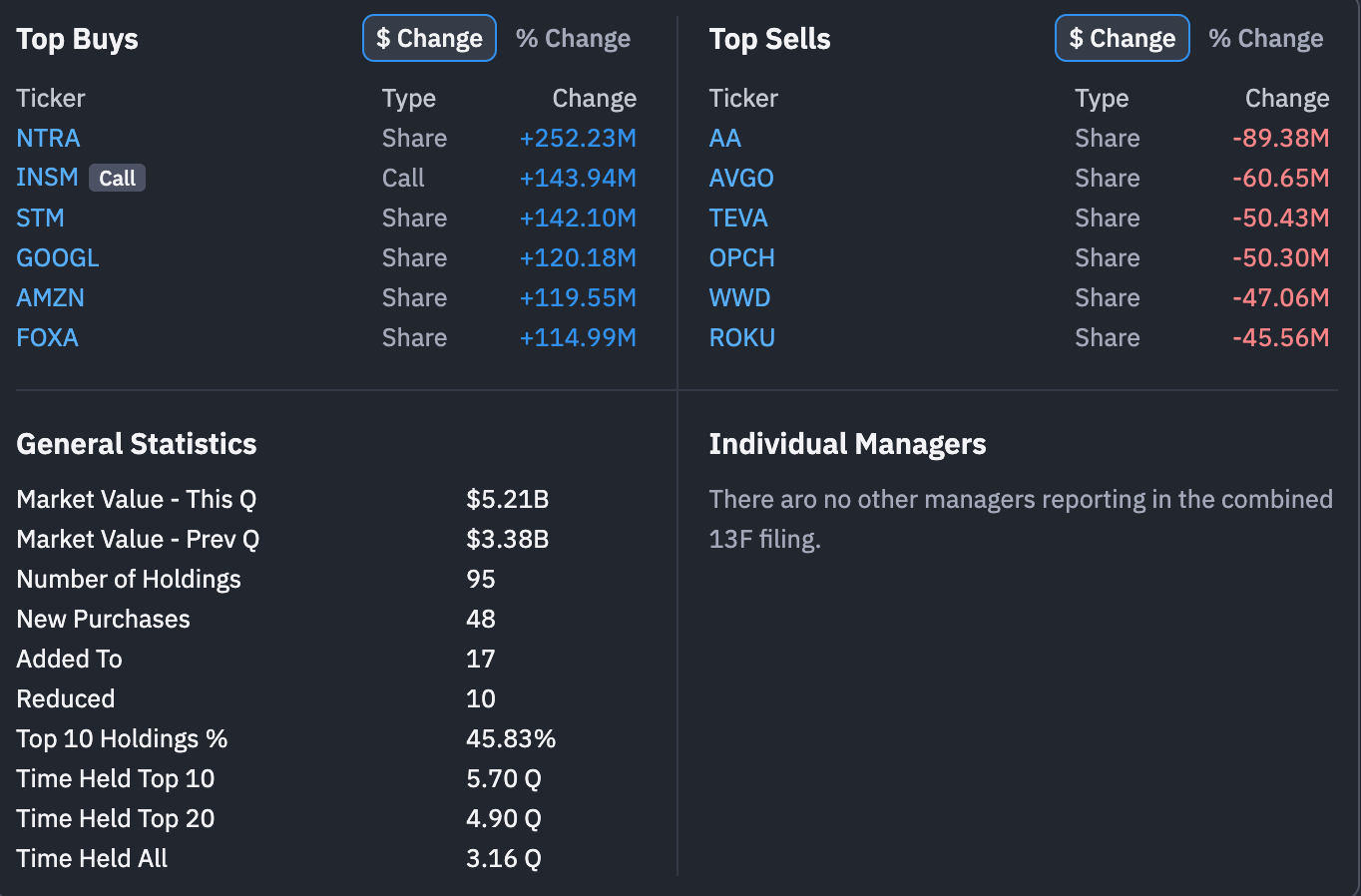
As of June 30, Duquesne Family Office disclosed a total of 95 holdings in its 13F filing, with 48 new positions added, 16 increased, 11 reduced, and 23 liquidated during the quarter, for a nominal portfolio value of approximately $5.21 billion, up noticeably from $3.38 billion in the prior quarter.
Core Holdings
The 13F filing shows that Duquesne Family Office's top ten positions account for approximately 45.8%:
- Genetic testing company Natera (NTRA) remains Duquesne Family Office's largest stock position, with approximately 3.19 million shares held at the end of Q2, valued at about $865 million, representing roughly 16.6% of the portfolio;
- The second and third largest positions have shifted to TSMC (TSM) and STMicroelectronics (STM), accounting for approximately 5.4% and 4.4% of the portfolio, respectively;
- Additionally, biopharmaceutical company Insmed (INSM, held in both common stock and options), Argentine national oil company YPF Sociedad Anónima (REPYY), and Amazon (AMZN) are among the top ten positions.
Quarterly Changes
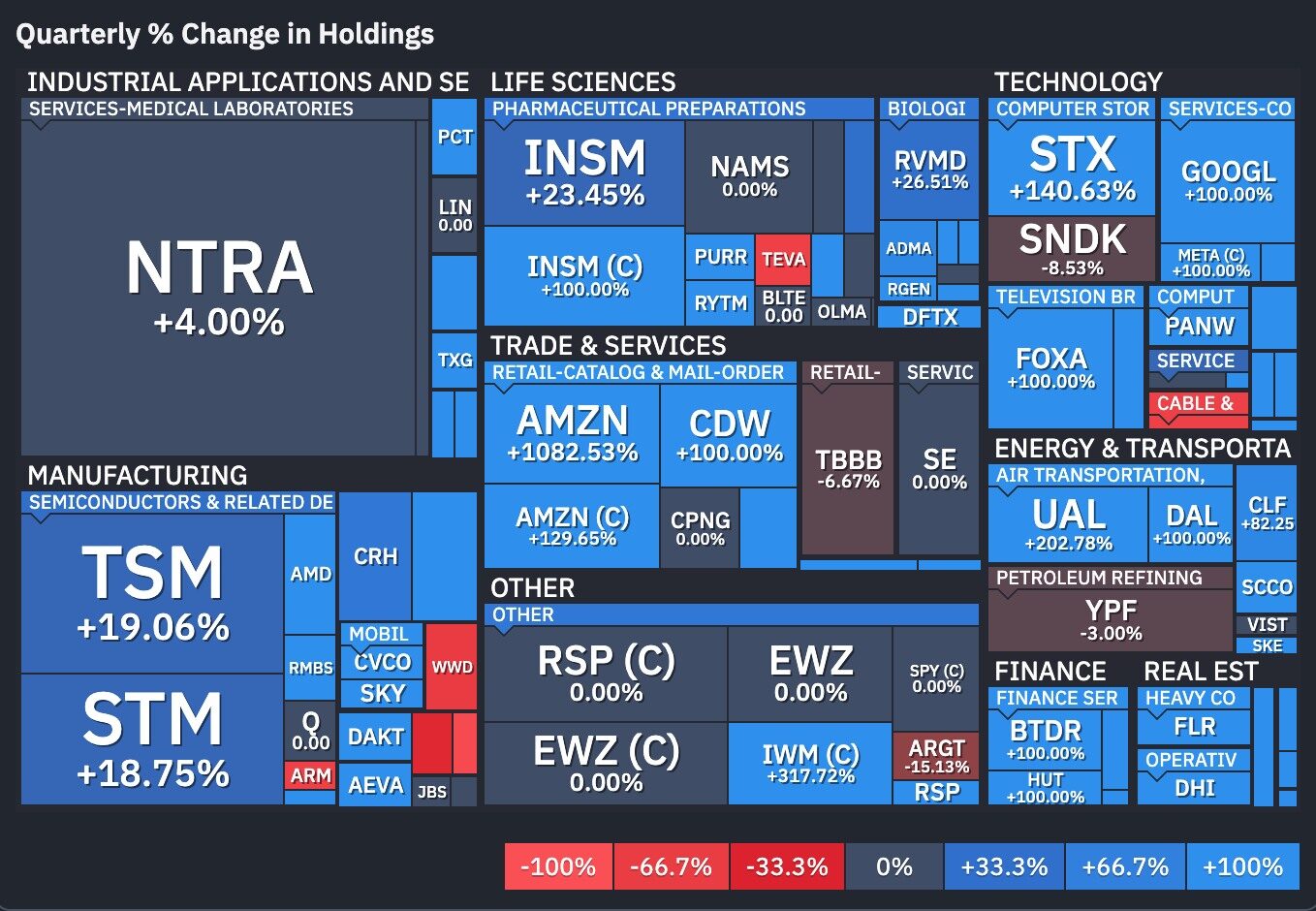
In Q2, the most notable change at Duquesne Family Office was the reshuffling within the AI supply chain.
Duquesne Family Office completely liquidated its positions in Micron (MU), Broadcom (AVGO), and Intel (INTC), with Broadcom having only been established in Q1. But this doesn't mean Druckenmiller has abandoned semiconductors — on the contrary, he continued to increase TSMC (TSM) and STMicroelectronics (STM), and opened a new position in AMD. The fund has also begun extending its reach to the periphery of AI infrastructure, buying Bitcoin miners that have pivoted toward data centers, including Hut 8 (HUT), Bitdeer (BTDR), and Riot Platforms (RIOT).
It appears that Druckenmiller chose to cash in some positions with larger prior gains while rotating capital into targets he believes offer better risk-reward profiles.
Additionally, Duquesne Family Office re-purchased Alphabet (GOOGL) in Q2 — which it had fully sold in Q1 — and significantly increased its Amazon (AMZN) position, which had been reduced in Q1. This move may reflect a bet that the tech giants that have shouldered massive AI capital expenditures will gradually shift from being "payers for AI infrastructure" to "beneficiaries of AI commercialization."
Beyond these AI-related changes, Duquesne Family Office also expressed bullishness on aviation, matching Berkshire, by opening a new position in Delta Air Lines (DAL) and increasing United Airlines (UAL). Notably, Duquesne Family Office also re-established a position in Baidu ADR (BIDU) of approximately 88,000 shares in Q2 — marking its first U.S.-listed Chinese stock holding in two and a half years since liquidating Alibaba at the end of 2023.
Summary Analysis
If this 13F could be condensed into one sentence: Druckenmiller hasn't left AI — he's reselecting the winners for AI's next phase. At least based on end-of-Q2 holdings, Druckenmiller retains a fairly complete AI exposure, merely reallocating from certain crowded hardware segments toward cloud platforms, data centers, and AI applications.
Meanwhile, the reappearance of Baidu is another signal worth watching. While the 88,000-share position is not large, tentatively re-establishing a position after a long period of avoiding Chinese stocks suggests his attention to Chinese tech assets is warming.
To reiterate, given Druckenmiller's relatively high-frequency trading pace, Duquesne Family Office's 13F is even harder to simply "copy," and is better suited for observing allocation direction.
H&H International Investment (Duan Yongping)
Next, let's turn to H&H International Investment, managed by legendary Chinese investor Duan Yongping. From this 13F filing, it's clear that Duan's holdings remain highly concentrated, but Q2 has shown signs of rotation from certain high-valuation tech stocks back toward Chinese internet names.
Report Summary
As of June 30, H&H International Investment disclosed a total of 18 holdings in its 13F filing, with a nominal portfolio value of approximately $19.101 billion (roughly RMB 130 billion), down from approximately $20 billion at the end of Q1.
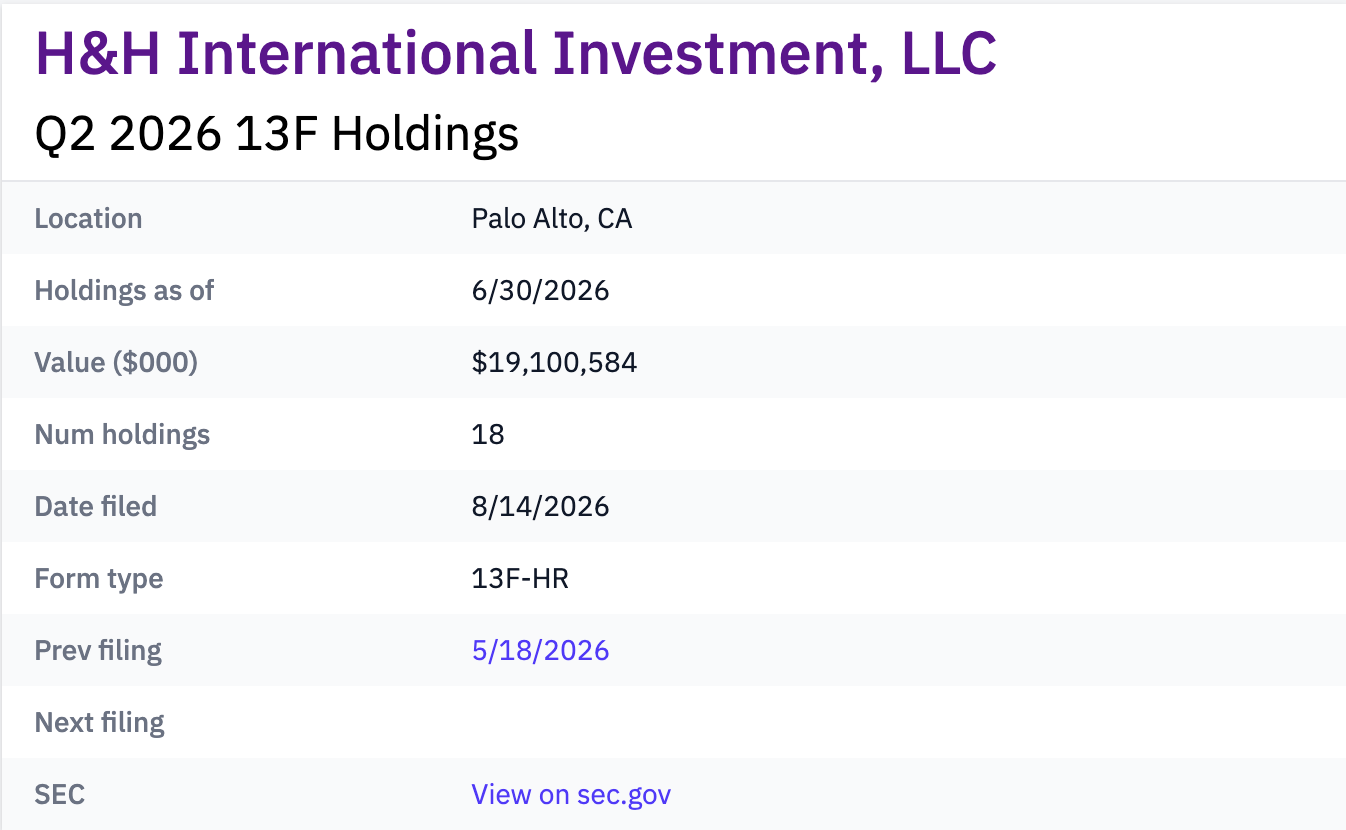
It should be noted that the 13F only discloses long positions in U.S. stocks, so Duan's holdings in Tencent, Pop Mart, Kweichow Moutai, and other assets, as well as his extensive put-selling options operations, are not reflected in this filing.
Core Holdings
H&H International Investment's concentration remains very high, with the top five positions collectively accounting for over 88%.
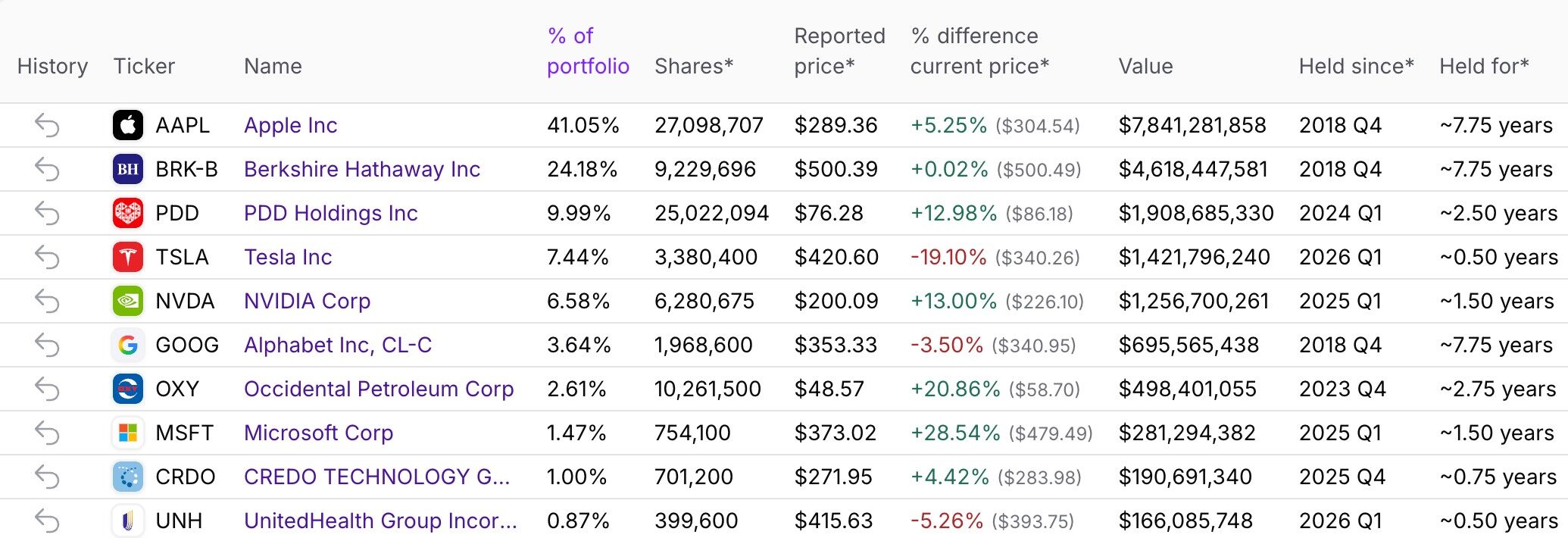
- Apple (AAPL): Approximately $7.841 billion, accounting for 41.05%, firmly maintaining the top position;
- Berkshire (BRK.B): Approximately $4.618 billion, accounting for 24.18%, forming the "ballast" alongside Apple;
- PDD Holdings (PDD): Approximately $1.91 billion, accounting for 9.99%, jumping to the third-largest position, marking a significant increase in Chinese internet weight within Duan's portfolio;
- Tesla (TSLA): Approximately $1.42 billion, accounting for 7.44%;
- NVIDIA (NVDA): Approximately $1.26 billion, accounting for 6.58%.
Quarterly Changes
In Q2, the most important move at H&H International Investment was the significant accumulation of PDD Holdings (PDD) — an increase of 5.2738 million shares, up 26.71%, elevating it to the third-largest position. The fund also modestly increased its Berkshire Hathaway Class B shares (BRK-B), which can be interpreted as long-term recognition of the value investing framework. Additionally, Alibaba (BABA), which Duan had fully liquidated in Q1, was bought back in Q2 with 301,400 shares (approximately $28.93 million).
On the reduction side, AI and tech leaders were the primary profit-taking targets in Q2. NVIDIA (NVDA) was cut by 7.5631 million shares, a reduction of 54.63%; Google (GOOG) was reduced by over 1.7 million shares, down 46.88%; Microsoft was cut by 25.78%; Apple was also reduced by 1.8469 million shares — marking the second consecutive quarter of selling (Q1 saw a reduction of 3.4129 million shares). Additionally, TSMC (TSM) and CrowdStrike (CRWD) were completely liquidated.
It's worth noting that Duan is not simply bearish on the tech stocks he reduced. In late July, he publicly stated he would "add more Google," while also indicating he would continue seeking opportunities to buy NVIDIA at lower prices via put selling. In other words, the reductions reflect more of a judgment on price and margin of safety rather than a wholesale rejection of the companies themselves.
Summary Analysis
If this 13F could be summarized in one sentence — Sell a bit when prices run up, buy a bit when things get cheap, and keep holding the good companies.
Overall, H&H International Investment's Q2 repositioning logic is relatively clear — minor tweaks to ballast positions, increasing Chinese internet exposure, and taking profits on high-flying AI names. Apple and Berkshire remain the core foundation, but after consecutive reductions, Apple's share count has now declined for two straight quarters. Meanwhile, PDD has become the new third-largest position, and Alibaba has returned to the portfolio. Although NVIDIA and Google were reduced, this doesn't represent bearishness — rather, it's locking in paper gains first, with Duan having already expressed his intention to buy back at lower prices.
This means what Duan was doing in Q2 wasn't a full pivot toward some new theme, but rather re-seeking margins of safety amid valuation shifts — taking appropriate profits on AI and tech leaders with large gains, while re-adding Chinese internet names that have undergone prolonged corrections and are familiar territory for him.
Himalaya Capital (Li Lu)
Similar to Duan Yongping, another legendary Chinese investor Li Lu's Himalaya Capital also chose to significantly increase its PDD Holdings (PDD) position in Q2.
Report Summary
As of June 30, 2026, Himalaya Capital disclosed a total of 8 holdings in its 13F filing, with 2 increased and 6 liquidated. The number of positions decreased significantly from 14 in Q1, yet the nominal portfolio value rose from $3.201 billion in Q1 to $3.703 billion, with positions further contracted and concentrated — the top five holdings now account for as much as 94.77%.
Core Holdings
The 13F filing shows that Himalaya Capital's current 8 positions present a structure of "Google as ballast,


