OpenRouter sells itself for $7 billion


- Key takeaway: Stripe acquired AI model routing platform OpenRouter for over $7 billion, with the core strategic intent of extending its payment and financial infrastructure to AI model calls, capturing a critical "transaction layer" position connecting developers and model providers in a multi-model environment.
- Key elements:
- OpenRouter was founded in 2023 and was valued at approximately $1.3 billion in its Series B round this May. Less than three months later, it secured an acquisition price of over $7 billion, representing a more than fivefold increase in valuation, with earlier discussions reportedly reaching as high as $10 billion.
- The platform has expanded rapidly: over 10 million global users, connections to more than 80 providers and over 500 models, processing more than 200 trillion tokens monthly, and serving over 8 million developers as of May this year.
- Business value stems from model supply diversity—developers must weigh capabilities, price, and latency—and OpenRouter provides a unified interface for model routing, failover, usage analytics, and billing.
- The company generates revenue through a 5.5% platform service fee. Stripe has already been providing it with invoicing, tax, payment, and settlement services, and the two operations will be integrated following the acquisition.
- Stripe launched AI streaming payments in April this year, settling based on token consumption. OpenRouter's routing and metering data sits precisely at the front end of this system.
- Industry analysts suggest that if AI agents are to conduct autonomous transactions in the future, model inference, payments, and settlements must be interconnected—Stripe aims to occupy this infrastructure corridor.
- Some observers note that OpenRouter is essentially a "meter between developers and models," and with Stripe's acquisition, the AI gateway could evolve from a tool into part of financial infrastructure.
Author: Su Yang
Editor: Xu Qingyang
Source: Tencent Tech
On August 16, local US time, Stripe acquired OpenRouter for over $7 billion.
OpenRouter is currently the most popular routing platform, connecting developers with different AI model providers. Through a unified interface, developers can access hundreds of models, while the platform handles model routing, failover, usage tracking, billing, and settlement.
The key to Stripe's acquisition of OpenRouter lies in the fact that as the number of AI models grows, enterprises are beginning to use models from multiple providers simultaneously. OpenRouter's position has also expanded from a simple developer tool to encompass model selection, invocation, and payment.
Valuation Soared 5x in 3 Months
OpenRouter was founded in 2023 and has raised over $150 million in total funding. In May of this year, OpenRouter just completed a $113 million Series B funding round at a valuation of approximately $1.3 billion.
Less than three months later, Stripe offered an acquisition price exceeding $7 billion. Based on this price, OpenRouter's valuation has increased more than fivefold compared to its last funding round. The Wall Street Journal previously reported that Stripe and OpenRouter had discussed an acquisition price of around $10 billion.
OpenRouter founder Alex Atallah previously co-founded NFT marketplace OpenSea. In 2017, he co-founded OpenSea with Devin Finzer, serving as CTO until his departure in July 2022. Less than a year later, he founded OpenRouter. Earlier this year, Atallah referred to OpenRouter as "the Stripe of AI."
OpenRouter's user base is also expanding rapidly. In May of this year, OpenRouter stated that its platform had served over 8 million developers and provided access to more than 400 AI models. According to current data disclosed on the company's about page, it now serves over 10 million global users, processes over 200 trillion tokens monthly, and connects more than 80 providers and 500+ models.
More Models, More Important Routing Becomes
OpenRouter's growth is directly tied to the increasing supply of AI models.
While Anthropic and OpenAI's models are still widely regarded as highly capable, Chinese companies are offering cheaper alternatives, and these models are already capable of meeting practical needs for many tasks. Developers therefore need to choose between model capability, price, latency, and availability, rather than always relying on the same provider.
This is precisely the layer of service OpenRouter provides. Developers only need to integrate with a single interface to access different models, without having to separately develop and maintain interfaces for each provider. If a model experiences issues, the platform can switch to other providers; enterprises can also set budgets, data policies, and zero data retention requirements.
In May of this year, OpenRouter stated that its main growth was coming from developers adding agentic capabilities to their software. Agents need to call different models, tools, and data sources when executing different tasks, making model switching more frequent. OpenRouter brings these providers together on one platform, placing model selection and usage costs within a single system.
AI analyst @danizhu also evaluates this deal from this perspective.

He believes that Stripe previously turned fragmented financial infrastructure into programmable services via APIs, and OpenRouter is doing something similar for hundreds of AI models. If the deal closes, Stripe will move closer to becoming the "transaction layer" of the AI economy, because in a multi-model environment, the infrastructure connecting model supply with developer demand may hold strategic value comparable to the models themselves.
This is also why OpenRouter's business continues to grow despite falling open-source model prices.
For developers, if a cheaper model can already get the job done, they can switch to it through the routing system; if a model goes down, they can switch to other providers. The more models there are, the more direct the value of a platform that can compare and orchestrate them becomes.
Stripe's Real Bet
Stripe has already been involved in OpenRouter's payment and billing infrastructure.
Stripe has previously described how OpenRouter uses its products for invoicing, tax calculation, accepting local payment methods, and fraud management, while connecting model costs, usage, and customer billing.
OpenRouter primarily generates revenue through platform service fees. Under its pay-as-you-go model, users pay based on actual model usage, OpenRouter charges a 5.5% platform fee, and passes through model providers' inference costs to customers. It tracks the model used, token usage, and corresponding costs for each request, while Stripe provides payment, billing, and settlement services.
Following the acquisition, these two businesses will operate under one roof.
At Stripe's conference in April of this year, the company already launched streaming payments for AI products, combining usage tracking with frequent settlement based on token consumption. The model routing and token usage data that OpenRouter controls sits precisely at the front end of this system.
External observer @Zevryn0 explains that OpenRouter is not developing the next frontier model, but rather providing infrastructure for access, comparison, routing, and cross-provider payment settlement between developers and models. Stripe already has payment and financial infrastructure, and acquiring OpenRouter allows it to further move into the AI inference layer.

He also believes that the bigger change lies in the fact that if AI agents will be able to autonomously execute tasks and conduct transactions in the future, then model inference, payments, and transactions need to be connected — and Stripe aims to occupy one of those infrastructure channels.
South Korean user @cozybearlog focuses on OpenRouter's metering capabilities.
He notes that just 82 days after OpenRouter raised funds at a valuation of approximately $1.3 billion, it received an acquisition offer of over $7 billion. What's truly noteworthy isn't how many times the valuation multiplied, but that Stripe is acquiring "the meter between developers and models."
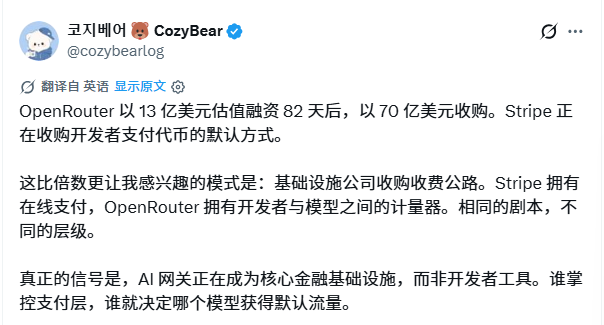
In his assessment, Stripe already owns online payments, while OpenRouter controls the metering and routing of AI developers' model calls. When combined, the AI gateway could evolve from a developer tool into part of the broader financial infrastructure.
These assessments all point to the same business shift: as model providers continue to multiply, enterprises need more than just the models themselves — they need a unified entry point to select models, switch providers, track token usage, and complete payments.
Based on currently disclosed information, the core of Stripe's acquisition of OpenRouter is not obtaining a new large language model, but rather extending its existing payment and financial infrastructure further into the AI model invocation layer. OpenRouter becomes the intermediary layer connecting developers, model providers, and AI spending.