The Era of Duopoly: Are the First Wave of Prediction Market Projects Heading for a Wave of Shutdowns?


- Core Takeaway: The prediction market is rapidly entering a stage of oligopoly. The closures of Trepa and Fireplace are not isolated incidents, but rather the inevitable result of mechanism and tool innovation struggling to survive independently in a landscape dominated by giants. The living space for small and mid-sized projects has been severely squeezed.
- Key Elements:
- Trepa, which focused on a "precision prediction" prize pool mechanism, launched on Solana in December 2025. Due to high cognitive burden on users, conflicts between concurrent demand and growth paths, and a real active user base of only a few hundred thousand, it announced its closure on August 10, with access ceasing on September 30.
- Fireplace positioned itself as a professional trading terminal on Polymarket, offering charting and execution tools. However, its 1% fee was unfriendly to large capital, and the liquidity moat could not be replaced by interface differentiation. It shut down just six months after launch.
- Market concentration is extremely high: As of June 21, Kalshi and Polymarket lead significantly in trading volume, with Kalshi's growth rate already surpassing Polymarket's. Together, they account for over 80% of total volume.
- The valuation gap is enormous: Kalshi's latest funding round is valued at approximately $40 billion (under negotiation), while Polymarket plans to raise $1 billion at a valuation exceeding $20 billion. Capital is rapidly concentrating among the leaders.
- Kalshi, regulated by the CFTC, focuses on sports contracts and has smooth institutional and retail distribution channels. Polymarket is more crypto-native, with a higher share of political and crypto market contracts, but is subject to compliance restrictions. Their differentiated competition further compresses the long-tail space.
- The Trepa team acknowledged that the "pay for precision" thesis holds value, but they failed to find a path to commercialization. Fireplace, meanwhile, exited after open-sourcing its technical achievements, reflecting the extremely short survival cycle for innovators in a winner-take-all landscape dominated by giants.
Original author: Ma He, Foresight News
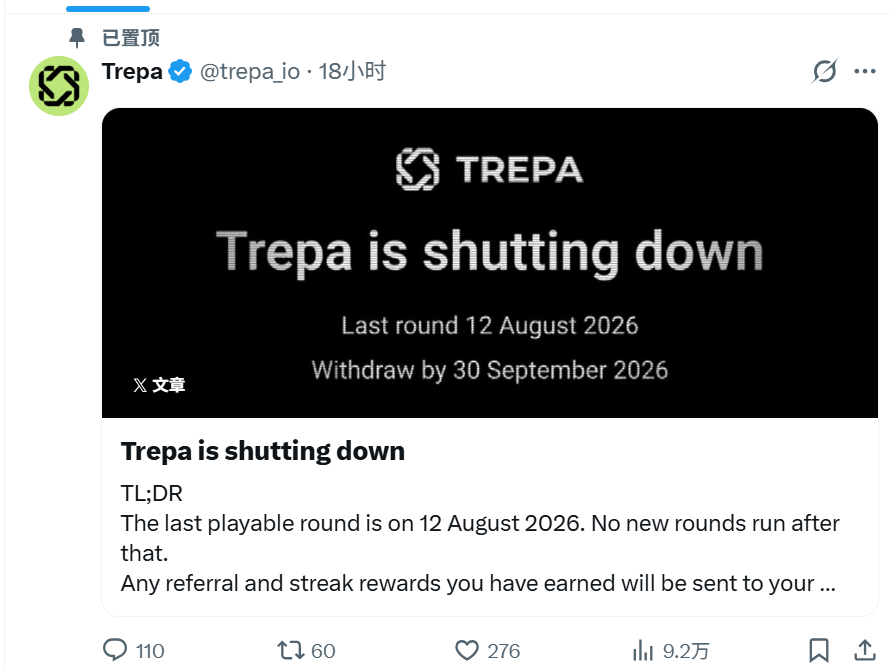
On August 10, two prediction market-related projects with completely different positioning announced their closures almost simultaneously. One is Trepa, a Solana application that attempted to reconstruct prediction logic through "precision," and the other is Fireplace, a professional trading terminal built on Polymarket. Trepa's final round of playable predictions will end on August 12, 2026, after which no new rounds will be opened. The application will remain online until September 30 to facilitate user withdrawals, after which it will become inaccessible. Fireplace, meanwhile, will halt trading on August 15, followed by a full website shutdown on September 30 at 23:59 (UTC).
Their exits may not be an isolated coincidence, but rather the inevitable outcome of a prediction market landscape that has become highly concentrated.
Trepa: From a Precision Experiment to a Full Shutdown
On December 8, 2025, Trepa officially launched on the Solana mainnet, with a clearly defined core positioning — not betting on direction, but on precision. Instead of choosing Yes/No or up/down, users directly guess a specific value (BTC price, macroeconomic data, sports statistics, etc.). The system uses a precision-weighted prize pool distribution mechanism, where the smaller the margin of error, the higher the share of the prize pool. The team called it "precision predictions," attempting to carve out a third path beyond binary prediction markets.
Trepa traces its origins to the Bybit × DMCC hackathon in November 2024, initially as a Telegram mini-app on TON designed to predict opinion poll results. It then competed in multiple hackathons, including Sonic SVM, Superteam Korea, Colosseum Breakout, and spent time at Balaji Srinivasan's Network School. In August 2025, Trepa completed a $420,000 Pre-Seed round led by Colosseum, with participation from Ignite Capital, The Balaji Fund, and Balaji himself.
Co-founders Jong-Chan Chung (CEO) and Leon Meka (CTO) wrote candidly in the official shutdown statement: they bet on the premise that "people would pay for precision, rather than just paying to be directionally correct." They chose the prize pool structure, fully aware of the trade-offs — no ability to know odds in advance and no way to exit positions once entered — but believed it was the only way to fairly reward numerical accuracy while remaining intuitive enough for ordinary users.
Reality, however, told a different story. The official article highlighted several key points of failure:
The demand analogy did not hold. The fact that people bet heavily in binary markets does not mean they are equally willing to bet in a competition to "be more accurate than others." The cognitive burden was higher — requiring precision to the decimal point actually reduced the fun factor. Trepa concluded: in consumer-grade prediction, simplicity itself may be the entire product.
Next was the concurrency trap. A prize pool requires enough people participating in the same time window; otherwise, the pool is too thin and the experience is terrible. Trepa ultimately compressed active time to just one hour per day (between 1–2 PM UTC), forcing users to structure their schedules around this window, creating enormous retention pressure. The growth path conflicted with the mechanism itself. To expand users, the team would need to add more assets and time windows, but this would directly dilute concurrency and degrade the mechanism. By the time the team recognized the contradiction, it was already too late.
User scale was also overestimated. The referral mechanism was almost useless, and paid KOL promotions yielded nearly zero results. Geographic restrictions, entry barriers, and the fact that truly active crypto users were far fewer than public data suggested — the team concluded that the real active audience suitable for this type of product currently numbers in the hundreds of thousands, not millions.
In its final message, Trepa stated that it still believes "people are willing to pay to be precisely measured" is a valuable proposition. It's just that they were not the team that could turn that proposition into a business.
Fireplace: A Brief Attempt at a Professional Terminal
Fireplace did not operate a prediction market itself; rather, it built an upper-layer trading terminal primarily on top of Polymarket, offering more professional charting, position management, wallet and whale tracking, market discovery, and execution tools. Its positioning was "the Bloomberg Terminal of prediction markets."
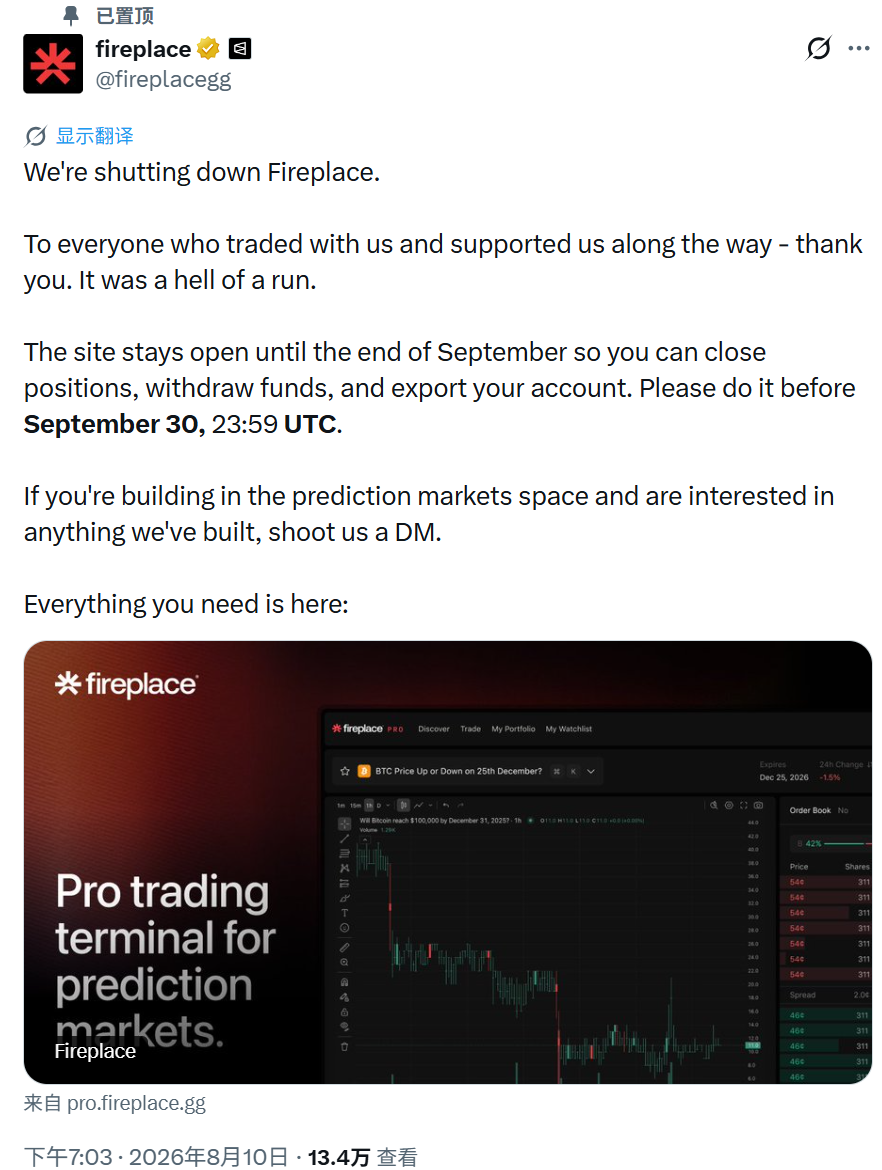
Fireplace launched on January 27, 2026, and completed a $1.5 million Pre-Seed round in February, led by Frachtis with participation from White Star Capital and others. Founders Sumer Malhotra (CEO) and Akshay Rajagopal (CTO) had publicly stated that what prediction markets lacked was professional-grade infrastructure and an execution layer.
Yet within just six months, they announced a shutdown. Unlike Trepa, the official announcement did not include a lengthy retrospective — the tone was concise and direct. But a recurring point in market feedback was fees: some users directly pointed out that a transaction fee around 1% was unfriendly to large capital, representing too high a cost premium compared to trading directly on Polymarket. In an environment where traffic and liquidity are nearly monopolized by giants, third-party terminals struggle to form sustainable independent value.
Furthermore, as Polymarket gradually improves its own user experience, the differentiation of third-party terminals quickly evaporates. The core moat of prediction markets is liquidity and trading volume, not interface. Interfaces can be copied; liquidity cannot.
Prediction Markets Enter an Oligopoly Era
Placing the failures of these two projects into a broader context makes the causes clearer.

Prediction market volume is currently highly concentrated. As of the data on June 21, Kalshi and Polymarket's market turnover far outpaces all other competitors. Moreover, Kalshi's growth rate has already surpassed Polymarket's.
The valuation gap is equally pronounced. In May of this year, Kalshi completed a $1 billion funding round led by Coatue Management, pushing its valuation to $22 billion. In late June, the Financial Times, citing sources, reported that Kalshi was in talks for a new funding round at a valuation of approximately $40 billion, potentially closing as early as Q3 this year. Meanwhile, competitor Polymarket was reported to be in early discussions with potential investors. On August 4, Bloomberg, citing sources familiar with the matter, reported that Polymarket plans to raise approximately $1 billion at a valuation exceeding $20 billion.
The differences between the two determine the survival space for smaller projects. Kalshi is a US-based platform regulated by the CFTC, focused on sports and event contracts, with smoother institutional capital, compliance channels, and retail distribution (including partnerships with brokers). Sports contracts contribute the majority of its trading volume. Polymarket is more crypto-native and globally oriented, with a higher share of political, geopolitical, and crypto-related markets. Its liquidity depth and brand recognition are stronger within the crypto community, but it is more constrained by compliance and geographic restrictions.
Under this landscape, mechanism innovation (Trepa's precision prize pool) and tool-layer innovation (Fireplace's professional terminal) both struggle to find independent growth flywheels. The former requires a sufficiently large concurrent user pool to make the prize pool meaningful; the latter needs enough trading flow to cover operational and customer acquisition costs. When over 80% of trading volume is captured by two giants, the remaining long-tail space is no longer sufficient to sustain a viable business model for startup teams.
The Trepa team wrote a very measured sentence in their statement: they still believe "people are willing to pay to be precisely measured" is a valuable proposition in itself — they just hadn't found the path to turn it into a business. Fireplace, meanwhile, chose to open up its technical achievements to future builders and exited quietly after leaving a migration window.
The first wave of projects attempting to enter prediction markets with new mechanisms or new interfaces has begun to fall. This does not mean prediction markets themselves have peaked — on the contrary, Kalshi and Polymarket's volumes remain at elevated levels.
The real signal is this: the sector is rapidly transitioning from a period of diverse experimentation to a "winner-takes-most" phase. For those who come later, the options are either to create differentiation that is genuinely difficult to replicate, or to build complementary products directly on top of the giants' shoulders. Otherwise, the window of opportunity may already be shorter than imagined.