Arthur Hayes New Essay: Betting on Yen Appreciation, ENA Could Rise 5 to 10 Times in the Coming Months


- Core Thesis: Arthur Hayes predicts that the yen will appreciate significantly against the dollar, with the most likely path being Japan's Ministry of Finance utilizing the FIMA repo facility to pledge U.S. Treasuries to the Federal Reserve in exchange for dollars, then selling those dollars to buy yen. This move would trigger large-scale money printing by the Fed, leading to a surge in dollar liquidity, which would push up the prices of assets like Bitcoin and physical gold, while he also holds a bullish outlook on Ethereum and Ethena (ENA).
- Key Elements:
- Comparison of Approaches: Both a Bank of Japan rate hike and the sale of overseas assets by "Japan Inc." are difficult to execute due to unbearable political and economic consequences; the preferred approach is to leverage the FIMA mechanism, which supports the yen while avoiding the shock to U.S. markets from Japan Inc. dumping U.S. Treasuries.
- Current State of the FIMA Mechanism: The current outstanding loan cap per counterparty is $60 billion; this cap needs to be removed and the pool of eligible counterparties expanded (to include institutions like GPIF) before effective intervention can be implemented.
- Historical Precedent: In July 2024, the Bank of Japan's surprise rate hike caused the yen to surge sharply from 160 to 140, triggering declines of over 10% in the Nasdaq and Nikkei indices, highlighting the risk of global market impact from the unwind of yen carry trades.
- Capital Scale: The Japanese government and GPIF collectively hold approximately $1.373 trillion in U.S. Treasuries. If these are included as FIMA collateral, the scale of money printing would be comparable to the roughly $4 trillion liquidity injection during the COVID-19 pandemic, which is highly correlated with Bitcoin price increases.
- Execution Level: The Fed's Foreign Exchange Subcommittee is composed of Waller (Chair), Williams (Vice Chair), and Jefferson. Decisions do not require Congressional approval. Trump and Bessent have already explicitly supported the reform, and Waller lacks independence, making execution highly likely.
- Market Signals: The recent rebound in gold suggests capital is flowing into monetary financial assets rather than AI capital expenditure; ENA's supply has dropped by 75% due to shrinking liquidity, with its price down over 90%. However, growth in dollar liquidity can drive a recovery in Bitcoin basis yields, and improved USDe yields will attract capital inflows, potentially enabling a gain of more than 5 times.
Source: Arthur Hayes
Compiled by Odaily's Golem (@web3_golem)

Editor's Note: In his latest article "Yen-quake," Arthur Hayes argues that the yen is poised to appreciate against the dollar. The most likely path, he suggests, is for the Japanese government to utilize the FIMA mechanism—pledging its Treasury holdings as collateral to the Federal Reserve for repo financing, borrowing dollars, and then using those dollars to buy yen. Hayes also states this will trigger a surge in dollar liquidity, boosting assets like Bitcoin and physical gold. He believes that besides Bitcoin and Ethereum being undervalued, ENA could also rally 5-10x in the coming months.
Arthur Hayes reveals he hasn't fully deployed his "ammunition" yet. What must be awaited now is Waller convening the subcommittee and amending FIMA rules to pave the way for Japan to use the FIMA mechanism to drive yen appreciation. Odaily has compiled the core content of the full article below—enjoy~
————————
Over the past decade, the yen has weakened, becoming extremely feeble, propelling global asset markets ever higher. But like all good things that favor holders of rich financial assets, this situation will eventually end. The yen is the most undervalued currency globally and a point of contention between the US, China, and the average Japanese voter. There are three paths to untangle the yen conundrum, but the US Treasury and Japanese politicians favor only one.
I will explain the mechanics of each method to strengthen the yen and conclude why the last is the preferred option. Then, I will discuss how to implement this third option politically. Finally, I will elaborate on why Bitcoin and cryptocurrencies will surge as dollar liquidity explodes (I know this is also why you read my "human nonsense").
The three options are as follows:
- The Bank of Japan (BOJ) significantly raises interest rates, eliminating the interest rate differential between the dollar and the yen (at least in short-term rates);
- The government lobbies domestic institutions and public entities (like Japan's Government Pension Investment Fund, GPIF) to shift investment strategies, selling overseas assets and buying domestic ones;
- [Preferred Option] The Japanese Ministry of Finance (MOF) pledges its US Treasury holdings to the Fed via repurchase (repo) agreements to obtain dollars, then sells those dollars and buys yen in the foreign exchange market.
Before diving into details, you "degens" should ask yourselves: why discuss yen appreciation now? Over the past decades, countless people have claimed the yen was about to strengthen and end the global carry trade. Two weeks ago, monetary policy officials from the US and Japan conducted a joint currency manipulation, euphemistically called "intervention." The same actions, if done by ordinary people, would be called "collusion" and "conspiracy," but when the operators are nations, the terminology changes entirely.
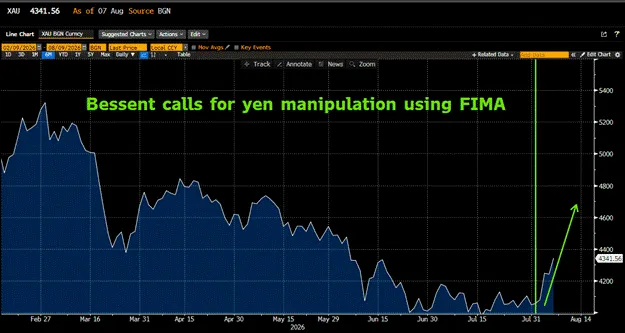
US Treasury Secretary Bessent declared he wants the Fed to raise the counterparty limit for the FIMA repo facility so that Japan's MOF can use its massive asset reserves to defend the yen. The MOF also announced it is joining forces with the US to push the dollar-yen exchange rate lower. The authorities have made it clear they will alter the global monetary landscape, so we must take notice.
Three Ways to Strengthen the Yen
Options one and two simply won't work because the parties involved cannot bear the political and economic consequences of deviating from the policies established since the 2010s.
Option One: BOJ Rate Hikes
Currency trading often hinges on interest rate differentials, and dollar yields are 2.75% higher than the yen. Borrowing yen, converting to dollars, and buying US Treasuries yields a positive carry. Therefore, by no-arbitrage, the dollar-yen rate must rise (yen depreciates) to offset this rate differential. The most direct way to make the yen appreciate against the dollar is for the BOJ to hike rates, aligning with other central banks that raised rates post-COVID.
To understand the BOJ's dilemma in hiking rates, one must remember: due to over a decade of Yield Curve Control (YCC) policy—buying bonds with printed money to cap 10-year JGB yields—the BOJ has become the largest holder of these "junk" Japanese government bonds.
Once rates rise, bond prices fall; the lower bond prices go, the bigger the BOJ's unrealized losses become. Unlike ordinary investors, the BOJ, capable of unlimited money printing, can absorb unlimited yen losses. However, a crisis emerges if massive BOJ money printing causes global loss of confidence in the yen, leading to its rejection for settling trades in oil, food, medicine, etc.
While not there yet, the BOJ must confront this potentially catastrophic prospect. It is precisely the fear of seeing balance sheet losses that makes the BOJ hesitant, only managing minimal rate hikes while watching the market sell off long-dated JGBs. The result: the yen stays weak, and imported energy inflation severely impacts Japanese society.
Politicians don't want the BOJ to hike because they must issue JGBs to finance fiscal deficits. If yields rise, debt servicing costs increase, weakening their ability to "buy off" the public with various subsidies (often consumption tax breaks).
If rapid BOJ hikes strengthen the yen, raising dollar-yen volatility, all investors funding global stock or bond purchases with yen will be forced to unwind.
Remember July 2024? The yen went from 160 to 140 in a few trading days. I wrote two articles analyzing this deeply, but in short, new BOJ Governor Ueda surprisingly hiked rates and promised more. Markets panicked; speculators shorting the yen and long other financial assets rushed to cover. Rumors circulated that PMs at several hedge funds were forced out, just like Kenny G ended AI stock god Leopold.
Back then, the yen hit 140, and both the Nasdaq 100 and Nikkei fell over 10%. The BOJ panicked and, on August 12th, stated it would consider "market conditions" in assessing future hikes, effectively shelving them. The yen weakened, stocks bottomed, and the upward march resumed.
Compared to other central banks, the BOJ moved too fast in its normalization path and cannot withstand the resulting severe market stress.
Option Two: "Japan Inc." Sells Overseas Assets to Repatriate Yen
I define "Japan Inc." as corporations and the public sector holding financial assets.
In Albert J. Alletzhauser's "The House of Nomura: The Inside Story of the Legendary Japanese Financial Dynasty," there's a fascinating anecdote: after the 1987 crash, Japan's Ministry of Finance instructed Nomura Securities to buy US stocks to support the market. As a private firm, Nomura had no obligation to comply, but Japan is a society of conformity and collective action, so Nomura executed the order.
Often, corporations' highest goals aren't shareholder returns but achieving full employment and upholding "national honor" (whatever that means). If the government suggests private firms and individuals sell overseas assets (mainly US stocks and Treasuries), sell dollars for yen, and repatriate funds, "Japan Inc." must comply.
No indicator better signals "Japan repatriation" than the moves of Japan's largest pension fund—GPIF. It's managed by a bureaucratic committee appointed by various government ministries.
In 2014, to align with the massive money printing under "Abenomics," the then-Prime Minister spent years replacing GPIF leadership, pushing a vote to increase the portfolio's allocation to overseas stocks and bonds. This was crucial because GPIF manages a portfolio worth $1-2 trillion. When their strategy shifted in October 2014, it unleashed an unstoppable wave of selling yen for dollars to buy US stocks and bonds.
This created a structural yen seller, reassuring speculators who could fund various financial assets with cheap yen without worrying about yen appreciation upon rollover or repayment.
I mention GPIF because the head of Japan's MOF, Mr. Katayama, recently declared it's time to adjust GPIF's strategy toward domestic securities over foreign ones. However, GPIF's bureaucrats balked, publicly stating they'd prioritize beneficiaries' best interests. Clearly, as Abenomics proponents, they'd never support shifting focus to domestic Japanese securities.
Just as Abe used personnel changes to gain control from 2012-2014, Prime Minister Takaichi must do the same. For us investors, the signal is clear: GPIF's strategy will eventually change, forcing sales of hundreds of billions in foreign securities, and repatriation will boost the yen.
This process takes years, but it's enough to worry Bessent, as it means "Japan Inc.," one of the largest holders of US securities, shifts from buyer to seller. This would devastate the stock and Treasury markets propping up "Lord USA's" profligate empire. Yet, because "Lord USA" underwrites Japan's national security, "Japan Inc." effectively cannot sell its US assets.
None of this is new news. Everyone thinks the yen is cheap, and both Washington and Tokyo want dollar-yen higher. But if dollar-yen fell from 160 to 90 (the PPP fair value), neither side could bear the resulting losses.
And the moment Trump's buddy, the "weasel" Waller (he genuinely looks and acts like a cunning, sly weasel), becomes Fed Chair, Option Three is greenlit.
The 2026 "Treasury-Fed Accord" remains firmly in place; besides directly funding Bessent's bill issuance via reverse repos and policy rates below nominal growth, Waller also has the authority to implement "Option Three," adjusting dollar-yen to the level needed to rebalance the global economy once and for all.
Option Three: Lending to America
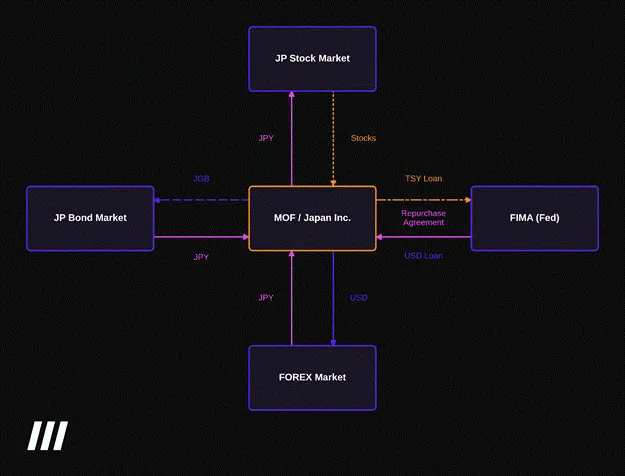
Bessent has made it clear: instead of selling US securities to raise funds for yen support, Japan's MOF and companies should use the FIMA mechanism—pledging Treasury holdings to the Fed for repo funding, borrowing dollars, and using those dollars to buy yen. There's a small flaw in his plan, which I'll address later, but the "boxes and arrows" diagram above depicts this flow. Let's walk through it again:
- Japan's MOF buys Treasuries and obtains dollar loans from the Fed's FIMA facility;
- Japan's MOF sells dollars and buys yen in the global FX market;
- Japan's MOF reinvests these yen domestically, buying JGBs and stocks.
The primary effects of this policy include:
- The Fed supplies dollars via money printing; its balance sheet expands alongside outstanding FIMA repo balances;
- Dollar-yen falls, meaning yen appreciation;
- Japanese bond yields decline as yen buys JGBs;
- Japanese stocks rise as yen buys equities.
Who's the "sucker"?
1. US taxpayers: Japan owes US taxpayers money that, for political reasons, will never be repaid. It's pure money printing, causing inflation in both financial assets and physical goods. The US can't revoke its forward bases in the Asia-Pacific to counter China/Russia just to demand repayment of this loan.
2. Anyone short the yen: They must cover immediately once the trend is clear. Not a huge issue, as dollar-yen volatility will decline, allowing for orderly yen carry trade unwinding over years.
Why hasn't Option Three been implemented yet?
Currently, the FIMA facility has a $60 billion cap on outstanding loans per counterparty. During the recent dollar-yen operation, the US Treasury and Japan's MOF deployed over $100 billion, only pushing the yen up 5%, lasting a few trading days. To use FIMA, this cap must be lifted entirely, and eligible counterparties expanded to include major Japanese corporations and quasi-public investors like GPIF.
Who runs the FIMA facility? During COVID, the FOMC delegated authority over adjusting FIMA's functioning to its Foreign Currency Subcommittee. Voting members include Waller (FOMC Chair), Williams (Vice Chair, NY Fed President), and Jefferson (Vice Chair, Board of Governors). The committee meets as needed, publishes no minutes or vote records—only outcomes.
Will this committee listen to Bessent? Absolutely.
Trump and Waller communicate regularly, and since Bessent has clearly articulated how to rebalance the global economy via dollar-yen, Trump is fully supportive. So Trump and Bessent will convey instructions to Waller. Waller has already proven himself a slippery, blustering "paper tiger." Under Williams' NY Fed stewardship, the Fed's balance sheet continues expanding via the RMP.
Waller claimed he'd listen to markets in setting policy, and markets clearly demand hikes—2-year yields are over 0.5% above the effective fed funds rate—yet he refused to hike in July. Instead of immediate, drastic Fed reform, Waller created five task forces to study how and why the Fed should change. By the time they propose anything, "Godot" will have arrived long ago (Odaily note: a reference to "Waiting for Godot"; Hayes is mocking the task forces' inefficiency).
Thus, in short order, Waller has proven himself just another party-line politician doing his boss's bidding. Just like his predecessor, the spineless, servile "wimp" Powell, and before him, the "garden gnome grandma" Yellen (who turned into a "bad girl" once she became Treasury Secretary).
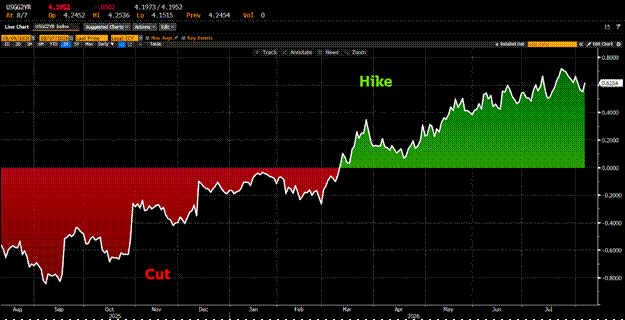
Spread between 2-year Treasury yields and the effective fed funds rate
I don't know when Waller will convene the subcommittee to amend FIMA, allowing unlimited money printing to manipulate dollar-yen lower, but I'm certain it will happen. In fact, I'm betting on it and steadily increasing exposure to assets that reflect another massive Fed balance sheet expansion. These include Bitcoin, physical gold, and gold miner stocks.
Option Three Implementation Will Boost Bitcoin's Price
The more the Fed prints, the higher Bitcoin goes. So, is this FIMA trick enough to be a massive "pump," injecting trillions of dollars to lift our asset prices?
For now, we're focusing only on Treasury holdings, as Treasuries are the only FIMA-eligible collateral. That may change, but let's stick to currently permitted assets. The two largest Treasury holders are the Japanese government and GPIF. The Japanese government holds $1.143 trillion in US Treasuries, GPIF holds $230 billion, totaling $1.373 trillion.
That's substantial. For scale, consider COVID: the Fed printed roughly $4 trillion, visible in its balance sheet expansion from 2020 to end-2021.
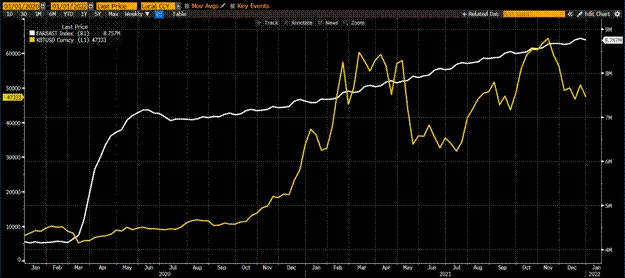
There's a clear correlation between Fed balance sheet growth (white line) and Bitcoin's price surge (gold line). In previous articles, I've speculated that AI construction is entering a capital-waste phase. This is crucial because the Trump administration wants this liquidity to fuel US domestic AI capex, not pump crypto prices.
But I believe extending credit to AI companies unable to achieve positive capital returns—whether hyperscalers wasting billions without real profits or US AI labs failing to profit at "China market token prices"—is inherently wasteful; Bitcoin's rise reflects this unproductive capital usage.
Gold's recent sharp rebound from lows signals that markets prefer routing the impending dollar flood into monetary financial assets rather than giving it to Altman's money-burning OpenAI or Musk's ethereal space data centers.
Altcoin Party Coming, Bullish on ENA for 5x Returns
I know you want to know what we're specifically doing at Maelstrom, but building investment conviction requires understanding the macro backdrop first.
As I said earlier, when Bessent speaks, I listen. If he has any specialty, it's currency manipulation. Just Google his illustrious resume working with Soros. Pulling off this monetary "trick" requires neither elected politicians' approval nor confirmation hearings for term-limited Senate nominees. Just convene that sleepy "Foreign Currency Subcommittee" to change the rules, triggering a dollar-printing gusher.
When I saw the news about Bessent calling for FIMA reform, I had an immediate bullish instinct. Every macro analyst I follow believes this signals a major turning point for dollar-yen. You must position early because they're serious this time.
Money printing is a political decision to address unsustainable economic realities. Politics is messy, but in this case, the Trump administration's intent is clear: get logged into your brokerage account and buy financial assets. That's why Bessent is signaling clearly to anyone who'll listen where the printed money will start spreading. I'm listening, and I'll do my "duty"—buy in.
We already hold significant Bitcoin, so the next question is who else will outperform?
This isn't an AI stock recommendation piece, but if you're into that, feel free to bottom-fish. The "Leopold low" has given you an