赢家通吃:首只比特币现货ETF清盘,中小玩家生存告急


- Key Insight: Hashdex has announced the liquidation of its spot bitcoin ETF (DEFI), marking the first such case in the US market. The root cause lies in its asset scale being too small for management fee revenue to cover high operational costs, compounded by structural disadvantages in customer acquisition as an emerging-market issuer in the US market.
- Key Factors:
- As of July 30, DEFI's asset scale stood at only approximately $14.7 million, holding 225.58 bitcoins; the last trading day is August 17, with cash distributions expected to be paid on August 28.
- The fund's annual management fee revenue is only about $36,700, far below the industry-estimated minimum annual operational cost of $500,000 to $1 million, creating a significant operational shortfall.
- The 13 spot bitcoin ETFs in the US market total approximately $77.7 billion in assets, but the top five products account for around $72.85 billion, with BlackRock's IBIT alone holding over 60% of the market share—a highly concentrated landscape.
- As a Brazil-originated issuer, Hashdex lacks a traditional asset management foundation in the US, making its marginal customer acquisition costs far higher than Wall Street giants like BlackRock and Fidelity, and making it difficult to attract institutional capital.
- Since transitioning to a spot ETF in March 2024, DEFI's asset scale has remained persistently low, peaking at only $17.54 million. Even the bull market failed to improve its position, proving that rising prices alone cannot compensate for customer acquisition shortcomings.
Original author: Nicky, Foresight News
On August 3, asset management firm Hashdex announced it would close and liquidate its Hashdex Bitcoin ETF (NYSE Arca: DEFI), marking the first spot Bitcoin ETF in the U.S. market to officially announce liquidation. As of July 30, the fund held approximately $14.7 million in assets under management, with about 225.58 BTC. Hashdex stated the decision to close was based on a comprehensive assessment of factors including assets under management, trading liquidity, operating costs, and investor interest.
According to the official announcement, the last trading day for DEFI shares is August 17, after which it will stop accepting creation orders from authorized participants and be delisted from NYSE Arca. Shareholders still holding shares as of the last trading day will receive cash liquidation distributions, expected to be paid around August 28.
DEFI originally launched in September 2022 as a Bitcoin futures ETF, making it the first U.S. Bitcoin futures ETF registered solely under the Securities Act of 1933, launched in partnership with Teucrium Trading and Victory Capital. In January 2024, the U.S. Securities and Exchange Commission approved 11 spot Bitcoin ETF applications, including Hashdex's. In March of the same year, DEFI completed its conversion from a futures strategy to a spot strategy, officially renamed as the Hashdex Bitcoin ETF with a fee of 0.25%. Since inception, the fund has delivered cumulative returns of approximately 166%, but its assets under management have remained persistently low, peaking at only about $17.54 million before declining again.

Marcelo Sampaio, Hashdex CEO (Source: NYSE)
Hashdex is a global asset management firm focused on crypto asset index investing, founded in 2018 in Rio de Janeiro, Brazil, by Marcelo Sampaio and Bruno Caratori, among others. In 2020, it partnered with Nasdaq to develop the Nasdaq CME Crypto Index, launched products like HASH11 in Brazil in 2021, and subsequently expanded into European and U.S. markets. In February 2025, Hashdex launched a multi-asset crypto ETF, NCIQ, in the U.S., which currently tracks seven crypto assets. As of July 28, 2026, Hashdex's global crypto index product assets under management exceeded $888 million, spanning eight countries.
While closing DEFI, Hashdex continues to advance other product innovations. On July 24, the company filed with the SEC, announcing that its NCIQ had been approved to engage in staking activities for the crypto assets held by the fund, with Coinbase Cloud as the initial staking service provider. Under the distribution plan, staking net income equivalent to up to 25 basis points of the net asset value of common shares on an annualized basis accrues to the sponsor, with any excess distributed 40% to the sponsor and 60% to holders.
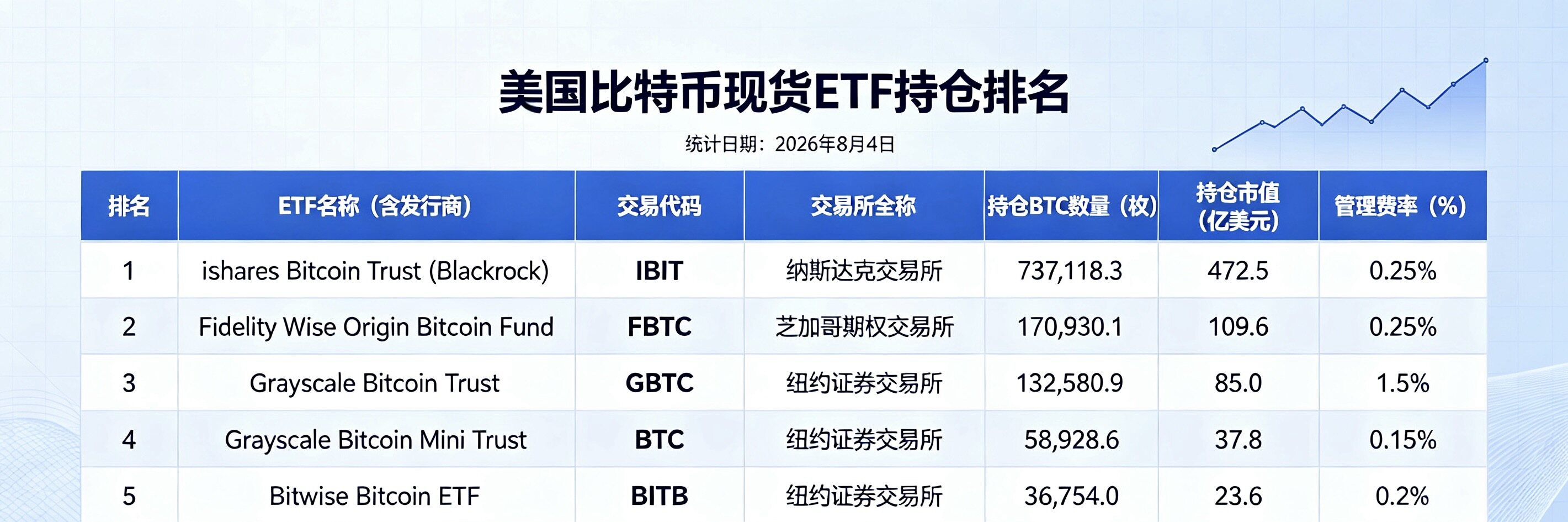
According to BitBo data, as of August 4, there are 13 spot Bitcoin ETFs in the U.S. market, collectively holding approximately 1.212 million BTC, accounting for roughly 5.773% of the total Bitcoin supply, with total assets of about $77.7 billion. However, capital distribution is highly uneven, with the top five products holding approximately $72.85 billion, capturing nearly the entire market share.
BlackRock's iShares Bitcoin Trust (IBIT) holds approximately 737,000 BTC, valued at around $47.25 billion, accounting for over 60% of the total market size, with a fee of 0.25%. Fidelity's Wise Origin Bitcoin Fund (FBTC) holds about 171,000 BTC, valued at roughly $10.96 billion, with a matching fee of 0.25%. Grayscale Bitcoin Trust (GBTC) holds approximately 133,000 BTC, valued at about $8.5 billion, and despite a high fee of 1.5% and prolonged net outflows, maintains its third-largest position through first-mover advantages and existing holdings. Grayscale's mini trust, BTC, holds roughly 59,000 BTC, valued at about $3.78 billion, with a fee of just 0.15%, absorbing significant capital transferred from GBTC.
Bitwise's BITB (0.2%), ARK 21Shares' ARKB (0.21%), and VanEck's HODL (0.25%) range between $1 billion and $2.4 billion, forming the mid-tier cohort. Morgan Stanley's MSBT holds about 6,231 BTC, valued at roughly $399 million, marking the first Bitcoin ETP directly held by a Wall Street investment bank. Valkyrie's BRRR, Franklin's EZBC, and Invesco's BTCO range between $340 million and $380 million. WisdomTree's BTCW stands at approximately $143 million. Meanwhile, Hashdex's DEFI holds only about 225.6 BTC, valued at roughly $14.46 million, ranking last.
The Management Fee Ledger: Annual Revenue Struggles to Cover Operating Costs
ETF issuers' core revenue comes from management fees, accrued daily as a percentage of the fund's assets under management. Taking DEFI as an example, with a 0.25% fee and $14.7 million in assets, annual management fee revenue is only about $36,700. Even at its peak size of $17.54 million, annual revenue fell short of $44,000. The fixed operating costs of a spot Bitcoin ETF include custody fees (Bitcoin custody requires qualified custodians like Coinbase, typically charging a few basis points of assets plus fixed fees), legal compliance and auditing (SEC periodic reporting, anti-money laundering reviews, annual audits, etc., costing hundreds of thousands of dollars annually), market making and liquidity management (smaller ETFs must pay higher incentives to maintain reasonable spreads), exchange listing fees, and D&O insurance and administrative management. Industry estimates place the minimum annual operating cost of an ETF at $500,000 to over $1 million.
Even Valkyrie BRRR and Franklin EZBC, with assets exceeding $300 million, generate around $9 million in annual management fee revenue at comparable fee rates, leaving profit margins after operating costs. WisdomTree BTCW, below $150 million, generates about $357,000 in annual management fee revenue, already hovering near breakeven. DEFI's annual revenue is merely one-tenth of that, with a clear operating deficit, and as shares continue to shrink with no new capital inflows, the issuer's continued subsidization of operating costs is not commercially sustainable, making liquidation the rational choice.
Hashdex DEFI's exit is not merely a matter of scale figures; the deeper issue lies in the issuer's structural disadvantage in the U.S. market in terms of provenance and client acquisition capabilities. Hashdex originated in Rio de Janeiro, Brazil, building strong brand recognition in Latin American and European markets, with HASH11 once becoming Brazil's largest crypto index ETF. However, the U.S. ETF market is dominated by Wall Street giants, and institutional investors heavily weigh brand trust, capital strength, and trading depth when selecting products. When established institutions like BlackRock, Fidelity, and Morgan Stanley simultaneously launch similar products, fund managers tend to prefer these long-standing partners over issuers from emerging markets lacking traditional asset management roots in the U.S.
This gap is even more pronounced in client acquisition costs. Top issuers possess vast existing client bases—BlackRock and Fidelity cross-sell to existing clients through proprietary platforms and channels such as pension funds, endowments, and family offices, with marginal acquisition costs near zero. Grayscale has accumulated years of crypto-native investors. In contrast, Hashdex must build its brand from scratch in the U.S., with every step—attending industry conferences, maintaining data terminal presence, sustaining market-making relationships—entailing substantial investment. At the same 0.25% fee level, a tenfold revenue gap prevents Hashdex from allocating comparable resources to marketing and investor education.
If Bitcoin prices continue to rise, DEFI's assets under management could improve through market appreciation and new inflows, but its structural predicament may not fundamentally reverse. Assuming Bitcoin appreciation drives assets back to $50 million, annual management fee revenue would rise to $125,000, yet the operating gap persists. The true breakeven point requires surpassing $200 million in assets, demanding a confluence of net investor inflows and price appreciation. In a highly concentrated competitive landscape, new capital continuously gravitates toward the top—BlackRock's IBIT has absorbed tens of billions of dollars since launch—and smaller ETFs often capture only limited spillover even in bull markets. DEFI's peak of just $17.54 million during Bitcoin's 2025 highs is a testament that bull market tailwinds are insufficient to offset client acquisition shortcomings.
Beyond Hashdex: Which Small ETFs Are at Risk?
As of August 4, WisdomTree BTCW ($143 million), Invesco BTCO ($348 million), Franklin EZBC ($370 million), and Valkyrie BRRR ($377 million) are the four smallest funds. Among these, BTCW sits closest to the safety margin, generating approximately $357,000 in annual management fee revenue at a 0.25% fee rate; if assets continue to shrink, it could enter loss territory, though WisdomTree, as a veteran ETF issuer, may continue operations for strategic reasons to maintain product line completeness. Invesco, Franklin, and Valkyrie, with assets around $350 million, generate roughly $870,000 in annual management fee revenue, facing minimal short-term survival pressure.
Prior to DEFI, there have been precedents for Bitcoin-related ETF closures in the U.S. market, but all involved futures or other types. In January 2024, VanEck closed its Bitcoin futures ETF, XBTF, with approximately $50 million in assets at closure, citing a decision to concentrate resources following spot ETF approvals. Earlier, in October 2022, Valkyrie's VBB was liquidated due to assets of only about $570,000.