






The Ethereum community is in an uproar! Whose interests does EIP-8363 threaten?


- Core Viewpoint: Ethereum researchers have proposed EIP-8363, which aims to reduce validator staking yields through a gradual burning mechanism, curbing risks of over-staking and validator centralization. However, the proposal has sparked fierce community debate because it could weaken institutional return expectations and potentially exacerbate centralization.
- Key Elements:
- The proposal sets a threshold at 50% of the total supply (approximately 60.25 million ETH). Beyond this ratio, all consensus layer issuance rewards would be burned, driving validators' nominal returns close to zero.
- At the current staking rate of around 33%, if the new curve were fully implemented, the consensus layer annual yield would drop from approximately 2.6% to about 1.2%, with an 18-month transition period designed to mitigate the impact.
- Supporters argue this would reduce dilution pressure on holders of non-staked ETH, prevent LSTs and large custodians from dominating the validator ecosystem, and enhance the neutral asset properties of native ETH.
- Opponents (such as the founder of Aave and co-founders of Obol) warn that zero yields would undermine institutional cash flow predictability and could crowd out high-cost independent operators, potentially strengthening large institutions' control over validation rights instead.
- Solo stakers bear the brunt: fixed costs remain unchanged while net returns decline, the time required to recoup downtime losses would extend to approximately 3.8 times, and tax treatment of the burned portion remains uncertain.
- As the gap between LST yields and native ETH narrows, positive carry strategies on Aave, Morpho, and other platforms that rely on loop staking would face contraction pressure, subsequently impacting the DeFi base rate system.
- The proposal is still in its early draft stage and has not been included in the formal agenda for the Hegotá upgrade. Core developers plan to discuss its priority at the 184th ACDC meeting scheduled for August 6, 2025.
Original author: KarenZ, Foresight News
Intuitively, the more ETH that is staked, the higher the economic cost of attacking the network.
But an expanding staking scale does not necessarily bring a proportional increase in security. If new stakes primarily flow to a few large service providers, the validator ecosystem could actually become more centralized.
On August 4, EthCC founder Jérôme de Tychey, Ethereum Foundation researcher Justin Drake, and four other researchers jointly submitted a proposal for "Tapered Issuance Burn," aiming to install a "yield downhill slope" for the ever-growing staking rate. When the staked amount approaches 50% of the total ETH supply, the consensus-layer issuance rewards received by validators would be fully offset.
Initially published under the number EIP-8361, the proposal was later changed to EIP-8363 after that number was found to be already assigned to another proposal. Although it is still in its early draft stage, it has quickly become one of the most contentious topics in the Ethereum community.
What Exactly Does This Proposal Aim to Do?
Currently, Ethereum's consensus-layer rewards decrease as the total amount staked increases, but even if all ETH were staked, the nominal consensus yield for a single validator still has a theoretical floor of around 1.5%.
The authors of EIP-8363 argue that this means the protocol continues to provide positive incentives for more staking without a true "stop button," potentially driving ETH toward large custodians, exchanges, and staking derivatives.
Additionally, unstaked ETH is continuously diluted by new issuance. Because LSTs come with built-in yield, they are more likely to replace native ETH as DeFi collateral and savings assets. The proposal's authors hope to reduce this dilution pressure, making native ETH a more competitive neutral asset once again.
The solution proposed is not to ban new validators or to hard-cap the staking rate at 50%, but rather to deduct and burn a portion of validator rewards after they are calculated normally. The burn ratio depends on the network-wide effective staked balance: it is calculated as "the ratio of the network-wide effective staked balance to 60.25 million ETH raised to the power of 1.5," capped at 100%, i.e.:
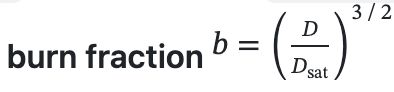
60.25 million ETH is approximately half of the current total ETH supply. As the staked amount approaches this figure, validators' net consensus-layer rewards gradually trend toward zero. Once it reaches or exceeds this level, the consensus-layer issuance rewards received by validators who perform their duties normally and completely will be fully offset by the newly introduced burn deduction. It should be noted that the 60.25 million ETH figure is a fixed value proposed to be written into the protocol at the hard fork.
There are two points here that are easy to misread:
First, 50% is not a staking cap, nor is it a target staking rate. Validators can still continue to join. The proposal simply hopes the market will stop growing on its own before rewards become insufficient to cover liquidity, operational, slashing, and regulatory risks.
Second, the so-called "zero yield" refers only to net consensus-layer issuance rewards. Execution-layer income such as priority fees and MEV is not affected by this proposal.
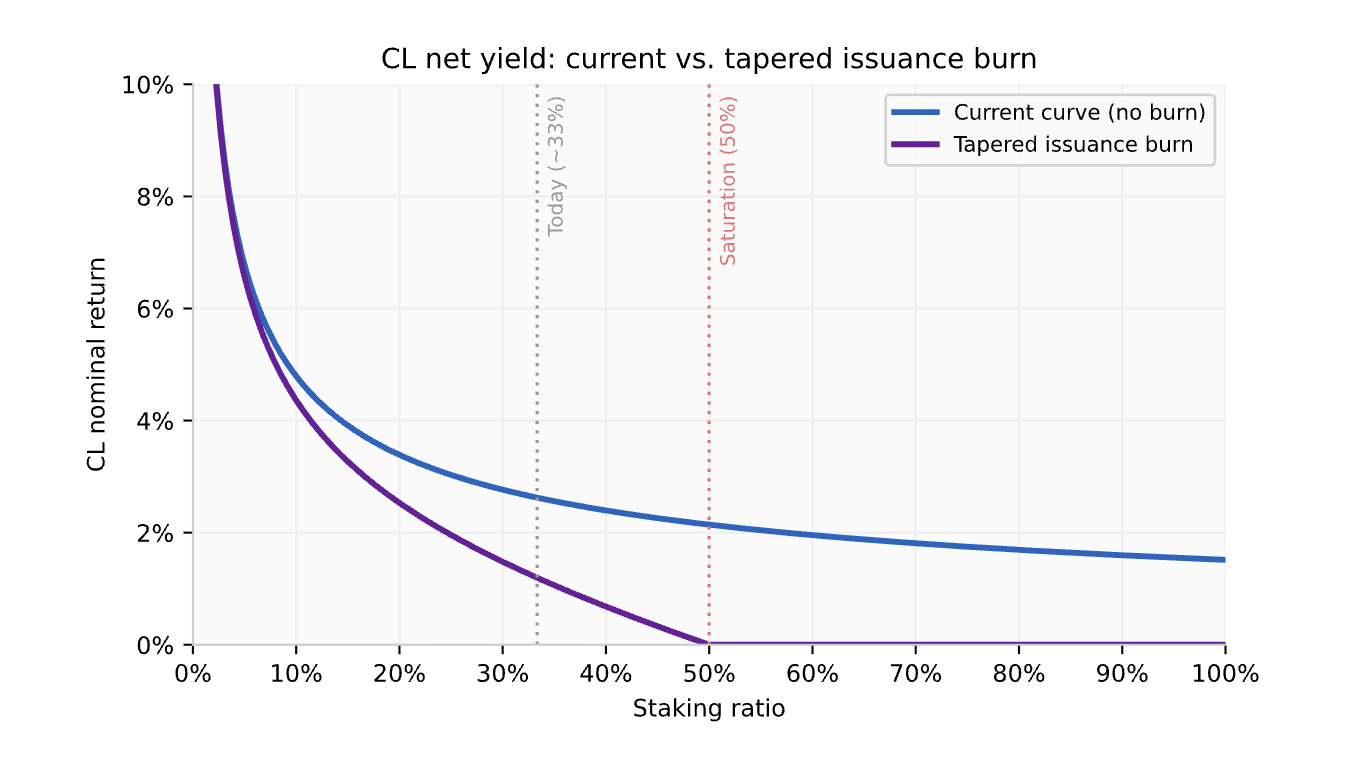
Net consensus-layer rewards under the current issuance curve and the EIP-8363 curve
Under the proposed curve, annual consensus-layer issuance would peak at around a 19.8% staking rate, then decline as the staking rate rises. Based on the current staking rate of approximately 33%, if the curve were fully implemented at the fork, the consensus-layer yield would drop from approximately 2.6% to approximately 1.2%.
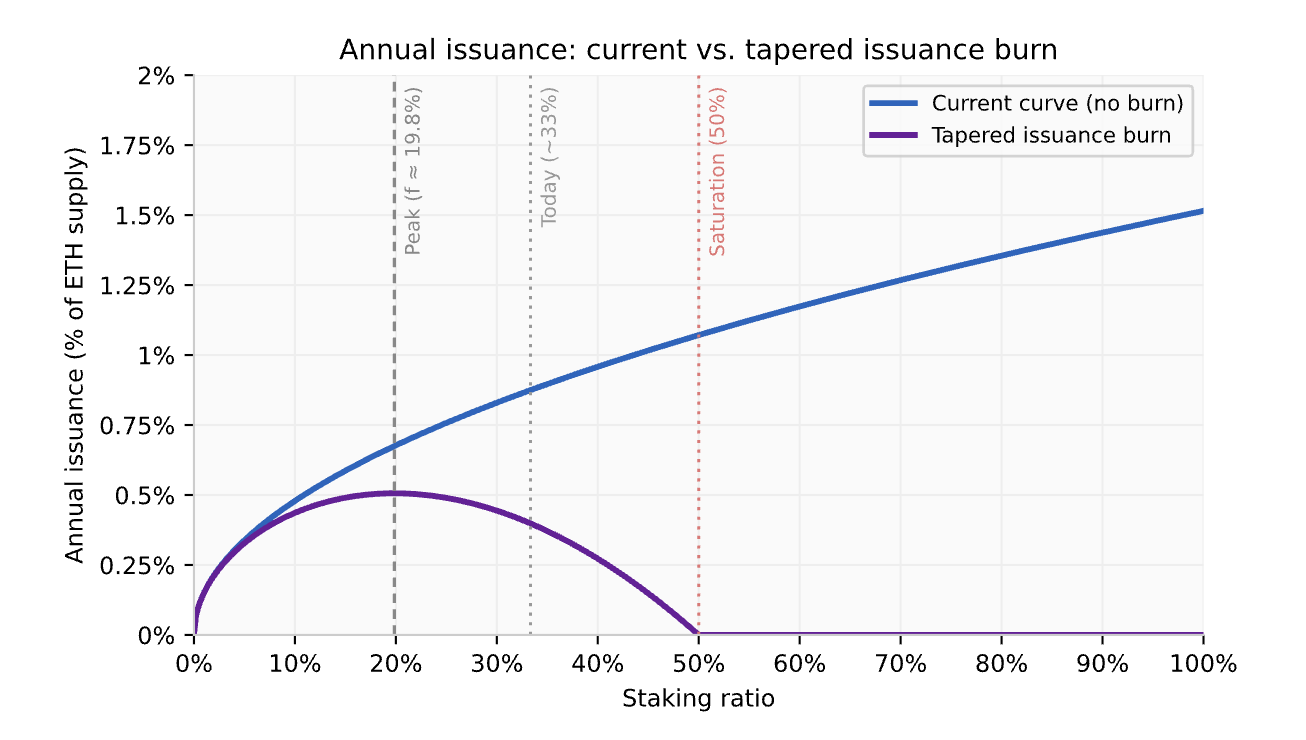
Annual issuance under the current issuance curve and the EIP-8363 curve
To avoid a sudden halving of rewards, the proposal includes an 18-month transition period: upon activation, the base reward factor would temporarily be increased from 64 to 128, then gradually reduced back to 64 over 65 steps, with each step lasting approximately 8.6 days. As a result, net rewards during the early activation phase would remain close to current levels before gradually declining. However, the curve that "ceases providing consensus-layer issuance incentives after 50%" would take effect from day one of activation, without waiting for the 18 months to elapse.
Currently, the proposal remains an unmerged Core EIP draft, in the editorial review and consensus evaluation stage. The authors have separately submitted PR #12087, requesting that it be listed as "Proposed for Inclusion" in the Hegotá upgrade. That PR has also not been merged, and the current official Hegotá Meta EIP does not yet include it.
Ethereum core developers plan to discuss Hegotá proposal deadlines at ACDC call #184 on August 6. Even if it enters "Proposed for Inclusion," that does not mean it is confirmed for implementation. It would still need to go through developer assessment, client implementation, testing, and "Scheduled for Inclusion" stages.
Community Reaction Is Clearly Negative
Jérôme de Tychey, one of the authors of EIP-8363, describes it as a "minimal, market-driven" change. In a forum response, he also noted that the issuance debate has been ongoing since 2023, and that this proposal merely opens a formal feedback window, not a confirmation of inclusion.
He also warned that if the validator entry queue remains full with few exits, staked ETH could exceed 70 million by early 2028, accounting for more than 55% of the supply. Reversing course at that point could cause greater exit volume and market disruption.
Those who support reducing issuance mainly cite three reasons:
- Ethereum may be overpaying for economic security that is already sufficient;
- Unstaked holders face continuous dilution, forced to choose between "bearing dilution" and "taking on staking risk";
- LSTs, ETFs, and custody services keep lowering staking friction, potentially allowing a few intermediaries to control large amounts of both ETH and validator power.
However, among current public reactions, the opposing voices are more prominent.
Aave founder Stani Kulechov believes that consensus-layer staking yields trending toward zero as the staking rate changes would weaken the cash flow predictability that institutions value when allocating to ETH, and would compress positive-carry strategies such as ETH lending and LST looping.
Obol co-founder Oisín Kyne argues that Ethereum's true security depends not only on how much ETH is staked, but also on whether validator power is sufficiently decentralized. If yields fall to extremely low levels, large institutions with low capital costs and low yield sensitivity could remain in the market long-term, crowding out higher-cost independent operators.
ether.fi CEO Mike Silagadze criticized the proposal for being submitted on the eve of the Hegotá deadline, leaving insufficient lead time for ecosystem developers to discuss. He worries that low yields will impact staking-related protocols and reduce institutional confidence in Ethereum's governance stability.
Ethereum community member Ryan Berckmans summarized that opponents include at least those concerned about who would run validators under zero yield, those unwilling to accept lower staking rewards, those opposed to another modification of ETH monetary policy, and those hoping to avoid controversy that could disrupt ecosystem growth. He personally supports a moderate reduction in issuance but opposes letting yields trend all the way to zero, and believes the current proposal is too divisive for the community.
A relatively middle-ground view comes from Lorenzo Valente, Head of Research at ARK Invest. He frames the debate around ETH's asset positioning. If one values ETH more as an "internet bond," reducing staking yields would indeed damage the lending market and yield curve. If one views ETH more as a neutral currency and store of value, then the base yield from looping primarily comes from new protocol issuance, at the cost of dilution to unstaked holders. Reducing issuance means reducing this transfer of value — borne by unstaked holders and flowing to stakers and their leverage strategies.
Who Benefits, Who Feels the Pressure?
If this proposal passes, the first to be affected would be solo stakers.
The 18-month transition period can smooth out the yield decline, but it cannot reduce fixed costs such as hardware, electricity, and operational maintenance. The proposal retains existing offline slashing penalties while compressing net yields, meaning a single outage would take longer to recoup through subsequent rewards. The proposal itself estimates that at the current staking rate of around 33%, the time needed to recover from downtime losses could increase to approximately 3.8 times the current duration.
For large operators with backup power, geographically redundant disaster recovery, and 24/7 operations, such changes are relatively easier to absorb. For home validators, a few network outages or hardware failures could significantly erode annual returns.
Tax treatment could also amplify this gap. The EIP-8363 proposal notes that in some jurisdictions, it is unclear whether tax authorities would recognize income based on pre-deduction rewards. If the burned portion can only be recognized as a capital loss, solo stakers' after-tax income could be lower than the apparent net yield.
The impact would further transmit to LSTs. The base yield of products like stETH and rETH comes from the underlying validators. As consensus-layer issuance declines, the yield gap between LSTs and native ETH would also narrow. Whether users would still be willing to take on smart contract, governance, custody, and de-pegging risks for a one or two percentage point yield advantage would become a new pricing question.
Looping strategies that rely on LST yields would feel the pressure even earlier. A common approach is borrowing ETH, buying or minting LSTs, then posting the LSTs as collateral to borrow more ETH. As staking yields gradually approach borrowing costs, the positive carry on such trades would progressively disappear, and leveraged positions could contract on their own. Aave, Morpho, Pendle, and products built around LST yields could therefore face declining ETH borrowing demand, capital efficiency, and liquidity.
The impact would ultimately cascade into the entire DeFi rate system. Staking yield is an important base rate in the ETH-denominated market, and LST lending, fixed income, yield splitting, and looping leverage are all priced around this benchmark.
Of course, LSTs would not lose all their utility. What could actually change is the advantage LSTs hold over native ETH.
Further upstream, the staking income of ETFs, exchanges, custodians, and ETH treasury companies would also decline. For institutions relying on staking yields to boost asset returns, ETH's predictable cash flow would weaken, potentially dampening new allocation appetite. Aave founder Stani Kulechov therefore believes the proposal would make it harder for institutions to assess ETH's returns and would weaken ETH's competitiveness relative to other yield-bearing assets.
The actual impact on institutions would not necessarily be uniform. As base yields decline, higher-cost participants may exit first, while the largest institutions least dependent on staking income would be better positioned to remain. This is exactly the validator centralization concern opponents have raised.
For ordinary ETH holders, the direction of impact is relatively clear. The burned issuance does not flow into any protocol or fund; rather, by reducing dilution, it benefits all ETH holders collectively.
However, a reduction in issuance does not necessarily mean ETH becomes deflationary, nor can one extrapolate that the price will necessarily rise. The final supply change still depends on EIP-1559 fee burns, network usage, validator issuance, and market conditions. If lower yields simultaneously weaken institutional allocation, LST demand, and on-chain lending activity, demand-side changes could offset some of the supply-side benefits.


