






Arthur Hayes’ 10,000-Word New Article: When Will the AI Wave Peak? Will the Bubble Burst? Why Am I Aggressively Buying ETH?


- Core Thesis: Arthur Hayes believes that the current AI capital expenditure (AI CAPEX) is essentially a credit bubble similar to the 2008 subprime mortgage crisis, rather than a profit bubble like 2000. Its collapse will trigger massive government money printing to rescue the market, ultimately pushing Bitcoin above $1 million.
- Key Elements:
- AI CAPEX is misread by the market as "technology investment," but it is actually "real estate investment," and its credit risk will be highly correlated with the construction cycle rather than technological iteration.
- The trigger for the AI bubble burst is not AI leaders stopping profitability, but a slowdown in data center construction growth or cloud giants lowering capital expenditure guidance, leading to a credit crunch.
- The U.S. maintains negative real interest rates and a steepening yield curve through the "Treasury-Fed Agreement," combined with "window guidance" to encourage banks to lend to the AI industry, forming systematic policy coordination.
- The government may utilize the emergency provisions of the Federal Reserve Act to directly print money and buy AI stocks (equity QE) through an SPV, offsetting fiscal deficits with book gains, but this will ultimately lead to a permanent expansion of the balance sheet.
- Bitcoin is expected to bottom out in the early stages of AI credit misallocation, potentially oscillating in the $50,000-$70,000 range, and then embark on a long-term rally driven by excessive liquidity injection.
- Ethereum is undervalued, as enterprise RWA chains (such as Robinhood's Arbitrum-based Layer 2) will adopt it as the securities settlement layer, with a target price of $5,000 by the end of 2026.
- The scale of AI credit is already equivalent to the railway era's share of GDP, and the degree of capital misallocation may exceed the subprime crisis. Future bailouts will be larger than 2009-2013, which is bullish for the crypto market.
This article is from Arthur Hayes
Compiled by Odaily (@OdailyChina); Translator: Azuma (@azuma_eth)

Looking around, humanity has transformed the Earth's natural environment into something entirely different. Some changes are remarkable, others alarming, but all of them began as a single idea in the mind of one or more evolved primates — namely, humans.
Because the brain processes vast amounts of information daily, we continuously construct narratives to make the world coherent and meaningful. For this reason, narratives ultimately shape reality.
For investors, predicting future price movements requires understanding the "collective illusions" that market participants share. The same company, with identical future cash flows, can command vastly different valuation multiples simply because the market believes a different story.
And the simplest way to "re-rate" a dull, uninspiring company is to give it a new narrative that fits the current market hotspot, making investors willing to chase it regardless of cost.
Is There Really an AI Bubble?
This brings us to the core question of whether AI is in a bubble.
However, before discussing the AI bubble, it's worth answering a more fundamental question: "What exactly are we investing in?" — to put it in relationship terms, "What are we, exactly?"
At least to someone with a somewhat "Luddite" inclination like myself, the key lies in how the market defines AI CAPEX — is it technology, or is it real estate?
The prevailing market narrative holds that this multi-trillion-dollar AI infrastructure buildout constitutes "technology," and therefore deserves extremely high growth valuations.
But I see it differently. AI CAPEX is, in essence, nothing more than another dull real estate investment. The only difference is that these data centers house computing power instead of office space. This computing power will ultimately give rise to silicon-based lifeforms, advancing human civilization in ways that may even surpass the railway revolution.
The reason we must distinguish between "real estate" and "computing power" is that today's freshly matured hedge fund managers, banks, private credit funds, and even governments mistakenly believe they are lending to tech giants like Apple, rather than providing real estate financing to Lehman Brothers.
I believe the AI bubble will ultimately burst because financial intermediaries will overbuild data centers and all the supporting infrastructure required — energy, electricity, and everything needed to power AI chip training and inference.
Therefore, the AI bubble is more akin to a 2008-style credit bubble than the earnings bubble of the 2000 internet bubble.
During the 2000 internet bubble, most publicly listed internet companies had little to no revenue, let alone profits — think Pets.com. That bubble was fundamentally an "earnings story" problem.
The 2008 financial crisis was different. What actually triggered the crisis was the slowdown in US home price appreciation, which raised concerns among banks and financial institutions about the solvency of mortgage-backed assets. That was a credit story.
The AI bubble will follow similar logic. The real turning point won't be AI leaders stopping making money, but rather a slowdown in data center construction growth, or hyperscalers lowering their future data center buildout guidance.
Even if AI leaders continue earning massive profits, their forward multiples will still contract due to declining growth expectations. And the first to fall will be the AI companies with the weakest credit profiles and highest leverage.
These risks will then rapidly transmit to the balance sheets of financial institutions that hold large amounts of AI-related debt and are themselves highly leveraged. Ultimately, governments will again intervene in the name of "national security" to ensure these over-leveraged AI companies and their backing financial institutions don't fail.
And these misallocated capital flows will eventually find their way into crypto... sending Bitcoin back to the moon (to da moon).
The Credit Risk of AI CAPEX
Whenever someone suggests "AI is in a bubble," AI bulls almost invariably invoke the "Jevons Paradox" as a rebuttal. Jevons argued that when the price of a commodity falls, its usage increases dramatically, causing the overall market size to continue expanding, even exponentially.
If you believe AI CAPEX itself represents computing power demand, then according to the Jevons Paradox, there's indeed nothing to worry about. As computing costs decline, demand for AI token-consuming applications and AI agents will grow exponentially, making lending to AI infrastructure a sure-win (money good) business.
But I believe this is a misreading of the Jevons Paradox. To understand why the Jevons Paradox doesn't mean all credit flowing to AI CAPEX will be repaid, let's look at what a hyperscaler actually does when building a data center.
Essentially, it's first undertaking a real estate development project. It builds a structure to house server racks, then procures the latest generation of semiconductor chips for AI model training and inference. And as industrial technology — particularly semiconductor manufacturing — continues to advance, the floating-point operations (FLOPs) achievable per kilowatt-hour of electricity will continue to grow exponentially.
In a few years, whether it's Nvidia, AMD, Intel, Huawei, or SMIC, they will all release new-generation AI chips vastly more efficient than today's. By then, the same data center will be able to produce 1,000 times more intelligence while consuming less electricity.
This means two things can be true simultaneously: on one hand, the physical infrastructure buildout of AI data centers could completely saturate; on the other hand, AI token consumption could still grow exponentially.
So the real question worth considering is: do you want to hold the real estate business — which is what hyperscalers are doing today — or the AI application layer?
The next common rebuttal from AI bulls is that hyperscalers are both landlord and tenant. They rely on the massive cash flows from their Web 2.0 "attention economy" businesses to provide credit support for issuing debt to fund data center construction; simultaneously, they leverage their AI capabilities to sell the "Forbidden Fruit of wisdom" from Eden to the world.
If you truly believe that story, I hope you're holding their stocks, not their bonds. Bonds are called fixed income for a reason — no matter how successful the company ultimately becomes, the best outcome for creditors is getting their principal back plus some interest.
If Google's AI bet pays off spectacularly, creating revolutionary products that change the course of human civilization and sending its stock soaring, shareholders certainly have reason to celebrate; but bondholders will still only receive their principal.
Conversely, if Google ends up as a "data center landlord" renting out vast amounts of depreciated Nvidia GPUs while failing to generate enough revenue to service its debt and interest, creditors will suffer severe losses. And how much a data center full of outdated chips is actually worth is highly questionable.
Hyperscaler CFOs and Wall Street financiers aren't stupid. They know they're really in the real estate business. Therefore, they must find some "bag holders" who believe they're investing in high technology rather than property.
These bag holders include insurance companies owned by alternative asset management giants like Apollo, as well as taxpayers in various countries who will ultimately foot the bill for government-backed AI credit guarantees.
If you carefully read those deliberately opaque financial statements, you'll find that much of the debt issued to finance AI CAPEX sits off balance sheet, with little clear connection to the core profitable businesses supporting stock valuations.
How we define AI CAPEX determines how we understand the entire AI investment cycle. This narrative explains why capital has become so severely misallocated, and why this bubble could exceed the railway bubble in scale.
More importantly, because the AI bubble is a credit bubble rather than an earnings bubble, when the crisis hits, governments will inevitably step in to rescue the final bag holders who mistakenly bought traditional real estate debt as new-tech equity assets.
Don't conclude from the recent AI sector correction — especially in highly leveraged markets like South Korea — that the AI bull market is over. Quite the contrary. The truly crazy "blow-off top" phase may have just begun.
Just last week, the Fed had the opportunity to raise rates in response to inflation that remains above trend by any statistical measure, but it chose to hold steady, with even former Chair Powell voting for maintaining rates.
So, for those crypto players forgotten by the market and struggling through a sideways bear market, does it matter whether AI credit allocation is good or bad? It matters because it determines how, why, and how much money governments will print to fill the financial hole created by runaway AI CAPEX investment.
The rest of this article will expand on this theory and explain why governments ultimately have no choice but to print money to save the system.
As AI CAPEX growth slows while credit expansion continues, Bitcoin will complete its bottom and embark on a long-term uptrend. When policymakers finally realize that their beloved AI GDP growth is essentially just another ordinary real estate bubble, they will be forced to launch monetary easing on a scale even larger than the 2008 Global Financial Crisis (GFC).
And ultimately, this will drive Bitcoin past $1 million and beyond.
The Second Derivative Determines Everything
I constantly remind myself: "Investing isn't really about growth itself, but the acceleration of growth."
In other words, what we're really watching is the second derivative — is growth accelerating or decelerating.
This is actually quite intuitive. When an asset is still in its accelerating growth phase, people constantly weave stories about its infinite future possibilities. Thus, you hear bold declarations in the market like, "I'd rather go broke holding a hyperscaler than miss the opportunity to build AGI (Artificial General Intelligence)."
However, all growth eventually enters a deceleration phase. The problem is that most asset prices tend to follow this pattern:
- Acceleration phase: prices keep hitting new highs;
- Deceleration phase: prices trade sideways;
- Only when growth itself (the first derivative) turns negative do prices actually begin to fall.
No one can accurately predict how long the period between growth deceleration and negative growth will last, but many investors — including myself — subconsciously assume that asset prices can keep rising indefinitely even after growth has begun to slow.
If the AI bubble is fundamentally a credit bubble, the importance of the second derivative becomes even more pronounced. Because society's willingness to continuously finance AI CAPEX rests on the assumption that AI investment will keep accelerating forever.
Once that acceleration disappears, adding more debt becomes increasingly dangerous. But the reality is, nobody knows when to stop until they've actually taken the punch.
Either a financial crisis erupts; or "Kenny G" (Odaily's note: this alludes to Ken Griffin, who recently bought AI stock positions at a discount) scoops up your assets at the market bottom.
Therefore, even as investment growth begins to slow, credit expansion tends to continue. Only when AI CAPEX budgets actually begin to decline will the market experience that classic "Wile E. Coyote" moment — where the character has already run off the cliff but doesn't realize there's no ground beneath until he looks down, and then plummets instantly.
At that point, the market will begin to identify who has become over-leveraged by holding large amounts of junk AI CAPEX debt.
Let's apply this logic to the US subprime crisis. One of my favorite courses in college studied US housing policy and the mortgage market. The professor had served as Deputy Secretary of Housing under the Clinton administration. Conveniently, I took this course in the spring of 2008 — right as Bear Stearns collapsed. The timing couldn't have been more fitting.
The core thesis of that course was that government policy, pursuing the social equity goal of "homeownership for all," continuously encouraged more people to buy homes, driving credit expansion. However, by 2006, many first-time homebuyers could no longer afford their monthly payments after interest rate resets. Their only way to keep paying was if home prices continued rising at an ever-faster pace.
Of course, I'm still waiting for the government to deliver my promised "forty acres and a mule." Since that's not happening, might as well just print money and build houses.
The four-panel chart below shows:
- The S&P 500 index;
- US construction loans and building activity;
- The Case-Shiller national home price index.
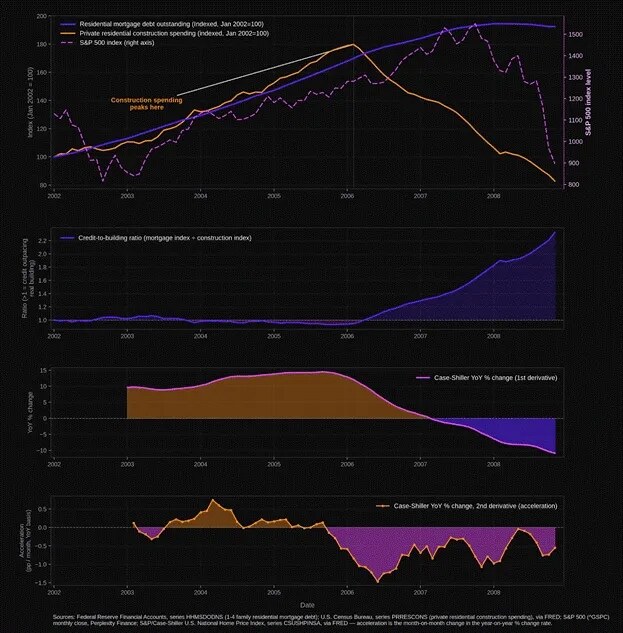
By the end of 2005, US home price appreciation had already begun to slow, which coincided with the peak in actual construction investment spending (the orange line in the first panel). However, real estate credit (the purple line) continued flowing into the market until the stock market peaked and began to pull back slightly.
2006 to 2007 was essentially "no man's land" before the crisis erupted. Home prices were still rising, but at a decelerating pace. The stock market then peaked in mid-2007 (the pink dashed line). The real "Wile E. Coyote moment" came in August 2007, when three credit hedge funds at BNP Paribas collapsed. The crisis then spread, eventually taking down Bear Stearns and Lehman Brothers in September 2008... and by then, the S&P 500 had already fallen roughly 50% from its highs.
What truly triggered the financial meltdown was investors finally discovering who actually held those toxic "Frankenstein-style" financial derivatives. In the end, governments had to take over both debt and equity of these institutions to avert a new Great Depression.
This point is crucial because we'll return to this logic when discussing how governments might rescue the AI industry later.
The second chart is equally noteworthy. It shows that the starting point of capital misallocation was precisely when home price appreciation began to slow. If new credit was still being used to build more housing, the problem wouldn't be as severe. But when the system begins relying on borrowing new money to service old debt, risk starts accumulating. The rising ratio of construction loans to construction investment spending perfectly illustrates this process.
Now, apply the same analytical framework to AI. The key corresponding variable here is each company's CAPEX spending plans.
The current market believes that real estate (in this case, AI) is technology; the more you invest in technology, the higher future profits will be. Therefore, the market rewards hyperscalers that announce increased capital expenditure budgets by pushing up their stock prices.
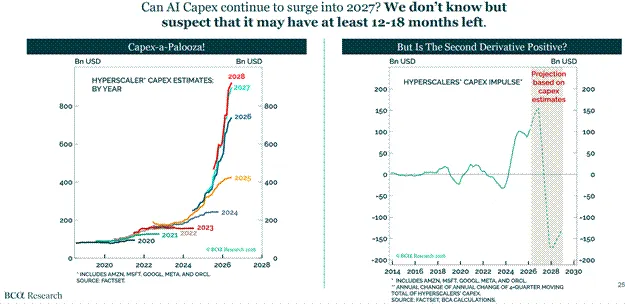
I expect that the announced growth rate of AI CAPEX will begin to slow between mid-year and the latter half of 2027, and by 2028, the market will clearly enter a "deceleration phase."
Simultaneously, a seemingly contradictory phenomenon will occur: while CAPEX growth begins to decline, credit flowing into AI will continue expanding. The reason is that lenders believe they're investing in technology, not real estate. Combined with governments constantly emphasizing the need to dominate the global AI race, continuing to finance everything AI CAPEX-related appears to be the most rational choice.
Thus, 2027 will become the "no man's land" analogous to 2006-2007. The current sharp correction in AI stocks is merely a normal pullback within a bull market. The true top of the AI bubble will occur next year.
After that point, the market will instead begin rewarding hyperscalers that "exit the arms race first" by proactively cutting CAPEX budgets. Unlike the early bubble phase from 2022 to mid-2026, hyperscalers will find it increasingly difficult to fund AI investment through their own free cash flow. They will have to rely more on issuing bonds and equity offerings to raise capital.
The pressure on balance sheets will also force management to seriously reconsider: "Is it really worth borrowing more money to build additional data centers, just to house more chips that are constantly depreciating?"
At least for US hyperscalers, China's frontier AI models — priced lower with comparable performance — will extinguish their "silicon deity" fantasies. After all, if two products are of equal quality, or only marginally different, most people will choose the cheaper one.
As the intelligence generated per kilowatt-hour of AI chips continues to grow exponentially, and as per-token costs decline under Chinese competitive pressure, a rational hyperscaler CFO won't continue degrading their balance sheet just to build more data centers.
Even under the Jevons Paradox, where AI token demand will eventually explode, that growth won't come fast enough to offset the negative impact of the massive debt issued years earlier. Ultimately, the market will first punish the weakest credit players. Only then will people truly realize how much capital has been wasted in this AI investment wave.
I can't predict which hyperscaler will be the first to overplay its hand, triggering a collective "Oh shit!" from bond investors.
Before discussing why banks continue lending despite knowing the enormous risks of AI investment, let's look at the chart below. It shows the comparison between the CAPEX investment scale already


