How to Interpret the AI Market Correction: Morgan Stanley's 120-Page Report Deep Dive


- Core View: Morgan Stanley believes the recent correction in the global AI sector stems mainly from technical factors such as crowded positioning and deleveraging, rather than fundamental deterioration. The structural shortage in AI computing demand remains unchanged, and "Time to Power" is the investment area with the largest pricing discrepancy in the current market.
- Key Elements:
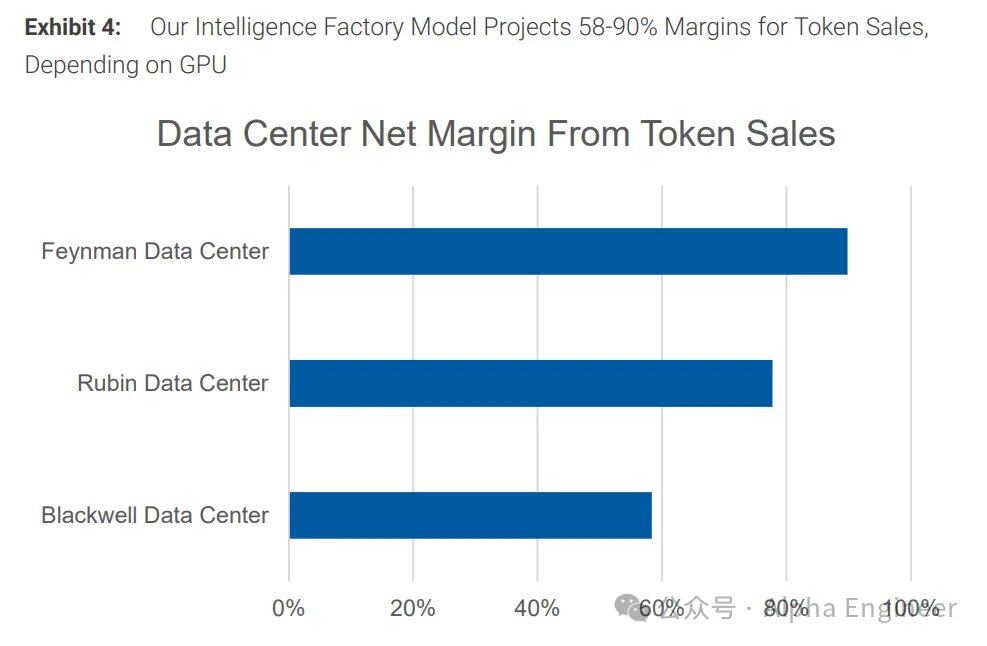
- Enterprise AI applications deliver ROI exceeding 10x (saving approximately $55 per call at a cost of only $2–5), rendering concerns about token budget caps unfounded; Blackwell data center token sales generate a net margin of roughly 58%, and future GPU generations could raise margins to 80%–90%, supporting price reductions to unlock demand.
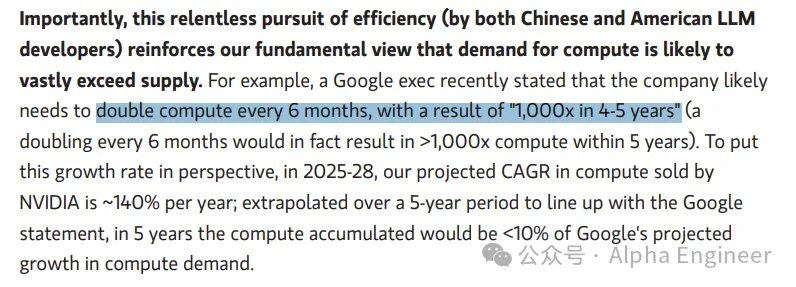
- Jevons Paradox applies to AI: improved computing efficiency will drive up total consumption; Google projects a 1,000x increase in computing demand over five years, yet NVIDIA's AI chip CAGR from 2025–2028 is approximately 140%—extrapolated over five years, supply would cover less than 10% of Google's demand alone, leaving a massive supply-demand gap.
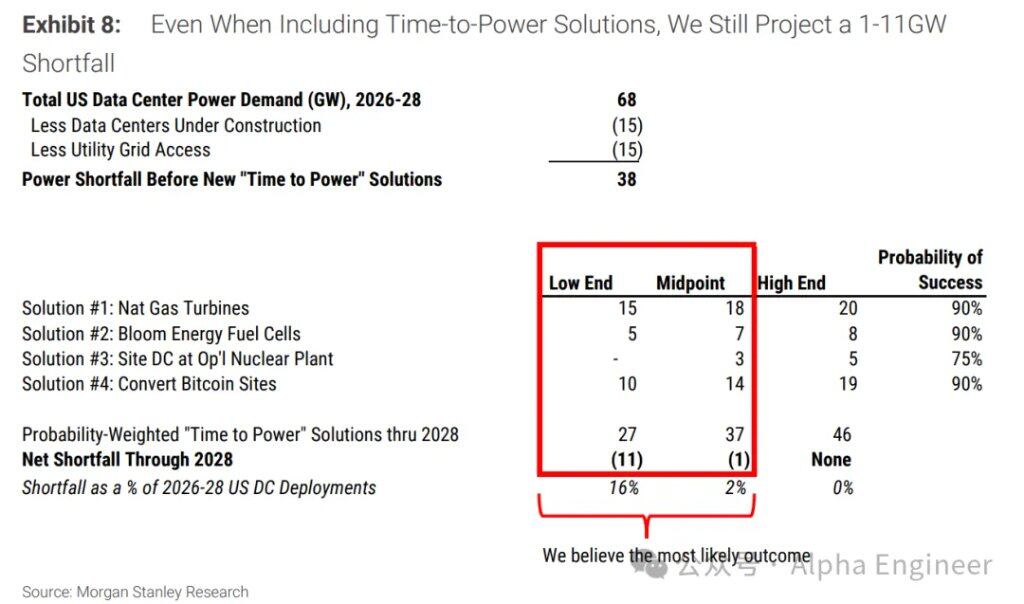
- Supply-side 3P constraints (labor shortages, 5–7 year grid interconnection queues, and growing political resistance) act as "speed bumps" rather than structural obstacles; U.S. data center electricity demand from 2026–2028 stands at 68GW, with a potential shortfall of 38GW after accounting for facilities under construction and already contracted capacity.
- Bitcoin mining sites can repurpose 10–19GW of interconnection capacity, gas turbines can contribute 15–20GW, and fuel cells 5–8GW; even including these solutions, a net gap of approximately 1GW remains in the base case, widening to 11GW in a pessimistic scenario.
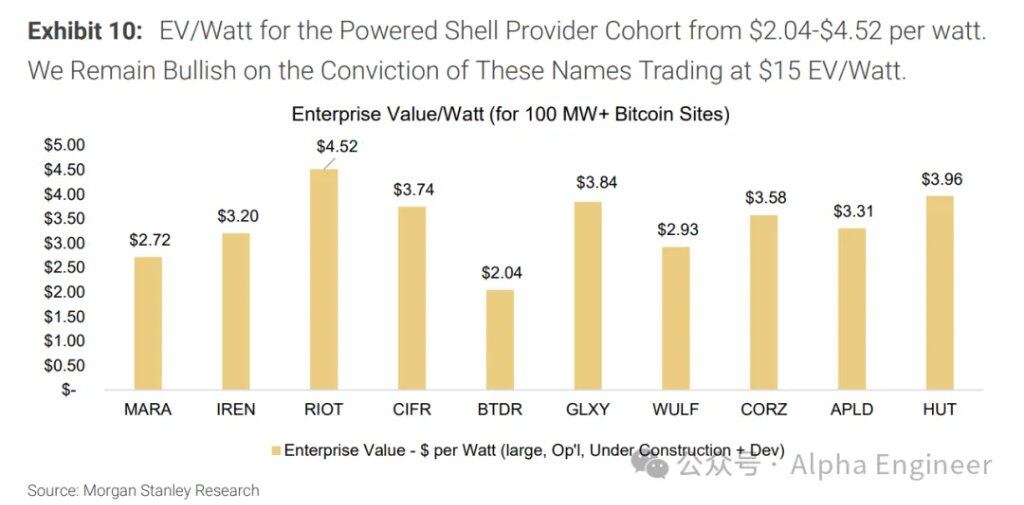
- Powered Shell Providers (such as TeraWulf, Cipher Mining, HUT 8, etc.) currently trade at an EV/Watt of only $2–4, compared to 20–25x valuations for mature data center operators; Morgan Stanley assigns a 15x target valuation, believing the market has not fully priced these in.
Original Author: Fei Binjie
Original Source: Alpha Engineer
Since late June, the global AI sector has experienced a notable pullback.
Whether this is a brief technical correction or a signal of a cyclical peak is a question worth its weight in gold.
Morgan Stanley explored this question in a deep-dive report published on July 27, titled "Playing the AI Infrastructure Dip."

The report offers a clear-cut conclusion: the pullback is primarily driven by technical factors — including the digestion of crowded positioning, deleveraging of margin financing, and momentum factor reversal — rather than a breakdown in fundamentals.
I read the report carefully and gained valuable insights. Here's a summary of its key points.
(1) Capital Market Concern #1: Is the "Tokenmaxxing" Narrative Reversing?
The first negative signal the market has focused on recently is a potential reversal of the "Tokenmaxxing" narrative.

Several enterprises have begun imposing budget caps on employee AI Token usage, raising questions about the sustainability of revenue growth for major AI model companies.
This concern does not hold up under scrutiny.
First, the current baseline for enterprise employee Token spending is extremely low, while the ROI is exceptionally high.
Morgan Stanley's research across numerous enterprise-grade AI use cases shows that a single AI call saves an average of approximately $55 in labor costs, while the average cost of completing an enterprise-level task via Agent collaboration is only $2–5, translating to an ROI exceeding 10x.
For tools with an ROI multiple above 10x, adoption is not a budget decision — it's a matter of core competitiveness. Enterprises that fail to actively deploy AI capabilities will face increasingly significant competitive disadvantages.
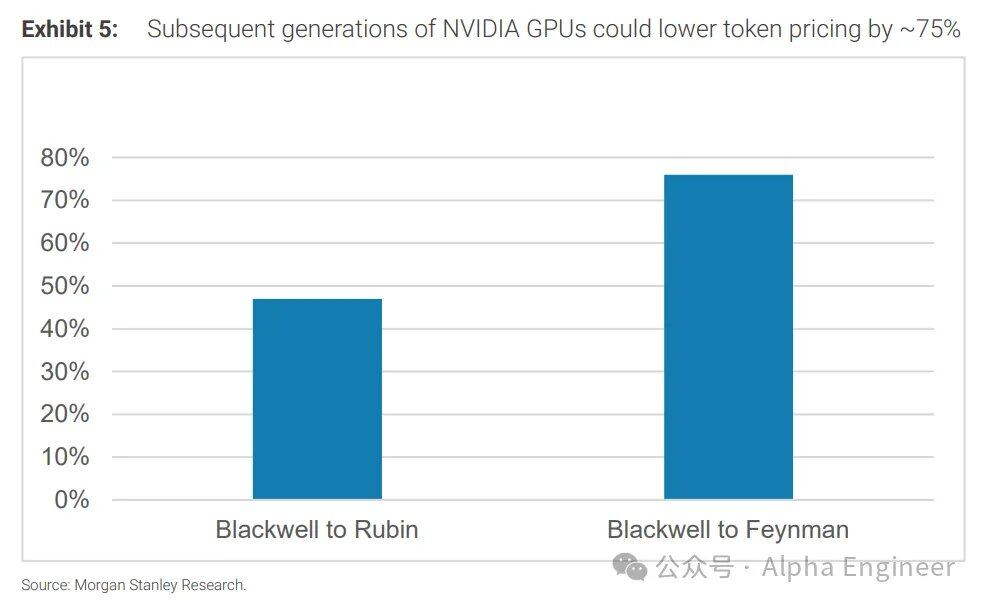
Second, GPU generational advancements will improve data center profit margins, meaning future Token prices can be significantly reduced without harming profitability, further unlocking demand.
According to Morgan Stanley's Intelligence Factory model estimates, the net profit margin on Token sales from Blackwell-based data centers stands at approximately 58%.
With the deployment of Rubin and Feynman generation GPUs, margins are projected to rise to roughly 80% and 90%, respectively.
This implies that Hyperscalers could cut Token pricing by roughly 75% while keeping margins unchanged. The downward shift in the cost curve is substantial enough that price cuts and profitability can go hand in hand.
(2) Capital Market Concern #2: Does the "Kimi Moment" Disprove the Rationale for CapEx?
The release of Kimi K3 has prompted the capital markets to re-examine a core assumption: if China can train frontier models with comparable performance at lower costs, do U.S. Hyperscalers' annual AI CapEx of over $1 trillion face downward revisions in returns?
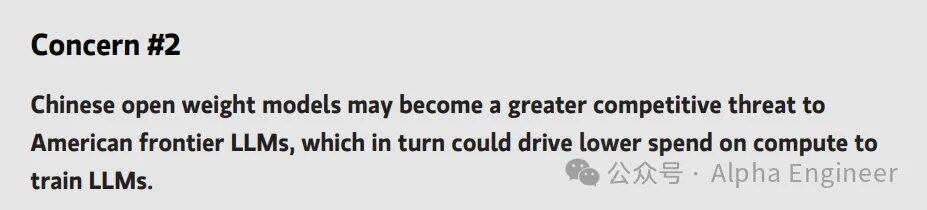
Morgan Stanley believes that the relentless pursuit of efficiency by both U.S. and Chinese AI model companies will not weaken compute demand. On the contrary, it reinforces the structural thesis that "demand far exceeds supply."
In the 19th century, economist William Stanley Jevons observed that Watt's improved steam engine dramatically increased coal combustion efficiency, yet Britain's total coal consumption actually surged — because the steam engine, now economically viable, was deployed across far more factories and mines than ever before.
This led him to propose the famous Jevons Paradox: when the efficiency of a resource's use improves, total consumption of that resource rises rather than falls.
The Jevons Paradox applies equally to the current AI revolution: improved compute efficiency lowers the unit cost of Tokens, and lower costs mean more use cases, more users, and higher-frequency calls — ultimately driving up total compute consumption.
Morgan Stanley cites data to quantify the severity of this supply-demand imbalance:
A Google executive recently stated that the company may need to double its compute capacity every 6 months — a 1,000x increase within 5 years.
On the supply side, however, NVIDIA's AI chip sales CAGR from 2025–2028 is approximately 140%. Even extrapolating at that pace over 5 years, cumulative delivered compute would still account for less than 10% of Google's single-company demand forecast.
In other words, even the world's largest compute supplier operating at its fastest historical growth rate could only cover a fraction of a single customer's needs.
(3) Capital Market Concern #3: Does Supply-Side Constraint Pose a Hard Ceiling?
The third concern among capital markets: even if demand-side certainty is sufficient, could physical-world constraints prevent compute infrastructure from being delivered as needed?

Morgan Stanley groups these physical-world constraints under the "3Ps": People, Power, and Politics.
People: Skilled trades required for data center construction (electricians, welders, pipefitters) are in structural shortage.
Power: Grid interconnection queues have extended to 5–7 years in some regions, making this the single largest timeline bottleneck for data center commissioning.
Politics: Data center development is facing multi-layered political resistance from local to federal levels, and the tide is undergoing a structural shift.
In recent years, states competed to offer generous incentive policies to attract data centers. Now the trend has reversed: states are pausing, attaching conditions to, or outright rescinding data center tax incentives.
Issues such as slowing the pace of data center development and shielding residential electricity rates from data center infrastructure costs are increasingly becoming planks in gubernatorial campaigns and are expected to be significant voter issues in the November elections.

Meanwhile, at the federal level, there are efforts to establish a nationwide "data center tariff."
The House is reviewing the Ratepayer Protection Act, which represents the first federal attempt at legislation to allocate infrastructure buildout costs, requiring state utility companies to consider creating a "large load standard" that would make data centers pay for grid upgrades.
Earlier (in March), Amazon, Google, Meta, Microsoft, Oracle, xAI, and others signed the White House's Ratepayer Protection Pledge, voluntarily committing to shield existing consumers from data center infrastructure costs.
The Act would codify this voluntary pledge into law, effectively creating a nationwide surcharge system on data center electricity consumption.
Morgan Stanley acknowledges the validity of this concern but characterizes these issues as "speed bumps" rather than structural barriers.
With grid interconnection queues exceeding 5 years in some regions and data centers facing growing pressure to "self-supply" power, on-site self-generation is emerging as a core solution.
(4) Time to Power: The Underappreciated Arbitrage on Electricity Timelines
Morgan Stanley conducted a quantitative assessment of the U.S. data center power shortfall.
The conclusion: U.S. data center power demand from 2026–2028 is approximately 68GW. After accounting for facilities under construction (15GW) and contracted grid capacity (15GW), the potential shortfall reaches 38GW, with grid interconnection queues stretching 5–7 years in some regions.

Against this backdrop, Morgan Stanley argues that the time value of power access ("Time to Power") represents the area with the greatest pricing discrepancy in the current market.
The logic chain is clear: data center commissioning is constrained by power availability → grid interconnection queues of 5–7 years → alternative solutions capable of delivering power within 1–3 years offer significant time-arbitrage value.
Morgan Stanley identifies two core "de-bottlenecking" pathways:
- Bitcoin mining sites: These companies already hold substantial grid interconnection capacity and physical land, which can be directly converted to data center use — 10–19GW.
- Rapid-deployment power generation solutions: Offering a 1–3 year time advantage over grid interconnection, with gas turbines contributing 15–20GW and fuel cells contributing 5–8GW.

Even after incorporating "Time-to-Power" solutions — gas turbines, fuel cells, direct nuclear power supply, and Bitcoin mining site conversions — into probability-weighted calculations, there remains a net shortfall of approximately 1GW in the base case, widening to 11GW in the bear case.
In other words, what Hyperscalers are most short of today is not CapEx, but physical space with access to power — i.e., "Powered Shell."
Morgan Stanley's research concludes that the market is not adequately pricing in these Powered Shell Provider names.
To quantify this undervaluation, Morgan Stanley uses traditional renewable energy PPAs as a reference benchmark for comparison, as detailed in the table below:
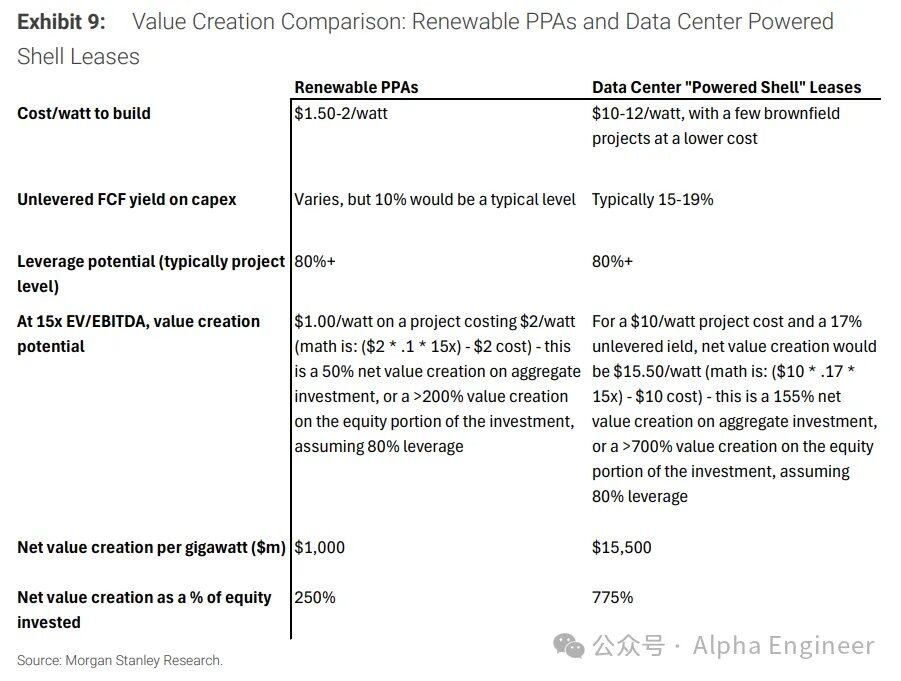
Currently, these Powered Shell Providers trade at an EV/Watt of just $2–4, including companies such as TeraWulf, Cipher Mining, HUT 8, Riot Platforms, Applied Digital, and Galaxy Digital.
Based on the 20–25x EV/Watt benchmark of mature data center operators (such as Equinix and Digital Realty), Morgan Stanley assigns a discounted target valuation of 15x EV/Watt to these transitioning companies.