A "Ignored" Market Event: U.S.-Japan-South Korea Joint Intervention, U.S. Treasury's "Rare" Move, Bessent Quietly "Saving the Market"?


- Core View: The U.S., Japan, and South Korea carried out their largest coordinated FX intervention in nearly 30 years on July 31, with the U.S. directly intervening in the yen for the first time through non-dollar channels, aimed at stabilizing Japanese and South Korean financial markets and preventing asset risk from allies in the AI supply chain from spilling over.
- Key Elements:
- The U.S. Treasury, via the New York Fed, commissioned Goldman Sachs and Morgan Stanley to sell euros and buy yen, marking the first direct U.S. participation in yen intervention in nearly 30 years.
- Japanese authorities used approximately ¥8.45 trillion (about $52.8 billion) to intervene in the FX market on July 30, and South Korean FX authorities sold dollars the same day, pushing the won up 2% in a single day to a nine-month high.
- USD/JPY fell from above 162 to the 157-159 range, with the yen moving away from 40-year lows and the won strengthening in tandem.
- The New York Fed adopted a new "rate check" tool, sitting between verbal and actual intervention, with some operations conducted via EUR/JPY to avoid putting pressure on the dollar.
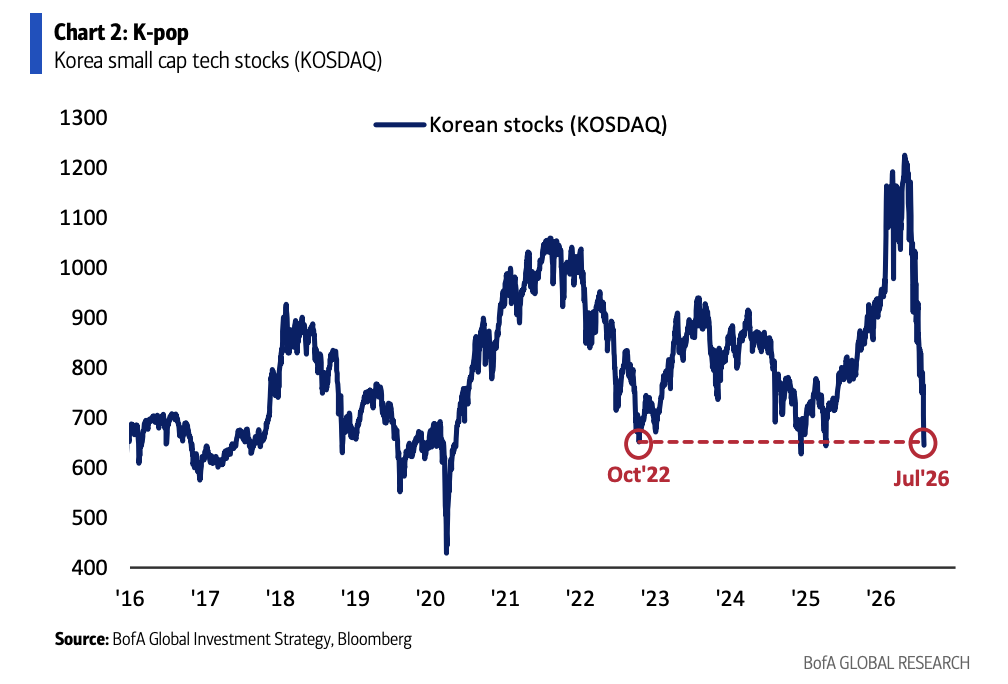
- South Korea's KOSDAQ index fell to its lowest level since October 2022, with notable corrections in the tech sector, underscoring the market-rescue backdrop.
- Bank of America strategists compared the action to a "price maintenance operation" in the AI era, with goals including preventing a sharp rise in Japanese bond yields, avoiding the spread of Asian financial stress, and reducing the impact on the U.S. bond market.
- Semiconductor ETFs have attracted roughly $53 billion in inflows this year, with the AI investment boom showing no signs of cooling, and the coordinated intervention may signal the end of high-leverage trades.
Original Author: Li Jia
Original Source: Wallstreetcn
The United States, Japan, and South Korea this week jointly executed the largest coordinated foreign exchange intervention in nearly three decades. Targeting not only the depreciation pressure on the yen and the Korean won, the action is also seen as an important measure by the U.S. to stabilize the financial markets of its allies Japan and South Korea and prevent risks from spilling over.
The operation covered two major Asian currencies, the yen and the Korean won. Both Japanese and South Korean foreign exchange authorities sold U.S. dollars to support their respective currencies; the U.S., meanwhile, intervened in the yen exchange rate through non-dollar channels, selling euros and buying yen to alleviate the yen's depreciation pressure while avoiding pressure on the dollar.
Currently, the Japanese and South Korean markets remain under sustained pressure: South Korea's KOSDAQ index has fallen to its lowest point since October 2022, with notable adjustments in the technology sector; the yen and the Korean won have also weakened consecutively against the U.S. dollar, and the market fears that further depreciation of these currencies could trigger a chain reaction of volatility in Asian assets.
Unlike past efforts to simply stabilize exchange rates, this coordinated action is regarded by the market as a "rescue operation" targeting the financial markets of Japan and South Korea. Amid persistent pressure on Japanese and South Korean stock markets and significant corrections in the technology sector, the U.S. hopes to boost market confidence by stabilizing exchange rate expectations and prevent further transmission of risks.
Both Japan and South Korea are important participants in the U.S. semiconductor and AI supply chain. Stabilizing the asset markets of these two countries helps reduce the possibility of financial risks transmitting to the technology industry chain and the U.S. market.
U.S., Japan, and South Korea Rarely Join Forces to Intervene in the FX Market; Yen and Won Surge in Response
According to the Financial Times, on July 31, the U.S. Treasury, through the New York Fed, commissioned Goldman Sachs and Morgan Stanley to sell euros and buy yen, marking the first direct U.S. participation in yen intervention in nearly 30 years.
Previously, it was reported that Japanese authorities had already used approximately ¥8.45 trillion (about $52.8 billion) in a single day on July 30 to intervene in the foreign exchange market. In addition, according to Reuters, South Korean foreign exchange authorities also unusually entered the market on the same day to sell U.S. dollars, driving the won to appreciate 2% in a single day, reaching a nine-month high.
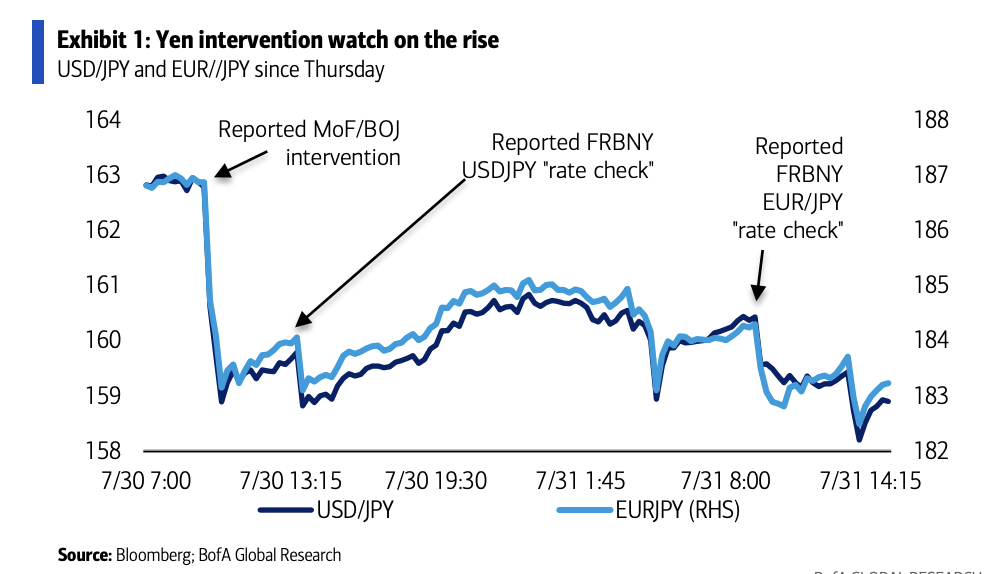
Driven by the joint efforts of the three parties, the dollar-yen exchange rate quickly fell from above 162 to the 157-159 range, with the yen clearly moving away from its 40-year low. South Korean Vice Finance Minister Moon Ji-sung stated that South Korea is maintaining close coordination with the U.S. and Japan; Atsushi Mimura, Japan's Vice Minister of Finance for International Affairs, also said that U.S. support has gone "beyond mere moral support."
U.S. First Direct Participation in Yen Intervention Sends a Policy Signal
The U.S. Treasury's direct intervention in the yen exchange rate this time is the most significant change that the market is focusing on. Unlike the past, when it mainly relied on verbal warnings, the U.S. has this time participated in yen intervention through actual trades.
According to the Financial Times, citing sources familiar with the matter, the New York Fed implemented the intervention by selling euros and buying yen through Goldman Sachs and Morgan Stanley. Before the action, the U.S. Treasury had signaled to multiple Wall Street institutions the possibility of intervention and maintained communication with the European Central Bank.
Prior to officially entering the market, the New York Fed had released policy signals for two consecutive days. On Thursday, the New York Fed conducted a "rate check" for the dollar-yen pair, asking dealers for current tradable rates without immediately executing trades; on Friday, it shifted to a "rate check" for the euro-yen pair. The market widely believes that this operation is seen as a precursor to formal intervention.
New York Fed's "Rate Check" Operation Explores a New Approach to FX Intervention
Alex Cohen, FX strategist at BofA Securities, stated in a report that the "rate check" sits between verbal intervention and actual intervention, and is a new tool the U.S. Treasury has begun using this year, allowing it to signal policy to the market without actually deploying capital. However, he also cautioned that without subsequent concrete action backing it up, the market may still retest the authorities' policy credibility.
Notably, the New York Fed this time partially chose the euro-yen pair, rather than the dollar-yen pair, for its operations. Analysts believe that this indicates the U.S. may aim to exert influence through non-dollar currency channels, alleviating the yen's depreciation pressure while avoiding additional pressure on the dollar.
On the Japanese side, authorities had already intervened in the FX market on a large scale. According to official data and market estimates, Japanese authorities used approximately ¥8.45 trillion (about $52.8 billion) on July 30 to support the yen, marking another large-scale intervention following a total of approximately ¥11.7 trillion deployed between April and May this year.
The U.S. Goal Is Not Simply to Stabilize Exchange Rates, but to Safeguard the Asset Stability of Its AI Allies
The significance of this U.S. intervention may extend beyond traditional exchange rate intervention.
Michael Hartnett, strategist at Bank of America, said in his latest report that this U.S.-Japan-South Korea coordinated action resembles a "Price Keeping Operation" (PKO) for the AI era, with the core goal of preventing sustained pressure on the assets of AI supply chain allies such as Japan and South Korea.
Hartnett believes that the U.S. aims to mitigate three types of risks: First, preventing a sharp depreciation of the yen from causing a steep rise in Japanese government bond yields; second, avoiding financial stress from spreading to Asian markets such as South Korea and Japan; and third, reducing the impact of disorderly capital flows on the U.S. bond market.
Recently, pressure on the South Korean market has visibly increased. The KOSDAQ index has fallen to its lowest point since October 2022, and major South Korean brokerage stocks have also been undergoing sustained corrections.
Meanwhile, the AI investment boom has not yet shown clear signs of cooling. Data from Bank of America shows that semiconductor ETFs have attracted approximately $53 billion in inflows this year, and despite a recent pullback in the Philadelphia Semiconductor Index (SOX), investors continue to bet on long-term growth in the AI supply chain.
Hartnett argues that the simultaneous occurrence of coordinated intervention and market corrections may indicate that previously highly leveraged trades are entering their final stages. However, current policies are more focused on controlling market volatility, rather than altering trends through liquidity policies.