






Microsoft is the only company whose stock rose after its earnings report – what’s supporting its share price?


- Core Thesis: Microsoft’s Q4 FY2026 earnings report initially appeared to show a slowdown in capital expenditure, triggering a sharp stock price rally. However, in reality, by extending the depreciation period for data centers from 15 to 25 years and moving some leases out of capital expenditure, capital spending has not truly decelerated; investment is still growing significantly.
- Key Factors:
- Microsoft’s capital expenditure this quarter was $41 billion (including finance leases), up 70% year-over-year. Total capital expenditure for FY2026 reached $145.3 billion, 2.6 times that of FY2024. Next quarter’s guidance exceeds $50 billion.
- The market reacted positively to the capital expenditure guidance being lowered from $190 billion to $175 billion, but this adjustment stems from a change in accounting methodology (extended depreciation period), not an actual reduction in spending.
- The commercial remaining performance obligation balance reached $678 billion, up 84% year-over-year. However, excluding the impact of OpenAI, the growth rate was 25%, and this amount needs to be recognized over approximately 2.3 years.
- Free cash flow this quarter was $19.6 billion, down 23% year-over-year; full-year FY2026 free cash flow was $67 billion, marking the first year-over-year decline.
- Microsoft Cloud gross margin fell to 65%, declining for four consecutive quarters. Depreciation expenses reached $34.3 billion, compared to just $15.2 billion two years ago, putting pressure on the income statement.
- Non-GAAP EPS ($4.74) was lower than GAAP EPS ($4.81), due to the exclusion of net income ($4.963 billion) generated from the equity method accounting for OpenAI.
- Revenue from commercial agreements with OpenAI was $24.1 billion. Microsoft holds approximately a 25% stake in OpenAI, with related accounts receivable of $6 billion.
After the US stock market closed on July 29, Microsoft released its fourth-quarter fiscal 2026 earnings. Revenue was $90 billion, up 18% year-over-year. Azure and other cloud services growth accelerated to 43% from 40% in the previous quarter. CEO Satya Nadella added a remark in the prepared remarks for the earnings call that he hadn't had the chance to say before: Azure's full fiscal year revenue "exceeded $100 billion," growing 41%. This marked the first time the business crossed the $100 billion threshold.
In the first ten-plus minutes after the earnings release, the stock rose less than 3% in after-hours trading. By the end of the earnings call, the gain had expanded to around 8%. The stock price briefly rose from a closing price of $390.54 to over $422. No new revenue figures emerged in between; what appeared was a capital expenditure guidance read by CFO Amy Hood. She stated that capital expenditure for calendar year 2026 is expected to be approximately $175 billion. Three months ago, the same metric was $190 billion.
Over the past three months, the market has treated "every extra dollar cloud providers spend deducts a dollar from their valuation" as a default rule. Jason Lemire, Chief Investment Officer at Bold Wealth Partners, put it bluntly before earnings week: "Previously, the more they spent, the better. Now, the less they spend, the better." So when Microsoft swapped a $190 billion figure for $175 billion, the market almost instinctively breathed a sigh of relief.
Is That $15 Billion Saved?
No.
Hood added in the same sentence that after this adjustment, "the investment expectation itself remains unchanged." She also explained the source of the difference. Starting from fiscal 2027, Microsoft extended the depreciation period for data centers and office buildings from 15 years to 25 years. This action itself relates to depreciation, but it consequently changed the classification of leases. With the longer period, more newly signed data center leases will shift from finance leases to operating leases, and only finance leases are counted as capital expenditure.
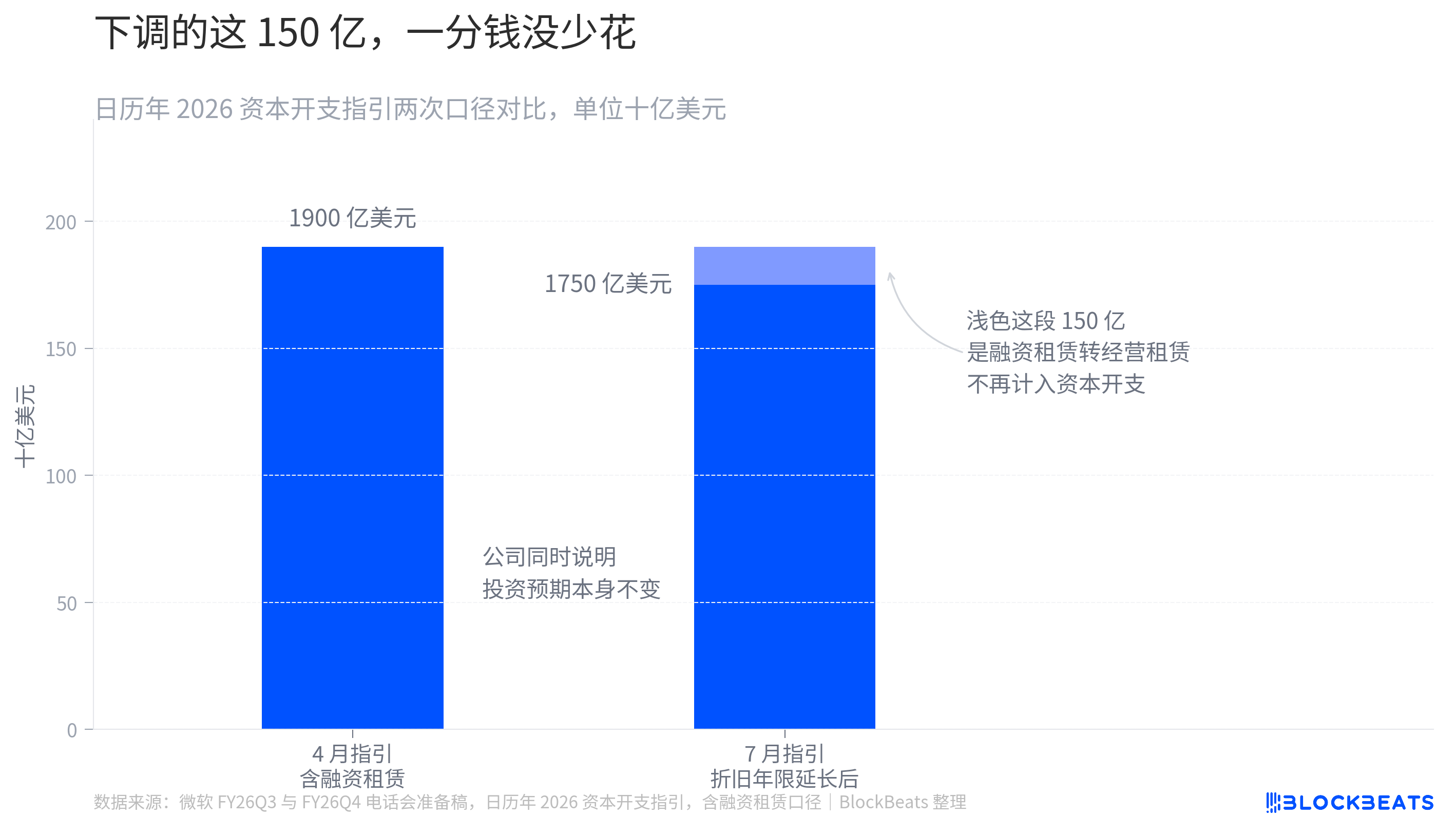
The lighter section in the chart represents the portion moved out of the statistical scope. The money still needs to be paid, and the server rooms still need to be built; it will just appear in the rent line on the income statement going forward, rather than in the capital expenditure line on the cash flow statement. Microsoft provided a supporting figure in the lease notes of its fiscal 2026 10-K: as of the end of June, lease commitments not yet commenced were $329.1 billion, expected to commence gradually from fiscal 2027 to 2033, primarily for data centers.
The change in depreciation period only appeared in the prepared remarks for the earnings call. It wasn't mentioned in the press release, and the 25-year term isn't found in the 10-K either; that document's accounting policies section still lists buildings as 5 to 15 years.
Has Capital Expenditure Actually Slowed Down?
Not at all.
Using Microsoft's own oral口径 from the call, which includes finance leases, this quarter's capital expenditure was $41 billion, up 70% year-over-year. The same quarter two years ago was $19 billion. For the full fiscal 2026, it was $145.3 billion, 2.6 times that of fiscal 2024. The company's guidance for the next fiscal quarter is "over $50 billion."
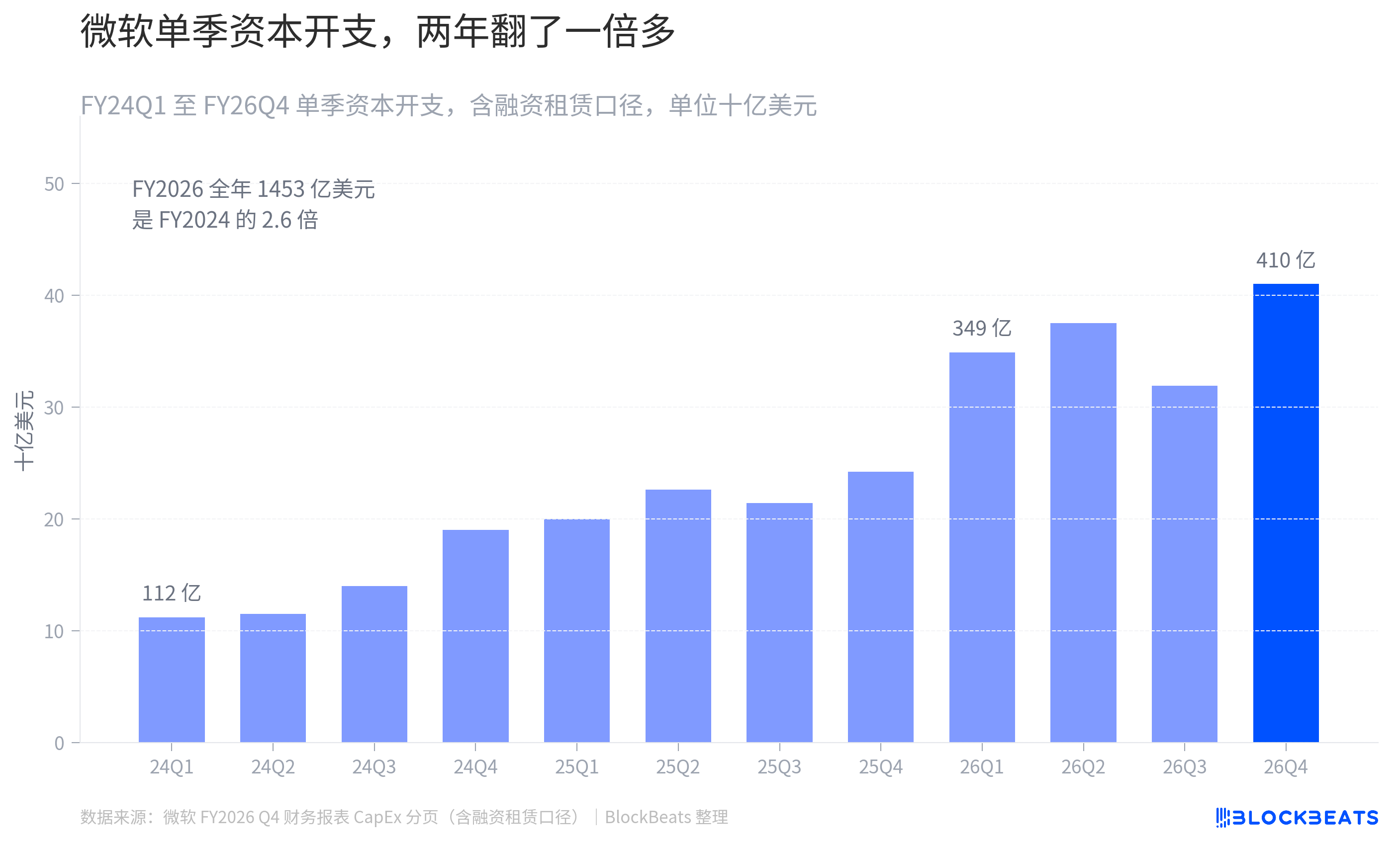
There is an easily confusing point here. On earnings day, some reports stated "this quarter's capital expenditure was $35.8 billion, below market expectations of $36.1 billion," using the "purchase of property and equipment" line on the cash flow statement, which excludes finance leases. Both metrics are correct; the difference is the $5.6 billion in finance leases for the quarter. From now on, whenever you see a Microsoft capital expenditure figure, first ask whether it includes finance leases – that's more useful than asking about the figure itself.
Regarding fiscal year 2027, the company only said three things: capital expenditure will grow year-over-year; the first fiscal quarter will exceed $50 billion; and free cash flow is expected to remain positive. The $255-$260 billion figure circulating in the market is not company guidance; it was the consensus expectation from sell-side analysts before the earnings release, mistakenly written as guidance by some media.
Can the $678 Billion Backlog Support These Investments?
This time, Microsoft reported its commercial remaining performance obligation balance at $678 billion, up 84% year-over-year. This figure was singled out by many reports as evidence of AI demand. It is indeed evidence, but the structure is a bit softer than it appears.
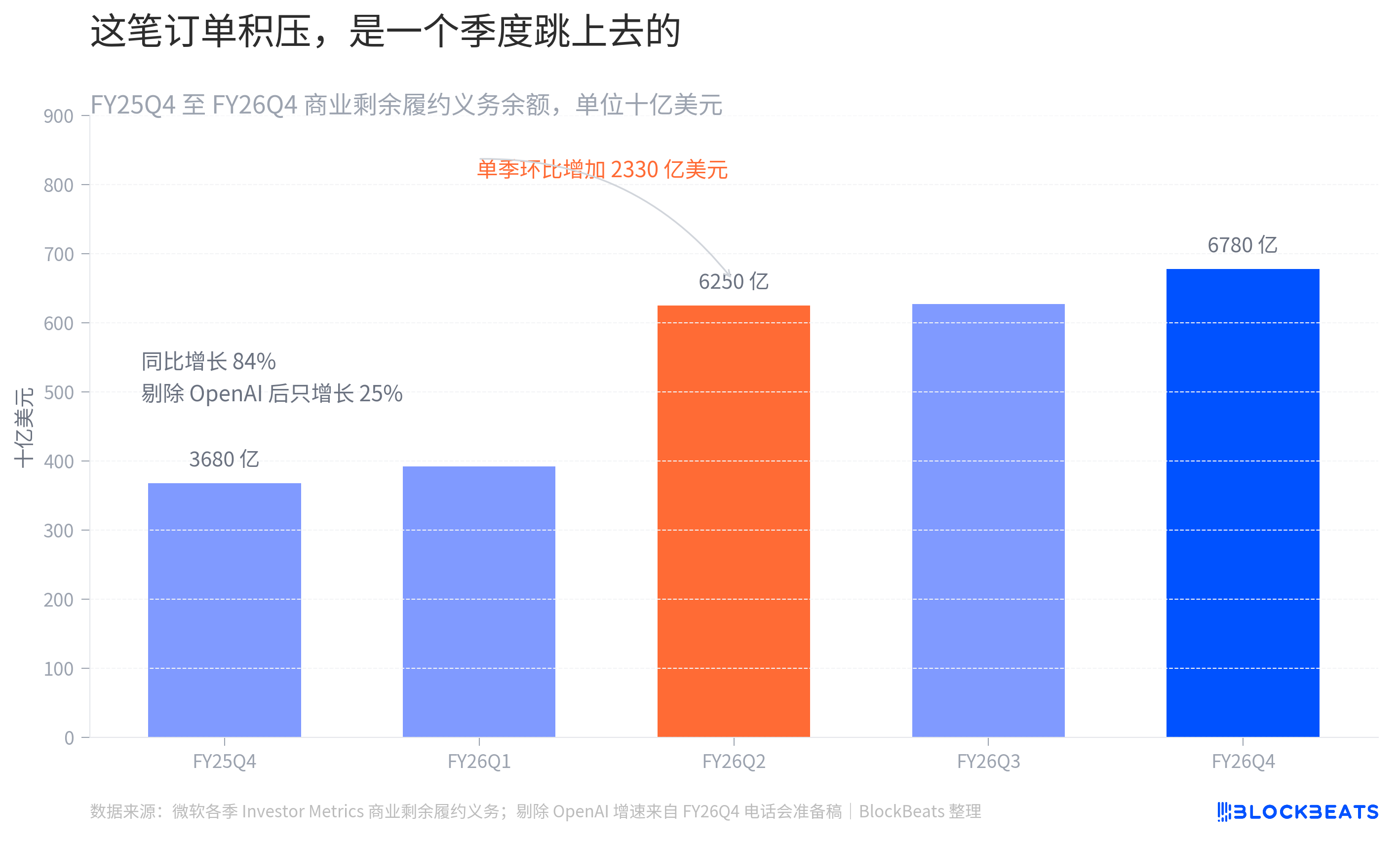
The bar in the chart didn't grow slowly; it jumped up in a single quarter, the second quarter of fiscal 2026, with a sequential increase of $233 billion, corresponding to the contract with OpenAI. Hood provided another metric on the call: excluding OpenAI, the year-over-year growth was 25%. The same pattern applies to commercial orders; reported growth was 10%, but excluding the OpenAI impact, growth was 18%.
The timeframe also needs consideration. According to the 10-K and the earnings call, the weighted average recognition period for this backlog is about 2.3 years. Only about 30% is expected to be recognized within the next 12 months, while the remaining 70% is scheduled beyond one year, and the year-over-year growth rate for this 70% portion is 112%. In other words, the $678 billion is more like a check to be cashed over several years, while the money for server rooms and graphics cards needs to be paid this year.
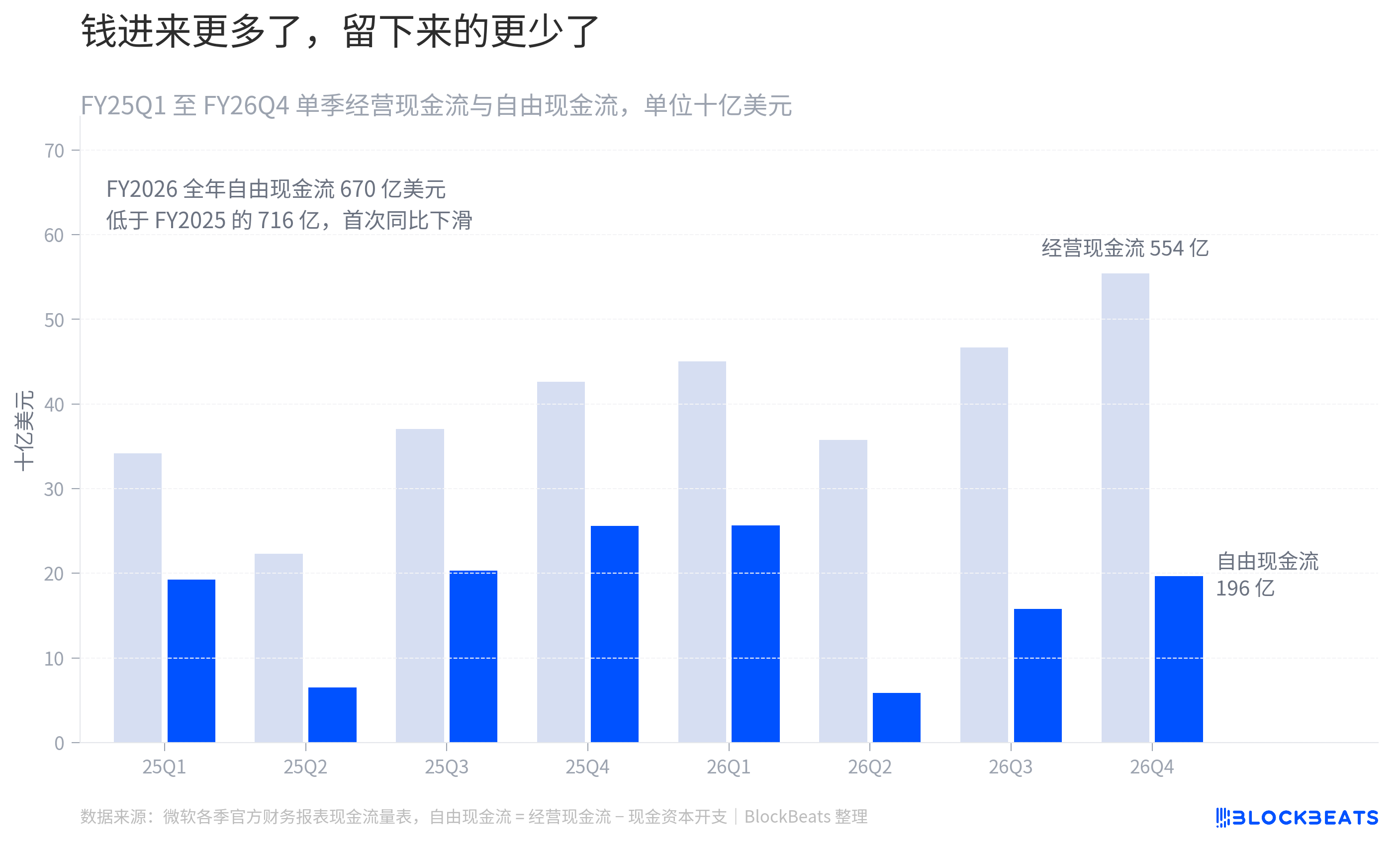
This quarter's operating cash flow was $55.4 billion, up 30% year-over-year, an all-time high. Free cash flow was $19.6 billion, down 23% year-over-year. Looking at the full year, free cash flow for fiscal 2026 was $67 billion, lower than the $71.6 billion of the previous fiscal year. This is the first time since Microsoft entered this AI investment cycle that full-year free cash flow has declined year-over-year.
Depreciation has begun to eat into the income statement. According to the property and equipment note in the 10-K, depreciation expense for fiscal 2026 was $34.3 billion, compared to $15.2 billion two years ago. Microsoft Cloud's gross margin fell to 65% this quarter from 68% a year ago, declining for four consecutive quarters. This metric is more worth tracking than capital expenditure, because capital expenditure can be shifted through accounting treatment, but once depreciation starts on machines, it must be accrued annually.
An Unexpected Surprise in the Opposite Direction
Microsoft's non-GAAP earnings per share this quarter were $4.74, lower than the GAAP $4.81. This is opposite to the direction seen for most companies, because Microsoft defines non-GAAP as excluding the impact of the equity method from OpenAI, and for fiscal 2026, this impact was a net gain of $4.963 billion. According to the 10-K explanation, this gain mainly came from the dilution gain when Microsoft's stake was diluted during OpenAI's restructuring in October 2025, not from operational earnings. The same line item in the previous fiscal year was a net loss of $3.62 billion.
The same note also hides an inconspicuous figure. Microsoft's revenue from the OpenAI commercial agreement in fiscal 2026 was $24.1 billion, and its accounts receivable from OpenAI at the end of the period were $6 billion. Microsoft currently holds approximately a 25% equity interest in OpenAI, calculated on an as-converted basis.
This quarter, Microsoft proved it can sell its computing power. And the moment the market gave an 8% gain, its approval was for moving a portion of those computing power costs out of the capital expenditure line.


