






Decoding Robinhood’s Public Chain: Global Launch of Stock Tokens + 7% Yield on Morpho + AI Agent Trading


- Core Thesis: Robinhood launched its own EVM-compatible Layer-2 public chain, Robinhood Chain, in 2026, marking a major traditional financial giant directly entering the Web3 infrastructure competition. By offering products like tokenized U.S. stocks, stablecoin yields, and AI agent trading, it aims to bring mainstream users on-chain at scale, potentially reshaping the industry's traffic and liquidity landscape.
- Key Elements:
- Robinhood Chain is built on Arbitrum technology, positioned as a permissionless L2 specifically designed for RWA and AI finance, integrating top DeFi protocols like Uniswap on day one.
- Its core product, Stock Tokens, enables users in over 120 countries to trade tokenized U.S. stocks (e.g., NVDA) 24/7 with DeFi composability, but these are debt instruments with no legal ownership rights.
- Robinhood Earn offers approximately 7% self-custody yield on USDG via the Morpho protocol, backed by insurance, bringing self-custody + DeFi yields directly to mainstream users for the first time.
- AI agent trading is extended to on-chain assets, combining account abstraction and session keys to connect the AI-driven agentic economy entry point with the tens-of-millions user app.
- With nearly 28 million monthly active users averaging 36 years old, Robinhood aims to convert them into native on-chain participants, representing a significant TradFi attempt to bring crypto users into the mainstream.
- Key risks include: regulatory uncertainty for Stock Tokens, unavailability to U.S. domestic users, initial ecosystem dependence on Robinhood's centralized traffic, and security liability issues with AI agents.
July 1, 2026, London. At a launch event titled "The World is Flat," Robinhood officially announced the mainnet launch of Robinhood Chain.
This is not just another slogan of ours supporting crypto, but a traditional financial giant with nearly 28 million funded users and over $370 billion in platform assets, personally launching its own Ethereum-compatible Layer-2 public chain.
Built on Arbitrum, it focuses on RWA (Real World Asset) tokenization, integrating major DeFi and infrastructure players like Uniswap, Morpho, Chainlink, and BitGo on day one. Stock Tokens are available for 24/7 trading in over 120 countries, USDG can earn approximately 7% self-custodial yield on-chain, and AI Agents can directly trade on your behalf.
For Web3 users, this serves as both a heavy blow and a mirror: when TradFi is no longer content with just onboarding into crypto but directly builds its own chain, issues its own tokens, and competes for traffic, are we welcoming incremental growth, or witnessing the onset of being absorbed?
This report is specifically analyzed from a Web3 perspective.
1. Why Is This Different? Robinhood Is No Longer Just an App for Buying Coins
In recent years, Robinhood's image within the crypto circle has been divided: it introduced countless newcomers to BTC and ETH, but was also criticized as a centralized malignancy due to frequent outages, withdrawal restrictions, and PFOF controversies.
In 2026, the landscape has changed.
The company's strategy has evolved from a retail trading tool to a three-tier objective:
- Top platform for active traders
- Number one in wallet share for the next generation of users
- The world's premier financial ecosystem
To achieve the third point, it chose the most hardcore path – building its own chain.
The positioning of Robinhood Chain is very clear:
An L2 that is permissionless, EVM-compatible, and purpose-built for RWA and AI-native finance.
The technical foundation is Arbitrum Dedicated Blockchains, inheriting Ethereum's security while offering high throughput, low fees, and support for ERC-4337 account abstraction. Gas is paid in ETH, uses a first-in-first-out ordering mechanism, and is completely open for developers to deploy contracts.
It is not a closed consortium chain but a genuine public chain.
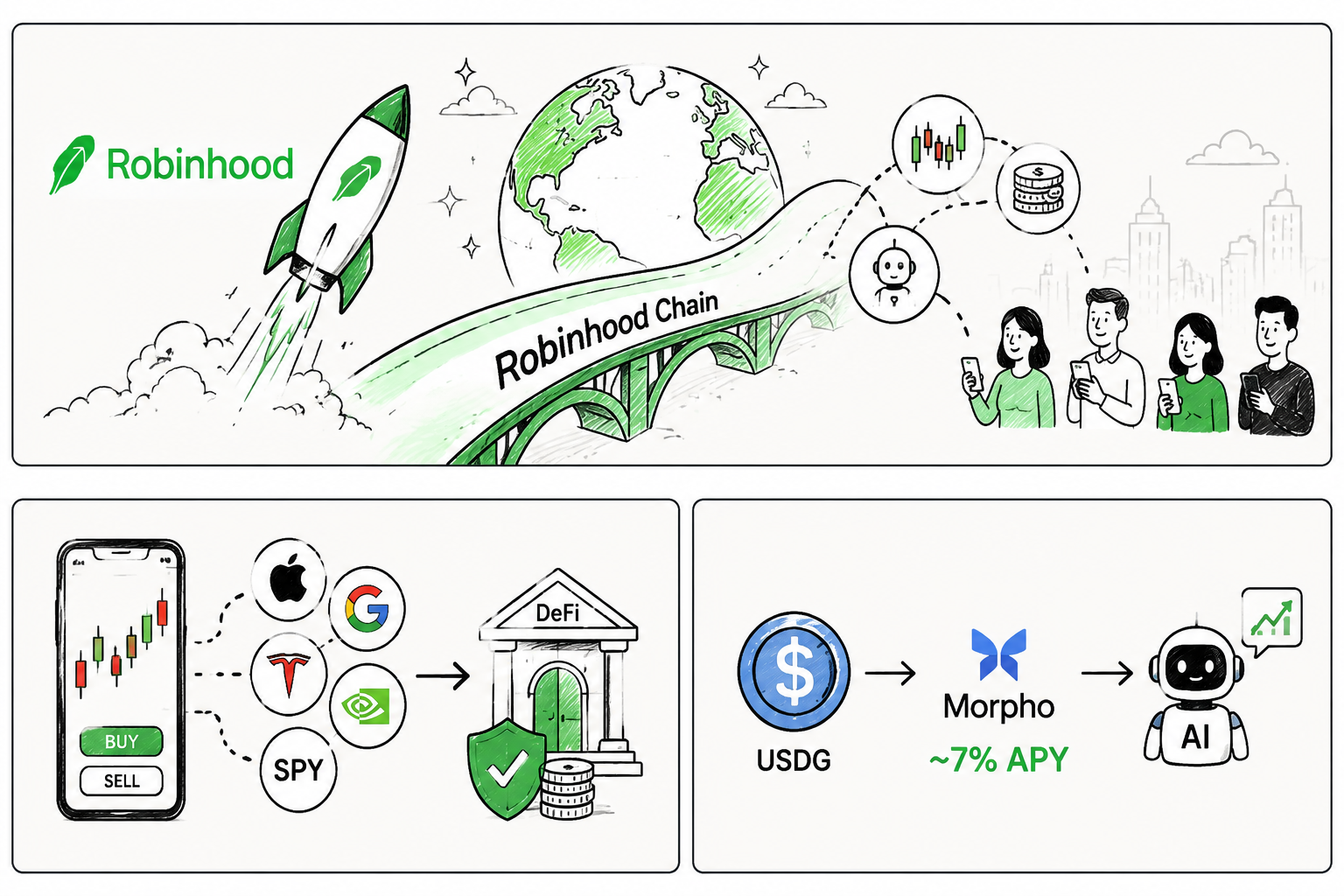
2. The "Welcome Package" on Mainnet Launch Day: Three Key Things for Web3 Users
Stock Tokens: Tokenized US Stocks Go Live
This is currently the most eye-catching product.
Users can trade tokenized US stocks and ETFs (including popular picks like NVDA, AAPL, GOOG) in over 120 countries via the Robinhood Wallet. These are tokenized debt securities issued by a Jersey entity, providing economic exposure but not granting legal ownership or voting rights.
Key highlights:
- 24/7 trading, unrestricted by traditional market opening hours
- Directly usable as collateral in DeFi
- Depositable into lending protocols
- Tradable on DEXs like Uniswap
For Web3 users, this effectively brings US stock liquidity directly onto the chain. Although it's not true stock ownership (regulatory red lines remain), it transforms tokenized stocks from a concept into a tradable, composable asset.
Robinhood Earn: Approx. 7% Self-Custodial Yield on USDG
Based on the Morpho protocol, users can lend out USDG (a USD stablecoin issued by Paxos), with an estimated APY of around 7%, backed by insurance from Lloyd’s of London and RELM.
This marks the first time Robinhood has truly pushed a self-custodial + DeFi yield product to mainstream users. For TradFi users accustomed to centralized finance, this is a disruptive form of education; for seasoned DeFi users, it represents a massive influx of traffic from a major player.
AI Agentic Trading On-Chain
AI agent trading, which launched for stocks and options in May, now extends to crypto and on-chain assets. Users can authorize an AI Agent to autonomously execute trading strategies while retaining control of their funds.
Combined with account abstraction and session keys, this makes the concept of an AI trader a reality. For Web3, this means the gateway to the agentic economy could be directly opened by an app with tens of millions of users.
3. Ambitions Revealed by Ecosystem Partners
The list of partners announced at the mainnet launch is quite telling:
- Uniswap: Deploys a dedicated AMM to serve as a public liquidity pool
- Morpho: The underlying lending protocol
- Chainlink: Oracles and cross-chain data
- BitGo & Fireblocks: Institutional-grade custody
- Alchemy: RPC and account abstraction infrastructure
- LayerZero: Cross-chain bridge
- Lighter, Arcus, 1inch, Rialto, etc.: Spot and perpetual trading
This isn't superficial support for a few protocols; it directly positions Robinhood Chain as the settlement layer for financial primitives.
More notably, Robinhood has explicitly stated its intention to gradually replace its own internal infrastructure with the blockchain. In other words, the chain is not just a value-added service, but a part of the long-term architecture.
4. Why Must Web3 Users Take This Move Seriously?
The Real User On-Ramp Has Arrived
Robinhood has nearly 28 million funded customers, with an average age of around 36, entering their peak earning years. Previously, these users might have just bought some coins within the app; now they have direct access to self-custodial wallets, DeFi yields, and on-chain stocks.
This is, by far, the most significant attempt to pull traditional users into the on-chain world at scale.
The RWA Narrative Finally Has a Real Trading Scenario
Many previous RWA projects were stuck in the phase of "we tokenized US Treasuries," plagued by low liquidity and few users. Robinhood is directly tokenizing the most attractive assets (US stocks) and opening them up for 24/7 trading + DeFi composability. This is genuine product-market fit.
The competitive landscape is being rewritten.
Previously, crypto circles debated whether Coinbase would lose market share to Binance. Now, we must consider an additional layer: when Robinhood, and potentially Schwab or Fidelity in the future, start building their own L2s or dedicated chains, how will traffic and liquidity be redistributed?
Robinhood Chain's choice of the Arbitrum technology stack, along with its commitment to channel some protocol fees back into the ecosystem, is itself a vote of confidence in the current L2 landscape.
5. Staying Calm: The Risks That Must Be Acknowledged
No matter the hype, several significant drawbacks cannot be ignored:
- Stock Tokens are not real stocks. They are debt instruments with no shareholder rights. If regulation tightens, the product structure may be forced to change.
- US-based users currently cannot access Stock Tokens. Excluding the most core market highlights that compliance remains the biggest bottleneck.
- Centralized inertia persists. While it's a public chain, the initial ecosystem and liquidity are heavily dependent on Robinhood's own traffic and products. The true degree of permissionlessness remains to be seen.
- Security and liability issues with AI Agents. When users delegate trading authority to an AI, who bears responsibility for significant losses? This will become a new governance challenge in the Web3 world.
6. Final Thoughts: This Isn't the Wolf Crying, but the Emergence of a New Species
The launch of Robinhood Chain marks the first time a traditional financial giant has entered the core battleground of Web3 – asset issuance, trading, lending, yield generation, and AI agents – by building its own public chain.
For pure crypto-native players, this might feel like an invasion.
For pragmatic builders, it represents a massive opportunity for growth: more users, more real assets, and more composable scenarios.
Regardless of which side you are on, one thing is now clear –
When Robinhood starts taking public chains seriously, Web3 is no longer just the world of cryptocurrencies, but the new underlying layer for the entire financial market.
In the coming quarters, only three key metrics truly matter:
- Actual trading volume and number of holders for Stock Tokens
- Deposit scale of Robinhood Earn
- Growth curve of on-chain independent developers and TVL
If these three indicators continue to rise, then 2026 could very well be the year TradFi and Crypto begin their deep convergence.
And you, are you ready?


