






From HBM to Cold Storage: Storage's Big Six at a Crossroads – What Will Drive the Next Bull Run?


- Key Thesis: The current AI storage cycle has expanded from HBM-driven high-speed memory to large-capacity, low-cost long-term storage solutions like server DRAM, enterprise SSDs, and HDDs. However, with stock prices generally pulling back 20%-30%, the market phase is shifting from "demand explosion" to "order and profit delivery." The core driver for the next cycle will hinge on long-term orders, price transmission, and free cash flow.
- Key Factors:
- AI storage demand is broadening from GPU-adjacent HBM (solving bandwidth) to the entire data infrastructure, including high-frequency access SSDs and data archiving HDDs. The investment narrative is evolving from "faster storage" to "more and cheaper storage."
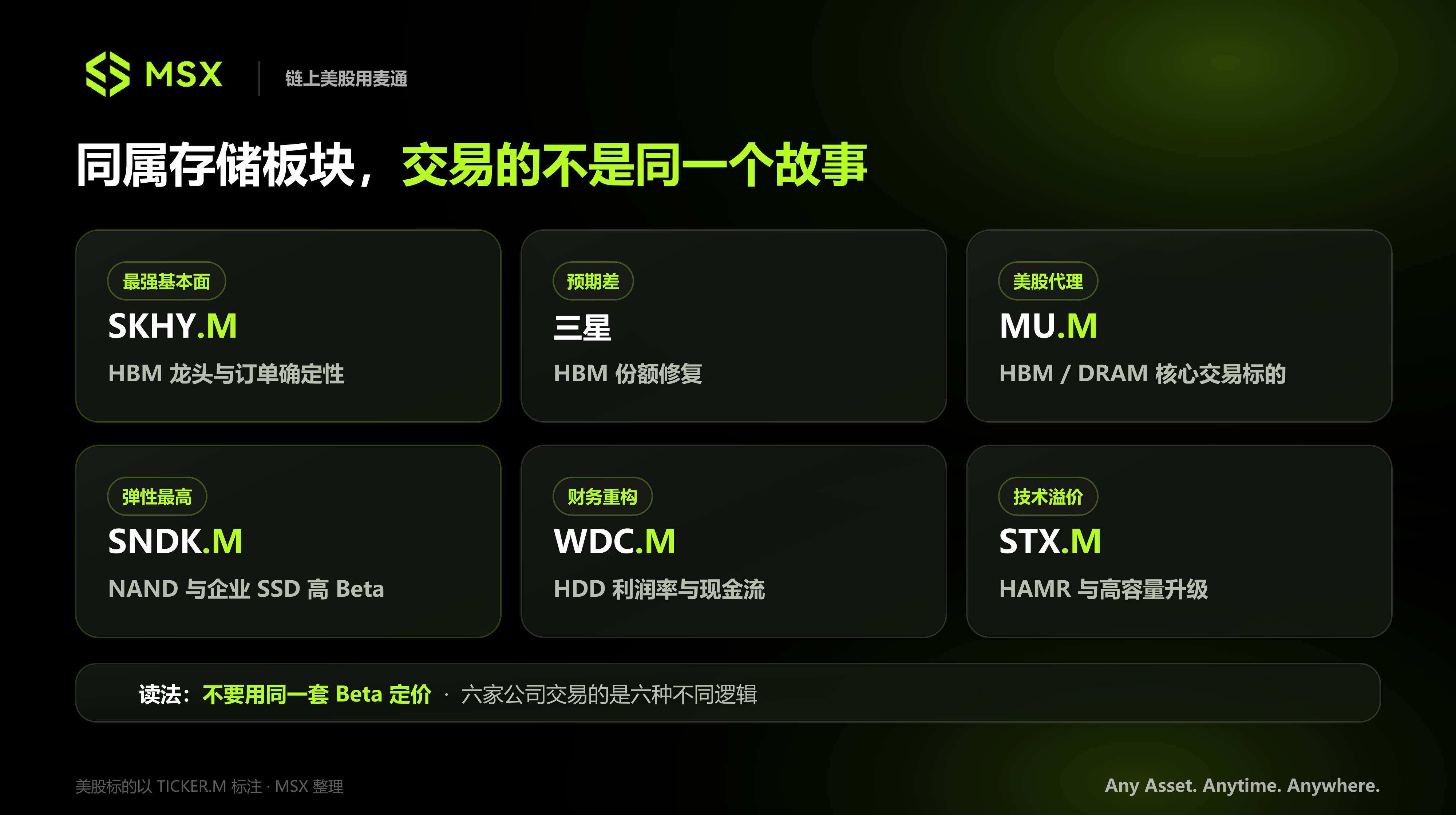
- The six companies represent different investment theses: SK hynix trades on its HBM market leadership; Samsung on technology catch-up and market share recovery; Micron is the most direct HBM/DRAM proxy in U.S. equities; SanDisk is most sensitive to NAND price increases; Seagate and Western Digital benefit from high-capacity HDDs and data lake demand.
- The market has entered a highly volatile phase. After peaking in June, the stock prices of these six firms have generally retreated 20%-30%. Even with strong earnings reports from companies like Micron, the market is now questioning product price sustainability and the impact of new capacity additions in 2027-2028 on supply and demand.
- The key catalysts for the next cycle have already been upgraded. It is no longer about product launches or sampling, but whether these can translate into long-term orders, upward earnings guidance, and sustainable free cash flow growth.
Key Takeaways:
- This storage market cycle is not just an ordinary price cycle; it is a gradual expansion of AI infrastructure demand from HBM to server DRAM, enterprise SSDs, NAND, and HDD. The market's trading focus has also shifted from "faster storage" to "more, cheaper, and long-term preservation storage."
- The six companies correspond to different investment theses: SK Hynix (SKHY.M) trades on its HBM leadership and order visibility; Samsung trades on technology catch-up and market share recovery; Micron is the most direct HBM and DRAM proxy in the US stock market; SanDisk is most sensitive to NAND and enterprise SSD price increases; Seagate and Western Digital benefit from high-capacity HDD, data lake, and cold storage demand.
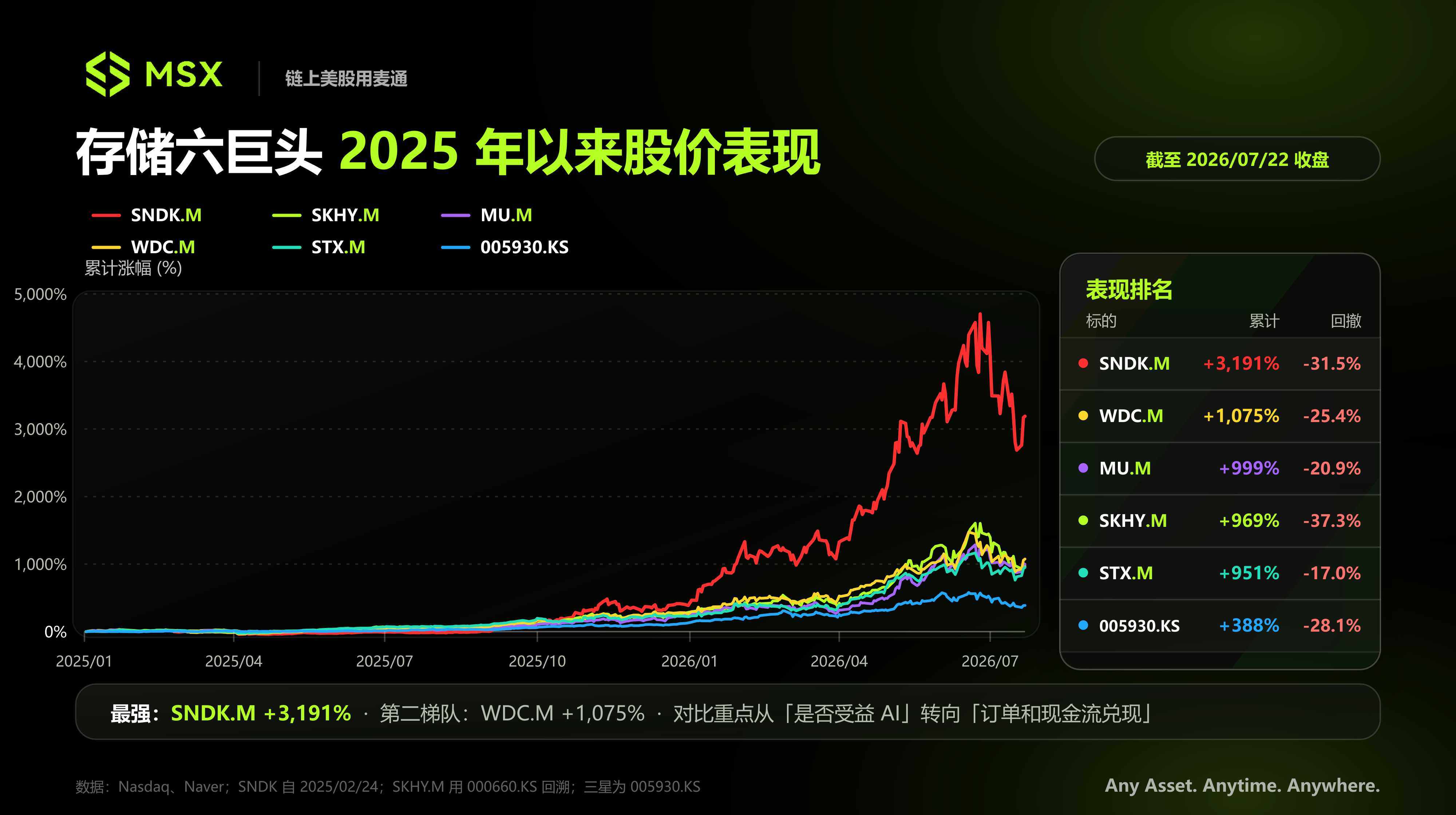
- Since 2025, all six companies have undergone significant revaluation. However, as of mid-July 2026, they have generally retreated about 20%-30% from their cyclical highs. The sector is transitioning from the "demand explosion and profitability recovery" phase to a phase of high expectations, high valuations, and high volatility.
- Historical performance shows that catalysts capable of creating sustained momentum are typically not product launches or sampling, but rather earnings beats, key customer qualifications, volume deliveries, next-year order bookings, and upward revisions to revenue, price, and margin guidance.
- The core of the next leg of the rally will depend on who can convert demand into long-term contracts, higher product prices, managed capacity expansion, and sustainably growing profits and free cash flow.
In June 2026, Micron (MU.M) reported earnings that were nearly flawless by any standard.
The company posted quarterly revenue of $41.456 billion, a non-GAAP gross margin of 84.9%, adjusted free cash flow exceeding $18.3 billion, and guided next quarter's revenue even higher to around $50 billion. In other words, whether looking at product prices, margins, or order visibility, all signs point to the same conclusion: AI storage demand remains robust.
However, the market's reaction was not as straightforward as in the past.
Micron's stock initially surged following the report but quickly gave back those gains. SanDisk, SK Hynix, Samsung Electronics, Western Digital, and Seagate also pulled back from their June highs. On a split-adjusted basis, as of July 22, the six companies have generally retreated roughly 20%-30% from their cyclical peaks, with some individual stocks down over 30%.
The irony is that fundamentals haven't suddenly weakened, and AI data centers haven't stopped expanding. Investors are no longer questioning whether AI will drive greater storage demand; instead, they are beginning to ask how much longer product prices can rise and whether new capacity additions in 2027-2028 will shift the supply-demand balance once again.
The storage sector has thus arrived at a new inflection point.
1. The Expansion of the AI Storage Rally Since 2025
The storage market rally since 2025 was initially ignited by HBM.
Large model training requires GPUs, and large-scale GPU clusters need a high-bandwidth, lower-latency memory system. By vertically stacking multiple layers of DRAM, HBM dramatically increases data throughput, quickly becoming one of the most critical, highest-margin, and supply-constrained components in AI accelerators.
SK Hynix (SKHY.M), leveraging its leadership in HBM3E products, key customer relationships, and mass production advantages, was the first to undergo a revaluation of its earnings power.
By Q3 2025, the company had already indicated that discussions for the following year's HBM supply were largely complete, HBM4 would begin shipping in Q4, and the following year's DRAM and NAND production capacity was also largely covered by customer demand. By Q1 2026, the company's revenue, operating profit, and net profit continued to set new records.
Micron (MU.M) became the most convenient core vehicle for US markets to trade on HBM and server DRAM supply and demand dynamics. This was especially true as HBM4 entered volume shipments, server memory prices rose, and multiple long-term customer agreements collectively boosted its revenue, gross margins, and cash flow.
Therefore, for US equity investors, the significance of Micron's earnings reports extends beyond the company itself. When Micron raises its revenue, price, and margin guidance, the market typically re-evaluates the profit potential for the entire storage industry.
Samsung Electronics followed a different path.
In 2025, the market primarily priced in its lag in HBM product progress, customer qualifications, and yields compared to SK Hynix. Entering 2026, as HBM4 began commercial deliveries and HBM4E entered the sampling phase, coupled with a significant improvement in its memory business margins, Samsung's valuation logic began shifting from "lagging behind" to "catching up."
The company's preliminary Q2 2026 results showed quarterly sales of approximately KRW 171 trillion and operating profit of about KRW 89.4 trillion. Of course, this data includes businesses like smartphones, foundry services, displays, and consumer electronics, and cannot be directly viewed as the independent performance of the memory division.
What truly drove the sustained expansion of this market cycle was not just HBM itself.
As manufacturers allocated more wafers, capital expenditure, and advanced packaging resources to high-value AI products while maintaining relatively strict supply discipline, the supply-demand dynamics for server DDR5, general DRAM, and NAND also improved.
Simultaneously, as AI progressed further from training to large-scale inference, storage demand began spreading from the GPU periphery to the entire data ecosystem.
Model weights, vector databases, key-value caches, inference context, and frequently accessed data drove demand for higher capacity and performance in enterprise SSDs. Meanwhile, training data, videos, multimodal materials, inference logs, historical model versions, and compliance archives required more cost-effective and scalable high-capacity storage.
SanDisk (SNDK.M) emerged as the most elastic stock in the sector during this phase.
Following its separation from Western Digital (WDC.M) in February 2025, SanDisk transformed from a part of a hybrid HDD and flash company into a purer NAND and SSD play in the US stock market. In its latest fiscal quarter, the company's data center revenue grew 233% sequentially. It signed new commercial model agreements with financial guardrails, and announced a stock buyback program of up to $6 billion after repaying debt.
As AI data continues to accumulate, demand has further expanded from high-speed storage to high-capacity storage.
Not all data—such as model training data, videos, multimodal data, inference logs, historical versions, and compliance archives—needs to reside permanently on expensive SSDs. A large volume of infrequently accessed but long-term retention data ultimately finds its way to nearline HDDs and tiered storage systems.
Western Digital reported a non-GAAP gross margin of 50.5% in its latest fiscal quarter, with free cash flow of $978 million. The company expects exabyte shipments of its nearline HDDs to grow at a mid-to-high single-digit rate or higher over the next three to five years.
Seagate (STX.M), meanwhile, commanded a more obvious technology premium thanks to the commercialization of its HAMR technology. In its latest quarter, the company reported a non-GAAP gross margin of 47% and free cash flow of $953 million. Its highest-capacity Mozaic 4+ products, reaching 44TB, have already begun volume shipments to two top-tier hyperscale customers.
Therefore, this storage cycle cannot be simply summarized as a price upswing. It is more akin to a step-by-step expansion of the storage demand radius as AI infrastructure deployment deepens. HBM solves the bandwidth problem around GPUs, server DRAM handles workloads during computation, enterprise SSDs support high-frequency data access, and HDDs accommodate the ever-expanding data lakes and long-term archives.
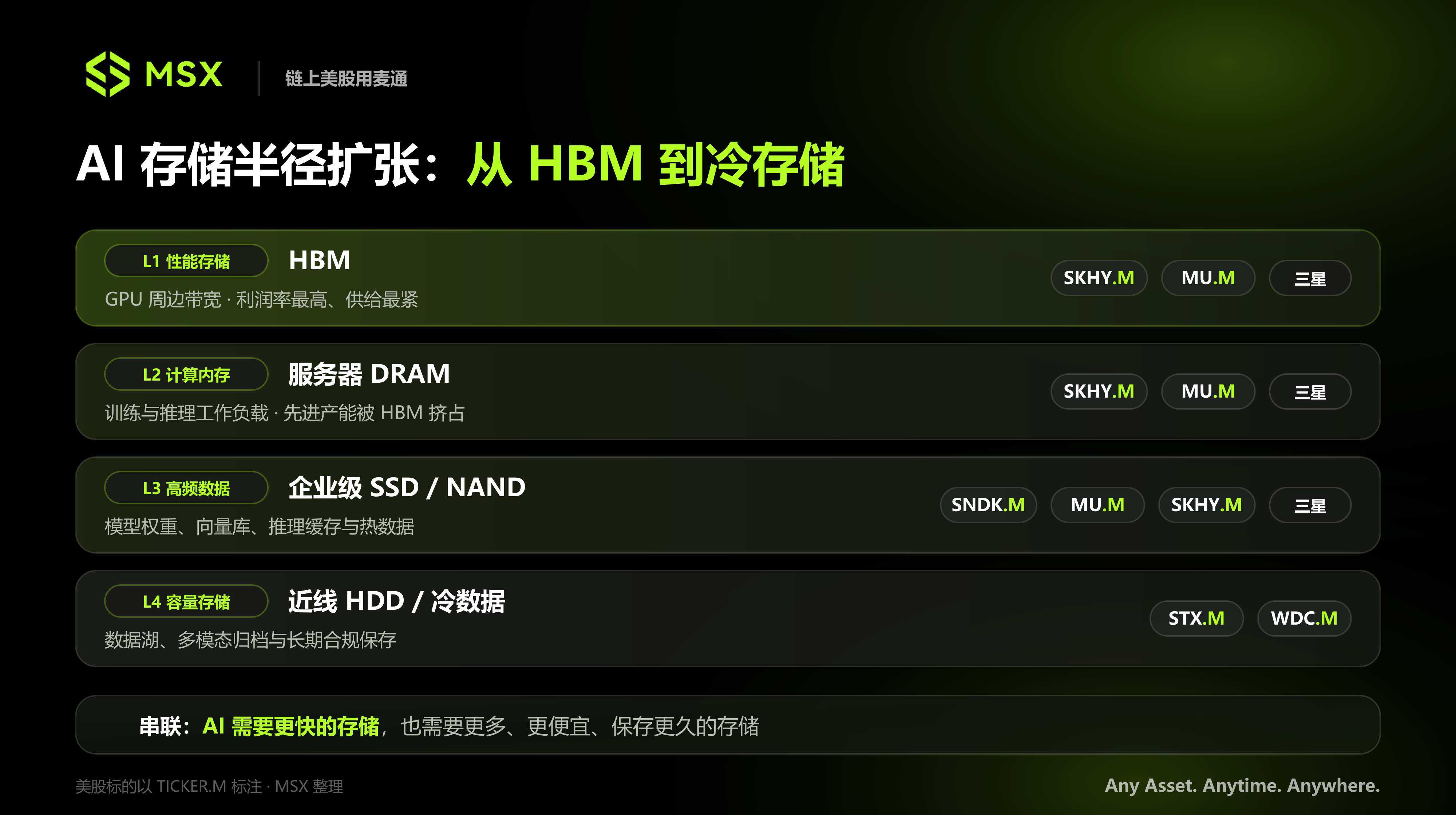
To some extent, the market initially traded on the idea that "AI needs faster storage," and subsequently on "AI needs more storage." This industrial logic—spreading from HBM to server DRAM, NAND, enterprise SSDs, and HDDs—is fully reflected in the stock price performance of these six companies.
On a split-adjusted basis, from the start of 2025 (or the first trading day post-split) to July 22, 2026, all six companies underwent significant revaluations, though the magnitude and timing of the rallies differed:
- SK Hynix and Micron benefited earliest from the upcycle in HBM and server DRAM.
- Samsung subsequently began trading on its HBM technology catch-up and market share recovery.
- SanDisk, after its spin-off, became the most elastic stock in this cycle due to its purer NAND and enterprise SSD exposure.
- Western Digital and Seagate took over the rally in the first half of 2026, as the market began incorporating nearline HDD, high-capacity products, and cold data demand into its AI infrastructure valuation framework.
Breaking down the past 18 months of market action, it can be roughly divided into four phases:
- First Half of 2025: Market Initially Traded HBM. SK Hynix and Micron were the most direct beneficiaries. Investors began confirming that HBM demand wasn't a short-term inventory restock but a long-term high-margin product associated with the expansion of AI accelerators.
- Second Half of 2025: Rally Spread to General DRAM and NAND. HBM's consumption of advanced wafer, packaging, and test resources tightened supply for server DRAM and other memory products. The market began raising earnings estimates for companies like Samsung and SanDisk.
- First Half of 2026: Enterprise SSDs and HDDs Took Over. As AI moved from training to inference, storage demand was no longer centered solely on high-speed memory near GPUs. Training data, inference logs, and long-term archiving needs drove a repricing of HDDs and cold storage.
- June-July 2026: Shift to High Expectations and High Volatility. The cyclical highs for the six stocks were almost all concentrated in June. Thereafter, even strong earnings reports from companies like Micron failed to sustain the previous one-sided upward trend.
This pullback signals that the market's pricing logic is changing. The previous stock price rally relied on the continuous strengthening of three consensuses: continuously expanding AI storage demand, tight industry supply, and room for further increases in product prices and margins.
However, after significant revaluation, investors are simultaneously considering other issues: whether current valuations have already priced in future growth, whether positioning is too crowded, whether new capacity additions in 2027-2028 will gradually come online, and how much of the robust demand can ultimately translate into long-term orders and free cash flow.
Thus, this collective pullback seems more like a signal of the storage market cycle transitioning from its first phase to a second phase. Future performance will depend more on who can offer longer order visibility, stronger pricing power, and more sustainable profit growth.
2. All Six Are in Storage, But They Trade on Different Stories
Looking only at stock prices, the six companies appear to be part of the same AI storage market cycle.
However, in terms of industrial positioning, profit elasticity, and catalysts for the next phase, they represent six distinct pricing logics.
SK Hynix remains the company with the strongest industrial position and highest order visibility among the six.
Its core advantage isn't just its leading HBM market share, but also its ability to lock in customers, prices, and next-year capacity earlier. Compared to mere product launches, early order coverage more easily improves the visibility of future revenue and profits, and more readily fosters sustained market momentum.
However, with the NASDAQ listing of SKHY in July 2026, a new layer of trading dynamics was added. SKHY was issued at $149 and closed its first day around $168. With limited US market float initially, the ADR traded at a noticeable premium to the ordinary shares in Korea. Naturally, as conversion and arbitrage mechanisms gradually open up, this premium may converge.
Therefore, it's necessary to analyze the company's fundamentals separately from the ADR's supply-demand dynamics.
The ordinary shares in Korea more purely reflect HBM orders, prices, and margins. SKHY, on the other hand, is also influenced by US capital access restrictions, float size, ETF allocations, and arbitrage mechanisms. This implies that even if the company's operations remain strong, the ADR could experience volatility independent of fundamentals due to increased supply.
Micron is the most direct US-listed proxy and the stock most susceptible to being traded ahead of events.
Its strength lies in covering HBM, server DRAM, NAND, and enterprise SSDs simultaneously, and it benefits from US domestic manufacturing and supply chain policy support. When Micron raises product prices, gross margins, and guidance, the market often revises upward its earnings expectations for the entire storage sector. Its earnings reports are not just a catalyst for the company itself but also an important price signal for the global storage industry.
However, its problem is equally clear: the market adjusts expectations for it extremely quickly.
Simply put, when valuations are low and industry expectations are weak, a strong earnings beat can trigger sustained revaluation. Once in a phase of high expectations, simply performing well is no longer sufficient. The stock price needs prices higher than the market's most optimistic forecasts, longer order visibility, and more substantial upward margin revisions to sustain a rally.
This explains why Micron's one-day post-earnings volatility remains significant, but the sustainability of its moves has started to decline.
Samsung Electronics has experienced relatively less upside, but its market share recovery offers the most clear-cut upside potential.
It is not the purest fundamental play in this cycle. Its foundry, smartphone, consumer electronics, and display businesses dilute the impact of memory profit improvements on the conglomerate's overall earnings. Its earlier lag in HBM customer qualification also caused its stock performance to lag behind SK Hynix and Micron.
Conversely, Samsung also possesses the clearest "expectation gap" among the six. The market already knows SK Hynix is the HBM leader, but it remains uncertain how much high-end HBM business Samsung will ultimately secure.
Therefore, the truly meaningful catalysts for Samsung in the next phase are whether key customer qualifications are completed, products enter volume procurement, the HBM revenue share increases, and market share along with memory business margins improve synchronously. Once these metrics begin to materialize, Samsung's narrative will upgrade from "technology catch-up" to "market share recovery."
SanDisk is gradually transitioning from a pure play on NAND price increases to a trade on contract visibility.
It is the stock with the highest price elasticity in this cycle, but also the one with the greatest risk when expectations cool. On one hand, its business has high purity in NAND and enterprise SSDs, making it extremely sensitive to product prices and industry inventory changes. On the other hand, the independent valuation framework post-spin-off, data center revenue growth, and long-term business agreements have further amplified the potential for upward earnings revisions.
However, a noteworthy change is occurring at SanDisk. In the past, the market primarily viewed it as a high-beta proxy for NAND price hikes. Recently, with an increase in agreements featuring minimum purchase commitments, financial guardrails, or long-term collaboration mechanisms, investors are beginning to assign higher valuations to its revenue and cash flow visibility.
While the commencement of BiCS10 sampling is an important product milestone, it may not directly create sustained market momentum. What truly needs to be observed is whether the product passes enterprise customer qualification, enters volume procurement, and ultimately reflects in average selling prices, data center revenue, and gross margins.
After all, for high-valuation cyclical stocks, technological advancement is just the starting point; order fulfillment is the destination.
Western Digital and Seagate are both benefiting from HDD demand, but their revaluation paths differ, as do their core investment theses.
Western Digital's revaluation is more skewed toward financial structure. After completing the flash memory spin-off, WDC became a purer HDD company. The increased proportion of high-capacity products, improved pricing per TB, industry supply discipline, and operating leverage jointly drove higher gross margins and free cash flow.
Therefore, WDC's stock price sometimes doesn't fully react on the first day after an earnings report. The market needs confirmation that margin improvements aren't due to inventory, currency, one-time factors, but rather from sustained changes in long-term orders, product mix, and industry supply discipline.
Seagate's revaluation leans more towards the value of its technology and production capacity. HAMR technology can increase per-drive capacity without significantly increasing the physical number of hard drives, reducing cost per TB and increasing the sales value of each unit. As products exceeding 40TB enter volume deliveries, the market is no longer just trading on HDD shipment growth, but on the penetration rate of new-generation products, scarcity of production capacity, and long-term margin profiles.
This is why Seagate's earnings catalysts often have stronger sustainability. Investors revise upward not just current EPS, but also the capacity upgrade path and earnings power


