Movement Labs Files for Bankruptcy, Movement Industrial and Foundation Poised to Be the Biggest Winners


- Core Thesis: The bankruptcy filing by former development company Movement Labs is a meticulously orchestrated "shell game" designed to transfer assets, intellectual property, and the team to new entities—Move Industries and the Movement Foundation—thereby cutting off risk and evading investigations and lawsuits from the U.S. Department of Justice concerning the MOVE token sell-off.
- Key Elements:
- Core Assets Transferred Before Bankruptcy: Through the "Fenix Project Agreement," Movement Labs transferred its intellectual property and contracts to the Movement Foundation, relinquished the right to issue MOVE tokens, and transferred the team to Move Industries for $1.2 million.
- Bankrupt Entity is Now an Empty Shell: At the time of filing for bankruptcy, Movement Labs had no operating assets, no employees, and only approximately $60,000 in cash, with liabilities of up to $10 million. The primary purpose is to leave behind legacy risks such as litigation claims.
- Bankruptcy Strategy Selected: The company chose the small business simplified bankruptcy process (Subchapter V of Chapter 11) to avoid forming a creditors' committee that would conduct a potentially burdensome review, aiming to complete the process quickly.
- Financing Terms Protect New Entities: A subsidiary of the Movement Foundation provided a $5.7 million loan, but with stringent conditions, including prohibiting investigations or lawsuits against the Movement Foundation, Move Industries, and the transferred executives and employees. The terms explicitly exclude the scandal-plagued former co-founder, Rushi Manche.
- Bankruptcy Background: Movement Labs was previously facing a federal grand jury investigation by the U.S. Department of Justice over a scandal involving the sale of 66 million MOVE tokens linked to Rushi Manche and insider trading. This bankruptcy filing aims to clear compliance hurdles for the Movement Network and the MOVE token.
Original by Odaily Planet Daily (@OdailyChina)
Author: Wenser (@wenser 2010 )

Last night, news that "Movement developer Movement Labs filed for bankruptcy protection" sent shockwaves through the crypto community. No one expected that this "star L2 project," which had previously sought $100 million in funding at a $3 billion valuation, would end up bankrupt.
However, as more details emerged, the truth finally came to light: Only the former development company, Movement Labs, filed for bankruptcy, and it has no impact on the Movement network. The Movement network was already taken over by Move Industries in May 2025 and has since transitioned into an L1 network focused on cross-border payments and stablecoin settlement. Move Industries CEO Torab alsoconfirmed this news in a post.
Just as we thought this was merely a cliché "legacy issue from developer team rotation," a post revealing the true bankruptcy process of Movement Labs offered a different answer: This is not a simple bankruptcy filing but a meticulously planned "shell game" escape act.
Unraveling the Mystery of Movement Labs' Bankruptcy: The Former Developer Transforms into a Bankrupt Shell
According to a tweet from Thomas Braziel, a partner at the corporate insolvency firm 117Partner, Movement Labs' bankruptcy filing appears more like a premeditated "shell trick": Before declaring bankruptcy, the company had already transferred its operational business, intellectual property, contracts, token rights, and employees elsewhere, leaving the original company with only $60,000 in cash and litigation claims.
In other words, this is not a standard application for bankruptcy protection. It is a tactic to sever risks and protect Movement Industries and the Movement Foundation from litigation disputes, as these two entities are the recipients of the assets from the original Movement Labs.
In the bankruptcy protection filing submitted by Movement Labs, we can find more evidence supporting this view:
- In mid-July 2026, the company filed a Chapter 11 (Subchapter V, a streamlined process for small businesses) petition in the U.S. Bankruptcy Court for the District of Delaware. The company's assets are between $100,000 and $500,000, liabilities are up to $10 million, and it has ≤299 creditors.
- According to a prior "Fenix Project Agreement," Movement Labs transferred its remaining intellectual property and key contracts to the Movement Foundation, relinquished its right to issue MOVE tokens, and agreed to terminate its business operations.
- Movement Labs transferred its core team to Move Industries (the current developer of the Movement network) for a price of $1.2 million.
- As of the bankruptcy filing date, Movement Labs had no operating assets, no active business operations, and no full-time employees. It only had approximately $60,000 in cash. The company still faces litigation claims and residual rights issues from contracts.
- MNF DIP SPV Ltd., a Cayman Islands subsidiary of the Movement Foundation, is providing Movement Labs with a financing facility of up to $5.7 million for debt repayment and an exit plan. However, this is subject to a series of stringent requirements, including but not limited to the bankruptcy court recognizing and adhering to the "Fenix Project Agreement," requiring that the bankruptcy trustee be approved by the subsidiary, and prohibiting any investigation or lawsuit against the Movement Foundation, Movement Ltd., the DIP lender, and numerous affiliates. Notably, this also covers Cooper Scanlon (former co-founder of Movement), Ruby Sekhon (Chief Legal Officer of Polychain Capital), and all officers, directors, and employees of Move Industries (including CEO and head Torab Arya/Torab Torabi) who were transferred over. Former co-founder Rushi Manche, who was previously dismissed due to market manipulation and token insider trading scandals, and market-making institutions are not covered by this clause.
Thus, Movement Labs became the scapegoat shouldering all the blame, while the Movement Foundation (and its Cayman Islands subsidiary) and Move Industries effectively became the "benefactors" funding the creditor litigation, seizing the initiative to prioritize settlements and approve the trustee's bankruptcy plan. Whether former co-founder Rushi Manche, who acted as a creditor in the bankruptcy protection, can recover the $1.6 million in legal and litigation fees incurred from the lawsuits will also depend on the whim of the Movement Foundation's subsidiary. Currently, this subsidiary has temporarily approved $750,000 for the bankruptcy protection process.
This brings us to the distinction between Chapter 11 and its Subchapter V of the U.S. Bankruptcy Code.
According to public information, Chapter 11 bankruptcy protection applies to medium-to-large enterprises, requires establishing a creditors' committee, involves a complex and lengthy process, and incurs higher execution costs. In contrast, Subchapter V of Chapter 11 – the section used by Movement Labs for its bankruptcy filing – is tailored for small businesses (like Movement Labs, a "small business" with no full-time employees). The bankruptcy process under this subchapter is streamlined for speed and simplicity, potentially avoiding the more thorough scrutiny that a creditors' committee might undertake.
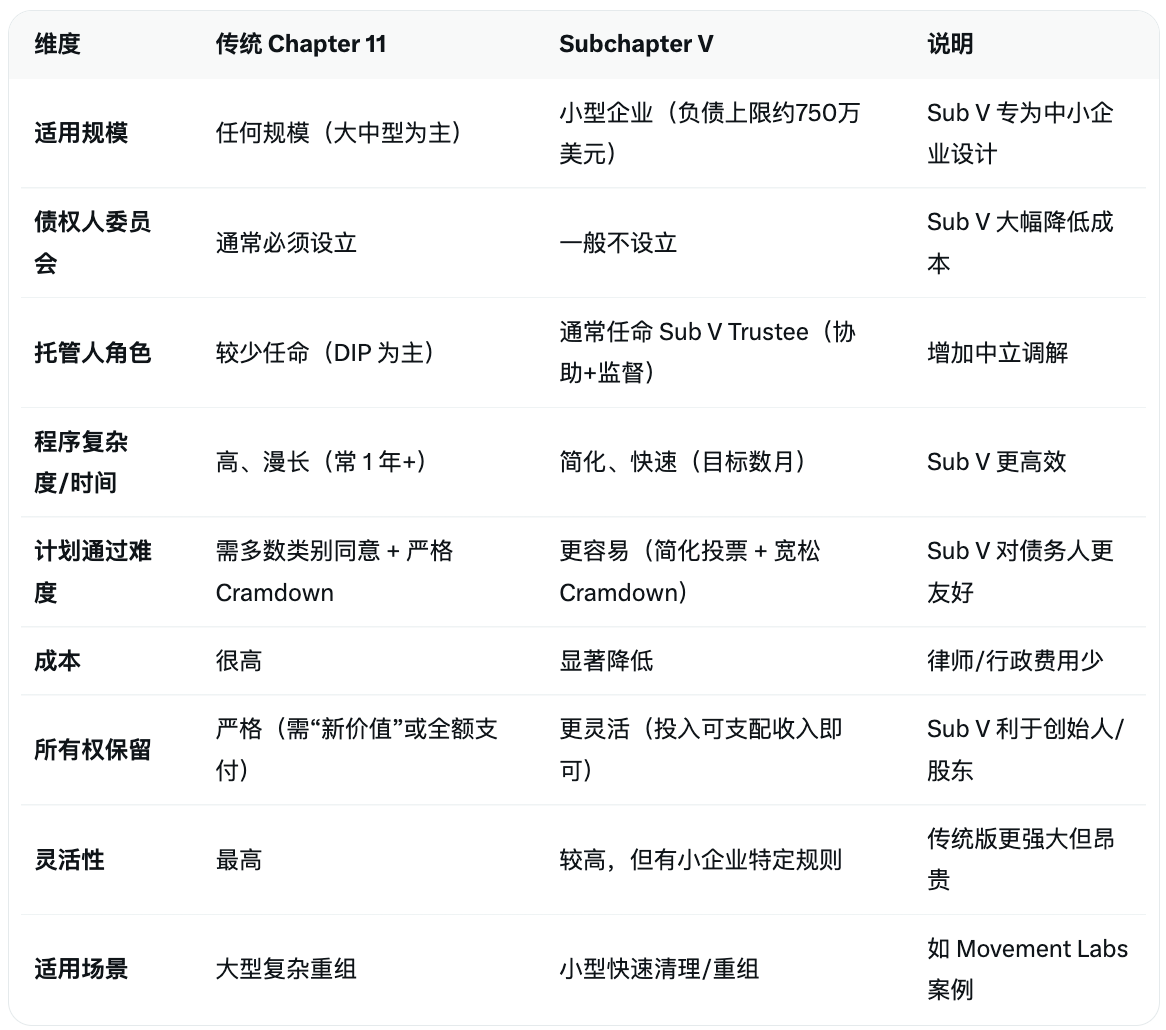
According to the filing documents, the deadline to object to the final DIP financing order is 4:00 PM ET on August 20th, and the final bankruptcy hearing is scheduled for 11:00 AM ET on August 27th, presided over by Judge Thomas M. Horan.
Behind the Movement Labs Bankruptcy: MOVE Token Under DOJ Investigation, Two Co-founders Go Separate Ways
In April of last year, Movement faced the "66 million MOVE token sell-off incident." At the time, the $38 million sell-off was revealed by an insider contract, drawing significant criticism towards MOVE's market maker, Rentech, and its parent company, Web3Port, once again for their market-making practices.
This incident eventually subsided after Binance froze the market maker's accounts and confiscated profits, Coinbase suspended MOVE trading, the Movement Foundation conducted a $38 million token buyback with the recovered funds, and co-founder Rushi Manche was fired by the team. However, the U.S. Department of Justice (DOJ) is still conducting a grand jury investigation into this matter and the MOVE token launch event, making Rushi, as a party involved, one of the defendants.
Currently, Rushi Manche still holds a 34.25% stake in Movement Labs and retains the co-founder title but has no business decision-making authority. These token sell-off incidents, along with "Movement Labs secretly promised up to 10% of token allocation to two advisors," are the direct catalysts that pushed Movement Labs towards bankruptcy protection.
Additionally, it's worth noting that Cooper, the other co-founder of Movement Labs, is not entirely innocent either.
Earlier, Thapaliya, a participant behind the MOVE token airdrop, allegedly revealed that Cooper insisted on giving the highest MOVE token allocation to specific 75,000 wallets. He also pointed out via on-chain heatmaps that these wallets were almost the only addresses that claimed and could sell bundles of over 60 million MOVE tokens during the Move token airdrop on December 9, 2024. Currently, Cooper has stepped back from the Movement ecosystem's decision-making layer, having previously handed over leadership to Movement Industries CEO Torab, appearing somewhat ready to retire from the space.
Looking at the current situation, aside from the DOJ investigations and lawsuits, Rushi's career in the crypto industry doesn't seem to have been significantly impacted.
In December last year, Rushi announced the formation of Nyx Group, planning to invest up to $100 million to support crypto token projects. The group aims to provide liquidity and comprehensive operational support for projects preparing for token launches, including community building, financial management, and compliance guidance. It seems he is off to pursue his "second career spring."
As for whether Movement Labs can successfully escape regulatory scrutiny and the fallout from token sell-offs and market-making scandals through this shell game, the upcoming bankruptcy hearing may provide the final answer.