Robinhood chain's market trend worth paying attention to?


- Core View: The meme coin market on the Robinhood chain has fallen into chaos following a 35% drop in the leading token $CASHCAT. While the short-term correction is normal, there are both opportunities and challenges in the long run regarding whether the Robinhood chain can leverage its user base to surpass Solana and Base and become the next main battleground for meme coins.
- Key Elements:
- $CASHCAT has pulled back from a market cap peak of $230 million to $150 million, a decline of about 35%, which has dampened overall sentiment on the Robinhood chain.
- Due to news of a suspected purchase by the Robinhood CEO's address, $1 surged from a market cap of $800,000 to $15 million. However, after the news was debunked, it fell back to $1 million, highlighting market speculation.
- A hacker took over the official SpaceXAI Twitter account to pump $SCATMAN to a market cap of $2.5 million, which then went to zero. Similar events are seen as signs of "doom" on the chain.
- This market cycle lacks a clear second-place token, similar to the previous "Space Dog" $ASTEROID and $ANSEM cycles; insufficient capital is the core limiting factor.
- The current meme coin market is essentially an "attention prediction market." The short-term pullback is due to the leader's correction and a lack of sustained catalysts, while potential plays like $GME and $JUGGERNAUT are in a left-side trading phase.
- In the long term, the Robinhood chain has the potential to attract retail capital and drive the expansion of the meme coin ecosystem by leveraging its user base (participants from the GameStop incident) and traditional investment channels.
The day before yesterday, $CASHCAT briefly approached a market cap high of $230 million, but has since pulled back to around $150 million, a decline of nearly 35%.
With the pullback of $CASHCAT, activity on the Robinhood chain has begun to descend into chaos and cool down. Yesterday, a token called $1 surged rapidly from a market cap of about $800,000 to around $15 million due to news that an address suspected to be Robinhood CEO's had bought in. However, this news was quickly disproven, and the token has now fallen back to a market cap of just over $1 million.
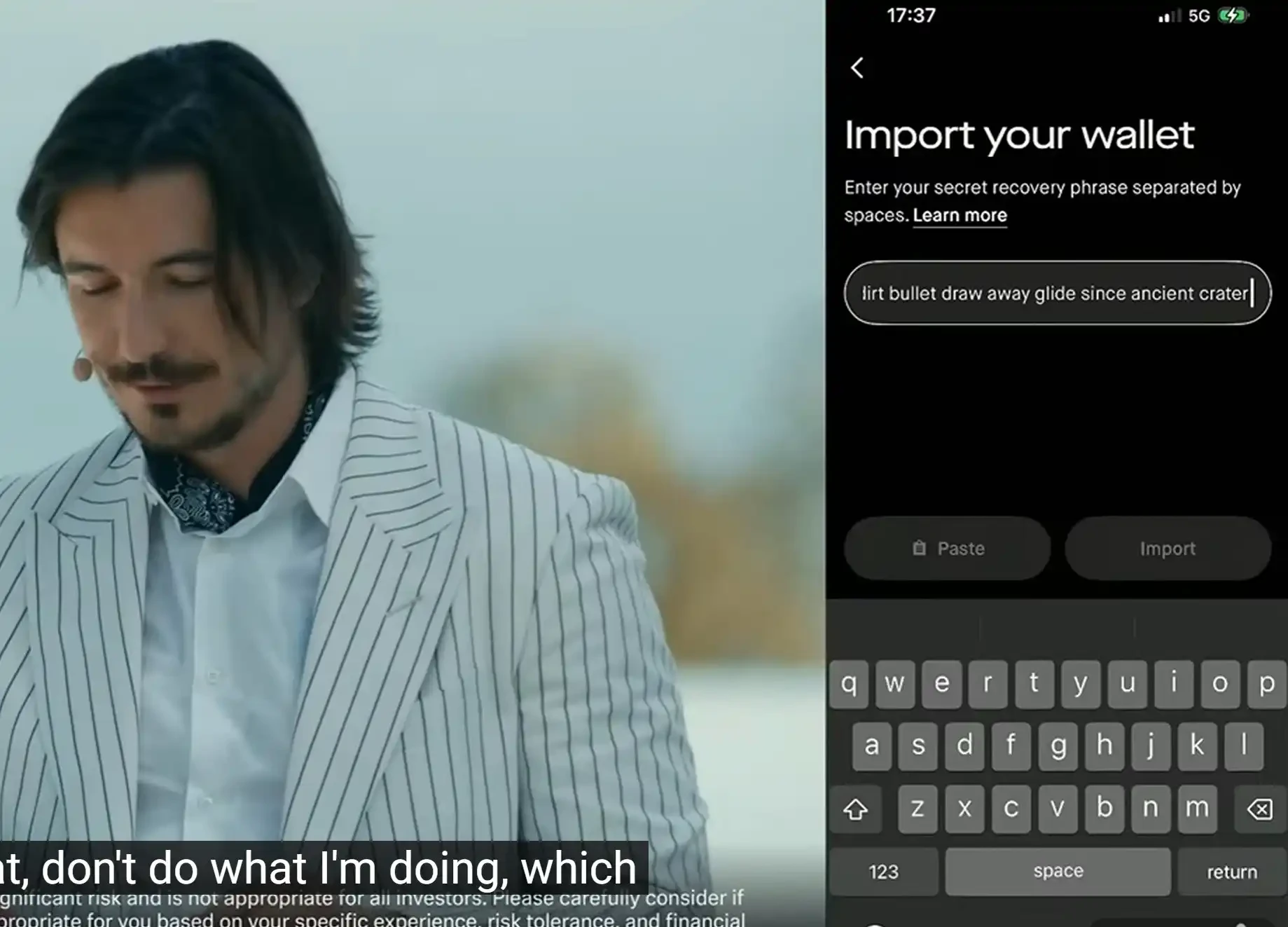
This address was previously used by the Robinhood CEO for a live demonstration, during which 9 out of 12 seed phrase words were accidentally leaked. Due to this partial leakage of the seed phrase, the address had already been compromised over a year ago.
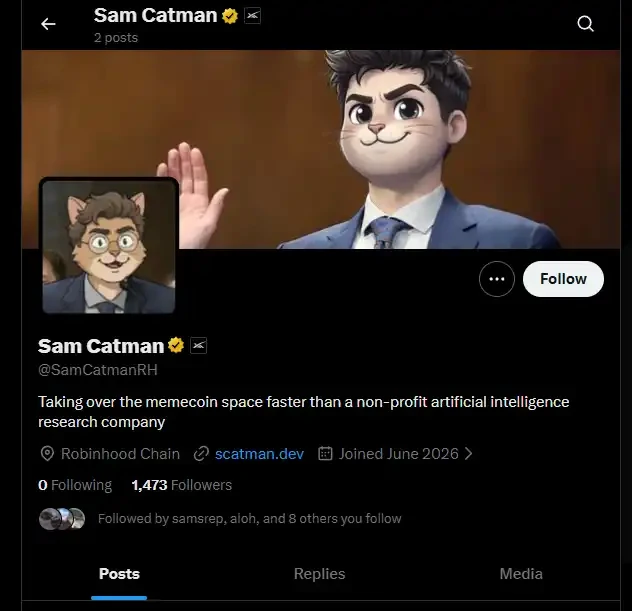
Another token that experienced wild swings yesterday was $SCATMAN. Hackers stole the official SpaceXAI Twitter account, used it to grant a verified affiliate badge to the X account of this token, which mocks Sam Altman, and then retweeted its posts. At its peak, the token's market cap exceeded $2.5 million, but it is now worth less than $100,000.
Due to the $CASHCAT pullback, the overall sentiment on the Robinhood chain had already cooled somewhat. The emergence of scenarios like a "suspected wallet buy-in" and hackers stealing social media accounts to launch rug pulls—events often seen as "doomsday signs"—has led some players to declare that the "Robinhood rally is over."
Is it truly over? To answer this, we need to look at several rallies since the beginning of this year to provide both short-term and long-term perspectives.
Short-Term: A Normal Pullback
If we recap the most direct catalysts for $CASHCAT's surge, one is this tweet from Robinhood CEO Vlad Tenev:
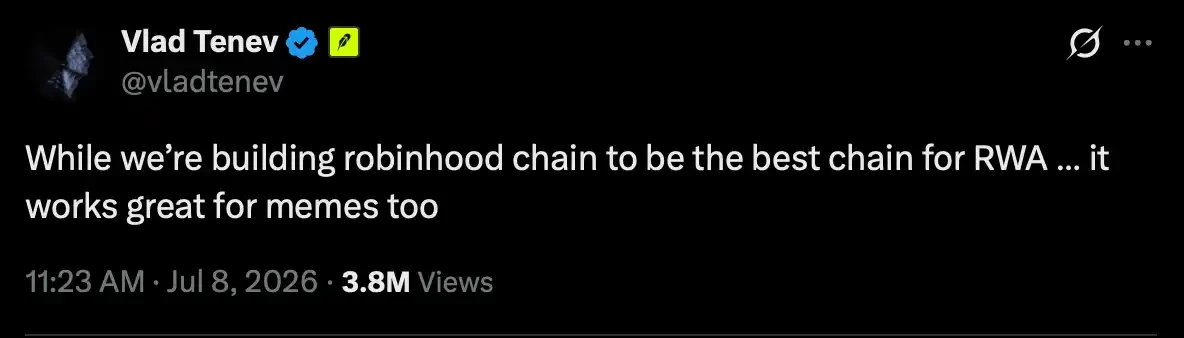
"When we build the Robinhood chain as the best RWA chain, it’s also great for memes"
Also, on the morning of July 8, Vlad followed the official $CASHCAT account on X, causing the token's market cap to instantly skyrocket from $10 million to nearly $50 million, continuing its upward trajectory.
Both catalysts were indispensable. One conveyed the attitude that "Robinhood's CEO supports meme coins on their own chain," and the other signaled that "CASHCAT is the designated leader of the Robinhood chain."
Flashback to July 2, when the Robinhood mainnet first launched. There was some attention on this new chain, but not much. Most were watching it under the logic of "prospecting on a new chain." No one could have predicted that, within less than a week, the Robinhood CEO himself would step in, catapulting expectations to an extraordinarily high level.
Due to this "from rags to riches" shift in expectations, so sudden and unexpected, the market began to reprice the Robinhood chain's prospects, setting them very high. Examples include "Robinhood Chain can bring its stock-trading retail investors on-chain" and "CASHCAT listing on Robinhood could replicate DOGE and SHIB's success." $CASHCAT's rapid surge further fueled the market's FOMO sentiment.
However, this day's rally also sowed some seeds of trouble. The main issue was the lack of a clear second-place winner besides $CASHCAT. This strongly resembles other rallies this year:
The Ethereum mainnet rally led by "Space Dog" $ASTEROID had no clear second-place winner, though it had supplementary narratives like Uniswap v4 hooks (e.g., $UPEG, $SATO).
The Solana rally led by $ANSEM also lacked a second-place winner, with gains mostly confined to narratives related to Ansem.
In both rallies, everyone hoped the leading token would reach a $1 billion market cap, allowing liquidity to spill over into other narratives and expand the range of PvE targets. But neither succeeded. The primary reason remains insufficient capital within the ecosystem. A $1 billion market cap is exceptionally difficult in the current market environment. Secondly, the explosive growth of these leading tokens stemmed from sudden attention events. "Space Dog" took off after Elon Musk agreed to make it SpaceX's mascot, and $ANSEM surged after Ansem claimed it. Because the initial pump originated from an attention event, subsequent growth requires even bigger events for momentum. Neither token experienced another attention event capable of catalyzing further FOMO.
Attention events are unsustainable and cannot be amplified, which means the nature of the rally is "arbitrage" rather than "long-term holding." When almost all active on-chain players rushed to the Robinhood chain to prospect, they began analyzing Robinhood’s tweets for clues—researching the CEO's favorite meme image $JUGGERNAUT (which he mentioned in a reply), the $GME rally that Robinhood famously hindered by "pulling the plug," or the $WALLET token allegedly deployed by a Robinhood employee. This situation mirrors the panic-buying of salt during Japan's nuclear leak years ago. People buy first, regardless of actual need. If it works, they win big; if not, it's no big deal.
Everyone is hunting for the next token that might receive a Robinhood interaction, betting on unknowns. This vividly illustrates that the current meme coin market is almost entirely an "attention prediction market." The short-term pullback is therefore understandable. As the leader $CASHCAT declines and Robinhood fails to deliver more compelling statements, tokens suspected of having "schemes" behind them, like $JUGGERNAUT and $HOODRAT, couldn’t break through and hold the $20 million market cap level. This indirectly confirms that, so far, the Robinhood chain rally isn't significantly different from the $ASTEROID or $ANSEM rallies.
At this stage, besides "conspiracy-driven" schemes, the tokens that can maintain relative stability are those likely to receive Robinhood interaction over a longer timeframe, or those that can sustain themselves with their own narratives or attract attention even without direct Robinhood involvement. For instance, $GME, hovering around a $2-3 million market cap, carries the expectation that Robinhood might mention it again in the future. Catalysts like a price swing in GameStop stock or the sudden return of Roaring Kitty could trigger a pump. Similarly, $JUGGERNAUT, which the Robinhood CEO mentioned as his favorite meme, could see another significant rally if he mentions it again.
However, this kind of positioning is very "left-side"—betting on potential attention and completely disconnected from traditional meme coin community building. Anticipations that Robinhood will persistently support the meme coin ecosystem or list its own chain's meme coins in the future are still too early and optimistic. Yet, it is precisely through such optimism that players can capture outsized gains like $CASHCAT's. You can't win the lottery without buying a ticket.
Long-Term: The Presence of Competition Fuels Expectations
When the "Space Dog" rally ended, players returned to Solana. BSC's brief "token minting" rally ended, and players went back to Solana. Solana's advantage in the meme coin market has somewhat reached a level of user habit. Playing with meme coins on Solana is becoming a routine, a culture.
Because of this foreseeable competition, Robinhood’s nascent chain inspires long-term expectations. "What if the Robinhood chain becomes the next Base or Solana, or even surpasses them, ushering in a full-fledged meme bull run on its platform?"
This isn't impossible. After all, the stock market's "meme-ification" is intensifying, and Robinhood was the original stronghold for retail investors—the birthplace of the GameStop saga. Its user base consists of stock traders who embrace or are accustomed to meme-driven trading. If $GME on the Robinhood chain rallies and is promoted through channels reaching traditional investors, similar scenarios could very well bring users and capital on-chain.
Meme coins, or trading centered around memes, represent the general trend. Both bullish and bearish outcomes revolve around market sentiment fluctuations. Meme coins simply make this process more direct and engaging. As the market expands, negative memories of fragmentation and scams will naturally fade, as players no longer need to compete for scraps in a limited pond.
The long-term expectation for the Robinhood chain is an expectation for Robinhood as a company to provide sustained, deep support for meme coins. More fundamentally, it's an expectation for meme coins to reach a much larger audience.