






Is the storage cycle peaking? Here's Bank of America's "fundamental reassurance" for you.


- Core Viewpoint: Bank of America believes the recent correction in global storage stocks stems from the market overinterpreting risks such as Meta's orders, CXMT's entry into Apple's supply chain, and South Korea's capacity expansion—not a fundamental reversal. The industry remains in a strong cycle, but the trend will shift from broad-based gains to earnings verification and stock differentiation.
- Key Factors:
- Markets fear Meta's leasing of computing power will cut storage orders, but BofA points out its demand for HBM, LPDDR5, and enterprise SSDs is still strengthening—this move is more likely asset monetization.
- BofA expects the probability of Apple adopting CXMT's DRAM on a large scale in the short term to be low; CXMT is more likely to serve as bargaining leverage with vendors like Samsung and SK Hynix.
- South Korea's 800 trillion won expansion plan spans over a decade, making it difficult to form effective supply in the short term, so it cannot yet serve as evidence of a cycle peak.
- Supply chain research in Japan shows DRAM and NAND prices are expected to rise quarter-over-quarter in Q3 and Q4, with the industry potentially remaining in shortage into 2027, as manufacturers maintain restrained capital expenditure.
- Capital expenditure by hyperscale cloud providers continues to grow, DRAM and NAND prices remain high, and demand for high-end storage in AI servers and data centers stays robust.
Original report: BofA Global Research《Global Memory Tech》, July 2, 2026
Translation & Organization: DaiDai, MSX Maitong
Editor: Frank, MSX Maitong
Key Highlights:
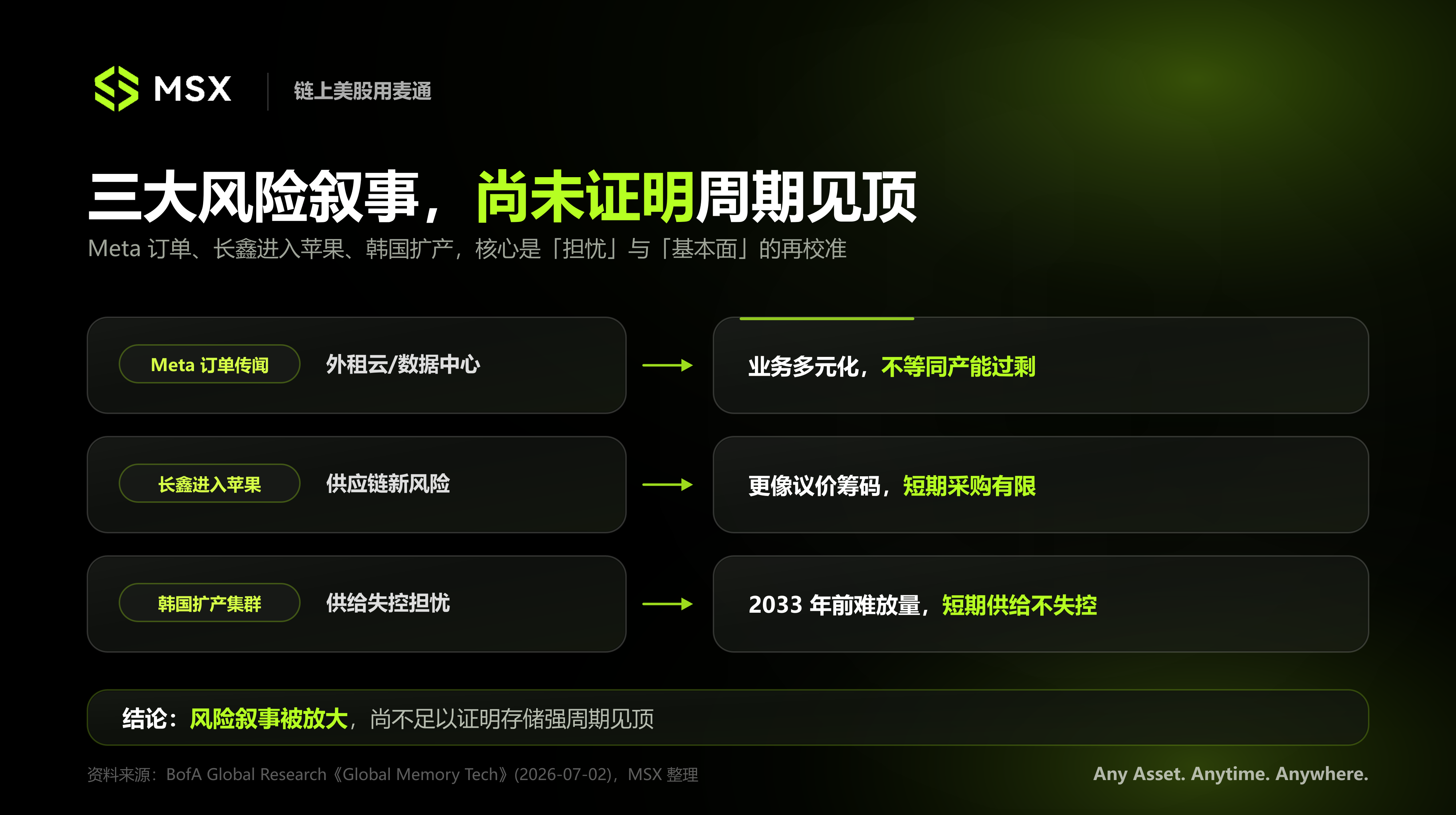
- Bank of America believes the recent concentrated pullback in memory stocks is primarily driven by risk narratives related to Meta's orders, CXMT entering Apple's supply chain, and Korea's capacity expansion, rather than a fundamental reversal of the industry.
- Meta's provision of data center or cloud services to external parties is more likely a monetization and business diversification strategy, not a significant reduction in memory demand. Its demand for HBM, LPDDR5, and enterprise SSDs continues to grow.
- In the short term, CXMT is unlikely to become a major DRAM supplier for Apple. Apple is more likely to use it as leverage in price negotiations with Samsung, SK Hynix, and Micron.
- A survey of the Japanese supply chain indicates that DRAM and NAND prices are still expected to rise quarter-over-quarter in Q3 and Q4. The industry may continue to face shortages in 2027, with manufacturers' capital expenditure and wafer output remaining relatively restrained.
- The memory industry remains in a strong cycle. However, following significant increases in product prices and related stocks, future performance will increasingly depend on earnings delivery, potentially leading to greater sector volatility and stock divergence.
The past week witnessed a notable correction in global memory stocks.
The market quickly identified three seemingly plausible explanations for this decline: Meta's plan to sell some computing power externally might indicate an oversupply from previous data center builds; Apple is evaluating CXMT's DRAM, potentially disrupting the supply structure of Samsung Electronics, SK Hynix, and Micron; South Korea announced another massive semiconductor cluster plan, further fueling concerns about future oversupply.
These three narratives ultimately point to one conclusion: Demand may be peaking, supply is set to expand, and the memory super-cycle might be nearing its end.
However, the latest "Global Memory Tech" report from Bank of America presents a contrasting view.
In its assessment, while these risks are not entirely baseless, the market has significantly overestimated their near-term impact on the supply-demand balance. Cloud capex, South Korean semiconductor exports, and spot and contract prices for DRAM and NAND have yet to indicate a directional shift in the memory cycle.
What has truly changed is not a fundamental weakening but that the industry, after substantial price increases and stock revaluation, has entered a new phase where fundamentals remain strong, but the difficulty of trading has increased significantly.
1. Dissecting Each Risk: Are the Market's Concerns Valid?
1. Meta Selling Compute Power ≠ Cutting Memory Orders
The market's concern about Meta stems from a seemingly logical deduction: If Meta starts opening its data centers or selling cloud services to external customers, does it imply the company purchased too many servers and cannot digest the existing computing power internally?
If true, demand for AI hardware like GPUs, HBM, server DRAM, and enterprise SSDs could subsequently decline.
However, the Bank of America report states that feedback from the supply chain indicates memory chip manufacturers believe Meta will continue to more aggressively adopt high-performance memory products like HBM, LPDDR5, and enterprise SSDs in its AI data centers. Therefore, market speculation about Meta leasing out its previously overinvested AI servers or cloud infrastructure lacks solid foundation.
In fact, some NAND controller chip and packaging substrate material manufacturers have indicated that Meta's chip and component orders are still strengthening. Thus, Meta opening its data centers to external customers is more likely an attempt at asset monetization and business diversification rather than a forced disposal of severely excessive computing capacity.
2. CXMT Entering Apple's Supply Chain: More Likely a Price Negotiation Chip
The Bank of America report expects the probability of Apple adopting CXMT DRAM on a large scale in the short term remains low.
Several constraints exist:
- Policy and Supply Chain Restrictions: Apple must consider U.S. restrictions related to China's semiconductor industry, along with associated compliance and supply chain risks.
- Technical Specifications: Apple demands high performance in mobile DRAM, including transfer speeds exceeding 10Gbps, low-power design around 1.1V, and ECC error correction capabilities. Whether CXMT can stably and massively meet these requirements long-term needs further verification.
- Intellectual Property Risks: Core DRAM patents are concentrated among top players like Samsung, SK Hynix, and Micron. If Apple adopts products with insufficient patent coverage on a large scale, it could face potential lawsuits and supply disruption risks.
Theoretically, CXMT could target orders for the low-end iPhone 18e, but given the scale of that model in the Chinese market, the actual purchase volume is expected to be limited.
Rather than a genuine supply chain restructuring, Apple is more likely using this to enhance its bargaining power in contract price negotiations for H2 2026 or 2027. Therefore, this event is more likely to impact the pricing expectations of Samsung, Hynix, and Micron in the near term, rather than immediately altering the global DRAM supply-demand landscape.
3. South Korea's Large-Scale Expansion ≠ Short-Term Supply Out of Control
Another recent concern stems from South Korea's new semiconductor cluster plan.
Some investors believe the South Korean government's plan to invest approximately 800 trillion won in a new memory fab cluster in the southwestern region signals the memory cycle is nearing its peak. However, the Bank of America report disagrees with this view, expecting the project will not generate significant effective supply until the early 2030s. Currently, the priority remains the expansion of the Yongin and Pyeongtaek clusters from 2026 to 2035.
Therefore, an industrial plan spanning over a decade cannot be directly equated to short-term supply getting out of control in the next 2-3 years. Long-term expansion warrants continued monitoring but is not yet a direct basis for judging the peak of this memory cycle.
4. Japanese Supply Chain Survey Remains Relatively Optimistic
A recent supply chain survey conducted by Bank of America in Japan further reinforces an optimistic outlook for the memory industry.
Japanese investors generally acknowledge the current industry prosperity. However, with rapid increases in product prices and related stocks, the market is also paying more attention to potential downside cycles. Compared to investor caution, management along the supply chain gave more positive assessments:
- Memory ASP was strong in Q2, especially for NAND.
- ASP for Q3 and Q4 is expected to be higher than Q2.
- DRAM and NAND may continue to be in shortage in 2027.
- The number of long-term supply agreements is increasing, but most primarily involve volume commitments.
- Capital expenditure and wafer output remain restrained, particularly among Japanese NAND manufacturers.
This implies that although the market has started discussing the next supply cycle prematurely, based on actual manufacturer expansion plans and customer procurement behavior, the industry has not yet entered a phase of obvious oversupply.
5. Samsung's Memory Business May Still Exceed Expectations
In its July 2 report, Bank of America estimated that due to special bonus expenses and pressure on smartphone business margins, Samsung Electronics' overall Q2 operating profit might be slightly below the market's more optimistic expectations. However, thanks to strong ASPs for DRAM and NAND, the operating profit for the memory business alone could still exceed market expectations.
Five days after the report, Samsung announced preliminary Q2 results on July 7: consolidated sales of approximately 171 trillion won and operating profit of about 89.4 trillion won, representing year-over-year increases of 129.3% and 1810.3% respectively. The operating profit was higher than the market's previous expectation of around 86 trillion won, meaning Bank of America's prediction that group profit might fall slightly short of optimistic expectations ultimately did not materialize.
However, Samsung's disclosure is still preliminary group-level results; detailed profit data for its memory, foundry, and mobile businesses haven't been released. Whether the memory division alone exceeded expectations requires confirmation from the complete financial report. Given the Q2 increases in DRAM and NAND prices and the surge in South Korean semiconductor exports, the memory business will most likely be the core driver of Samsung's profit surge this cycle.
2. What Signals Are Exports, ASP, and Product Prices Sending?
1. Significant Growth in South Korean Semiconductor Exports
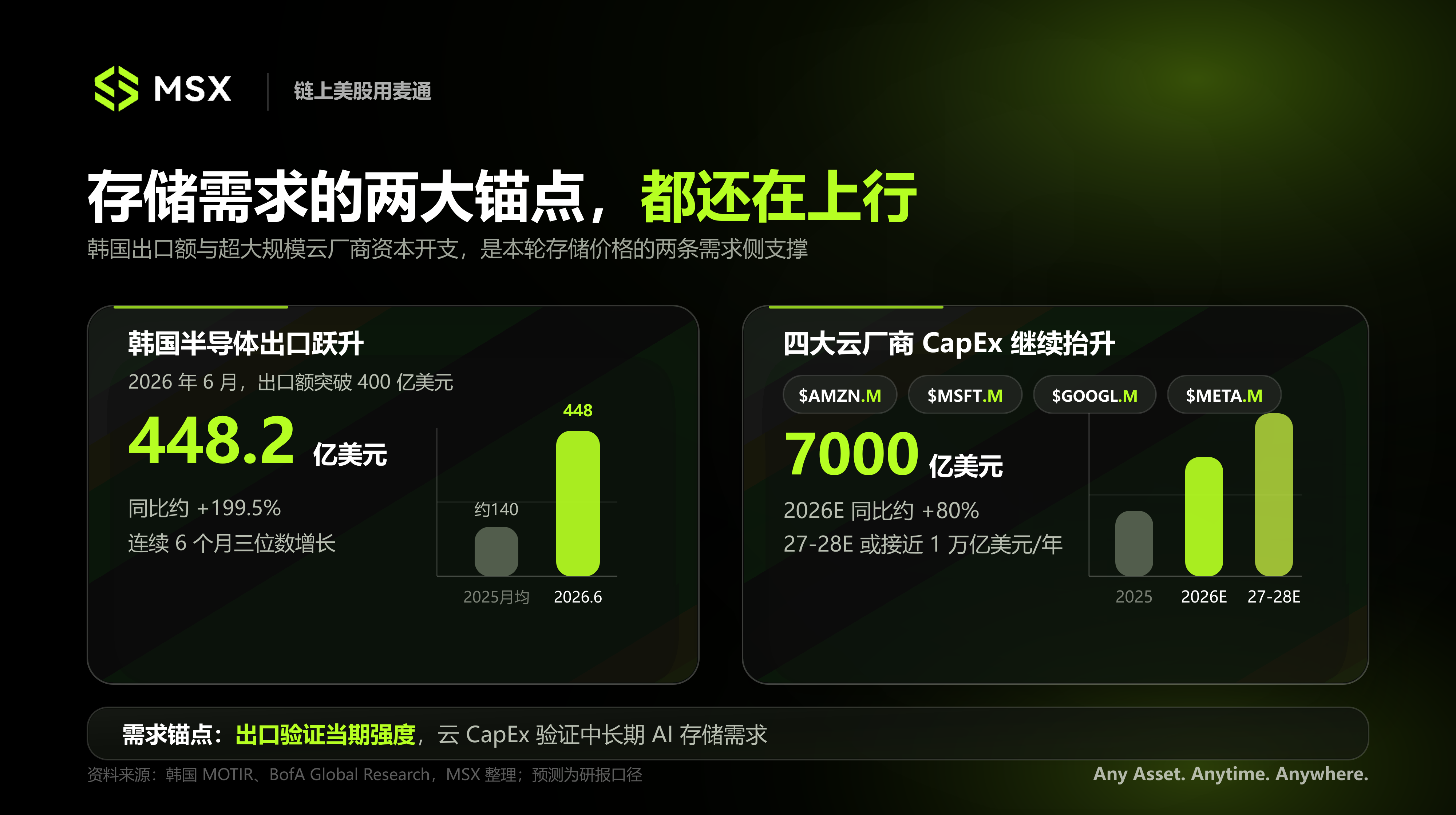
In June 2026, South Korea's semiconductor exports reached $44.8 billion, up 21% month-over-month and 199% year-over-year, marking six consecutive months of triple-digit annual growth.
This figure is roughly three times the average monthly export value of $14 billion in 2025, reflecting that rising memory prices are now clearly translating into export revenues and corporate profits.
Of course, rising export values do not entirely represent volume growth. A significant portion of the increase comes from rapidly rising average selling prices. But this precisely indicates that the core contradiction in the current supply chain remains price increases and tight supply, not inventory buildup or significant demand contraction.
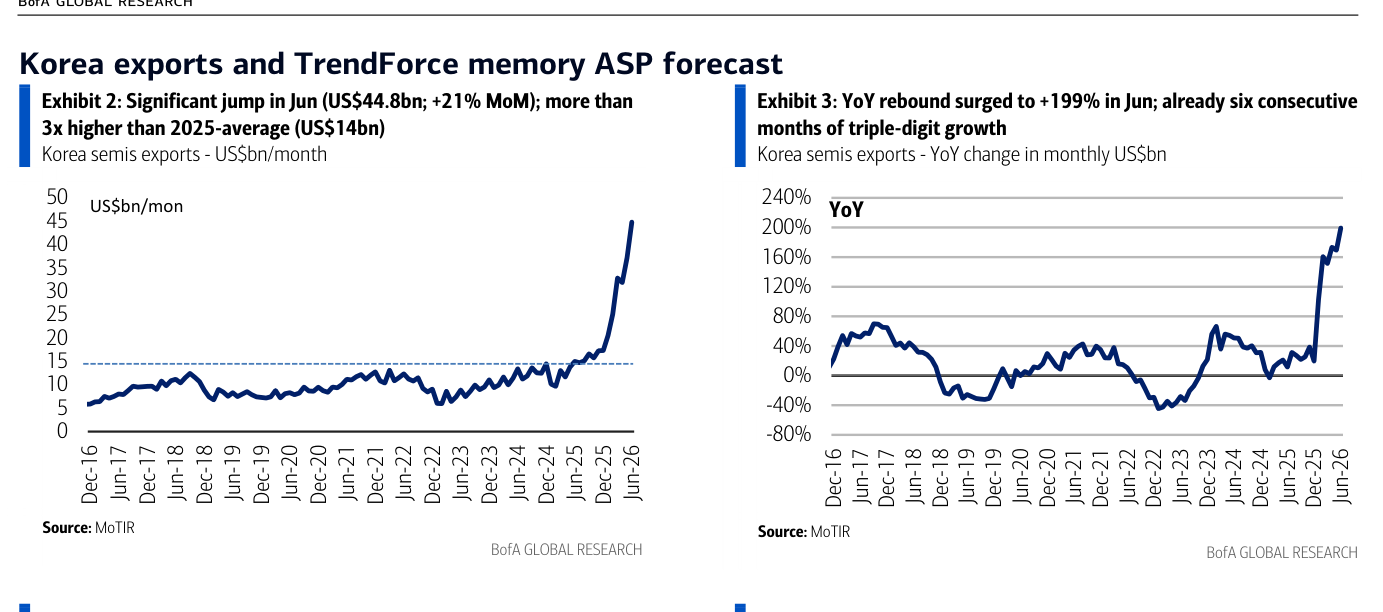
South Korea Semiconductor Export Value and YoY Growth: Notable Jump in June 2026 (Original Report Page 2)
2. DRAM Remains the Strongest Memory Category Currently
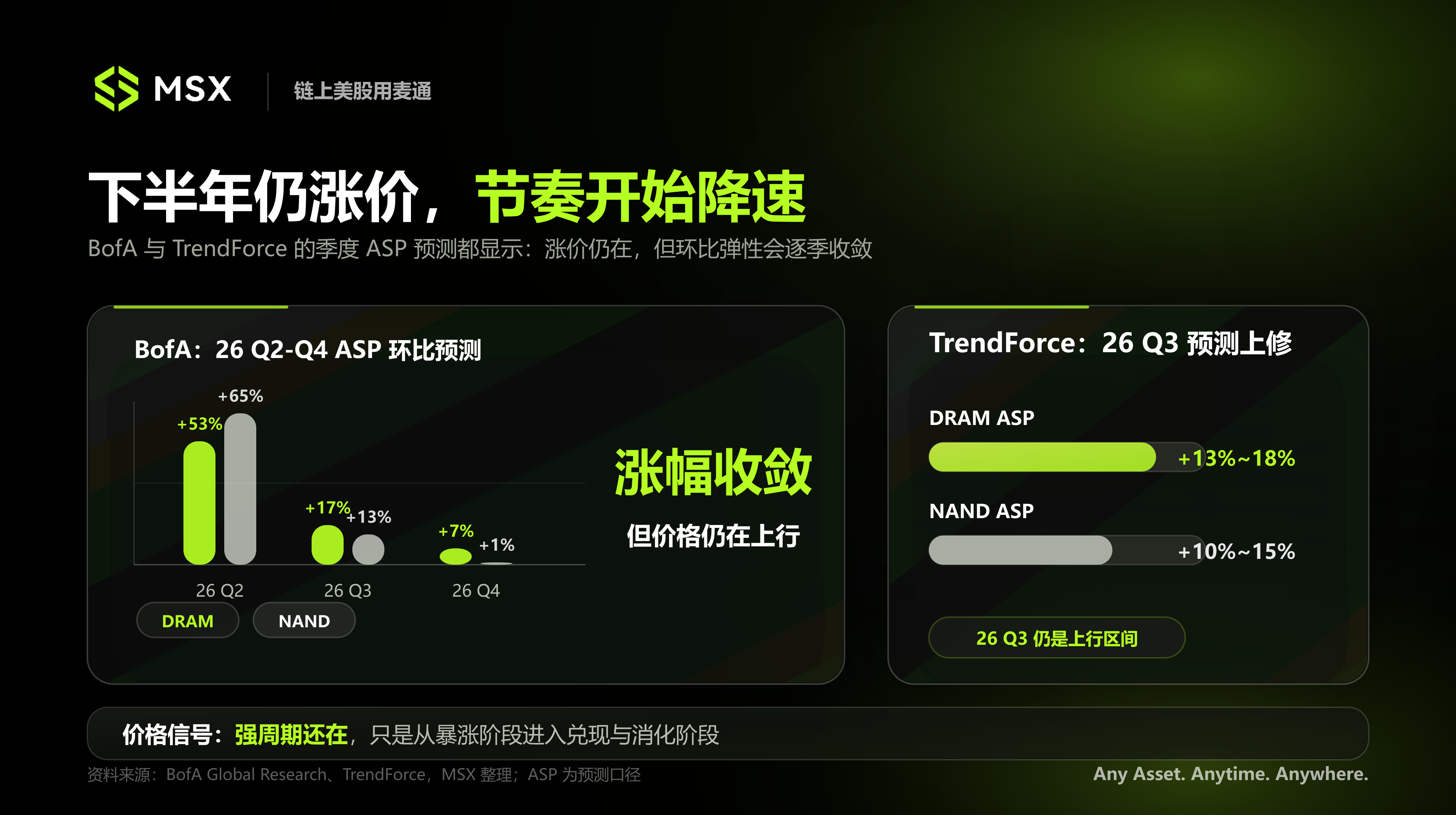
TrendForce has revised its Q3 2026 DRAM ASP forecast upwards from a 3%-8% QoQ increase to 13%-18%. Bank of America estimates Q2-Q4 2026 DRAM ASP will rise 53%, 17%, and 7% QoQ, respectively.
While the specific metrics differ between the two forecasts, they both point to the same trend: DRAM prices will continue to rise in H2, but the QoQ growth rate may decelerate quarter by quarter as the price base increases.
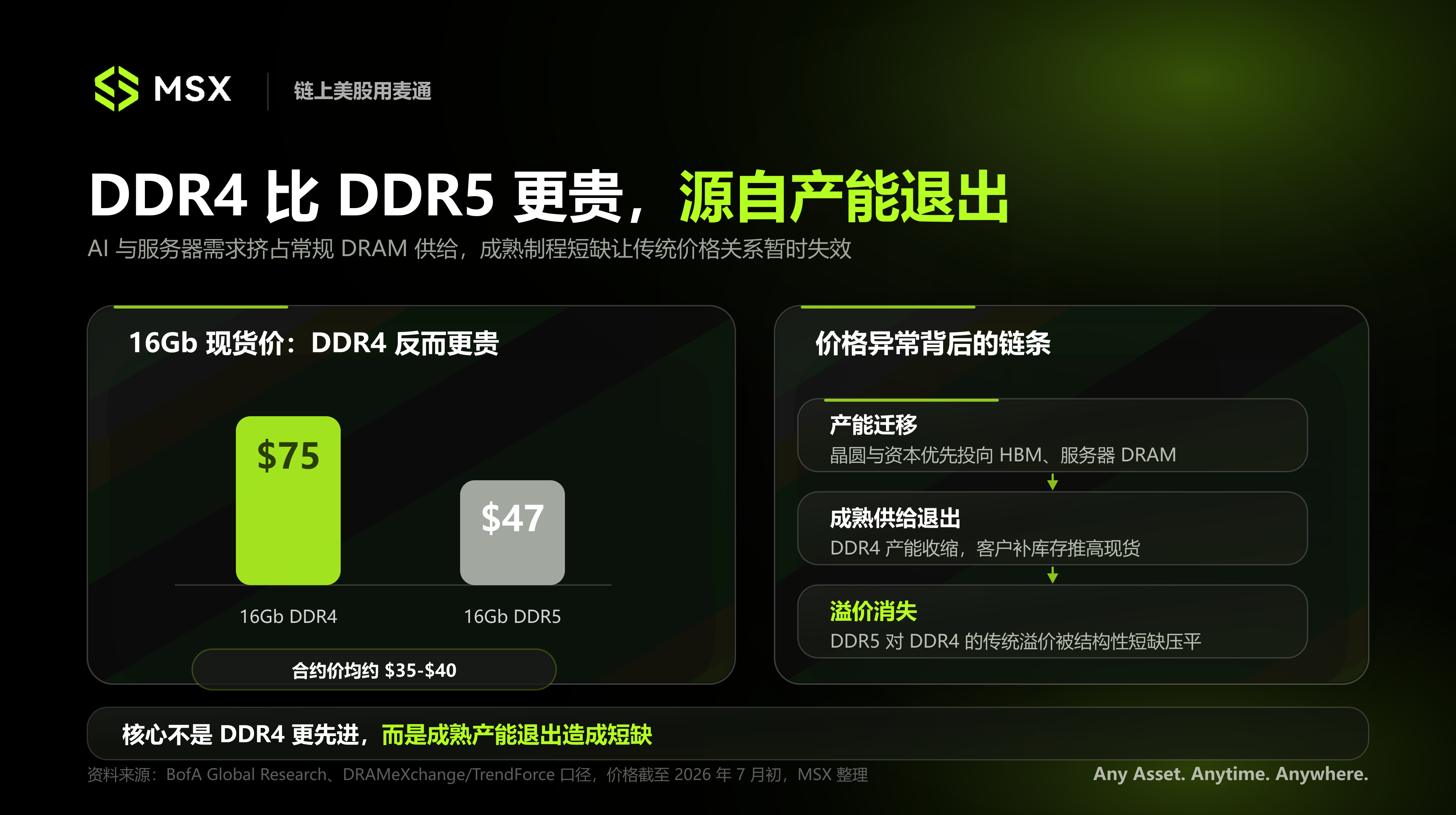
As of early July 2026, the spot price for 16Gb DDR5 stood around $47, and 16Gb DDR4 around $75, both significantly higher than the peak prices of the previous memory cycle. The core reason is not just inventory replenishment by end customers, but memory manufacturers continuously shifting wafer capacity towards higher-margin HBM and server DRAM.
After advanced capacity is absorbed by AI-related products, the supply available for traditional DDR4 and regular DDR5 decreases simultaneously.
This is especially true for DDR4. As leading players gradually phase out mature products, DDR4 faces a clear structural shortage. Contract prices for 16Gb DDR4 and DDR5 have both risen to the $35-40 range, effectively eliminating the long-standing technology premium of DDR5 over DDR4.
This doesn't mean the market prefers the older DDR4 generation; rather, manufacturers are exiting faster than customers are completing their product transitions, making mature products scarcer.
3. NAND Price Increases Slow, but Absolute Prices Remain High
Compared to DRAM, the marginal change in NAND prices is more pronounced.
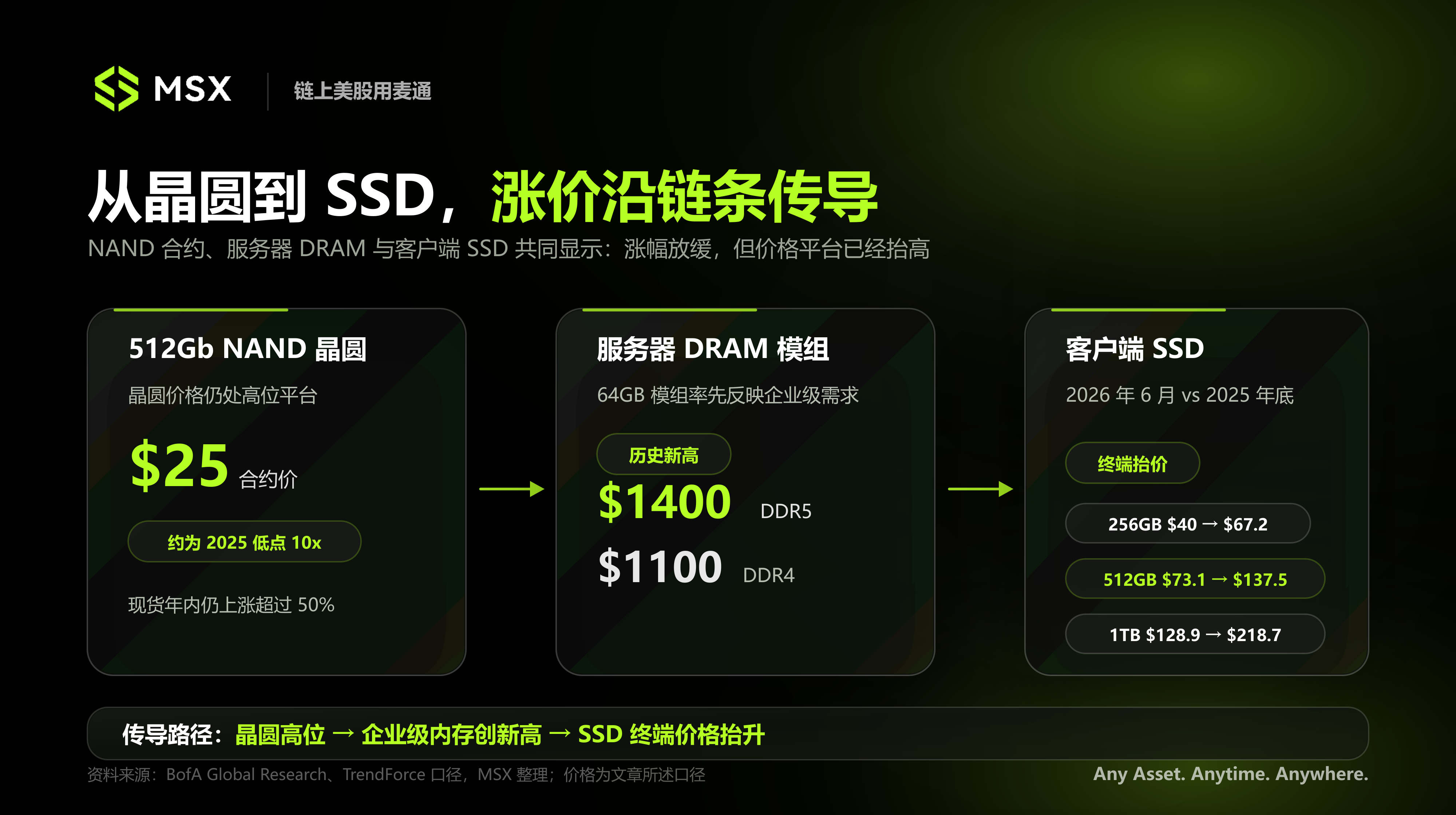
After peaking in March 2026, the spot price of 512Gb NAND wafers stabilized or slightly declined between April and June. However, it is still up over 50% year-to-date and roughly eight times the low point in February 2025.
The NAND contract price, around $25, is about ten times the February 2025 low of $2.5. Following substantial increases in Q4 2025 and Q1 2026, the monthly growth rate of NAND contract prices from April to June has moderated to around 1%-5%.
This doesn't signal a reversal in NAND prices, but rather that customers' ability to absorb high prices is approaching its limit, and the pace of price increases is normalizing.
The change in client SSD prices is particularly notable. As of June 2026, the price of a 512GB client SSD has nearly doubled from $73.1 at the end of 2025 to $137.5, reflecting the ongoing pass-through of upstream NAND price hikes to end products.
Therefore, a more accurate description of NAND's current state is that absolute prices remain very high, but the rate of QoQ increase is decelerating.
4. Server Memory Continues to Hit New Highs
Server memory also continues its strong trend.
64GB server DRAM module prices have reached all-time highs, with DDR5 around $1,400 and DDR4 around $1,100. In June 2026, DDR5 server DRAM contract prices increased again, while DDR4 prices were largely flat.
This indicates that even as price increases for some consumer-grade memory products begin to slow, demand for high-end memory related to AI servers and data centers remains robust.
3. Cloud Capex Remains the Demand Anchor, but the Investment Thesis is Changing
1. Hyperscalers Continue to Expand
Hyperscale cloud providers like Amazon, Microsoft, Alphabet, and Meta are becoming the most important source of incremental memory demand. The report estimates that the combined capital expenditure of these four companies in 2026 will be roughly $700 billion, up about 80% YoY. By 2027-2028, annual capital expenditure could approach $1 trillion.
Furthermore, Bank of America does not see clear signs of major cloud providers significantly cutting back on capex in 2027. This implies that these investments will ultimately translate into more AI accelerators and HBM, more server DRAM, more enterprise SSDs, and more data center and AI inference infrastructure.
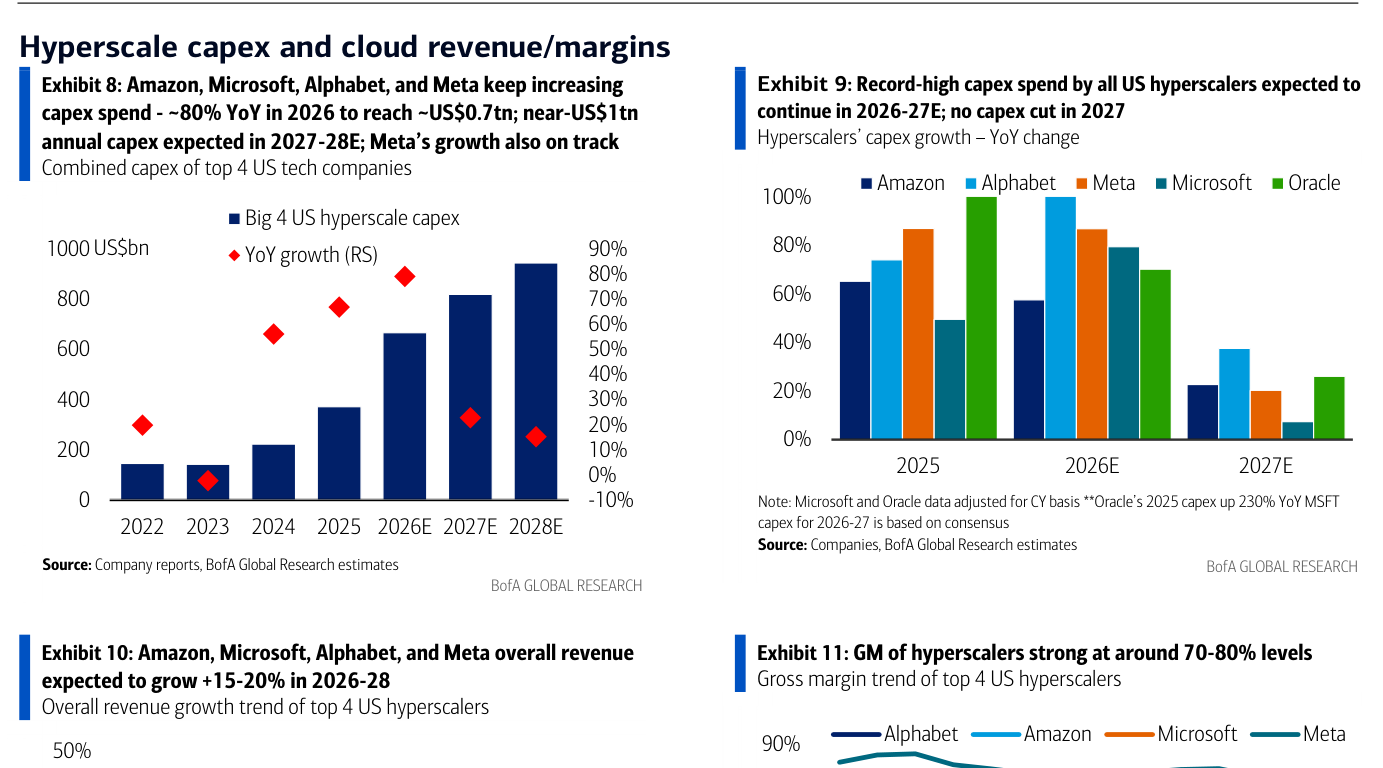
Capex, Revenue, and Gross Margin Trends for Major US Hyperscale Cloud Providers (Original Report Page 3)
The report projects that total revenue for the four major tech companies could grow 15%-20% from 2026 to 2028, with cloud revenue potentially growing 35%-40% YoY.
Within this, AWS operating margin is expected to remain above 35%, Azure could exceed 40%, and Google Cloud is expected to reach 30%-35%.
As long as cloud businesses maintain high revenue growth and profit margins, tech giants will continue to have the commercial incentive to expand AI infrastructure investment.
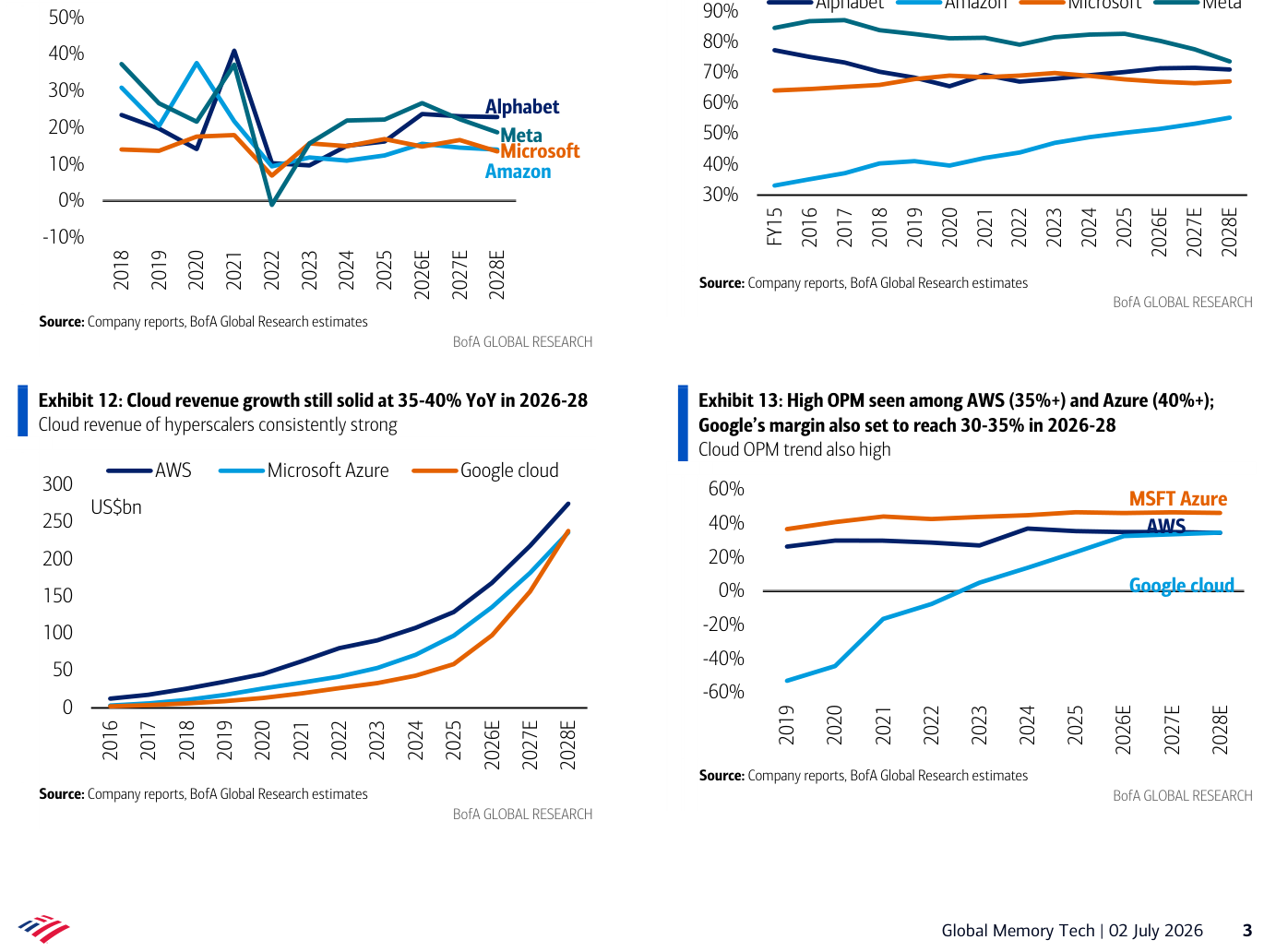
Cloud Revenue and Operating Margin Trends (Original Report Page 3)
2. This Cycle is No Longer Just About Consumer Electronics Replenishment
The biggest difference between this memory cycle and past ones is that demand is no longer primarily driven by smartphone and PC inventory replenishment.
Previous memory cycles were often driven mainly by PC and smartphone inventory changes, creating a typical cycle: rising end demand, customer restocking, rising memory prices, followed by capacity expansion, inventory buildup, and price decline.
However, the structure of this current cycle is more complex. Demand has already expanded from simple consumer electronics restocking to encompass:
- HBM
- Server DRAM
- Enterprise SSDs
- AI Inference Infrastructure
- Hyperscaler Capital Expenditure
- Structural shortage from DDR4 capacity phase-out
This means that solely observing PC and smartphone sales is insufficient to gauge the entire memory cycle. Even if some consumer electronics demand wavers due to high prices, AI servers and data centers can continue absorbing high-end capacity, keeping overall supply tight.
However, this also implies that divergence within the sector will become increasingly apparent. In short, companies focused on HBM, server DRAM, enterprise SSDs, and advanced packaging may continue benefiting from stronger orders and margins. Manufacturers overly reliant on client, mobile, and consumer-grade NAND may be the first to feel the impact of declining demand elasticity.
3. From Sector-Wide Rally to Earnings Delivery
Since the start of 2026, stocks related to NAND, HDD, and DR


