Yield Guild Games (YGG) Cuts Losses: Shuts Down Publishing Platform, Goes All-In on AI Data Economy


- Core Thesis: Yield Guild Games (YGG) announced the closure of its game publishing division, YGG Play, to fully pivot to the AI data economy, signaling the unsustainability of the "play-to-earn" model in the blockchain gaming industry. This is attributed to a structural mismatch between speculative financial design and players' entertainment needs, which has led to significant capital destruction.
- Key Elements:
- YGG Play will shut down by July 31st due to insufficient macro liquidity and declining user confidence. Affected 35 employees will receive 8 weeks of compensation, with some games being transferred or retired.
- Since its launch in 2025, YGG Play generated cumulative revenue exceeding $9 million (with a single quarter Q1 2026 bringing in $876,000). However, its revenue peaked only after October 2025, subsequently suffering from a market sell-off.
- Originating as a guild for Axie Infinity in 2020, YGG's token peaked at over $10 in 2021. After the 2022 bear market triggered the collapse of the P2E model, the pivot to a publishing model failed within just one year.
- The overall blockchain gaming industry is in decline: 93% of the approximately 3,200 tracked projects are considered "effectively dead," with average token prices down 95% from their 2022 highs. The reason is a death spiral caused by the Ponzi-like dividend logic inherent in "play-to-earn."
- The closure of YGG Play is seen as a microcosm of the blockchain gaming industry. The team emphasizes this is a market decision, not a product failure, validating the casual gaming track but failing to achieve commercial sustainability.
Original Author: Mahe, Foresight News
On July 6, the official account of Yield Guild Games (YGG) and co-founder Gabby Dizon simultaneously issued a statement announcing the decision to shut down their game publishing division, YGG Play. The team plans to gradually take the platform and some games offline by July 31. 35 employees will receive an additional 8 weeks of severance pay. Some games, such as GIGACHADBAT, will be handed over to developer Delabs for continued operation. Others like LOL Land and Waifu Sweeper will be officially retired. Games published by YGG Play have generated cumulative revenue of over $9 million, with $876,000 contributed in the first quarter of 2026 alone.
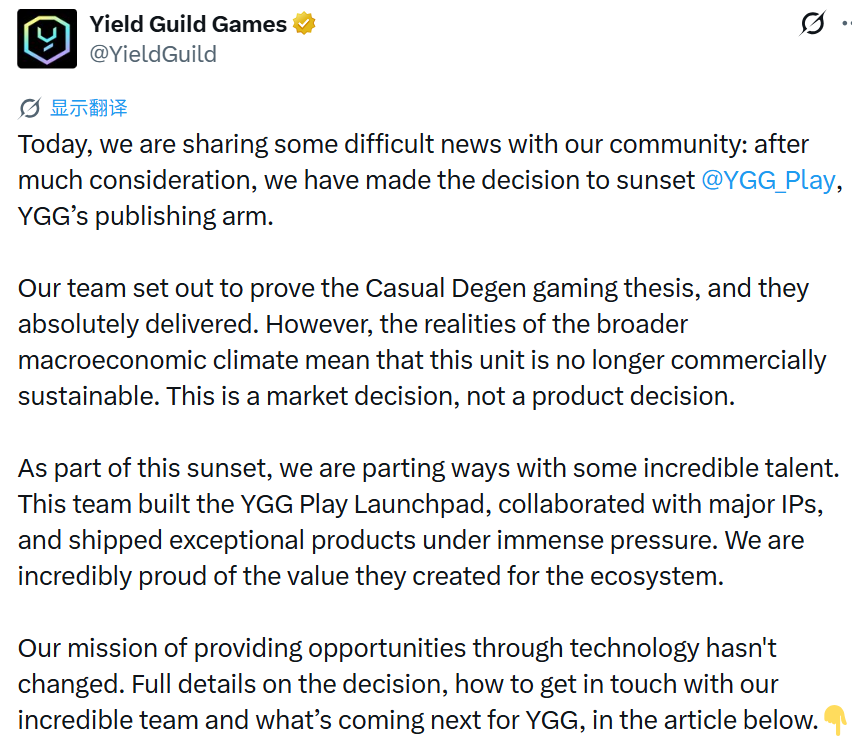
In the statement, Gabby Dizon said: "This is a market decision, not a product decision. While the team successfully validated the casual gaming track—short sessions, high engagement, and a fast feedback loop for crypto-native users—the lack of liquidity and declining user confidence in the current macroeconomic environment has made this business no longer commercially sustainable."
Alongside shutting down YGG Play, YGG also announced a complete pivot to the AI Data Economy, aiming to capture the multi-billion dollar market for AI training datasets. The initial focus is on building B2B pipelines centered around gaming datasets.
The Game Publishing Platform: YGG Play
YGG Play was YGG's Web3 gaming publishing arm launched in 2025, focused on serving casual gamers within the crypto space. It targeted short, quick mobile games with social and reward elements, helping independent studios quickly distribute on-chain and acquire users through YGG's community network. These games generated significant revenue during the 2025-2026 period, proving that even near the tail end of a bear market, specific vertical tracks could still yield real payments.
However, revenue peaked around October 2025. The large-scale crypto market liquidation event in October further dampened the target users' willingness to pay and retention rates. The closure of YGG Play marks a strategic contraction for YGG from its dual-engine model of 'guild operations + publishing'.
To understand the weight of this closure, one must trace YGG's complete trajectory.
In 2020, Philippine gaming industry veterans Gabby Dizon, Beryl Li, and anonymous partner Owl of Moistness co-founded YGG. This was during the peak of the COVID-19 pandemic, when many service industry workers in the Philippines were unemployed. Axie Infinity, then the hottest Play-to-Earn (P2E) game, allowed players to borrow Axie NFTs for free through its 'scholarship' model, battling and sharing the earnings.
YGG seized this opportunity. Starting as a small guild, it raised funds to purchase Axie assets, organized and trained players, quickly becoming one of the largest and most impactful guilds in the Axie ecosystem.
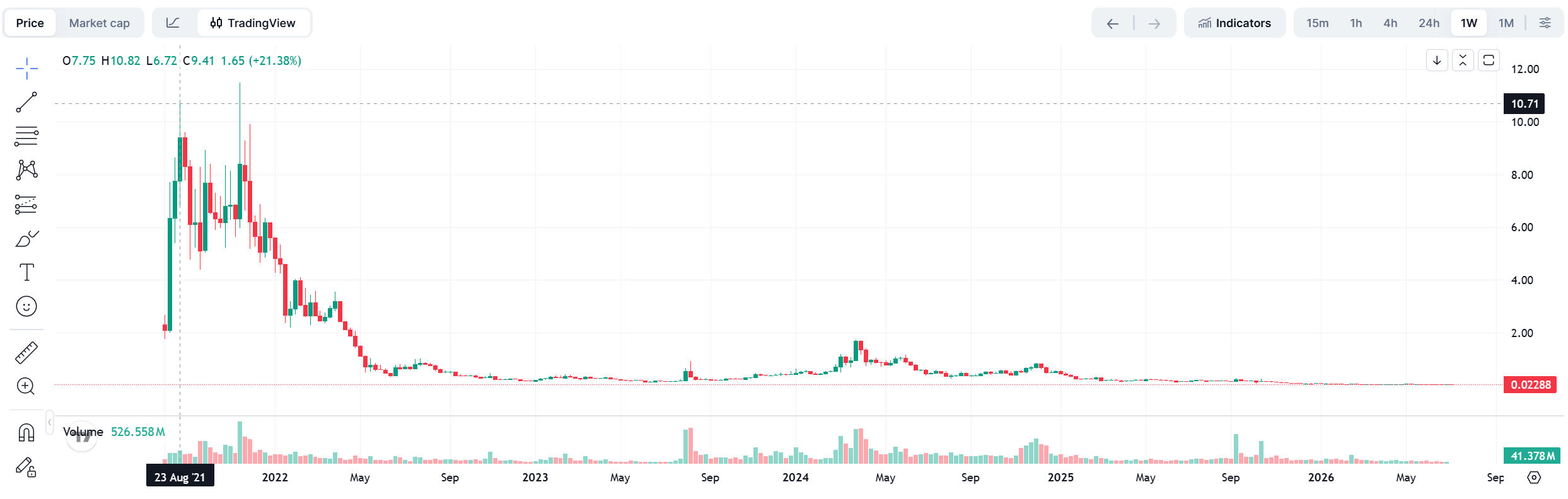
2021 was YGG's peak year. Driven by both the bull market and the P2E narrative, its token price soared, reaching a high of over $10. YGG expanded from a single Axie guild into a global network, covering dozens of regional guilds and collaborating with over 80 blockchain gaming and infrastructure projects. It didn't just provide asset loans; it helped players maximize earnings through quests, events, and community operations. In places like the Philippines, a real economic phenomenon of 'playing games as work' emerged, with YGG seen as the benchmark of the P2E model.
At its peak, YGG's model was widely replicated: guilds became key intermediaries connecting players, assets, and games. DAO governance and token incentives allowed participants to share in growth dividends. YGG also evolved from a simple 'asset manager' into an investment, content, and community platform.
The crypto bear market arrived in 2022, exposing the fragility of Axie Infinity's economic model—slowing new user inflow, token price collapse, and significant player churn. Guilds and P2E projects disappeared directly, and the entire industry entered a downturn. YGG didn't fall but began a long period of adaptation. In 2025, YGG bet on a new direction: launching YGG Play to officially enter game publishing. This was because heavy P2E was no longer sustainable, and crypto users naturally preferred high-frequency, instantly rewarding casual experiences.
This cessation of operations comes just about a year after its last major pivot.
A Microcosm of the Blockchain Gaming Industry
The closure of YGG Play can be considered a concentrated embodiment of the blockchain gaming industry's trajectory over the past five years.
As early as this April, crypto quantitative trading and market-making firm Caladan reviewed the five-year journey of the Web3 gaming sector from frenzied explosion to total collapse. Their core conclusion was that the decline of Web3 gaming is not a normal cyclical low, but stems from a fundamental 'structural mismatch' between the underlying speculative financial design and players' genuine entertainment needs. This led to a devastating destruction of up to $15 billion in capital.
Examples abound: Pixelmon, which raised $70 million and didn't even launch an open beta in 4 years; Ember Sword, which burned through $18 million before liquidating; and Hamster Kombat, which lost 96% of its users within 6 months.
As of April 2026, out of approximately 3,200 blockchain game projects tracked in the report, 93% had been classified as 'effectively dead' or completely lost activity. The average price of crypto tokens in the entire gaming sector had dropped 95% from their all-time highs in 2022.
The boom in blockchain gaming was built entirely on the Ponzi-like dividend logic of 'play-to-earn'. This model is essentially an unsustainable speculative financial loop: the earnings of early players and the token price rely entirely on a constant influx of new players buying tokens or NFTs. Once the growth of new users slows and external capital inflows decrease, severe token inflation quickly breaks the economic balance, triggering a 'death spiral' of token crashes, shrinking earnings, and mass user exodus.
YGG Play did not fail in product delivery or revenue figures, but it was defeated by 'market timing'.
The story of blockchain gaming may be nearing its end.