SpaceX Nasdaq-100 Inclusion Day: Has Passive Buying Been Priced In, and Is the Unlock Wave the Key Variable?


- Core Thesis: The article points out that while SpaceX's inclusion in the Nasdaq-100 Index brings significant passive capital inflows, this event has been fully priced in by the market and is not an independent catalyst for stock appreciation. The stock currently faces issues of an extremely small free float and high volatility. Furthermore, the massive wave of unlocking starting in August will exert tremendous pressure on the stock price. The future trajectory depends on whether fundamentals can offset the supply shock.
- Key Factors:
- The scale of passive buying is estimated between $43 billion and $270 billion, but most analysts believe its driving force is overestimated. Inclusion is a known, formulaic event that has already been priced in.
- Listed for less than a month, the stock has already retraced 28% from its high of $225. With a free float of only approximately 4%, high volatility suggests a potential swing of $20 over the next 11 trading days.
- Starting in August, up to 44% of insider shares will gradually unlock, expanding the current free float by approximately 900%. This has been described as the "largest lockup expiry in history," creating severe selling pressure.
- Historical cases (such as Strategy and Palantir) show that stock performance after index inclusion varies and is not a directional determinant.
- Long-term fundamental support lies in the Starlink business (which contributed $11.4 billion in revenue last year), along with rocket launches and AI initiatives. Ultimately, the focus should be on whether the Q2 earnings report in August can withstand the unlocking shock.
Original Author: Claude, TechFlow
Introduction: SpaceX was officially added to the Nasdaq 100 before the market opened on July 7, forcing over $800 billion in index-tracking funds to reallocate their positions. Invesco QQQ Trust alone is expected to buy approximately $4.3 billion worth of shares. However, this stock, which has been listed for less than a month, has already fallen 28% from its high of $225. Starting in August, insider shares representing up to 44% of the total will begin to unlock gradually. Wall Street is unusually divided on whether the index inclusion signals a buying opportunity or a market top.
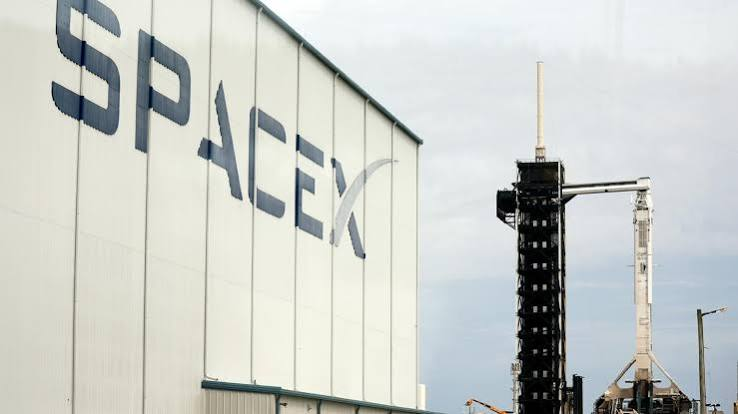
SpaceX officially joins the Nasdaq 100 index today. The technology and rocket launch company was added at the opening bell on Tuesday, with an index weight of approximately 1.3%, calculated based on three times its original free-float market capitalization of $75 billion. Less than a month after its IPO on June 12, this is one of the fastest inclusions in Nasdaq 100 history.
The mechanical buying from passive funds is the core of this story. But Wall Street offers nearly opposite views on the actual scale of this buying wave and the likely direction of the stock price.
$800 Billion in Index Funds Forced to Reallocate, But Actual Buying Scale Disputed
SpaceX's entry into the index just 15 trading days after its IPO is thanks to a new "fast-track" rule established by Nasdaq specifically for large-cap IPOs. In contrast, the S&P 500, managed by S&P Dow Jones Indices, has refused to create a similar fast-track process, meaning SpaceX still cannot join the S&P 500, held back by that index's separate profitability and seasoning requirements.
Over $800 billion in funds benchmarked to the Nasdaq 100 must make room for Musk's rocket company. However, estimates of the exact amount of forced buying vary. Passive investors may buy up to $4.3 billion worth of shares due to the Nasdaq 100 inclusion, with another approximately $3 billion coming from the Russell index rebalancing. Aggregating all mechanical buying from Nasdaq 100 and Russell tracking products, estimates range from $22 billion to $27 billion.
While these numbers sound significant, many analysts believe their actual impact on the stock price is overestimated. A 1.3% weighting would place SpaceX around the 21st position in the index, behind companies like Nvidia, Walmart, Intel, and Tesla, suggesting the driving force of passive buying on the stock price could be quite limited in the initial inclusion phase. One tech research director stated bluntly that the significance of index inclusion is far less than people expect, as the rules are formulaic and everyone knows the formula. Perspectives from derivatives strategy are similar, suggesting the actual volume required for inclusion is likely much lower than initial market speculation.
For those holding or considering a position, the implication is clear: don't treat "passive index buying" as an independent catalyst capable of pushing the stock price up on its own. It's more like public information already priced in by the market.
Small Float Amplifies Volatility, Potential $20 Swing in the Next 11 Days
A unique aspect of SpaceX's inclusion is its extremely small public float. Only about 4% of shares were available for trading during the IPO, although the retail allocation was higher than average. A small float combined with large passive demand amplifies price volatility rather than smoothing it out.
ETFs and mutual funds will seek to buy a substantial portion of the tradable shares. This dynamic can be self-reinforcing on the way up, but becomes fragile if the trend reverses. In other words, a thin float can amplify gains during periods of strong demand and exacerbate declines when sentiment turns.
The risks are already apparent. An exchange executive has cautioned investors to prepare for a potential $20 swing in the stock over the next week and a half. The market knows volatility is high, and some believe it could increase further. Investors need to ask themselves if they can tolerate an expected $20 swing over the next 11 days. People often only consider the possibility of the stock rising $20, but it can equally fall $20.
For short-term traders, this means position management is more important than directional prediction. For long-term holders, it means needing to endure sharp intraday fluctuations during the initial inclusion period.
Historical Precedents Vary: Index Inclusion is Not a Definitive Factor for Stock Direction
If passive buying is a short-term positive, the historical analogies commonly cited by the market actually point to a more complex conclusion: the post-inclusion performance of three high-profile stocks differs significantly.
The closest example of "peaking upon inclusion" is Strategy (formerly MicroStrategy). The stock entered the Nasdaq 100 on December 23, 2024, but its intraday all-time high of $543 occurred back in November, a month before inclusion. By the time of inclusion, the stock was already in decline, subsequently falling alongside Bitcoin. It currently trades around $102, an approximate 81% drop from its peak.
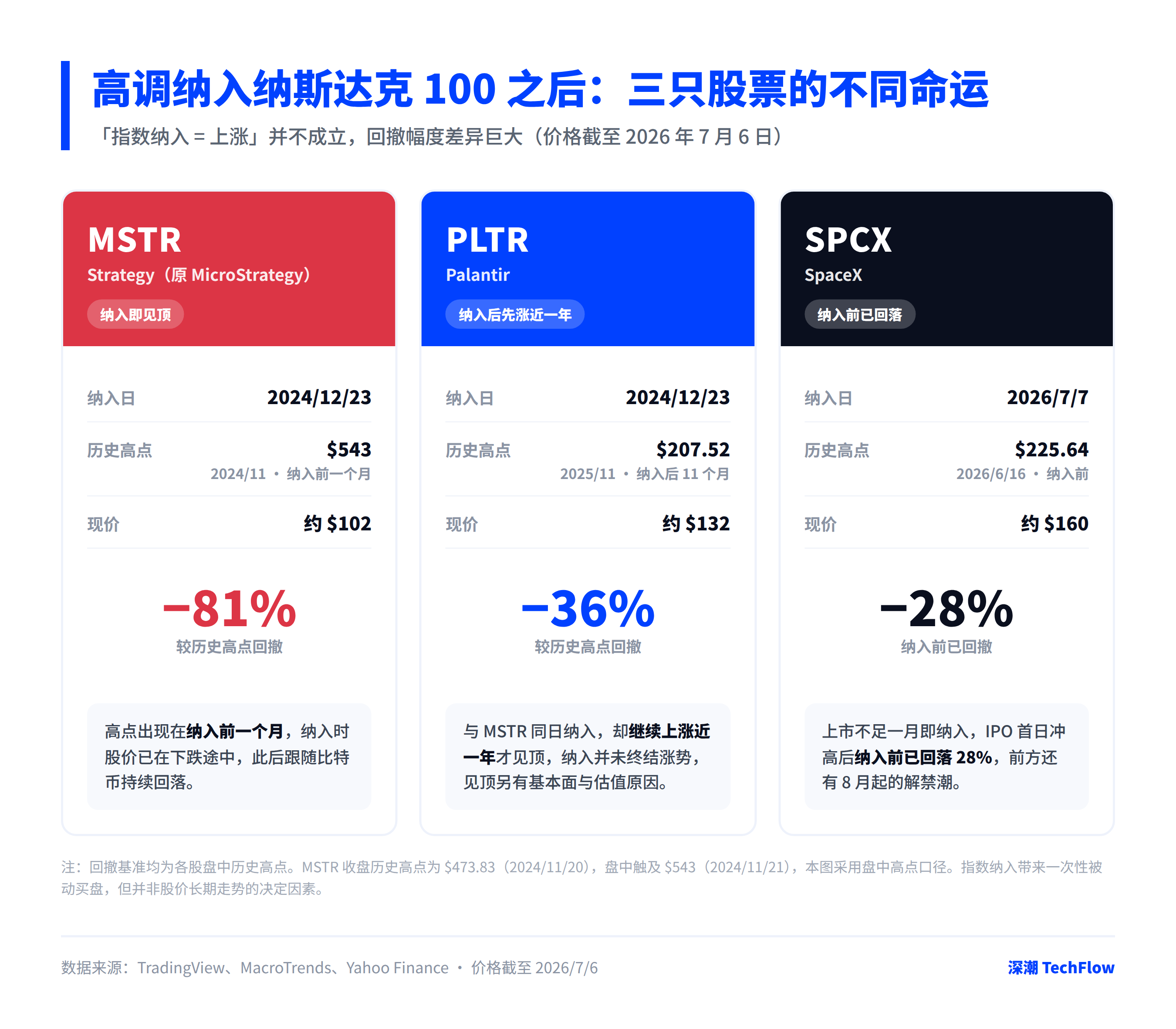
Palantir, which joined the index on the same day as Strategy, charted an opposite path. It did not peak after inclusion but continued to rise, eventually hitting its all-time high of $207.52 on November 3, 2025 – nearly 11 months *after* inclusion. It has since retreated to around $132, a drop of about 36% from its high. Palantir's peak was driven by other fundamental and valuation factors, with no direct causal link to the index inclusion itself.
SpaceX's position is different again. After surging 50% on its IPO day, it hit an all-time high of $225.64 on June 16. It has since fallen about 28% leading up to the inclusion. The stock price at this inclusion point is neither at its starting point nor its peak, but rather in the midst of a pullback.
The Real Bearish Pressure Lies Ahead: Wave of Lockup Expirations Begins in August
More noteworthy than the index inclusion is the upcoming wave of lockup expirations. The 180-day lockup period for SPCX expires on December 8, 2026. The first selling window opens after the Q2 earnings report (late July to August). Musk's 6.4 billion shares are locked up until June 12, 2027.
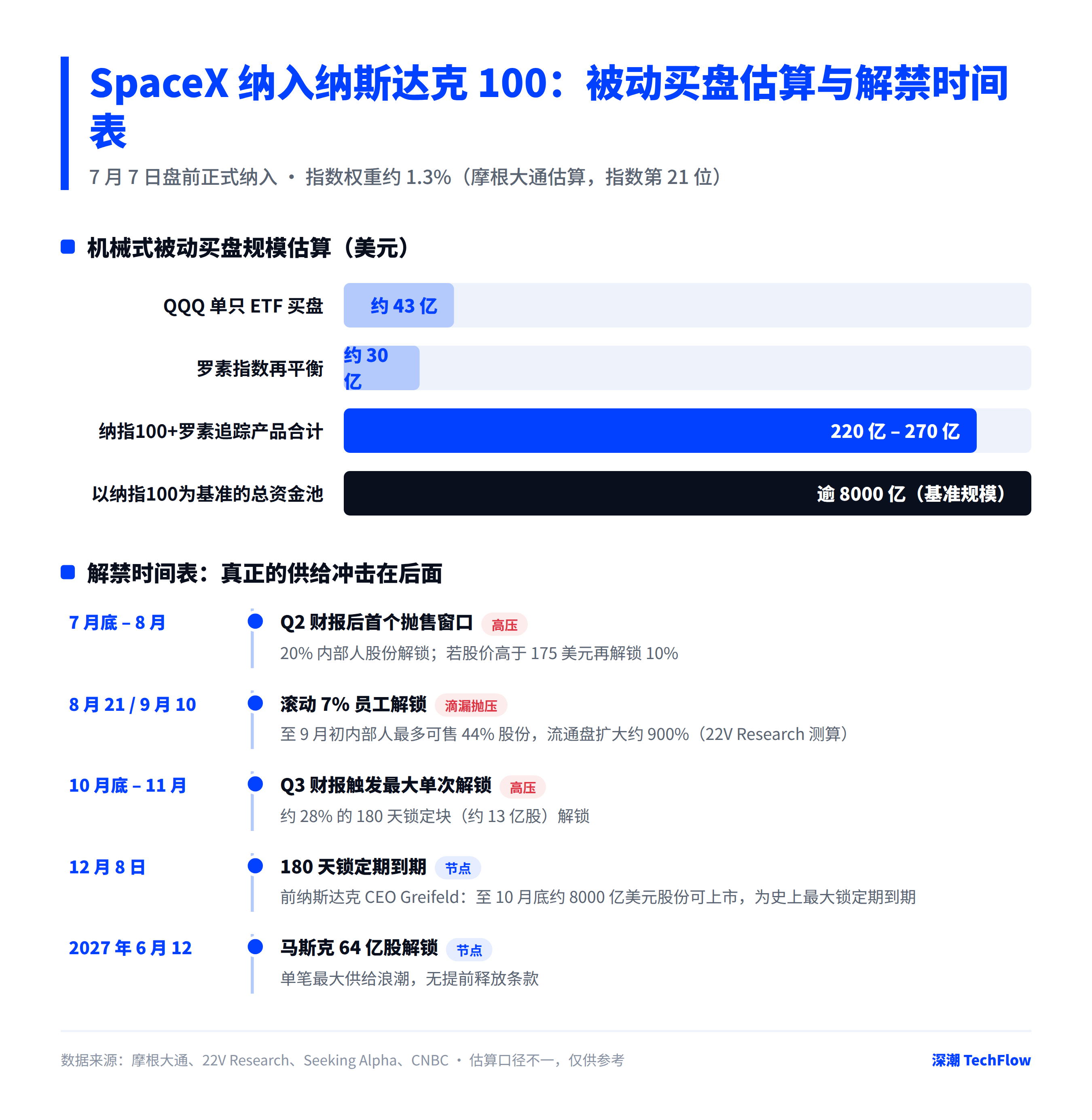
The lockup expiration is not a one-time event but occurs in tranches. Between early and mid-August, after the earnings report, 20% of insider shares unlock. If the stock price is 30% above the IPO price (i.e., above $175), another 10% unlocks. Additionally, 7% unlocks around August 21 and another 7% around September 10. By early September, insiders could potentially sell up to 44% of their shares, expanding the current public float by approximately 900%.
Warnings from seasoned market participants are even more stark: this constitutes the largest lockup expiration in US capital market history. While SpaceX is the largest IPO ever, having been in operation for 23 or 24 years, it also represents the largest lockup expiration ever. From now until the end of October, approximately $800 billion worth of shares could potentially enter the market, an unprecedented situation.
A balanced perspective worth noting is that while the unlock adds selling pressure, it could also potentially dampen the stock's extreme volatility. While these large-scale unlocks may exert considerable downward pressure on the stock price, the increase in the public float could also reduce the stock's overall daily volatility.
For current holders, this means the Q2 earnings window in late July to August, and the Q3 lockup expiration window in late October to November, are the two most critical supply-shock events to watch in the near term.
Outlook: Short-Term Noise High, Direction Depends on Fundamental Delivery
Synthesizing various viewpoints reveals a relatively clear picture: the index inclusion itself is more like a well-anticipated calendar event than an independent catalyst capable of driving the stock. Index membership supports liquidity and credibility, but it reflects past achievements, not a guarantee of future strong performance. Investors evaluating SpaceX should focus more on the company's operational milestones and cash flow trajectory, rather than the temporary tailwind from index-driven fund flows.
The foundation for the long-term narrative rests on the fundamentals of SpaceX's three business segments. Starlink is currently the largest revenue driver, contributing $11.4 billion of SpaceX's total $18 billion revenue last year, with its subscriber base surging from 2.3 million three years ago to over 10 million today. The cost advantages of rocket launches and the AI deployment in space data centers constitute longer-term aspirational value.
In the short term, four forces intertwine to push the stock into a high-volatility state: the support from passive buying, the amplification effect of the thin float, warnings from historical patterns, and the upcoming wave of lockup expirations. Interest rates remain the ceiling; a significant rebound in yields would put duration pressure on growth stocks with stretched valuations, a gravitational force SpaceX cannot offset. However, a completely new large-cap story might also sustain risk appetite in a turbulent macro environment. The spillover effect on the crypto market is also worth noting; when large-cap tech fund flows dominate the market, Bitcoin and Ethereum often move in line with broader risk sentiment.
The final verdict on direction does not rest with the index inclusion event itself, but on whether fundamentals can withstand the supply shock during the Q2 earnings report in August and the subsequent lockup expiration windows.