






927-page Filing: Breakdown of Trump's $1.4 Billion Crypto Revenue


- Key Takeaway: Trump's 2025 financial disclosure report shows that his first year of the second term generated over $1.4 billion in revenue from cryptocurrency-related businesses, primarily derived from meme coin licensing fees, DeFi platform token sales, and equity monetization. This illustrates a new model of capitalizing on a political brand for asset liquidation while in office.
- Key Elements:
- The $1.4 billion revenue came from meme coin licensing fees ($635 million), WLF token sales ($515 million), and WLF equity sales ($65 million), all realized through a brand licensing model rather than personal trading profits.
- The $TRUMP coin was launched on Solana with a total supply of 1 billion tokens, 80% of which are held by related parties; the issuer pays Trump brand licensing fees through the joint venture entity Fight Fight Fight LLC.
- The WLF platform issued 100 billion WLFI governance tokens, with approximately one quarter sold in public sales; Trump's entity received a 75% share of the sales revenue, totaling approximately $515 million.
- WLF obtained funding by selling nearly half of its equity to an Abu Dhabi-affiliated entity, with Trump's recorded income from the disclosure filing amounting to $65 million.
- Trump's crypto revenue in his second term far exceeds that of previous presidents and his own first term; his net worth rose from $5.1 billion in 2025 to $6.5 billion in 2026, with the crypto business as the core growth driver.
- Signed the GENIUS Act to establish a federal regulatory framework for USD stablecoins, while the indirectly associated stablecoin USD1 saw its circulating supply approach $4.5 billion by the end of Q1 2026.
On June 30, U.S. President Donald Trump submitted his 2025 annual financial disclosure report to the Office of Government Ethics. The document is 927 pages long. According to CNN, the combined similar filings from Obama and Biden totaled less than 20 pages.
What fills these 927 pages? Cryptocurrency. In his first year of the second term, Trump earned over $1.4 billion from cryptocurrency-related businesses. This figure comprises three distinct types of revenue from two different entities, flowing into the Trump family accounts through at least three layers of legal structures.
This is not a story about "how much the president made from trading crypto." Not a single dollar of that $1.4 billion came from Trump himself buying and selling on exchanges. It reads more like an income statement for a brand licensing business, except the product being sold is the president's name and likeness.
Where Did the $1.4 Billion Come From?
The $1.4 billion in crypto revenue breaks down into three main chunks. The largest is $635 million from meme coin licensing fees.
The second is $515 million from token sales by World Liberty Financial (WLF). The third is $65 million from the sale of equity in the WLF holding company.
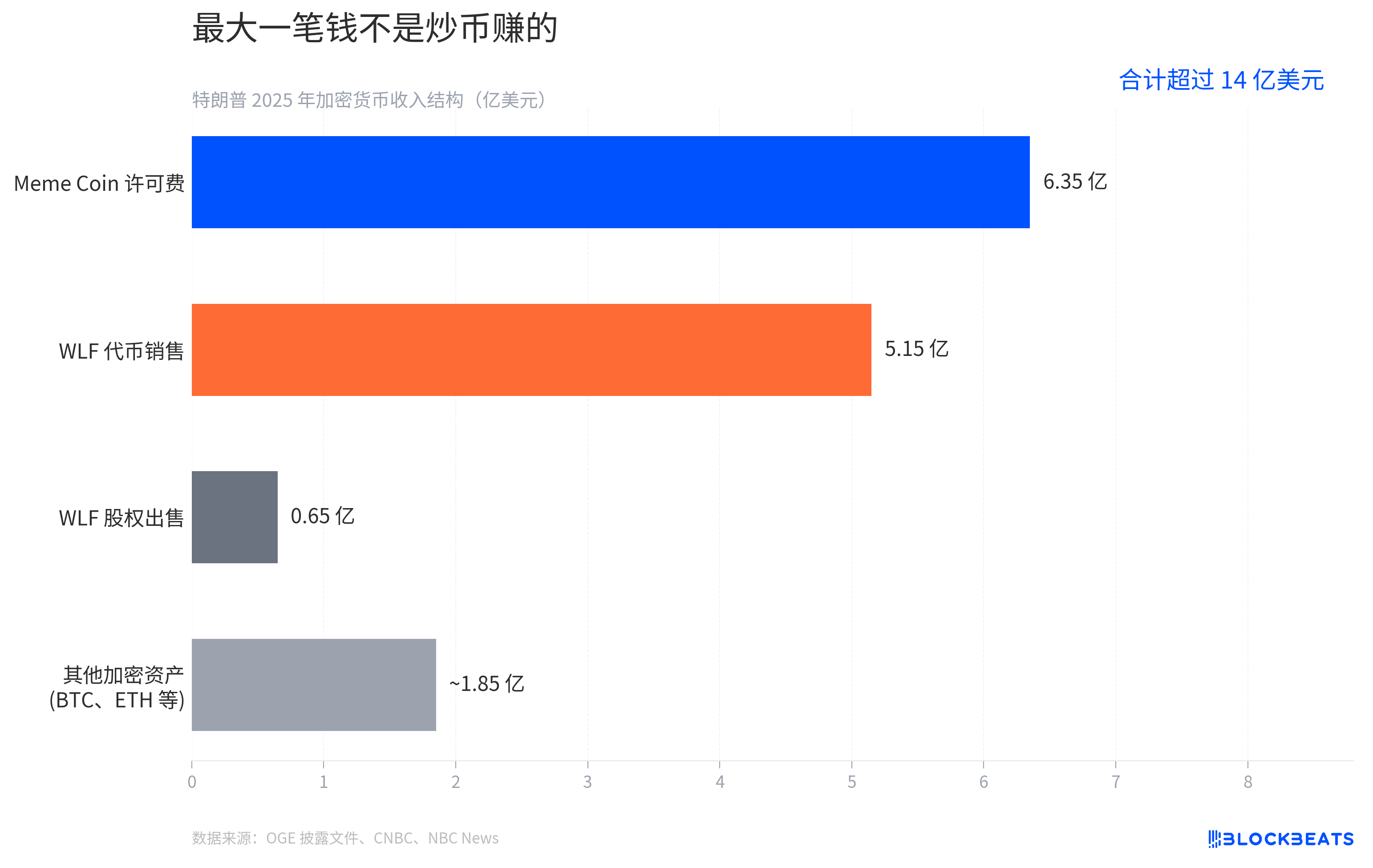
These three revenue streams total over $1.2 billion, with the remainder spread across smaller crypto asset holdings, including a Bitcoin position (reportedly over $50 million, per Bitcoin Magazine) and an Ethereum position ($5 million to $25 million).
These three revenue streams share a common characteristic. Neither Trump himself nor his immediate family directly operate any crypto project. Their role is much closer to brand licensing. Understanding this is key to reading the entire ledger.
What is the Business Model Behind Each Revenue Stream?
$635 million meme coin licensing fee. According to NBC News, the disclosure shows that CIC Digital LLC recorded royalty income of $635,068,835 associated with an entity named Celebration Coins. CIC Digital is held by the Donald J. Trump Revocable Trust.
Here's how it works. On January 17, 2025, three days before Trump's inauguration, the $TRUMP meme coin was issued on the Solana blockchain. The total supply was 1 billion tokens, with only one-fifth offered publicly. The rest were held by Trump-affiliated entities. The issuer was Fight Fight Fight LLC, a joint venture between CIC Digital and Celebration Cards LLC.
Trump doesn't issue coins or operate trading himself. He licenses his name and likeness to the entities in this issuance chain and collects licensing fees proportionally. The $635 million represents this brand usage fee.
According to CoinDesk, as of May 2025, trading fees from $TRUMP coin had generated over $320 million in additional revenue for its creators. During the same period, the coin had fallen 87% from its peak. How much money buyers lost and how much the issuer made are two parallel numbers.
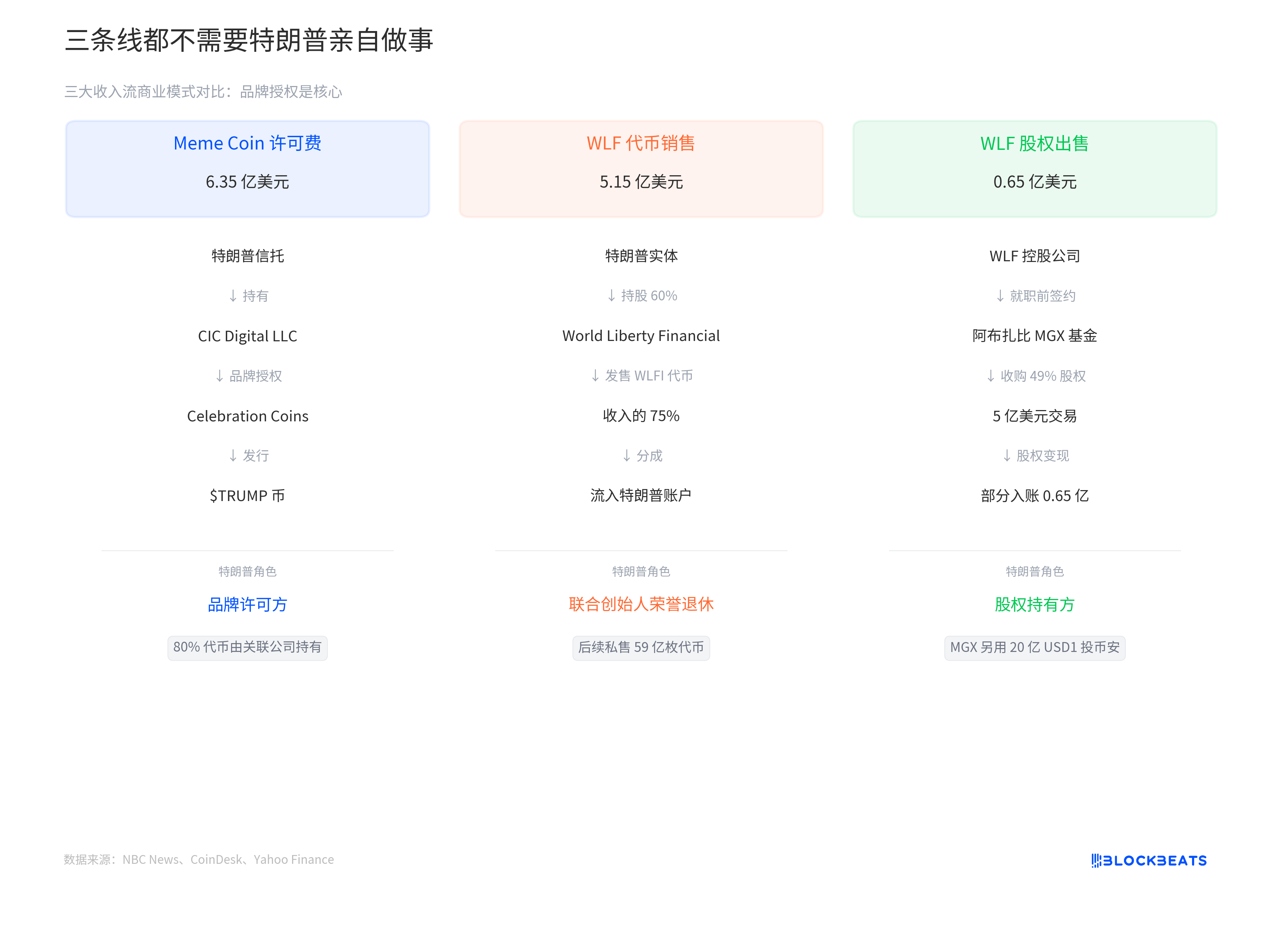
$515 million WLF token sales. World Liberty Financial is a DeFi platform co-founded by the Trump family and partners in 2024. According to Yahoo Finance, a Trump entity holds 60% of WLF, and Trump himself owns a 70% stake in that entity.
WLF issued the WLFI governance token, with a total supply of 100 billion, offering a quarter publicly. According to CoinMarketCap, the token sale ultimately raised approximately $550 million.
A key detail lies in the revenue split. WLF's disclosure documents show that three-quarters of the token sale revenue goes directly to the Trump entity, with the remainder split among the Witkoff family and co-founders Zak Folkman and Chase Herro.
The $515 million is the amount directed to Trump's side under this split.
WLF's management list is also noteworthy. The CEO is Zach Witkoff, son of White House Middle East Envoy Steve Witkoff. Trump's three sons—Eric, Donald Jr., and Barron—are co-founders. Trump himself and Steve Witkoff hold the title of "Co-Founder Emeritus," nominally no longer involved in day-to-day operations.
According to a May 2026 report from Unchained Crypto, WLF later privately sold an additional 5.9 billion WLFI tokens, while 80% of the holdings of early public buyers remained locked.
$65 million WLF equity income. According to CNBC, this money came from the sale of equity in the WLF holding company. Per a February 2026 report from CoinDesk, an Abu Dhabi-linked entity secretly signed an agreement before Trump's inauguration to acquire nearly half of WLF for $500 million.
The exact link between the $65 million recorded in the disclosure document and this transaction is not entirely clear, but it is part of the monetization of WLF equity.
WLF also launched the USD1 stablecoin in March 2025, pegged to the U.S. dollar and backed by U.S. Treasuries and cash equivalents. According to Phemex, USD1's circulating supply neared $4.5 billion by the end of Q1 2026. Per ABC News, Abu Dhabi's sovereign fund MGX used $2 billion worth of USD1 to participate in an investment transaction with Binance.
Lost in the First Term, Made Back in the Second
The $1.4 billion figure needs historical context to be fully understood.
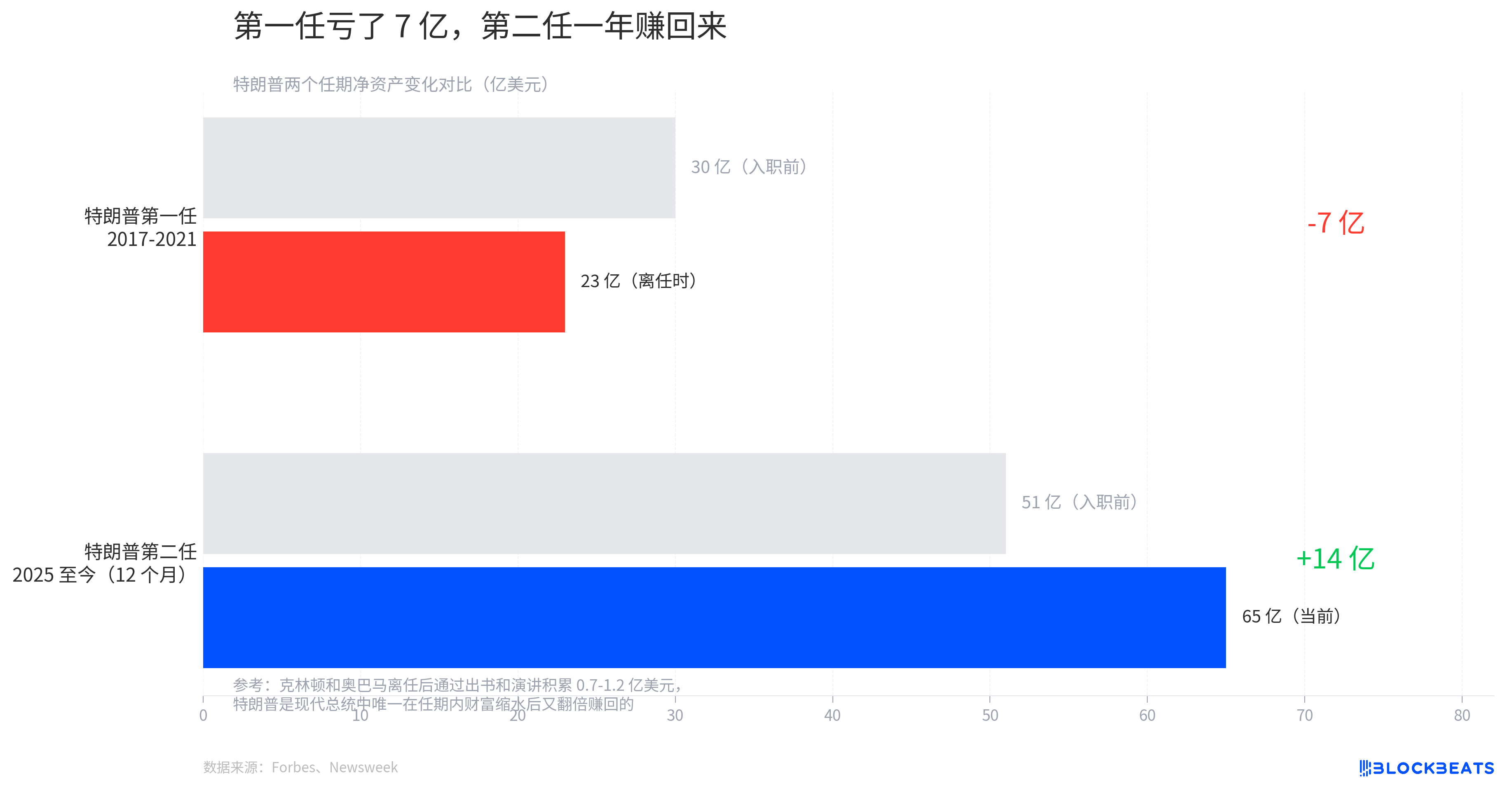
According to Forbes, Trump's net worth rose from about $5.1 billion in 2025 to $6.5 billion by February 2026. The crypto business was the core engine of this growth.
The changes in wealth of former U.S. presidents provide a benchmark. Clinton entered the White House with a net worth of about $1.3 million and accumulated about $120 million post-presidency through book deals and speaking fees. Obama's trajectory was similar, starting in the millions and taking over a decade to reach tens of millions. George W. Bush started higher but grew more slowly.
The common thread for these former presidents is that their wealth accumulation happened primarily after leaving the White House, fueled by book royalties and six-figure speaking fees. Trump's $1.4 billion materialized during his term, within 12 months.
An even more telling comparison is with Trump's own first term. His experience then was the complete opposite. According to Newsweek, his net worth was around $3 billion when he took office in 2017, but it shrank to about $2.3 billion by the time he left in 2021. He is the only modern U.S. president whose wealth decreased while in office.
In the first year of his second term, he recouped the losses from his entire first term and doubled them. The difference lies not in a change in business acumen, but in a change of monetization tools. Last time, it was hotels and golf courses. This time, it's tokens and licensing fees.
There is another detail in the 927-page document. According to the disclosure, on July 18, 2025, Trump signed the GENIUS Act, establishing the first federal regulatory framework for U.S. dollar stablecoins. The man who signed it also operates one of the fastest-growing stablecoins on the market.
Trump's 927-page disclosure makes one thing very clear: cryptocurrency is already this president's single largest source of income, bigger than real estate, bigger than golf courses, bigger than any traditional business line.





