






Storage is still rising, but smart money is starting to position in this "flash memory chain".


- Core Thesis: AI computing power is constrained by expensive and scarce memory (DRAM). Giants like AMD, Nvidia, and SanDisk are promoting the partial replacement of DRAM with cheaper flash memory (NAND). This "flash memory substitution" logic will create new incremental demand for the NAND industry chain, and segments whose valuations have not yet fully reflected this change (such as controller chips) offer higher cost-effectiveness.
- Key Elements:
- The surging demand for High Bandwidth Memory (HBM) from AI chips is straining DRAM capacity. Contract prices rose over 90% QoQ in Q1 2026, and HBM is expected to account for 25% of total DRAM wafer output, creating a hefty "memory tax".
- AMD's acquisition of MEXT, Nvidia's launch of CMX, and SanDisk's HBF standard project with SK Hynix—these three giants are all exploring solutions to shift AI data from DRAM to NAND flash to reduce costs and improve efficiency.
- In the NAND industry chain, original manufacturers (NAND fabs) and module makers (like SanDisk and Longsys) are already fully priced based on the "price hike logic". However, the controller chip segment (Silicon Motion, Phison, and Maxio) benefits from SSD shipment growth, yet their valuations lag behind.
- The world's top three independent SSD controller manufacturers are Silicon Motion (SIMO), Phison (8299.TW), and Maxio Technology (688449). Among them, Maxio's profit margin is thinnest due to its high R&D expense ratio of 36%-38%, resulting in the largest valuation gap.
- HBF (High Bandwidth Flash) is expected to sample in the second half of 2026, with a projected market size of approximately $12 billion by 2030. This will drive demand for advanced packaging (JCET, Tongfu Microelectronics) and packaging materials (Hua Hai Cheng Ke), but for now it's mostly forward-looking, with a mix of quality and speculative stocks in the market.
Original Author: David
Foreword: SanDisk surged roughly 40x in 16 months post-IPO, while A-share Longsys saw Q1 net profit jump 26x YoY... Storage is undeniably the hottest track in 2026. However, since June, three giants — AMD, NVIDIA, and SanDisk — have essentially done the same thing simultaneously:
Finding ways to use less expensive memory (DRAM) and shift the workload to cheaper flash storage (NAND). The underlying "flash replacement" theme is already lifting leading stocks, but the truly underpriced opportunities may lie upstream and downstream of this trend.
Understanding AI's Constraint: The "Memory Tax"
SanDisk (SNDK), spun off from Western Digital in February 2025 at an IPO price of roughly $38, touched about $2000 by mid-June 2026, a nearly 40x increase in 16 months, with a P/E ratio of around 69x; not to mention Micron.
On the A-share side, Longsys reported a Q1 2026 net profit of 3.862 billion RMB, up 2644% YoY; GigaDevice's Q1 net profit surged 522% YoY, hitting its historical high on June 17. The market consensus seemed to be just one sentence:
AI is so starved for storage, shortages will persist until 2028; buying storage stocks is a guaranteed win.
But while everyone celebrates the "shortage," the most influential companies are quietly laying the groundwork for a different narrative.
On June 15, AMD announced the acquisition of a company called MEXT, whose core technology uses AI to make flash memory "masquerade" as RAM;
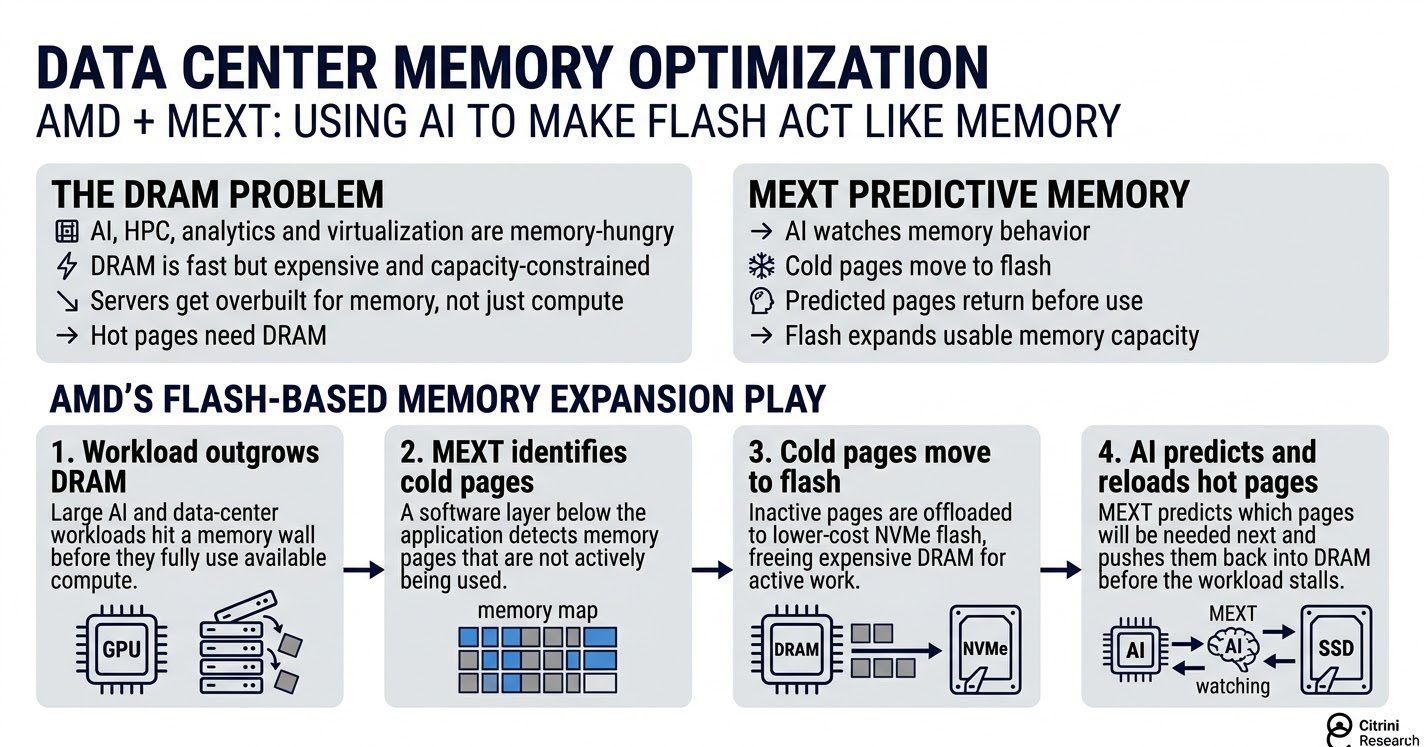
Going further back, NVIDIA launched CMX at CES and GTC in early 2026, shifting the most memory-intensive data during AI inference to a flash layer; and earlier, SanDisk and SK Hynix jointly initiated a new standard called HBF in February, aiming to fit flash memory into packages previously reserved for high-end memory (HBM).
Put these three things together, and the direction is perfectly aligned:
Add an intermediate memory layer for AI that is 'cheaper than DRAM, faster than HDD,' reducing reliance on expensive DRAM. Overseas thematic research firm Citrini Research even coined a term for this phenomenon: the "AI Tax" (or "Memory Tax").
To understand this term and identify investment targets, you first need to distinguish between AI's two types of "memory."
One is DRAM, and its highest-end form, HBM (High Bandwidth Memory, designed specifically for GPUs). It is extremely fast, allowing the GPU to access data easily, but it is very expensive and has limited capacity.
The other is NAND flash, the type of memory in your computer's SSD. It is cheap and offers large capacity, but it is slow. To use an imprecise but useful analogy: DRAM is like files spread out on your desk for immediate access; NAND is like inventory in the basement warehouse — cheap and abundant, but it takes time to retrieve.
The problem for AI development over the past two years is that the "desk" is too small and prohibitively expensive.
TrendForce data shows that DRAM contract prices rose over 90% QoQ in Q1 2026; Citigroup predicts DRAM average prices will rise 88% and NAND 74% for the full year 2026. The root cause is AI:
NVIDIA's GPUs need to be fed data, HBM is fast and expensive, so HBM is consuming an increasing share of DRAM production capacity.
Data cited by Citrini shows that HBM's share of total DRAM wafer output grew from 2% in 2020 to about 21% in 2025, and is expected to reach 25% in 2026... meaning a quarter of memory capacity is taken by HBM, leaving less for others, making it tighter and more expensive.
This is the origin of the "Memory Tax."
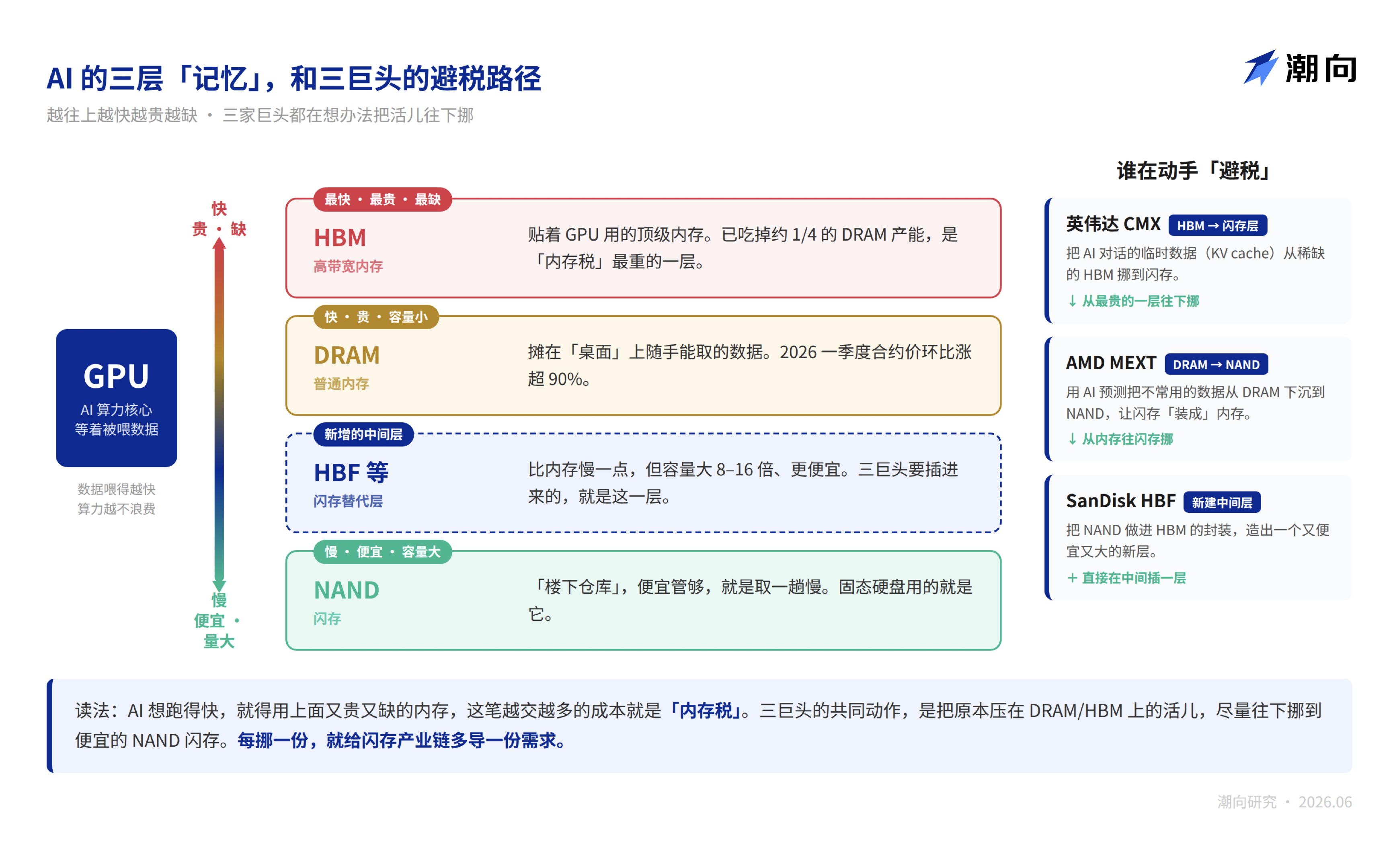
For AI to run fast, it is forced to pay an increasingly higher "tax" for scarce and expensive memory. As the tax burden grows, naturally, some try to find ways to avoid it. The only direction is to shift some of the workload from expensive DRAM to cheaper NAND flash memory.
The three actions taken by AMD, NVIDIA, and SanDisk mentioned earlier are essentially different paths toward this "tax avoidance." But the common goal is to add an intermediate memory layer for AI that is "cheaper than DRAM, faster than HDD."
The investment significance lies precisely in this 'shift.' Every unit of workload moved to flash memory generates additional demand for the NAND supply chain. Storage leaders have already rallied on the "shortage/price hike" logic. "Flash replacing DRAM" is the second layer superimposed on top of the price hikes.
It doesn't necessarily point to the already surging leaders, but rather to the links in this chain that haven't yet been priced for this new logic. That's what's worth digging into next.
Deconstructing the Flash Supply Chain: Manufacturers Profit, Controller Makers Sell the Shovels
The flash memory business, from wafer to finished drive, can be roughly divided into three layers. The further upstream you go, the more profitable and monopolistic it becomes.
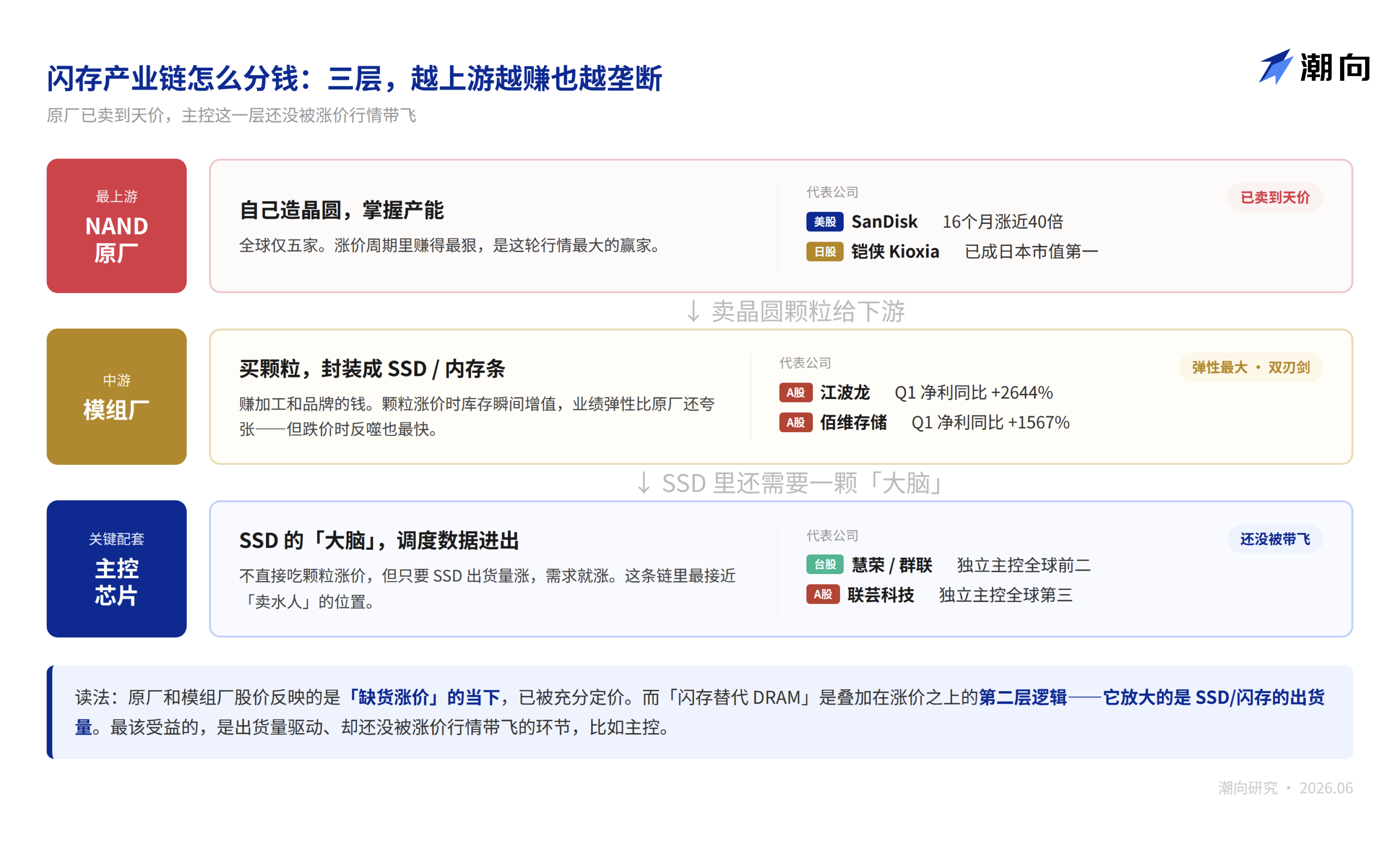
- The upstream layer is the NAND manufacturers, who produce their own wafers:
Samsung, SK Hynix (post-Kioxia integration), Micron, and SanDisk (spun off from Western Digital). They control production capacity and profit the most during upcycles.
- The middle layer consists of module manufacturers, who buy NAND wafers from manufacturers, package them into SSDs and memory sticks, and sell them to end customers:
They don't make wafers; they profit from processing and branding. Their earnings can be even more volatile than the manufacturers'. When NAND prices rise, their low-cost inventory instantly appreciates in value.
A-share companies like Longsys, Biwin Storage, and Demeter Electronics belong to this layer. Longsys reported a Q1 2026 net profit of 3.862 billion RMB, up 2644% YoY; Biwin Storage grew 1567% YoY in the same period.
However, this volatility is a double-edged sword. Once NAND prices fall, inventory becomes a liability; module manufacturers are the first to feel the pressure in a downturn.
- The most overlooked layer is the controller chip:
Besides the NAND chips, an SSD has a "brain" that manages data flow – the controller. It doesn't directly benefit from rising NAND prices, but as SSD shipments increase, so does demand for controllers.
Theoretically, this is the closest position to a "pick-and-shovel seller" in this chain. The global top two independent controller makers are Taiwan's Silicon Motion (SIMO) and Phison (8299.TW), followed by A-share's Lianyun Technology (688449).
Currently, within these three layers, the manufacturers and module makers have been fully priced by the market's "price hike logic," with stock prices reflecting the current shortage and rising prices.
The "flash replacing DRAM" theme is the second layer superimposed on top of price hikes. It benefits not just from price increases, but more importantly from the long-term expansion of SSD/flash shipment volumes.
The segments that should benefit most from this logic are precisely those driven by shipment volume, which haven't been swept up by the price hike frenzy, such as controller makers; and the new increment specifically driven by HBF, which we'll discuss in the next chapter.
Truly Underpriced: The Controllers' "Valuation Gap" and HBF's "New Pie"
Driven by shipment volumes, yet not carried away by the price hike rally. Digging deeper reveals two areas.
First: The Valuation Gap of Controller Makers.
Lianyun Technology (688449) is a prime example. It's the world's third-largest independent SSD controller maker, after Taiwan's Silicon Motion and Phison, and is among the few able to mass-produce PCIe 5.0 controllers domestically.
However, as of April 2026, its market cap was still below its IPO first-day high, significantly lagging behind module stocks like Longsys and Demeter... The reason isn't complex:
Controllers don't directly benefit from rising NAND prices. During this half-year of NAND price surges, capital rushed into the most volatile module makers, leaving controllers behind.
But I believe this is precisely the divergence point between the "price hike logic" and the "shipment volume logic." Price hikes benefit manufacturers and module makers holding inventory; controllers don't share the spoils. However, flash replacing DRAM leads to a long-term expansion of SSD shipments. For every additional SSD sold, another controller is needed.
If this thesis holds, beneficiaries are driven by volume, not price. Controllers are a purer play on this theme.
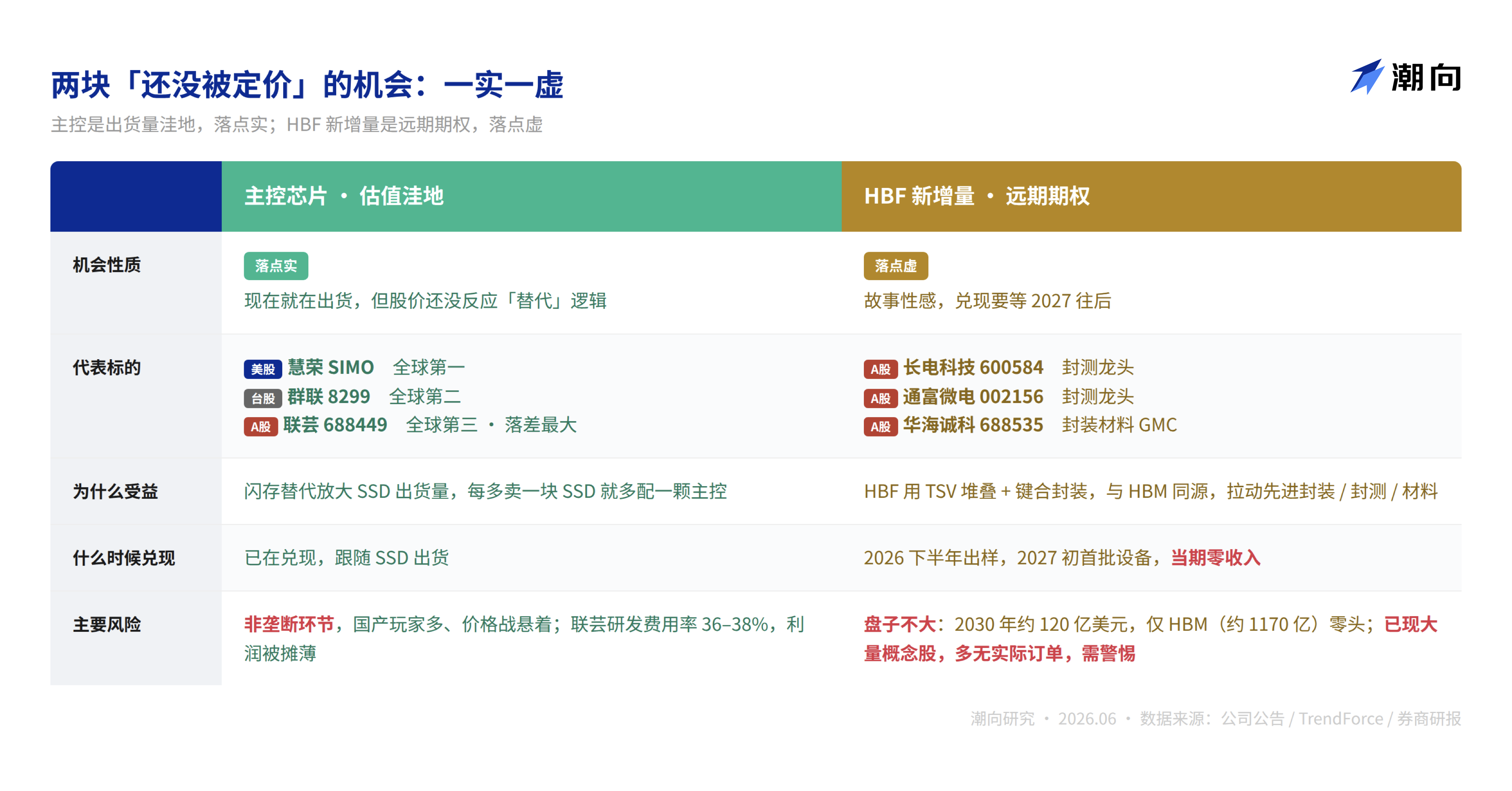
Three companies are worth watching in this layer:
Silicon Motion SIMO (US ADR): World's largest independent controller maker, with over 30% global market share in consumer SSD controllers.
Phison 8299.TW (Taiwan Stock): World's second-largest independent controller maker; Kioxia's custom controllers come from them.
Lianyun Technology 688449 (A-Share): World's third-largest independent controller maker, the most technologically advanced domestic controller maker, and the one with the largest valuation gap.
However, risks must be stated clearly. The controller market isn't a high-moat monopoly; there are many domestic players, and price wars are ongoing. Public data shows Lianyun's R&D expense ratio is as high as 36%-38%, continuously diluting profits. Its "global number three" market share doesn't translate to high profitability.
Second: The "New Pie" Created by HBF.
First, what is HBF?
HBM is fast and expensive, consuming a quarter of DRAM capacity. So SanDisk and SK Hynix devised a solution: stacking NAND flash to create a replacement layer similar in form to HBM, but with 8 to 16 times the capacity at a fraction of the cost. This is HBF (High Bandwidth Flash).
It doesn't compete with HBM's tasks; it acts as a "large-capacity warehouse" alongside HBM, specifically for AI inference data that "can't fit in HBM but isn't worth sending to cold storage."
The manufacturing process for HBF involves TSV (Through-Silicon Via, drilling vertical connections through chips) to stack multiple NAND layers and then bond them together, similar to HBM production. This process will drive demand for advanced packaging, assembly & testing, and specialized materials. Potential technically related targets:
JCET Group 600584, TongFu Microelectronics 002156 (A-Share): Domestic leaders in assembly & testing. The stacking and bonding processes for HBF are within their capabilities.
Wah Lee Industrial 688535 (A-Share): The only domestic company mass-producing GMC, a core material for HBM packaging. The same technology applies to HBF.
However, this is more about unfulfilled expectations. Be mindful of the following points:
First, HBF is not yet in mass production. SanDisk's timeline is sampling in H2 2026, with first devices in early 2027. Currently, all "benefits" are expectations, with no revenue yet reflected in financial reports.
Second, the total addressable market isn't as large as some think. According to SK Hynix's cited forecast, the HBF market could reach ~$12 billion by 2030, compared to ~$117 billion for HBM. HBF is a supplementary layer, not a disruptor.
Third, numerous "HBF concept stock lists" are emerging in A-shares, frequently naming companies like Yitong New Material, PhiChem, ACM Research, and Quick Intelligent. Most of these companies are "theoretically related" at best, lacking actual HBF orders or process validation disclosures — typical concept speculation.
They are fundamentally different from companies like JCET and Wah Lee, whose processes genuinely align with HBF. They must be evaluated separately.
Therefore, these two areas represent the current and future narratives under the same investment theme.
Controllers are the "value trap currently shipping product, but whose valuation hasn't yet reflected the replacement logic." This is a concrete near-term play. HBF's new increment is a "long-dated option with an attractive story, but monetization waits until 2027 onward." This is more speculative, and concept stocks are rife with hype.
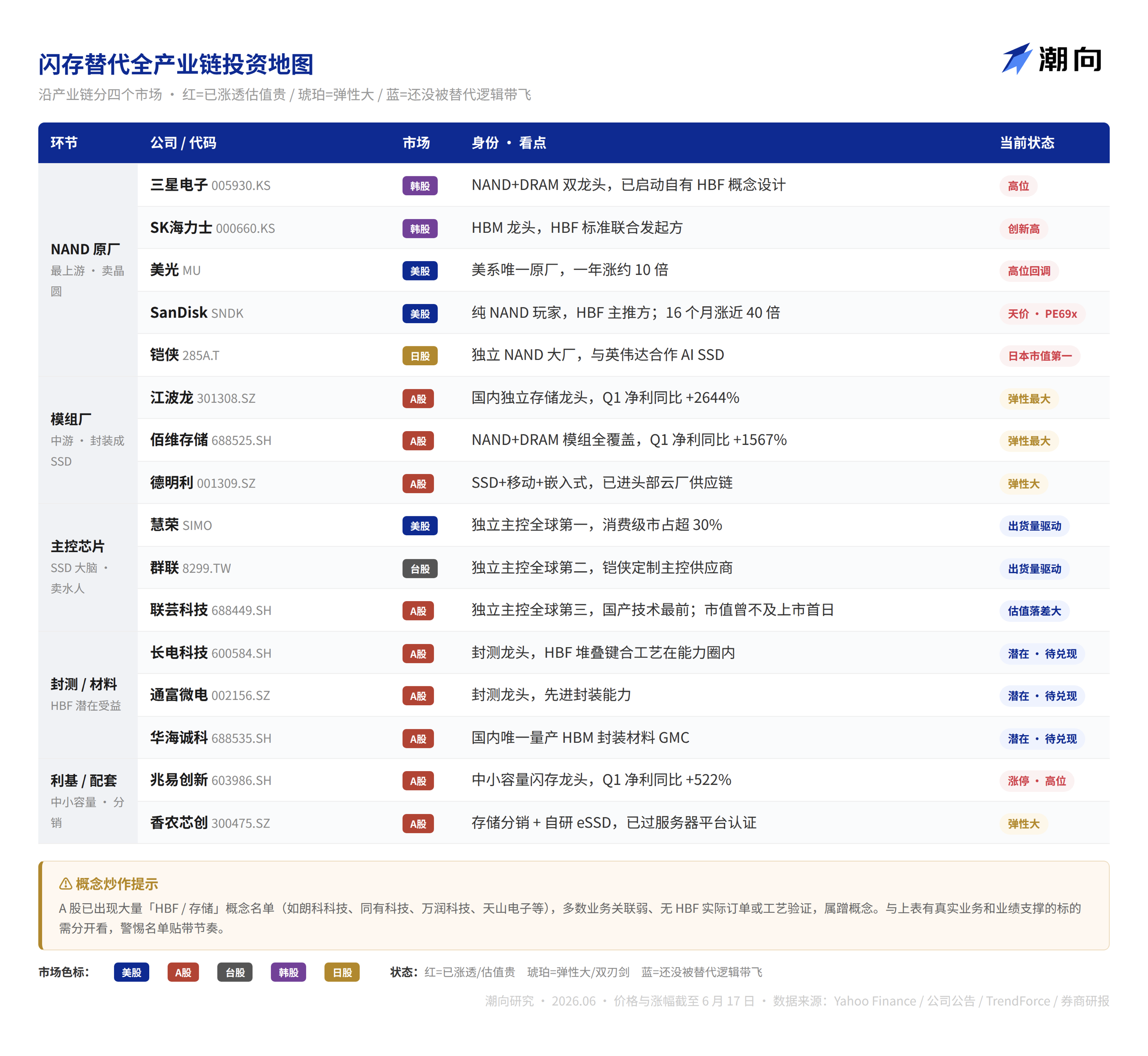
A Map of the Entire Market: Where are the Targets Along the Supply Chain and Are They Expensive?
Let's consolidate the layers analyzed earlier into a map.
In terms of geographic distribution, this chain is concentrated in four markets: NAND manufacturers in the US, Japan, and South Korea; controllers in US ADRs and Taiwan stocks; modules, assembly/testing, and materials almost entirely in A-shares. Hong Kong stocks lack pure-play flash memory targets, so none are forced here.
When reading this map, remember one coordinate:
The further upstream (manufacturers), the more monopolistic and beneficial the position, but also the most fully priced and expensive. Moving downstream (modules, controllers, assembly/testing, materials), the elasticity and certainty differ. Some haven't yet been priced for the "replacement logic."
Risks and Variables: Tailwinds in the Short Term, a Sword Over DRAM in the Long Term
The most common misinterpretation of the "flash replacement" theme is conflating short-term and long-term dynamics. Their directions are actually opposite.
Short-term (2026 to 2027): The replacement is far from large-scale implementation. The storage supercycle is still playing out. NAND contract prices are still rising over 70% QoQ in Q2, and manufacturers and module makers continue to post stellar earnings.
In this phase, the "memory tax" is a pure


