






Shifts in Computing Power Investment Logic: Bernstein Bullish on CPU Revival, Hygon Information Target Price Significantly Upgraded


- Core Thesis: As AI evolves from chatbots to the era of intelligent agents, the importance of CPUs in data centers will substantially increase. The associated server CPU market size is projected to reach $223 billion by 2030, six times that of 2025, marking a "revival" of CPUs in AI computing.
- Key Elements:
- The "inference loop" characteristic of agentic AI (e.g., retrieval, planning, tool invocation) requires CPUs to efficiently orchestrate workflows, with their computing share expected to jump from 14% in traditional LLMs to 50%, making them equals with GPUs.
- Bernstein predicts that by 2029, the GPU-to-CPU ratio in CSP inference clusters will reverse from 8:1 in 2025 to 1:1. Hardware roadmaps (e.g., new products from AMD, NVIDIA) already indicate a recovery in the physical CPU ratio.
- Based on assumptions like 70GW of AI data center deployments by 2030 and a $1.6 trillion accelerator market size, the server CPU TAM is forecasted at $223 billion, achieving a compound annual growth rate of 43%, with $174 billion coming from agentic AI workloads.
- Arm is identified as the largest structural beneficiary. Its architecture offers power efficiency advantages (e.g., AWS Graviton is 40% more cost-effective), and it plans to achieve $15 billion in chip revenue by 2030, already securing Meta as its first customer.
- The report raised price targets for AMD ($600), Intel ($100), and Hygon Information (CN¥450), believing they will benefit from stronger server CPU demand.
- The biggest uncertainty in the report lies on the supply side, specifically whether TSMC's foundry capacity and memory capacity can meet the approximately $30 billion annual incremental demand for CPU capacity.
When an AI agent is awakened, it is not simply waiting for an answer. It must retrieve information, plan steps, call tools, reason through intermediate results, call the model again, and finally execute an action. The CPU computing power required for this entire process far exceeds that needed for ChatGPT to generate a conversation.
A team led by Bernstein analyst David Dai released a report on June 17 titled "Global Semiconductors: A CPU Renaissance?" The core judgment is that AI is transitioning from the chatbot era into the agentic AI era. The role of the CPU in data centers is shifting from a supporting role to the GPU to a leading role, driving the total addressable market (TAM) for server CPUs to reach $223 billion by 2030, six times the $37 billion projected for 2025.
Inference Is No Longer a "One-Off Q&A"; The CPU Is Making a Comeback
Since the rise of large language models, GPU/AI accelerators have been the core of AI computing. In custom inference clusters like Google's TPU v6e and Meta's Grand Teton, the ratio of GPUs to CPUs once reached 8:1.
However, Bernstein believes this ratio is reversing as agentic AI becomes mainstream.
The core characteristic of agentic AI is "looped reasoning": a single request can trigger retrieval, planning, tool calls, intermediate reasoning, another model call, and action execution. While GPUs handle the intensive mathematical operations, the CPU determines whether the entire system can efficiently orchestrate workflows, schedule tasks, manage memory, and prevent accelerator idling. If the CPU is too weak, expensive GPUs are forced to idle, significantly reducing overall system efficiency.
Bernstein predicts that by 2029, the GPU-to-CPU ratio in CSP inference clusters will drop from 8:1 in 2025 to 1:1. In agentic AI workloads, the CPU's share of computation is expected to leap from 14% in traditional LLMs to 50%, putting it on par with the GPU.
The report specifically notes that hardware roadmaps are already confirming this trend. AMD's new Venice compute tray features 4 MI455X GPUs per CPU, NVIDIA's Vera superchip pairs 2 Rubin GPUs with each Vera CPU, and Google's TPU v7x expansion unit includes 4 TPUs per CPU. The physical ratio of CPUs is already recovering; this is not a prediction, but an ongoing reality.
How Is the $223 Billion Market Calculated?
Bernstein has significantly raised its 2030 server CPU TAM forecast from the previous $137 billion to $223 billion, based on the following core assumptions:
- AI capital expenditure reaches $3.5 trillion by 2030, corresponding to 70GW of AI data center deployment
- The AI accelerator market size is $1.6 trillion, accounting for 45% of AI DC capex
- The proportion of inference rises from 35% to 70%, with an inference scenario CPU:GPU ratio of 1:1, and a training scenario ratio of 0.5:1
- CPU unit price is equivalent to 13% of GPU price
Within this framework, the $223 billion TAM includes $174 billion from agentic AI workloads and $49 billion from non-AI traditional server CPUs. In comparison, the entire server CPU market in 2025 is only $37 billion, of which only $6 billion is AI-related. This implies that, according to Bernstein's prediction, the CPU market will undergo a six-fold expansion over the next five years, with a compound annual growth rate of 43%, almost unprecedented in the history of the semiconductor industry. Bernstein also provides a bull case ($330 billion, assuming $4 trillion AI capex + 1.5:1 inference ratio) and a bear case ($137 billion, assuming $3 trillion capex + 0.5:1 inference ratio).
An interesting cross-validation comes from the number of server CPU cores: Arm data shows that agentic AI requires 120 million CPU cores per GW, four times that of traditional data centers. Based on this, 70GW of AI deployment in 2030 would require 8.4 billion CPU cores, corresponding to a $168 billion AI CPU TAM, which is highly consistent with the model above.
Why Is Arm the Biggest Winner? It's Not Just IP; It's Making Chips Now
Arm is identified by Bernstein as a structural beneficiary of the CPU renaissance. The Arm architecture is becoming increasingly attractive in AI data centers due to its performance per watt. AWS Graviton offers 40% better price-performance and 60% lower power consumption compared to x86 instances.
More critically, in March 2026, Arm announced a strategic transformation: shifting from solely providing IP licenses to manufacturing its own CPUs, with a target of achieving $15 billion in chip revenue by 2030. Arm's AGI CPU has secured Meta as its first customer and co-developer, with partners including OpenAI, Cerebras, and Cloudflare. Consequently, Bernstein raised its Arm FY2030 EPS forecast to $11.79 (from $9.83) and believes its chip revenue could reach $22 billion, exceeding Arm's own target. Based on a 42x P/E multiple, they set a price target of $500 (up from $300).
This also led to an increase in the price target for SoftBank (which holds approximately 90% of Arm) from ¥8,200 to ¥11,200, implying a 58% upside. Bernstein's valuation of SoftBank is based on a 30% discount to its net asset value (NAV), a narrower discount than previously, reflecting the rise in Arm's equity value and improvements in SoftBank's own business.
AMD, Intel, Hygon: Who Benefits?
AMD (Overweight, PT $600): Its products remain leaders in the x86 camp and are expected to continue gaining market share. Its current model already incorporates relatively strong CPU assumptions. Rolling the valuation to the CY27/28 average, the price target is raised to $600.
Intel (Market Perform, PT $100): Benefiting from stronger and more sustained demand for server CPUs, earnings forecasts are significantly raised. Bernstein adjusted its Intel model from conservative assumptions to align with the industry, raising the price target from $65 to $100.
Hygon Information (Overweight, PT RMB 450): Bernstein believes China's x86 CPU demand will outpace global growth. Hygon's share of the Chinese server CPU market is expected to continue expanding from current levels, exceeding 35% by 2030. This growth is driven not only by government and state-owned enterprise clients but also by penetration into CSPs. The price target is significantly raised from RMB 280 to RMB 450.
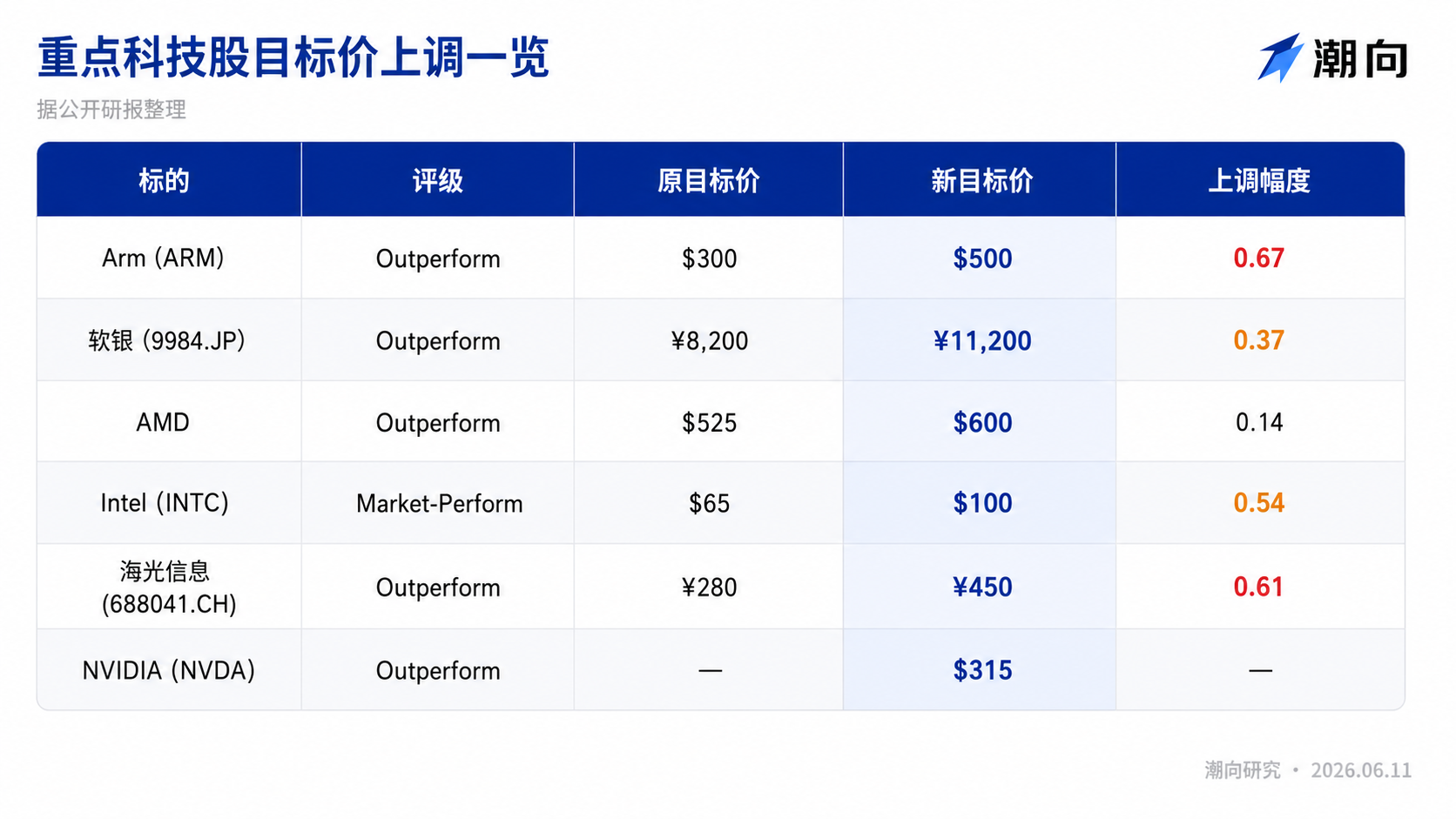
Source: Bernstein
Our Take: Wave Direction Insights
The weakest link in Bernstein's argument may not be on the demand side, but on the supply side.
The report acknowledges in a footnote that it is "still evaluating whether foundry and memory capacity is sufficient to support CPU growth," which represents the biggest uncertainty in the entire report. Moving the CPU TAM from $37 billion to $223 billion implies the need for an additional ~$30 billion in CPU production capacity annually by 2030.
TSMC's 3nm/5nm capacity is currently being squeezed by AI accelerators and smartphone chips. The report does not provide a definitive capacity mapping for the foundry capacity that can be allocated to server CPUs. Additionally, the report's core assumptions are built on NVIDIA's guidance of "AI infrastructure annual spending exceeding $1 trillion in 2027." This guidance itself is one of the most optimistic sell-side predictions, and using it as the demand starting point for another research report introduces a risk of "layer stacking" expectations.
Another noteworthy signal is that NVIDIA's Vera CPU uses a self-developed Arm architecture. This means NVIDIA could simultaneously act as both a partner and a competitor to Arm in the CPU space, subtly impacting whether Arm can achieve a long-term market share of 54%.
For focused investors, the most valuable takeaway from this report is not just a specific price target. It provides a clear analytical framework: If you believe agentic AI is the true next phase, then CPU provisioning must be re-priced from "adequate enough" to "mission-critical." This implies the center of gravity in the semiconductor investment landscape needs to shift from a GPU-dominated narrative to a more balanced CPU+GPU narrative.
Risk Disclaimer
This article is Wave Direction Research's compilation and interpretation of a third-party brokerage research report. The ratings, price targets, earnings forecasts, and related judgments cited herein represent the views of the analysts at that brokerage firm and only reflect the position of their affiliated institution. They do not represent the views of Wave Direction Research and do not constitute any investment advice.


