






Retail investors are buying aggressively, institutions are raising expectations – what’s next for SPCX?


- Core Thesis: SpaceX's first-day performance fell short of expectations, but it rebounded sharply by 19.6% the following day, pushing its market cap to $2.5 trillion. Market sentiment was bolstered by positive developments in the US-Iran agreement. A concentrated influx of retail capital and a low free float have led to significant price volatility, with analysts divided on the stock's future trajectory.
- Key Factors:
- On its first trading day, the stock closed at $160.95, giving it a market cap of $2.1 trillion. It surged 19.6% the next day to $192.5, raising the market cap to $2.519 trillion and making it the 8th largest company globally by market value.
- The US and Iran reached a memorandum of understanding to reopen the Strait of Hormuz. The stabilization of geopolitical tensions is viewed as positive for US stocks, with SpaceX being a clear beneficiary.
- Retail capital is highly concentrated. On June 16, SpaceX saw net retail purchases of approximately $93.8 million, accounting for 73% of total net retail inflow across the entire US market that day.
- Underwriters exercised the greenshoe option, issuing an additional 83.33 million shares. The total outstanding shares rose to 638.8 million, bringing the total fundraising to $85.7 billion.
- Analytical firm Zerohedge predicts that the gamma squeeze effect following the options listing could drive the stock price to $400.
- Investment bank Oppenheimer has initiated coverage with an "Outperform" rating and a $190 price target. Early investor Peter Diamandis has advised shifting idle capital from Bitcoin to SpaceX.
Original by Odaily (@OdailyChina)
Author: Golem (@web 3_golem)
Last Friday, SpaceX closed its first trading day at $160.95, giving it a market cap of $2.1 trillion. While SpaceX still set a record for the largest IPO in U.S. stock market history, the result fell short of full expectations compared to the market sentiment built up before the listing. Some research institutions, like CFRA, even assigned a "Sell" rating to SPCX, suggesting Musk's "Mars story" was well-received but not well-bought. (Related reading: After SpaceX’s Debut: A $2.1 Trillion Market Cap, Is It Still Worth Chasing?)
Amid market concerns, SPCX surprised everyone at the U.S. stock market open on Monday. According to Gate’s U.S. stock data, SPCX rallied throughout the session, eventually closing at $192.5, a gain of 19.6%. The closing price was also the day's high, pushing the market cap to $2.519 trillion and making SpaceX the world's 8th most valuable company. But market fervor is far from subsiding. According to Hyperliquid data, SPCX's pre-market price has already risen above $214. Therefore, when U.S. markets open on Tuesday, SPCX is highly likely to continue Monday's uptrend, potentially surpassing Amazon, currently ranked 7th in market cap.
U.S. and Iran Sign Memorandum of Understanding, Retail Investor Enthusiasm for SpaceX Remains Undiminished
On a macroeconomic level, the memorandum of understanding (MoU) reached between the U.S. and Iran this week brought significant positive news to the U.S. stock market. The market generally expects a new round of gains for global equities against a backdrop of stabilizing geopolitical tensions, with SpaceX being one of the beneficiaries.
On June 15, Trump announced the agreement with Iran, stating the Strait of Hormuz would be opened. Unlike past instances of unilateral rhetoric, this agreement was also acknowledged by Iran. Iran's Deputy Foreign Minister, Gharibabadi, confirmed the same day that the text of the U.S.-Iran MoU had been finalized and would be formally signed in Switzerland this Friday (June 19).
The MoU was further confirmed by the Iranian President, and U.S. Vice President Vance stated that the agreement between the U.S. and Iran had been signed electronically over the weekend, indicating the terms were already in effect and making it unlikely for either side to tear up the pact. Following the news, U.S. stocks opened broadly higher. The Dow Jones gained 0.92%, the S&P 500 rose 1.65%, and the Nasdaq surged 3.07%.
Morgan Stanley believes that a long-term agreement between the U.S. and Iran, which could lower oil prices and ease inflation, is steering the U.S. stock market from a "one-sided rally" towards a healthier, broad-based advance. The upward momentum may no longer be confined to the tech sector but gradually spread to a wider range of cyclical industries.
From a sentiment perspective, SpaceX remains the single most sought-after stock by retail investors. According to Vanda Track data, on June 16 (local U.S. time), SPCX saw approximately $93.8 million in net retail buying in a single day, accounting for about 73% of the total net retail inflow into all U.S. individual stocks. This implies that for nearly every $4 of incremental retail money flowing into the U.S. stock market, about $3 flowed into SpaceX.
Given such robust demand for SPCX, SpaceX's underwriters exercised the overallotment option (Greenshoe mechanism) in the IPO, purchasing an additional 83.33 million shares. This brought the total number of IPO shares issued to 638,888,888 Class A common shares and increased the total proceeds from the offering to $85.7 billion. This scale surpasses the overallotment arrangements of almost every tech company IPO on record.
Despite this, reports suggest that most eligible U.S. retail investors received only about one share each in the SPCX IPO allocation. Consequently, with extremely low float causing a severe supply-demand imbalance, concentrated buying by retail investors can significantly propel the stock price upward.
What's the Outlook for SPCX?
ZeroHedge: Options Listing Could Push Stock Price to $400
Influential financial media outlet ZeroHedge reported on June 16 that once options on SPCX begin trading, the stock price could surge to $400 due to a gamma squeeze, surpassing Nvidia.
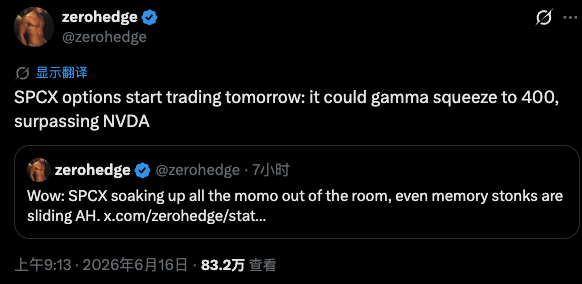
A gamma squeeze is essentially an upward spiral triggered by options market makers being forced to buy the underlying stock to hedge their positions. With SpaceX's extremely low float (4.2%) and incredibly high retail buying enthusiasm, retail investors who haven't secured SPCX shares might instead turn to purchasing relatively cheaper call options. If a massive influx of capital aggressively buys call options, market makers would be compelled to continuously buy SPCX spot to hedge risk, thereby driving the stock price higher in a positive feedback loop.
The meteoric rise of GameStop (GME) in 2021 remains one of the most classic examples of this effect.
Oppenheimer: SPCX Will Continue to Outperform the Market
On June 15, before the U.S. market opened, analyst Timothy Horan from investment bank Oppenheimer initiated coverage on SpaceX with an "Outperform" rating and a near-term price target of $190. When U.S. markets opened on Monday, SPCX closed at $192.5, broadly in line with Oppenheimer's target.
Timothy Horan is a 4.70-star analyst at Oppenheimer, primarily focusing on technology, communications, and telecom. According to TipRanks data, his prediction success rate is 58.82%. He views SpaceX as "the only fully vertically integrated AI company," controlling capital, data, large models, hardware, manufacturing, and engineering talent, and believes it should not be viewed merely as a traditional aerospace enterprise.
Peter H. Diamandis: Idle Funds Used for Bitcoin in the Past, Now for SpaceX
On June 14, renowned entrepreneur, XPRIZE founder, and early SpaceX investor Peter H. Diamandis wrote that SpaceX is the "railroad to orbit," which will usher in a multi-planetary civilization for humanity, creating immense wealth much like the railroads opened up the American West in the 19th century. He predicts that within the next year, SpaceX will merge with Tesla, becoming the first $100 trillion company.
Simultaneously, he stated that over the past decade, whenever he freed up capital from other transactions, he would invest it in Bitcoin. However, now, whenever he has idle funds, he invests in SpaceX. While he expects the stock price to decline when locked-up shareholders are able to sell and some shareholders cash out, he emphasizes that his investment in SpaceX is not about chasing quarterly gains but about advancing the off-planet economy.
Brad Gerstner: SpaceX is a Must-Buy, Must-Hold Asset for Institutional Investors
On June 16, prominent Silicon Valley investor Brad Gerstner described SpaceX as a must-buy, must-hold asset for institutional investors on the latest episode of the BG2 podcast. His rationale is that the company sits squarely on two main thematic tracks: the space economy and the expansion of AI computing power.
Gerstner noted that bears on SpaceX focus on the company's revenue last year and investment banks' forecasts for significant revenue growth over the next three years, questioning how few companies can achieve multi-fold expansion in three to four years. However, he argues that if investors believe in the direction of AGI development, they must accept the premise that the global demand for computing power will far exceed current market expectations. Combining this judgment with SpaceX's core business, he finds it difficult to identify another company or entrepreneur offering a more direct bet on the future.


