






「I don’t need a better model anymore」: The AI landscape under a Reddit hot post


- Core thesis: Anthropic’s Claude Fable 5 model has achieved significant leads in benchmark tests, but users generally find it over-performing and overpriced. Safety guardrails cause most requests to be rejected, sparking intense debate between the “good enough” faction and the “heavy tasks” faction.
- Key Points:
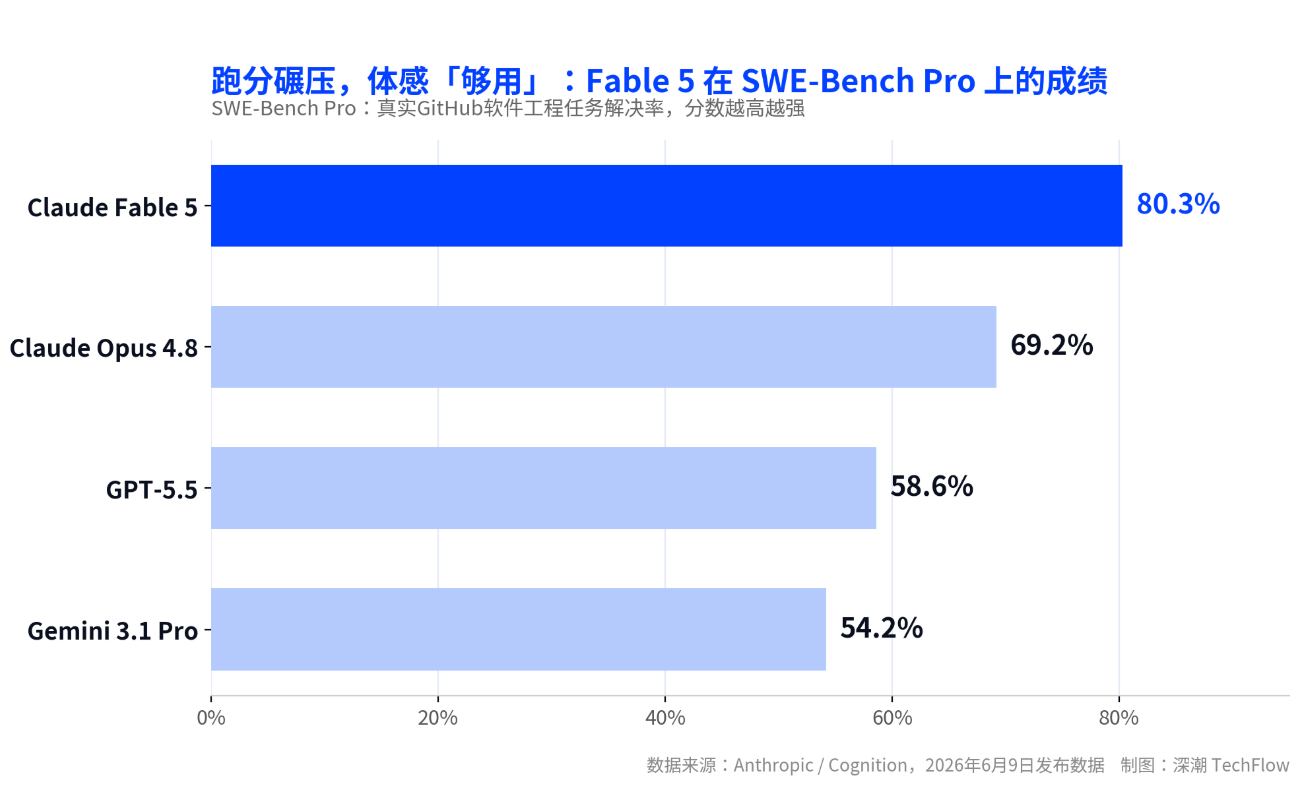
- Claude Fable 5 leads GPT-5.5 by over 20 percentage points with a score of 80.3% on the SWE-Bench Pro benchmark, but its API pricing ($10 per million input tokens) is roughly twice that of the previous generation Opus 4.8.
- Mainstream user sentiment reflects “model fatigue,” believing current flagship models (like Opus 4.8) are sufficient for daily tasks, and Fable’s improvement comes with high token costs and low return on investment.
- Safety guardrails are the biggest complaint: users report that up to 90% of safety-related requests (e.g., code reviews) are rejected, and are downgraded for Opus processing, severely affecting the usability experience for paying customers.
- The opposing view argues that Fable delivers a “night-and-day” improvement in complex tasks (e.g., high-energy physics simulations, ultra-long context), making it suitable as a “planner and fixer” rather than an everyday model.
- Some comments propose a “public AI freeze” thesis: the models accessible to ordinary users may stagnate, while enterprises/governments will possess more powerful private models (e.g., Mythos 5, not open to the public).
Original Author: Friday, Deep Tide TechFlow
Anthropic has just delivered a report card that is impeccable on paper.
Claude Fable 5, released on June 9, is the company's first Mythos-level model open to the public. It scored 80.3% on the real-world software engineering task benchmark SWE-Bench Pro, leading its previous generation flagship Opus 4.8 by approximately 11 percentage points and surpassing GPT-5.5 by over 20 percentage points.
But the user response has been a cold shower.
Three days after the release, a popular post on the r/artificial subreddit (weekly traffic of 305,000) was titled: "Claude Fable made me realize I don't need a better model." The poster, Axi0m-22, said he used Fable for a while on security research and daily tasks, then almost immediately switched back to Opus for coding and Haiku for handling miscellaneous work. He made an analogy: It's like watching the iPhone 17 launch while holding an iPhone 14, "you know the new one is better, but you think: forget it, mine is fine."
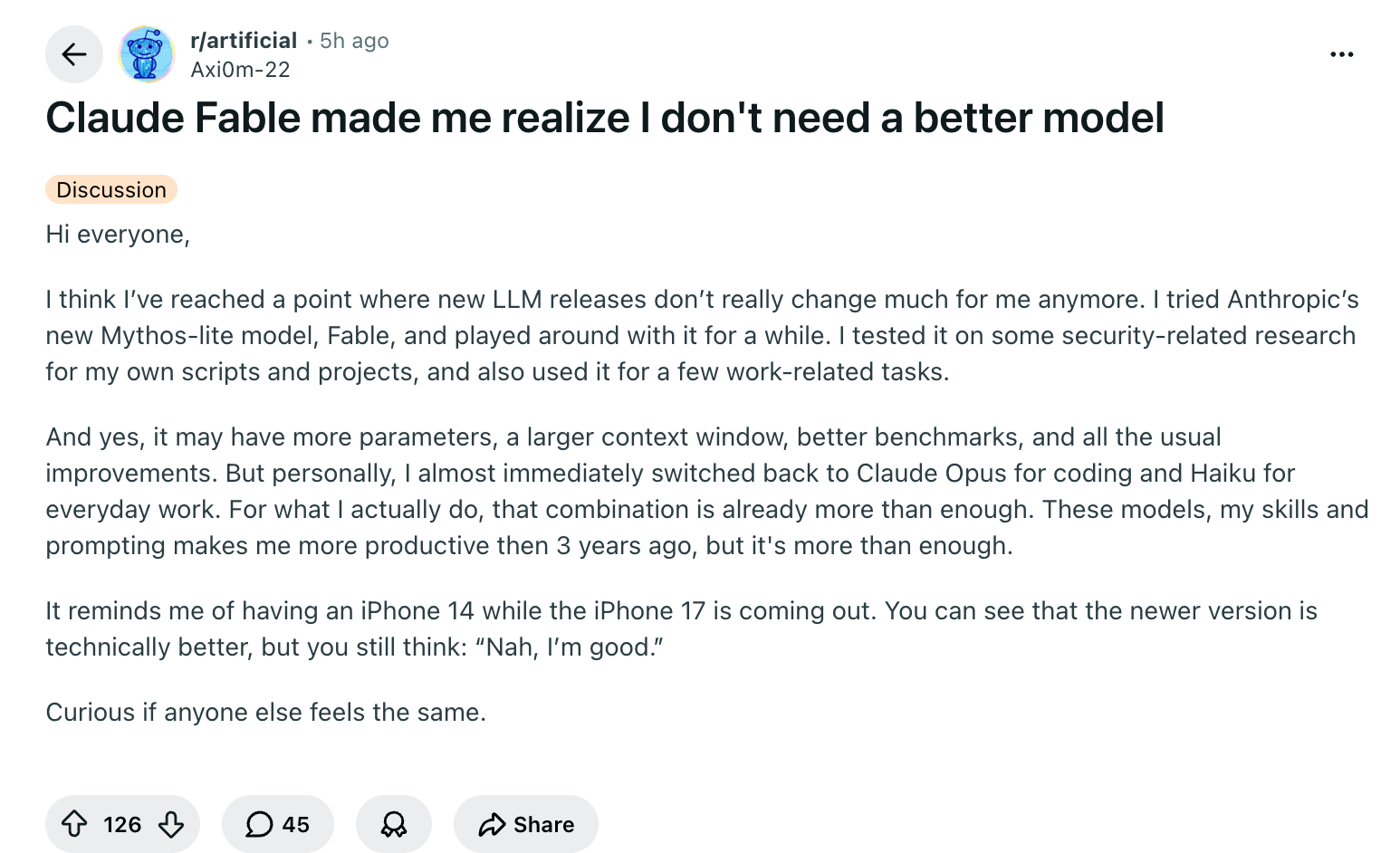
The "Good Enough" Crowd Takes Over Top Comments: Model Fatigue Becomes Mainstream Sentiment
The top comment received 42 upvotes: "Aside from a larger context window, I haven't felt the need for a stronger model since Opus 4.5."
Another user, hyprlab, stated, earning 13 upvotes: "Switching to a model that burns tokens more heavily, I see no benefit for my workflow. Opus 4.8 in high-intensity mode is already comfortable enough."
Behind these kinds of statements lies a common cost ledger.
The API pricing for Fable 5 is $10 per million input tokens, nearly double that of Opus 4.8. User siromega37 put it bluntly: "Higher token consumption, but no return on investment. I think we are seeing a plateau, the bubble is going to burst."
User hobopwnzor offered a more systematic interpretation: "We've been at the top of the S-curve for a while. Recent progress mainly comes from tool calling and peripheral engineering, not from the model's core capabilities."
Safety Guardrails Become the Biggest Grievance: "90% of Uses Get Rejected Directly"
If "good enough" is just a sentiment, then complaints about safety guardrails are a concrete product problem.
According to Anthropic's official statement, Fable 5 shares the same underlying model as Mythos 5, which is only open to a few institutions. The difference is that Fable is equipped with a safety classifier: requests involving high-risk areas like cybersecurity are intercepted and answered by Opus 4.8. The company states this mechanism is calibrated conservatively, triggered on average in less than 5% of conversations, and may mistakenly block harmless requests.
Under this Reddit post, the perceived trigger rate is clearly much higher than 5%. User jradoff, who received 17 upvotes, said he asked Fable to check the security of his code, and "it basically refused to handle anything security-related," then fell back to Opus. Another comment with 12 upvotes was even less polite: "90% of what you want to do with it gets rejected, making it useless."
Paying users harbor even more resentment. User kaitava, subscribed to the $200 tier, wrote: "I'm paying double the usage fees, wanting it to do a security review, and I get downgraded to Opus. Now I dislike everything about it, just waiting for OpenAI to catch up."
For a flagship product touting a leap in capability, "the usability cost paid for safety" is becoming a core variable in users' purchase decisions.
The Counterargument: Heavy-Task Users Feel the Difference is "Night and Day"
There is no shortage of dissenters under the hot post, and their profile is quite clear: the heavier the task, the higher the praise.
User Phylaras's comment received 15 upvotes: "Fable made a tangible difference for me. For those complex tasks requiring a massive context window, it caught errors that were previously missed." A user claiming to work on high-energy physics simulations said a single simulation model often involves 8,000 to 10,000 lines of code and hundreds of interacting models. "Having a model that can work independently and continuously, understanding environmental details, is incredibly valuable to me."
The most intense rebuttal came from user Navetz: "Honestly, anyone who's actually used this model would think this post is crazy. To me, it's categorically smarter; I can't stop using it. I explained it to my non-tech friends: it's like going straight from a college basketball player to an NBA starter."
Some also offered a middle-ground approach. User ready-eddy suggested using Fable as a "planner and fixer," rather than a daily "builder," unless you don't care about burning money. Another comment summarized it more like a user manual: using Fable to calculate spreadsheets is choosing the wrong model; using Haiku for complex tasks involving 16 agents is also choosing the wrong model. "There are no inherently bad models, only models used in the wrong scenarios."
After Benchmarks and Sentiment Diverge, Will Public AI Still Get Stronger?
The most interesting comment in this debate shifted the topic from the product to the industry structure.
User KedMcJenna proposed a "Public AI Freeze Theory": the models accessible to ordinary people might stay around their current level forever, while corporate and government elites will continue to access stronger private models. "We know about Mythos at least, and there are likely even stronger models that we will never hear about."
This comment points to a fact: Mythos 5 is indeed not open to the public and is currently only provided to network defense agencies and critical infrastructure enterprises through the Project Glasswing program.
Looking at the benchmarks and public sentiment together, the conclusions are not contradictory.
Benchmarks measure the upper limit of capability, while Reddit's top comments reflect the ceiling of daily needs. When most users' tasks were already being met in the Opus 4.6 era, stronger models can only prove themselves in extreme scenarios like physical simulation or ultra-long contexts. The challenge for model companies is no longer about "can it be done or not," but about "who needs it, how much are they willing to pay, and how much safety friction can they tolerate."
Three days after release, Fable 5 has received two completely different report cards: one from the benchmark leaderboard and one from the court of public opinion. Which one is closer to the truth depends on the speed at which Anthropic adjusts its safety classifier and the wallet votes of its heavy users.


