






The Small-Town Youth Labeling AI Models


- Core Viewpoint: The article reveals the harsh reality of the data annotation industry as the "sweatshop" behind the prosperity of the artificial intelligence sector. It depicts how grassroots workers, from counties in central and western China to across the globe, are alienated and exploited within the technological revolution, ultimately facing the predicament of being replaced by AI.
- Key Elements:
- Industrial Transfer and Employment Reality: Cities in central and western China, such as Datong in Shanxi, have transformed into data annotation hubs, driving tens of thousands of local jobs. However, the work is essentially repetitive, high-pressure piece-rate labor, with practitioners primarily being youth and women who struggle to find opportunities in the real economy.
- Labor Intensity and Compensation Imbalance: The unit price for data annotation has plummeted by over 90% in recent years, dropping from over ten cents to just a few cents. To maintain meager incomes, workers are forced into high-intensity labor, subjected to stringent digital management and high error-tolerance requirements.
- Alienation of Emotional Labor: In the RLHF (Reinforcement Learning from Human Feedback) stage, grassroots annotators must quantify complex human emotions into scores to train AI's "empathy." Yet, they themselves become emotionally depleted through mechanical judgment, leading to cognitive emptying.
- The "Folding" of the Knowledge Class: High-barrier positions like "AI Logic Trainer" attract master's graduates from prestigious universities, but their work is similarly filled with uncertainty and dehumanizing control. Together with grassroots annotators, they become replaceable "cogs" in the algorithmic system.
- Exploitation Structure and Value Deprivation: The industry exhibits an inverted pyramid outsourcing structure. Tech giants, acting as "cloud lords," capture the vast majority of the value. After layers of exploitation, the compensation that finally reaches frontline workers is extremely low, forming a "data and sweat conveyor belt."
- Crisis of Being Devoured by Technology: AI-powered automated annotation technology is replacing human labor with thousand-fold efficiency, leading to a cliff-like decline in outsourcing investments from major companies. The annotators who "fed" the AI are now facing the ultimate dilemma of being淘汰 by the very monster they helped create.
Original Author: Sleepy.md
Datong, Shanxi, a city once propped up by coal, has now shaken off its coal dust, picked up a sharp pickaxe, and is striking heavily at another invisible mine.
In the office buildings of the Jinmao International Center in Pingcheng District, there are no more mine shafts or coal trucks. Instead, there are thousands of tightly packed computer workstations. The Shanghai Runxun Yunshengshenggu Big Data Smart Service Base occupies several entire floors, where thousands of young employees wearing headphones stare at screens, clicking, dragging, and selecting.
According to official data, as of November 2025, Datong City had put into operation 745,000 servers, attracted 69 call center and data labeling enterprises, created over 30,000 local jobs, and generated an output value of 750 million yuan. In this digital mine pit, 94% of the workers are local residents.
It's not just Datong. Among the first batch of data labeling bases designated by the National Data Administration, counties and cities in central and western China like Yonghe County in Shanxi, Bijie in Guizhou, and Mengzi in Yunnan are prominently listed. At the data labeling base in Yonghe County, 80% of the employees are women. Most are rural mothers or returning youth who couldn't find suitable jobs.
A hundred years ago, Manchester's textile mills in England were packed with farmers who had lost their land. Today, in front of computer screens in these remote counties, sit young people who cannot find their place in the real economy.
They are engaged in a futuristic yet extremely primitive piecework job, producing the essential data feed for large AI models for tech giants far away in Beijing, Shenzhen, and Silicon Valley.
No one sees a problem with this.
The New Assembly Line on the Loess Plateau
The essence of data labeling is teaching machines to recognize the world.
Autonomous driving needs to recognize traffic lights and pedestrians; large models need to distinguish between cats and dogs. Machines inherently lack common sense. Humans must first draw a box on an image and tell it "this is a pedestrian." Only after digesting millions of images can it learn to identify on its own.
This job doesn't require a high degree, just patience and an index finger that can click incessantly.
During the golden age in 2017, a simple 2D bounding box could fetch over 0.1 yuan, with some companies even offering as high as 0.5 yuan. Fast labelers, working over ten hours a day, could earn five to six hundred yuan. In a county town, this was undoubtedly a high-paying, respectable job.
But as large models evolved, the brutal side of this assembly line began to show.
By 2023, the unit price for simple image labeling had plummeted to 3-4 fen (0.03-0.04 yuan), a drop of over 90%. Even for more difficult 3D point cloud images—dense point clouds that require extreme zoom to see edges—labelers must draw a 3D bounding box in space, encompassing length, width, height, and yaw angle, to tightly wrap around vehicles or pedestrians. Yet, such a complex 3D box earns only 5 fen (0.05 yuan).
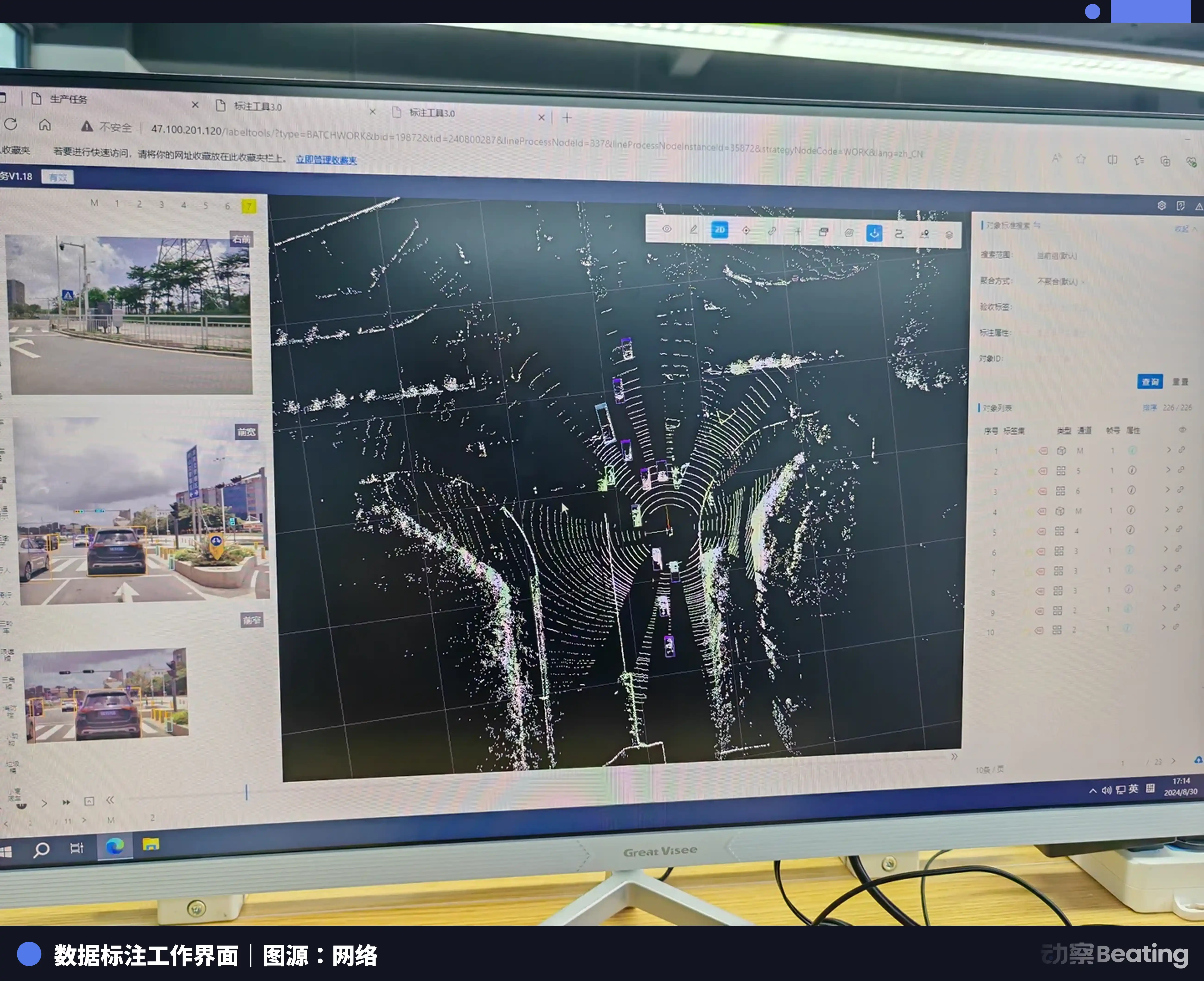
The direct consequence of the price crash is a dramatic increase in labor intensity. To barely cling to a base salary of two to three thousand yuan per month, labelers must constantly and relentlessly increase their clicking speed.
This is far from a comfortable white-collar job. In many labeling bases, management is stiflingly strict: no phone calls allowed during work, phones must be locked in storage lockers. Systems meticulously track each employee's mouse movements and idle time. If they stop for more than three minutes, warnings from the backend whip them back to work.
Even more crushing is the error tolerance rate. The industry's passing line is typically above 95%, with some companies demanding 98%-99%. This means if you draw 100 boxes and get just 2 wrong, the entire image is sent back for rework.
In dynamic images with consecutive frames, lane-changing vehicles get occluded, and labelers must use inference to find them one by one. In 3D point clouds, any object with over 10 points must be boxed. For complex parking space projects, lines drawn too long or missed labels are always picked up during quality checks. An image being sent back four or five times is commonplace. In the end, after an hour's work, the payout might be just a few dimes.
A labeler from Hunan posted her settlement slip on social media. After a day's work, she drew over 700 boxes at 4 fen each, earning a total of 30.2 yuan.
This presents an intensely fragmented picture.
On one side, polished tech leaders at press conferences talk about how AGI will liberate humanity. On the other, in county towns on the Loess Plateau and in the mountains of southwest China, young people stare at screens for eight to ten hours a day, mechanically drawing boxes—thousands, tens of thousands—so much that they dream of drawing lane lines with their fingers in mid-air at night.
Someone once said, the exterior of artificial intelligence is a luxury car speeding by, but if you open the door, you'll find a hundred people inside pedaling bicycles desperately, gritting their teeth.
No one sees a problem with this.
The Piecework Laborers Teaching Machines "How to Love"
After the bottleneck of image recognition was broken, large models evolved to a deeper level, needing to learn to think, converse, and even show "empathy" like humans.
This gave rise to the most core and expensive part of large model training—RLHF (Reinforcement Learning from Human Feedback).
Simply put, it involves real people scoring AI-generated responses, telling it which answer is better, more aligned with human values and emotional preferences.
ChatGPT seems "human-like" precisely because countless RLHF labelers are teaching it behind the scenes.
On crowdsourcing platforms, such labeling tasks are often clearly priced: 3 to 7 yuan per task. Labelers must assign highly subjective emotional scores to AI responses, judging whether an answer is "warm," "empathetic," or "considerate of the user's feelings."
A low-wage worker earning two to three thousand yuan a month, struggling in the mire of reality, with no time to tend to their own emotions, is tasked within the system to be the AI's emotional tutor and values judge.

They must forcibly break down complex, subtle human emotions like warmth and empathy, quantifying them into cold scores of 1 to 5. If their scores don't match the system's preset standard answers, they are deemed to have failed the accuracy requirement, leading to deductions from their already meager piece-rate wages.
This is a cognitive voiding. The complex, nuanced human emotions, morality, and compassion are being forcibly dragged into the algorithm's funnel. Within the icy quantification and standardized scales, they are drained of their last bit of warmth. While you marvel at the cyber behemoth on screen learning to write poetry, compose music, offer comfort, and even don a melancholic facade; outside the screen, those originally vibrant humans are degenerating, through daily mechanical judgments, into emotionless scoring machines.
This is the most hidden side of the entire industry chain, never appearing in any funding news or technical whitepapers.
No one sees a problem with this.
985 Master's Graduates and Small-Town Youth
As the basic box-drawing work is being crushed by AI's tracks, this cyber assembly line is creeping upward, beginning to devour higher-level intellectual labor.
The appetite of large models has changed. They are no longer satisfied with digesting simple common sense; they need to consume human professional knowledge and advanced logic.
A special type of part-time job frequently flashes on major recruitment platforms: "Large Model Logical Reasoning Labeling," "AI Humanities Trainer." The barrier to entry for this part-time work is extremely high, often requiring "Master's degree or above from 985/211 universities," involving specialized fields like law, medicine, philosophy, and literature.

Many top university graduate students are attracted, flooding into these outsourcing groups for major tech companies. But they soon discover this is no relaxed mental exercise; it's mental torture.
Before officially taking tasks, they must read dozens of pages of scoring dimension and evaluation standard documents and undergo two to three rounds of trial labeling. After passing, during formal labeling, if their accuracy falls below average, they lose qualification and are kicked out of the group.
The most suffocating part is that these standards are not fixed. Facing similar questions and answers, using the same reasoning to score can yield completely opposite results. It's like taking an endless exam with no standard answer. One cannot improve accuracy through self-effort or study, only spinning in place, consuming mental and physical energy.
This is the new exploitation of the large model era—class folding.
Knowledge, once seen as a golden ladder to break barriers and climb upward, has now become more complex digital fodder offered up to the algorithm. Before the absolute power of algorithms and systems, the 985 master's graduates from ivory towers and the small-town youth from the Loess Plateau have met the most bizarre convergence of paths.
They have both fallen into this bottomless cyber mine pit, stripped of their光环 (halos), their differences flattened, all transformed into cheap, replaceable cogs on the conveyor belt.
It's the same abroad. In 2024, Apple directly cut a 121-person AI voice labeling team in San Diego. These employees were responsible for improving Siri's multilingual processing. They once thought they were on the edge of a core business at a major company, only to instantly fall into the abyss of unemployment.
In the eyes of tech giants, whether it's the box-drawing aunties in county towns or the logic trainers graduating from prestigious schools, they are essentially replaceable "consumables."
No one sees a problem with this.
The Trillion-Dollar Babel Tower, Built with Pennies of Sweat
According to data released by the China Academy of Information and Communications Technology, China's data labeling market size reached 6.08 billion yuan in 2023, with an estimated 20-30 billion yuan in 2025. It is predicted that by 2030, global data labeling and service market sales will skyrocket to 117.1 billion yuan.
Behind these numbers lies the valuation frenzy of tech giants like OpenAI, Microsoft, ByteDance, reaching hundreds of billions, even trillions of dollars.
But this immense wealth does not flow to those who truly "feed" the AI.
China's data labeling industry exhibits a typical inverted pyramid outsourcing structure. At the top are the tech giants tightly gripping the core algorithms. The second layer consists of large data service suppliers. The third layer includes data labeling bases and small-to-medium-sized outsourcing companies scattered across the country. At the very bottom are the piece-rate labelers, the grassroots workers.
Each layer of outsourcing scrapes off a hefty share. When a major company offers a unit price of 0.5 yuan, after layers of skimming, what reaches the county town labeler might be less than 0.05 yuan.
Yanis Varoufakis, former Greek Finance Minister, presents a penetrating view in his book *Technofeudalism*: today's tech giants are no longer traditional capitalists but "Cloudalists."
What they own are not factories and machines, but algorithms, platforms, computing power—these are the digital territories of the cyber age. In this new feudal system, users are not consumers but digital serfs. Every like, comment, and browse on social media is free data tribute to the Cloudalists.
And those data labelers distributed in下沉 markets (lower-tier markets) are the lowest digital serfs in this system. They not only produce data but also clean, classify, and score massive raw data, transforming it into high-quality feed digestible by large models.
This is a covert cognitive enclosure movement. Just as the 19th-century English enclosure movement drove peasants into textile mills, today's AI wave drives youth who cannot find a place in the real economy to screens.
AI has not leveled class divides; instead, it has established a "data and sweat conveyor belt" directly connecting county towns in central and western China to the headquarters of tech giants in Beijing, Shanghai, Guangzhou, and Shenzhen. The narrative of technological revolution is always grand and华丽 (splendid), but its底色 (underlying tone) is always the scaled consumption of cheap labor.
No one sees a problem with this.
The Tomorrow That No Longer Needs Humans
The cruelest outcome is coming, faster and faster.
As large model capabilities leap, those labeling tasks that once required human day-and-night labor are being taken over by AI itself.
In April 2023, Li Xiang, founder of Li Auto, revealed data on a forum: in the past, Li Auto needed about 10 million frames of autonomous driving image manual labeling per year, with outsourcing costs接近 (approaching) one billion yuan. But after using large models for automated labeling, what used to take a year could basically be done in 3 hours.
The efficiency is 1000 times that of humans, and this was back in 2023. Just this past March, Li Auto also released its new-generation MindVLA-o1 automated labeling engine.
A painfully true industry self-mockery流传 (circulates): "As much intelligence, as much manual labor." But now, major companies' investment in data labeling outsourcing has seen a cliff-like drop of 40%-50%.
The small-town youth who sat for countless days and nights in front of computers, eyes bloodshot from strain, hand-fed a giant beast. And now, this beast is turning around to smash their rice bowls.
Night falls, and the office buildings in Datong's Pingcheng District remain starkly bright. Young people changing shifts silently exchange weary bodies in the elevator. In this folded space禁锢 (imprisoned) by countless polygonal boxes, no one cares about the epic-level leaps in the Transformer architecture across the ocean, nor can anyone understand the roar of computing power behind hundreds of billions of parameters.
Their gaze is welded to the red and green progress bar in the backend representing the "passing line," calculating whether those few fen, few mao piece-rate numbers can拼凑 (piece together) a decent life by month's end.
On one side, the Nasdaq bell rings and tech media publish extensively, with giants toasting the arrival of AGI. On the other side, these digital serfs who fed the AI mouthful by mouthful with their flesh and blood can only wait战战兢兢 (in trepidation) in their aching sleep for the beast they hand-raised to, on some seemingly ordinary morning, casually kick away their rice bowls.
No one sees a problem with this.


