






A "Top Performer's" Q1 New Listing List: What Hidden Clues Does It Hold for the 2026 U.S. Stock Market Temperature?


- Core View: The first quarter of 2026 saw a rotation in the main themes of the U.S. stock market, with AI hardware and optical communication emerging as the strongest dual themes. The Maitong MSX platform has constructed a cross-theme, cross-style asset framework through dynamic new listings. The overall performance of its Q1 new listings was impressive, validating a market style shift from "buying imagination" to "buying the path to realization."
- Key Elements:
- The 39 new U.S. stock token listings on the MSX platform in Q1 achieved an average gain of +37.6%, with only one recording a negative return. The positive return coverage rate was extremely high, indicating a significant overall wealth effect.
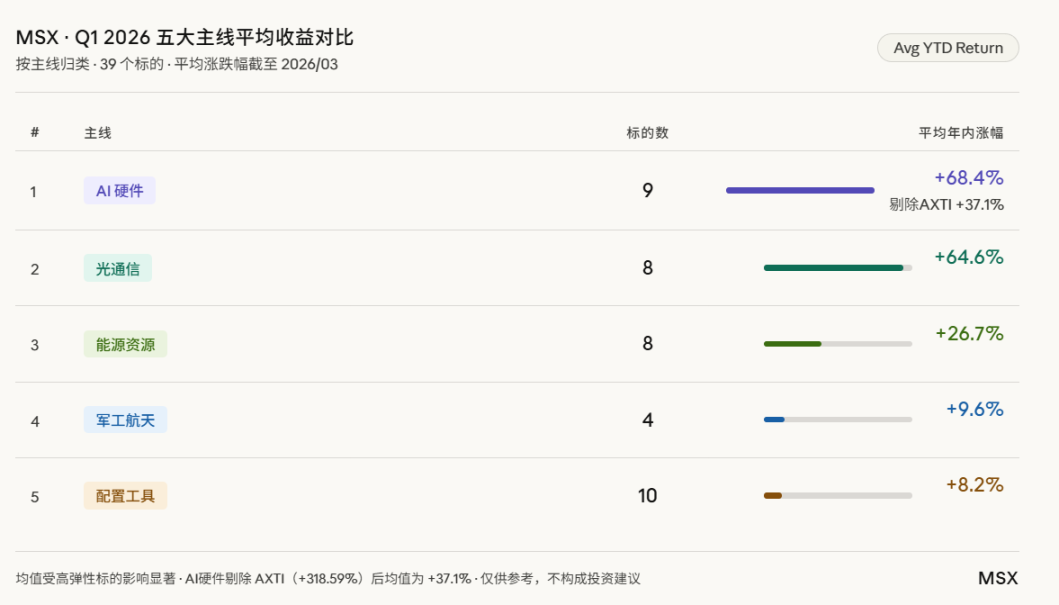
- AI hardware and optical communication were the strongest themes in Q1, with related listings achieving average gains of 68.4% and 64.6%, respectively. All four listings that doubled in gains were concentrated in these areas, showing capital diffusion towards the foundational layers of the industrial chain.
- The energy and resources sector posted a steady average gain of 26.7%, supported by multiple macro logics such as inflation and geopolitics. The defense/aerospace and allocation tools sectors had lower gains but served functions like event-driven opportunities and portfolio balancing within the overall mix.
- MSX's new listing rhythm demonstrates a characteristic of dynamically following the market. From building a macro framework in January, to deeply exploring AI infrastructure in February, and then supplementing with allocation tools in March, it has constructed a versatile "toolkit" with switching capabilities.
- The stock selection logic emphasizes representing tradable, combinable market views—such as expressing judgments on geopolitical risks, supply chain security, or interest rate defense through specific listings—rather than simply chasing short-term gains.
Original Authors: DaiDai, Frank
Q1 has passed in the blink of an eye. Did you make money in this volatile, back-and-forth market?
2026 has clearly seen the U.S. stock market shift into a different gear. Over the past three months, the "Magnificent Seven" and other heavyweight stocks have generally seen double-digit pullbacks, and the indices themselves have been choppy and weak. However, the profit-making effect hasn't disappeared. From energy to optical communications, from defense/aerospace to AI hardware, Q1 featured multiple concurrent themes with rapid rotation. This change has directly impacted the supply side of trading and is also validated by data in Maitong MSX's latest Q1 new listings review.
Based on this, Maitong MSX has compiled statistics on the Q1 new listings and internal data, hoping to serve as a cross-sectional sample for observing the main trading themes in the 2026 U.S. stock market. This aims to help Web3 and U.S. stock investors see the real temperature difference between hot and cold sectors in this year's market more clearly.
1. A Glimpse at Q1's U.S. Stock Market Themes from an Average 37% Gain
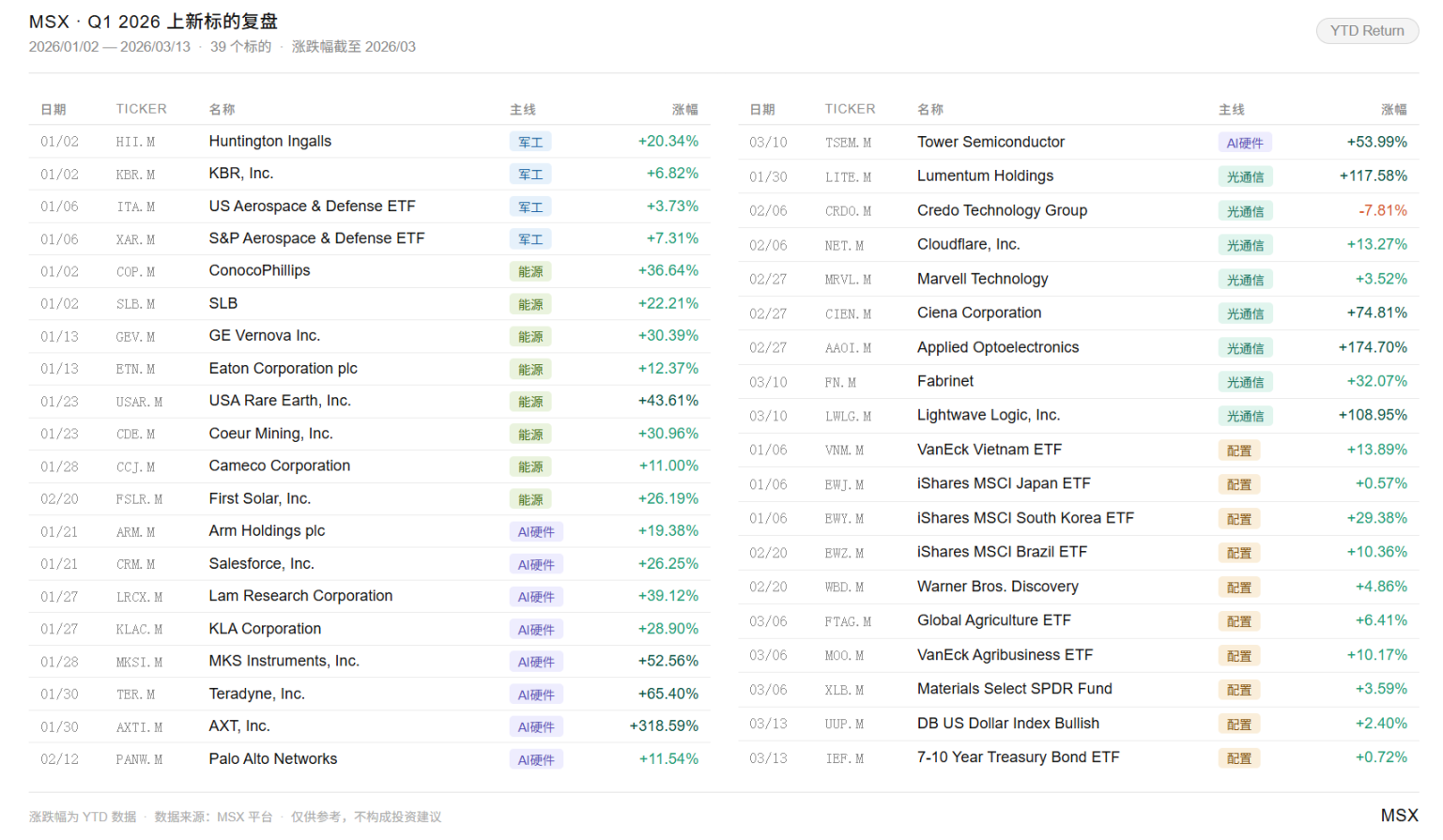
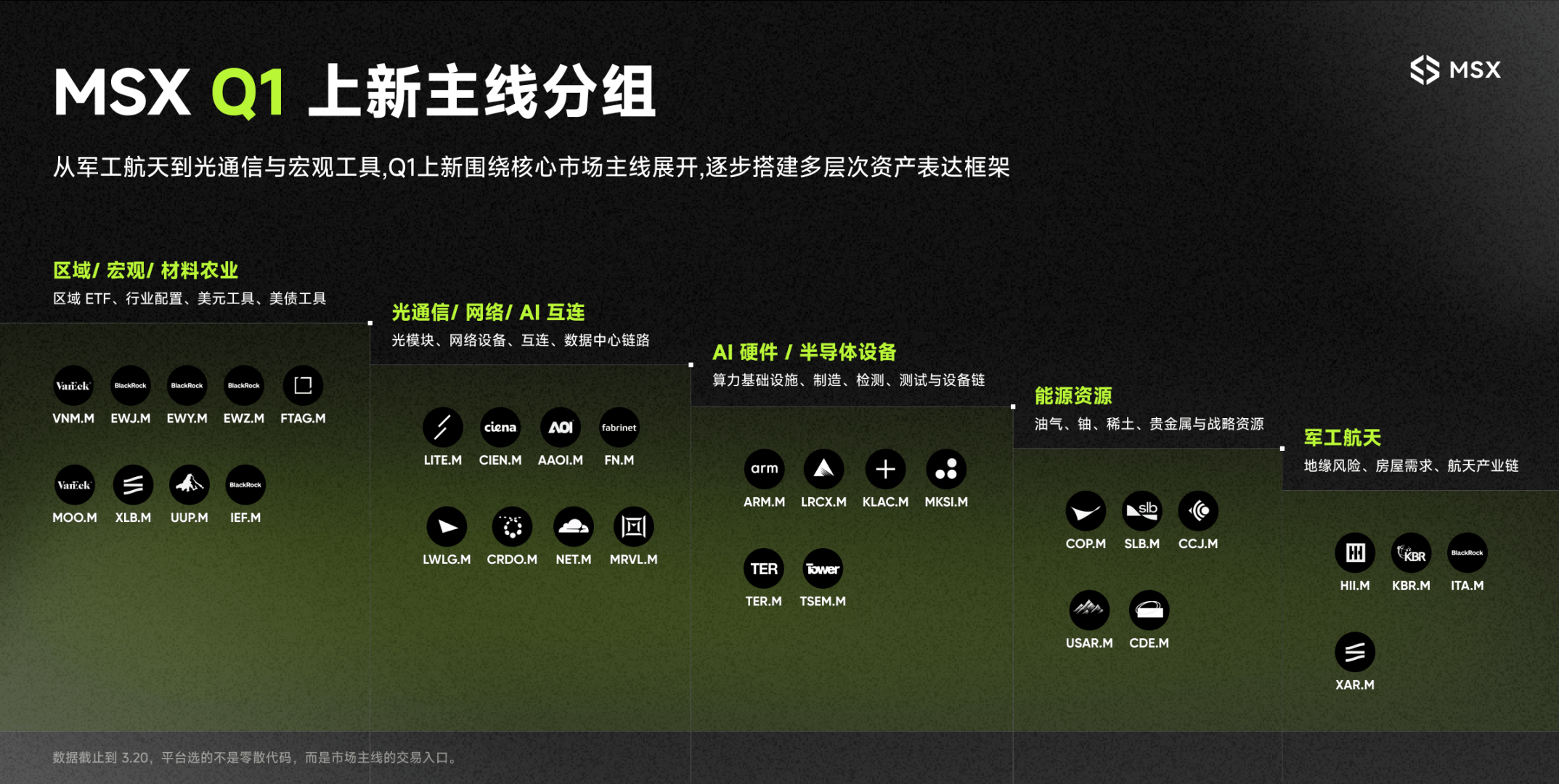
In Q1 2026, the MSX platform listed 39 new U.S. stock tokenized assets, spanning from January 2nd to March 13th. These covered individual U.S. stocks, sector ETFs, and macro tools, encompassing five main themes: Defense/Aerospace, Energy/Resources, AI Hardware, Optical Communications, and Regional Allocation.
In terms of results, this batch of assets performed impressively overall. As of the time of writing, only 1 out of the 39 assets recorded a negative return (CRDO.M, -7.81%), with all others being positive.
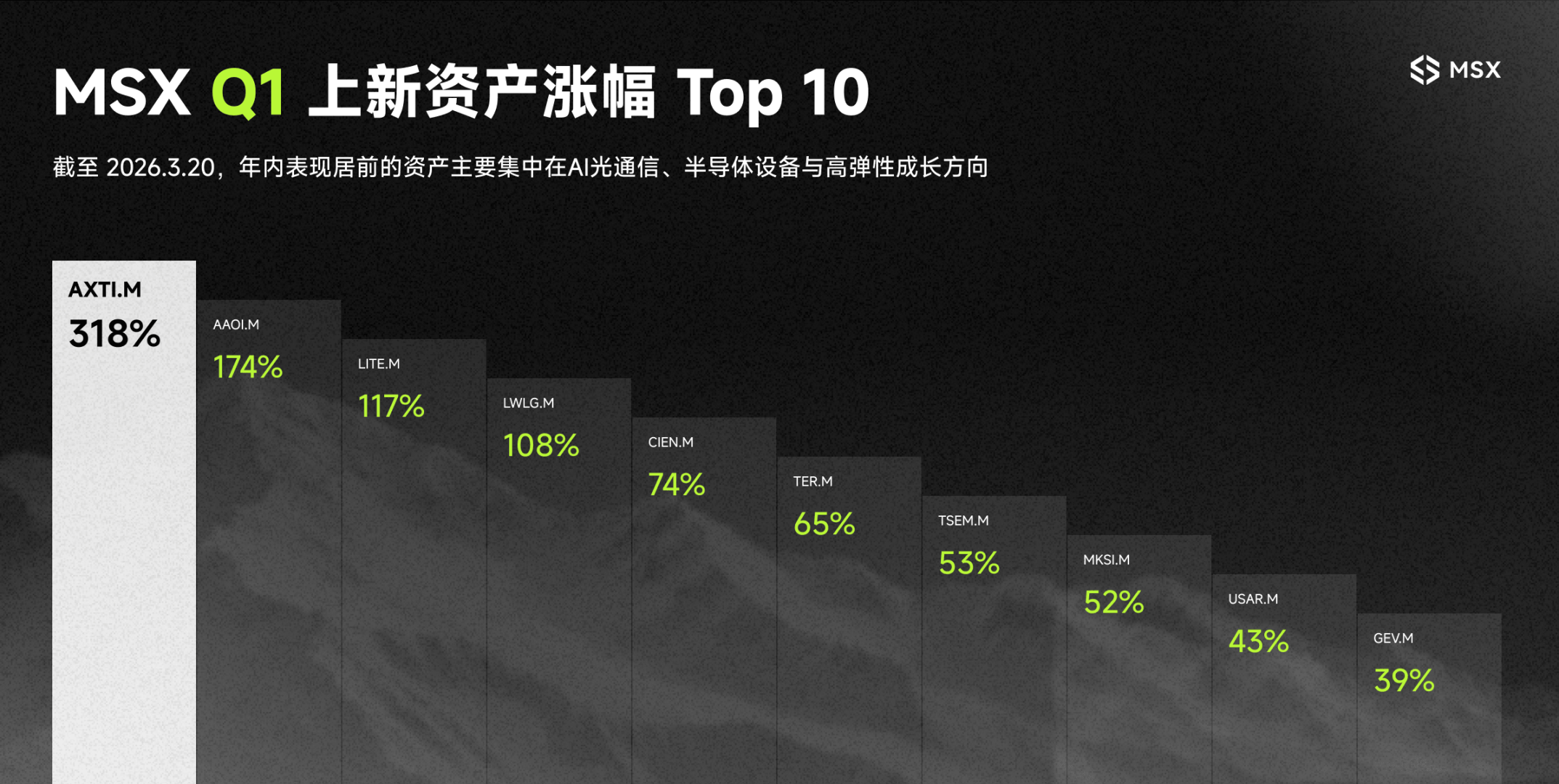
Among them, 4 assets achieved year-to-date gains exceeding 100%: AXTI.M (+318.59%), AAOI.M (+174.70%), LITE.M (+117.58%), and LWLG.M (+108.95%). All were concentrated in the AI Hardware and Optical Communications themes. Furthermore, 7 other assets gained over 50%, accounting for nearly one-fifth of the total.
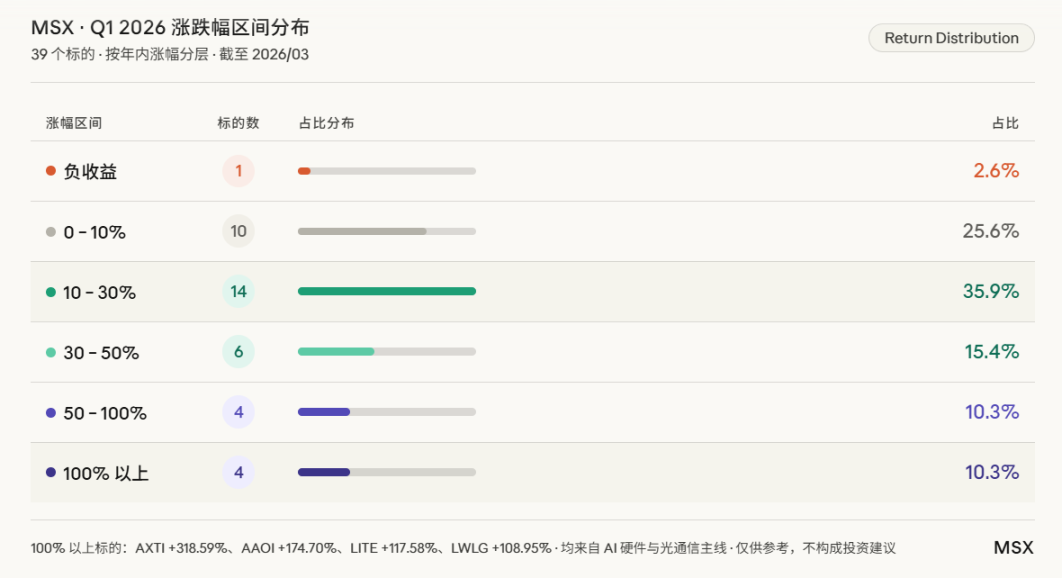
Looking at the overall distribution, the simple average gain for the 39 assets was +37.6% (the 20th asset, HII.M), with a median gain of +20.3%. The mean being significantly higher than the median indicates that the return distribution of these assets exhibits a clear right-skewed characteristic. This means most assets provided stable, substantial positive returns, while a few high-volatility assets created a strong fat tail on the upper end, pulling the average higher.
Looking closer, 14 assets (35.9%) had year-to-date gains between 10% and 30%, the most concentrated interval, forming the core layer of the entire asset pool. These provided stable, predictable market beta, acting as the ballast for the new listings portfolio.
Extending upward, 6 assets (15.4%) were in the 30% to 50% range, 4 (10.3%) in the 50% to 100% range, and another 4 (10.3%) above 100%. Summing these three high-return intervals means over one-third of the assets gained more than 30% year-to-date. This result precisely stems from early positioning in the two correct industry themes: AI Hardware and Optical Communications (detailed in the next section).
The data at both the tail and head ends deserve separate mention.
On one hand, there was only one asset with a negative return (CRDO.M, -7.81%), accounting for 2.6%, which is almost negligible. Especially in a Q1 characterized by rapid style shifts and frequent sector rotations, such a high positive return rate itself indicates that the overall stock selection direction was relatively accurate.
On the other hand, the four doubling stocks—AXTI.M (+318.59%), AAOI.M (+174.70%), LITE.M (+117.58%), and LWLG.M (+108.95%)—were all concentrated in the AI Hardware and Optical Communications themes. This is no coincidence and further illustrates that what truly widens the performance gap is not "casting a wide net," but first identifying the right direction and then finding the most elastic expression within the细分产业链.
In other words, the most noteworthy aspect of this Q1 new listings list is not just the decent overall赚钱效应, but the typical structure it presents: Core assets provide relatively stable beta, while a few high-volatility assets contribute超额回报. The coexistence of these two types of assets together constitutes a truly "top-tier"成绩单.
2. AI Hardware and Optical Communications: Why Were They Q1's Strongest Dual Themes?
Looking at the average returns of the five main themes, AI Hardware and Optical Communications undoubtedly formed Q1's strongest dual offensive themes in the U.S. stock market.
Among them, the 9 assets in the AI Hardware direction achieved an average year-to-date gain as high as 68.4%. Even after removing the extreme outlier AXTI.M (+318.59%), the average remained at 37.1%. This indicates that the超额回报 of this theme was not propped up by a single dark horse but rather stemmed from a relatively systematic realization across the entire细分产业链 in Q1.
This point is actually crucial. It means the market's trading of AI is no longer停留在 the most superficial layer of large model narratives or a few超级龙头. Instead, it has continued to扩散 to更底层的 semiconductor equipment, testing equipment, manufacturing links, and industry chain配套. In other words, capital is shifting from "buying imagination" to "buying the path to realization," which is precisely why the AI hardware chain achieved higher win rates and stronger弹性 in Q1.
The Optical Communications theme followed closely, with 8 assets averaging a 64.6% gain. The strength of this sector did not完全依赖 a single extreme value for uplift but showed a state of多点开花, with a more均匀 distribution—AAOI.M (+174.70%), LITE.M (+117.58%), LWLG.M (+108.95%), CIEN.M (+74.81%), and others相继走强.
This本质上 reflects that as AI data center construction continuously accelerates,光互连, optical modules, network links, and related infrastructure环节 are迎来 demand集中释放, confirming the全面爆发 of AI data center demand for光互连.
Connecting the dots, if AI Hardware represents "computing power realization," then Optical Communications更像是 represents "how data is truly delivered after computing power expansion." Moreover, in 2026, a stage where AI infrastructure is gradually transitioning from concept to工程落地, the importance of the latter is显然快速抬升.
In comparison, the 8 assets in the Energy/Resources direction averaged a 26.7% gain. While not as eye-catching as the前两者, it remained相当稳健. Different细分方向 like oil & gas, uranium,稀土, and precious metals each have their own independent驱动逻辑.
They are not the type of单点爆发式 themes but represent the most分散 yet韧性最强 line within the entire asset pool. Behind them lies the持续发酵 of multiple macro logics: inflation, geopolitics, supply chain restructuring, and resource security.
As for the Defense/Aerospace and Allocation Tools themes, their average gains were 9.6% and 8.2%, respectively.表面上落后于 the前三条主线, but this doesn't mean they "underperformed." After all, they play completely different roles in the portfolio:
- Assets in the Defense/Aerospace direction are event-driven. The release of their gains depends on the节奏 of geopolitical conflicts, budget changes, or policy catalysts, inherently lacking a linear上涨的属性.
- The Allocation Tools direction covers regional ETFs (Vietnam, Japan, South Korea, Brazil, etc.) and USD/U.S. Treasury tools. Their core value never lies in追求极致涨幅 but in providing broader market expression and portfolio balancing tools.
In a sense, the fact that the Allocation Tools theme has the most assets and the lowest average gain反而更能说明 that when MSX builds its asset framework, it doesn't solely focus on stacking弹性 in the hottest赛道. Beyond进攻性, it始终保留s sufficient配置弹性与对冲空间.
This is also MSX's consistent logic for U.S. stock selection and investment—not betting all chips on the single hottest theme, but consciously layering between high-volatility assets and配置型工具, allowing offensive,配置, and defensive functions to coexist simultaneously.
3. What Is the True Logic Behind Stock Selection and Investment?
If we only reason backward from the results, this Q1 new listings list can of course be simply归结为 "accurate selection."
But more important than the result is the underlying方法论. That is, the key criterion for whether an asset can be纳入 the platform is not just whether it will rise in the short term, but whether it can represent a观点 that is可持续交易,可被组合运用, and can切换随市场轮动.
In fact, clues can be seen from the time distribution of the new listings. MSX's rollout in Q1 was not a one-time铺开 but clearly exhibited characteristics of动态跟随市场阶段:
- New listings in January focused on Defense/Aerospace, Energy/Resources, Regional ETFs, Power Equipment, and Semiconductor Equipment, first搭建 the底层框架 related to macro, geopolitical, manufacturing, and resource security themes.
- February明显转向 deeper挖掘 into细分链条 of AI infrastructure, shifting focus to Optical Communications, Interconnect, Cybersecurity, and more弹性 Semiconductor品种.
- March further补充 Agricultural and Material类 ETFs, continued完善 the Optical Communications and Semiconductor landscape, while adding USD and U.S. Treasury tools. This allowed the entire asset framework to gradually extend from an "offensive pool" to a工具箱具备切换能力.
This timing节奏本身就说明 that Maitong MSX's stock selection and new listings are not based on a static list but on an asset framework that动态更新s with changes in market themes.
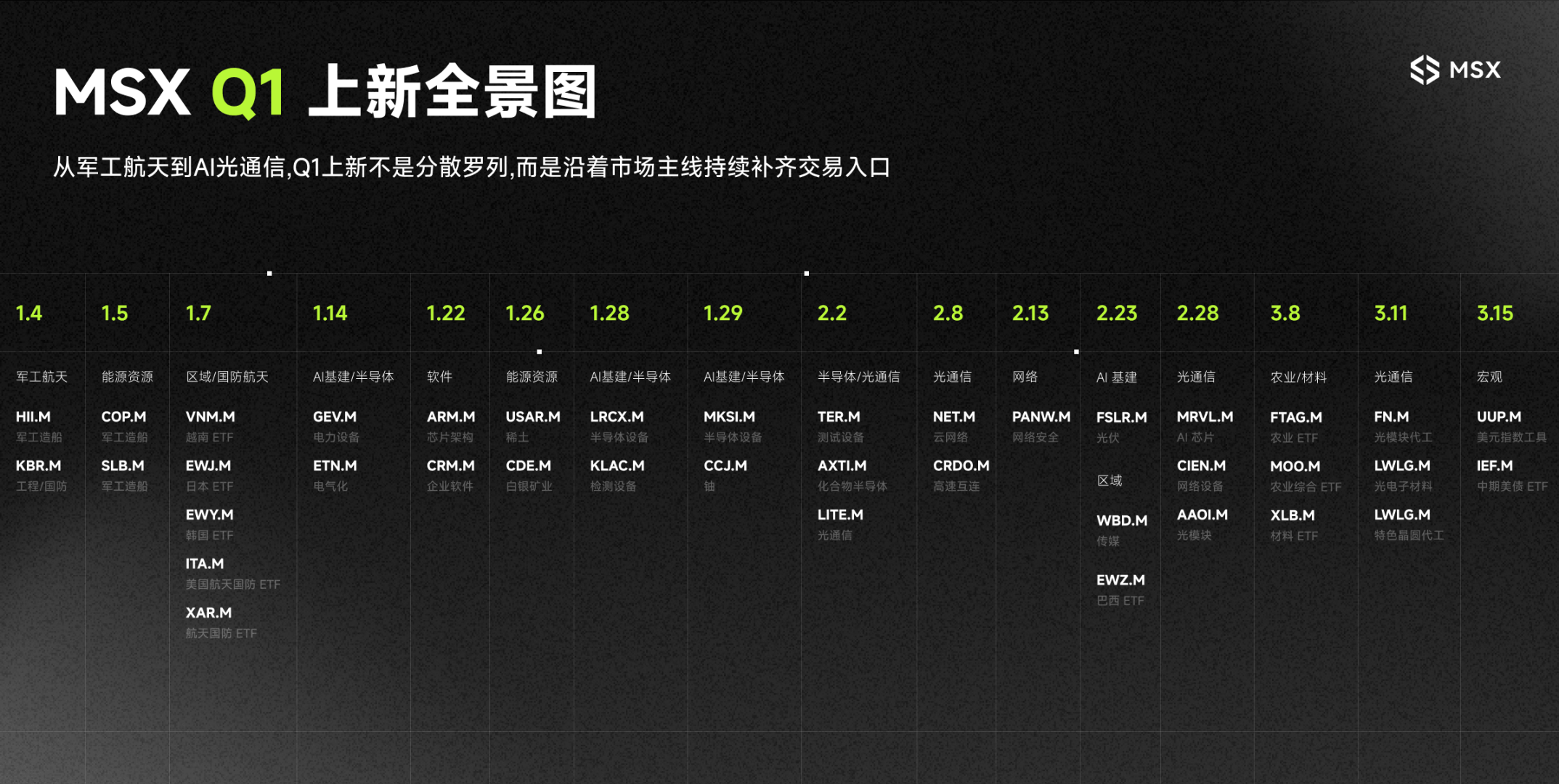
Looking at specific assets, this intent of观点表达 becomes even more apparent.
For example, COP.M and SLB.M represent not just traditional energy stocks but a组合表达 of oil prices, capital expenditure, and geopolitical risks. CCJ.M and USAR.M承接 not just resource price fluctuations but the long-term主题 of strategic resource security and supply chain restructuring. LITE.M, CIEN.M, FN.M, AAOI.M correspond to the产业逻辑 of "interconnect先行" against the backdrop of AI data center upgrades. Macro tools like UUP.M and IEF.M further补足 the仓位管理需求 under macro environments like a strengthening USD and利率防守.
From this perspective, what is truly being selected and listed is not just the stock tokens or ETF tokens themselves, but various market judgments that can be交易d,组合d, and轮动切换d.
In Conclusion
If we place Q1 2026 within a longer周期, the market显然已经不再满足于 the "chasing热门" logic driven by单一叙事.
Whether it's Defense/Aerospace, Strategic Resources, AI Infrastructure, Regional Allocation, or USD/U.S. Treasury tools, what capital truly needs is an asset expression system capable of自由切换 across different market environments.
In this sense, MSX's precise new listing actions in Q1 are not just常规扩品. They represent the gradual搭建 of an asset framework that is跨主题,跨风格,跨周期,围绕当下市场主线的演进. This also creates a更接近真实市场结构的观察样本 for everyone:
Which directions are worth提前布点? Which细分环节 possess higher弹性? Which tools can承担配置与防守功能 when volatility arrives?
We hope this provides a值得参考的视角.


