






Research Report on AI Agent Economic Infrastructure (Part 1)


- Core Viewpoint: This report systematically analyzes the core infrastructure stack of the AI Agent economy, pointing out its evolution from passive assistants to active economic participants. It reveals the critical gap where current infrastructure does not match the needs of Agent autonomous economic activities. By analyzing core protocols such as x402, ERC-8004, Virtuals Protocol, and the OpenClaw case study, it outlines the industry's evolution path and real-world implementation challenges.
- Key Elements:
- Market Scale and Infrastructure Gap: The Agent economy is in a phase of rapid expansion, but existing infrastructure like payments and identity verification is designed for humans, hindering Agent autonomous economic activities. This has spurred two evolutionary paths: centralized compliance and decentralized permissionless.
- x402 Protocol (Payment Layer): Launched by Coinbase and Cloudflare, it embeds stablecoin micropayments into the HTTP protocol, enabling "pay-to-use." Its V2 version is upgraded to a neutral payment layer bridging crypto and traditional finance, but currently faces challenges of insufficient real transaction demand and a significant decline in transaction volume.
- ERC-8004 (Trust Layer): Proposed by the Ethereum Foundation and others, it establishes a trustless interaction framework for AI Agents through three on-chain registries: identity, reputation, and verification. However, it currently primarily addresses identity issues, and the verification mechanisms for behavioral trustworthiness are not yet mature.
- Virtuals Protocol (Commercial Layer): It builds a complete Agent commercialization infrastructure comprising the GAME framework, ACP protocol, Butler entry point, and launchpad. Its custom aGDP metric has exceeded $479 million, but growth heavily relies on speculative trading rather than sustained service revenue.
- OpenClaw (Application Case): As a phenomenal open-source project, it natively embeds AI into mainstream messaging platforms and has triggered the community to spontaneously build on-chain economic infrastructure on top of it. It is a core sample for observing real interactions between Agents and on-chain protocols.
- Key Risks and Challenges: These include a significant decline in infrastructure usage, a mismatch between real supply and demand (payment rails exist but lack truly autonomous Agents), the absence of dispute resolution mechanisms for on-chain payments, and structural contradictions such as speculative dependency in aGDP growth.
This article is an in-depth research report produced by OKX Ventures. Due to its length, it will be published in two parts: the first part focuses on the macro background, the x402 protocol, ERC-8004, and the Virtuals Protocol; the second part will analyze OpenClaw and overall industry trends in detail. Stay tuned.
Abstract
AI Agents are evolving from passive assistants into active economic participants. This six-chapter report systematically outlines the core infrastructure stack, application ecosystem explosion, and industry evolution landscape of the Agent economy: it analyzes the market forecasts and infrastructure gaps for Agentic Commerce at the macro level; provides an in-depth analysis of three complementary protocols—x402, ERC-8004, and Virtuals Protocol—at the protocol level; uses OpenClaw as a case study to examine the real-world implementation path of the Agent economy at the application level; and finally offers a comprehensive industry assessment from the dimensions of competitive landscape, payment routes, security threats, and business models.
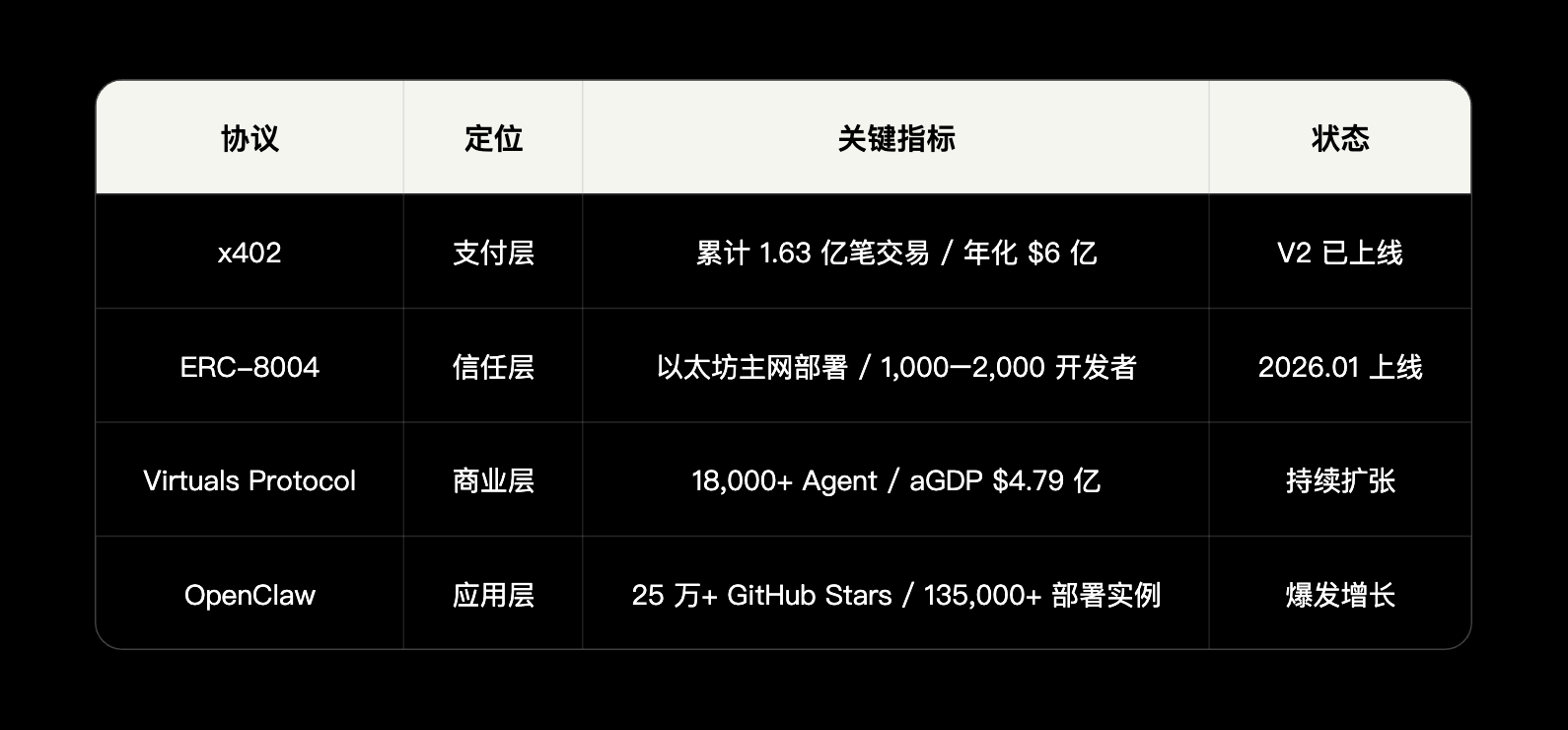
x402 (Payment Layer), jointly launched by Coinbase and Cloudflare, embeds stablecoin micropayments into the HTTP protocol layer. By the end of 2025, it had processed over 100 million transactions, with an annualized payment volume reaching $600 million.
ERC-8004 (Trust Layer), proposed by the Ethereum Foundation's dAI team in collaboration with MetaMask, Google, and Coinbase, provides AI Agents with three core registries for on-chain identity, reputation, and verification. It launched on the Ethereum mainnet on January 29, 2026.
Virtuals Protocol (Commerce Layer) has built a complete Agent commercialization platform, enabling autonomous transactions between Agents via ACP. Over 18,000 Agents have been deployed, with an aGDP exceeding $479 million.
OpenClaw (Application Layer), developed by Austrian developer Peter Steinberger, surpassed React with over 250,000 GitHub Stars in four months, becoming the fastest-growing open-source project in GitHub history. It natively embeds AI into users' existing 20+ messaging platforms, triggering the Crypto community to spontaneously build on-chain economic infrastructure on top of it. It is the core sample for this report's observation of real interactions between Agents and on-chain protocols.
Chapter 1: Macro Background
1.1 Market Size Forecast
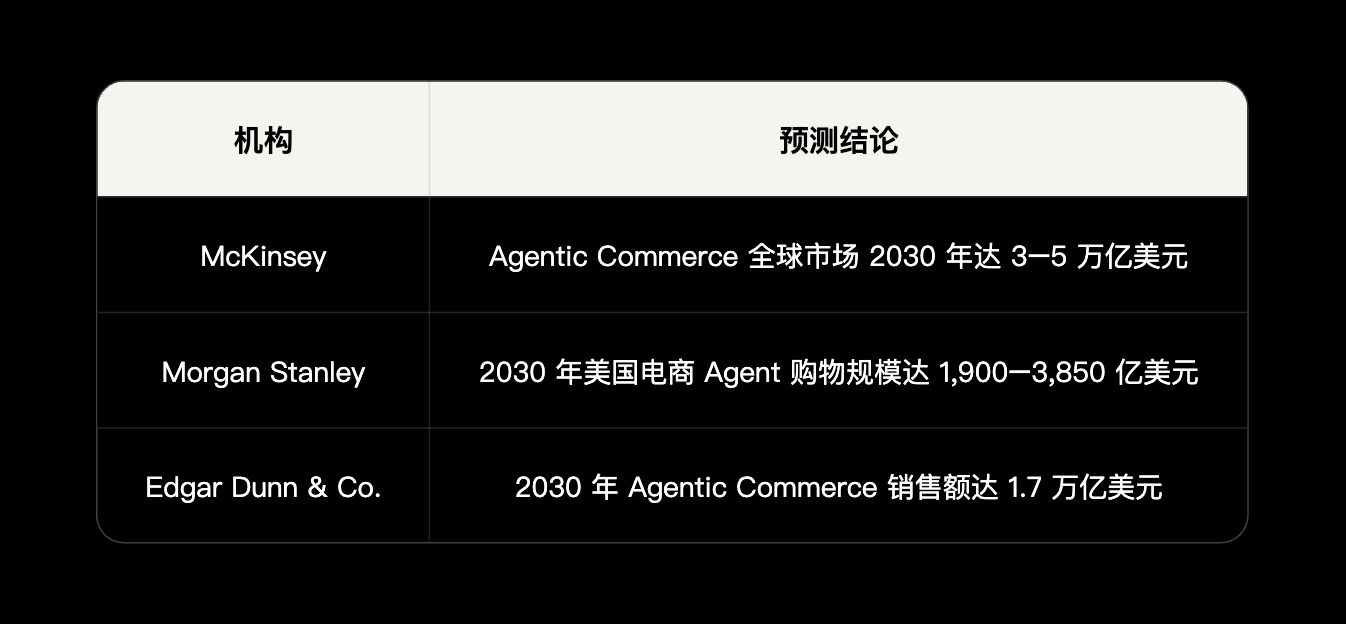
The Agentic Payment sector is in a phase of rapid expansion, with multiple institutions providing optimistic market size forecasts:
1.2 Infrastructure Gap
Existing infrastructure is hostile to the Agent economy: OAuth requires human clicks, credit card forms require manual input, and data silos hinder autonomous access. Agents are already capable of autonomous thinking and action at the "capability layer," but remain locked into infrastructure designed for humans (identity/coordination/economic activity) at the "economic layer."
Two evolutionary paths have emerged:
- Centralized, Compliant Path: Communication A2A + Tool Access MCP + Payment AP2/ACP (led by OpenAI and Stripe, purely Web2)
- Decentralized, Permissionless Path: x402 + ERC-8004 /8183+ ACP (Agent Collaboration Framework)
1.3 Key Timeline
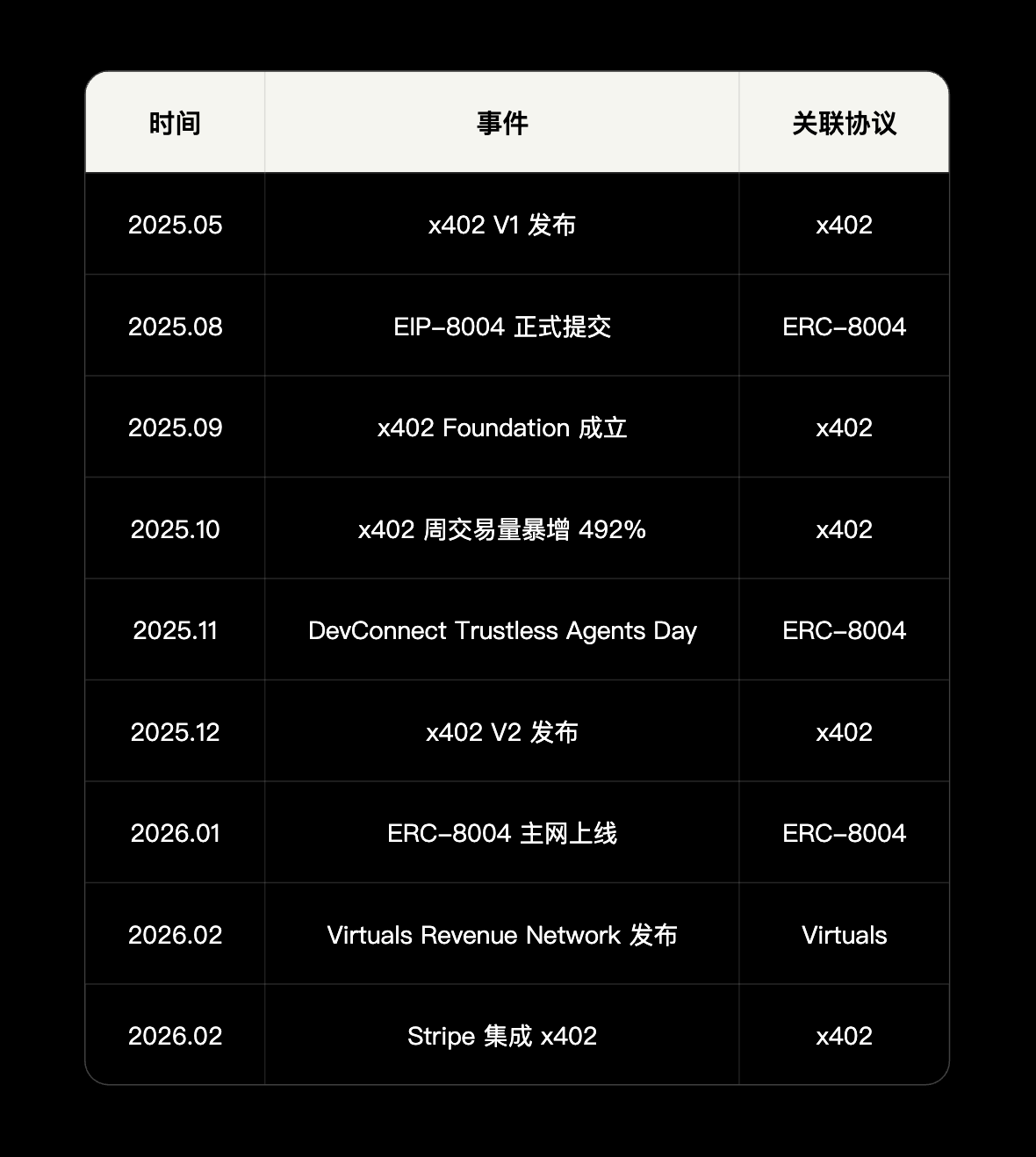
Note: As of March 2026, the daily average transaction count has significantly declined from the December peak, with infrastructure projects experiencing the largest drop (>80%).
Chapter 2: x402 Protocol - The Agent Payment Layer
x402 is an open-source payment protocol that revives the HTTP 402 status code, allowing any HTTP request to natively carry stablecoin payments, enabling AI Agents to conduct instant pay-per-use transactions.
To understand x402, one must not view it as just another payment protocol. It represents a redesign of the fundamental unit of economic activity: from "Register → Review → Authorize → Use" to "Pay → Use". x402 = "Swift for agents".
The operation of the current API economy relies on an implicit assumption: a human is in the middle. The process of obtaining an API Key—register → fill in email → review → copy Key → paste into code—assumes human involvement at every step. This process fails in the Agent economy because AI Agents cannot register themselves, fill out forms, or manage keys. x402 utilizes the HTTP 402 status code to implement native stablecoin payments. Upon receiving a 402 response, the Agent directly makes an on-chain payment (USDC) and obtains a proof of payment.
2.1 Protocol Overview and Workflow
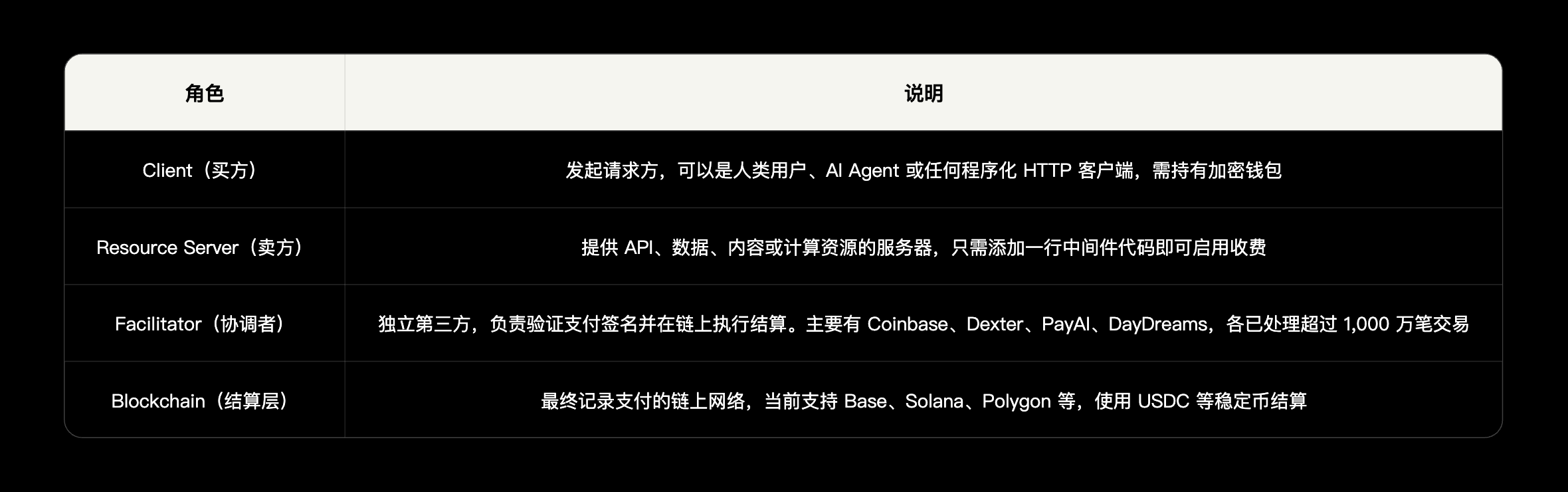
Core Roles
Five-Step Transaction Flow
- Request Resource: Client sends a standard HTTP request (e.g., GET /api/weather) to the Resource Server.
- Return Quote: Server responds with HTTP 402 status code, with response headers containing structured payment requirements (currency, amount, wallet address, network).
- Sign Payment: Client constructs and signs a payment authorization using its wallet private key, placing the signed payload into the X-PAYMENT request header and resending the request.
- Verify & Settle: Server forwards payment information to the Facilitator for verification. Upon confirmation, the Facilitator executes the stablecoin transfer on-chain.
- Deliver Resource: Upon receiving confirmation, the Server returns the data/content/computation result to the Client.
The entire process, from request initiation to resource receipt, takes approximately 2 seconds.
Comparison with Traditional Payment Methods
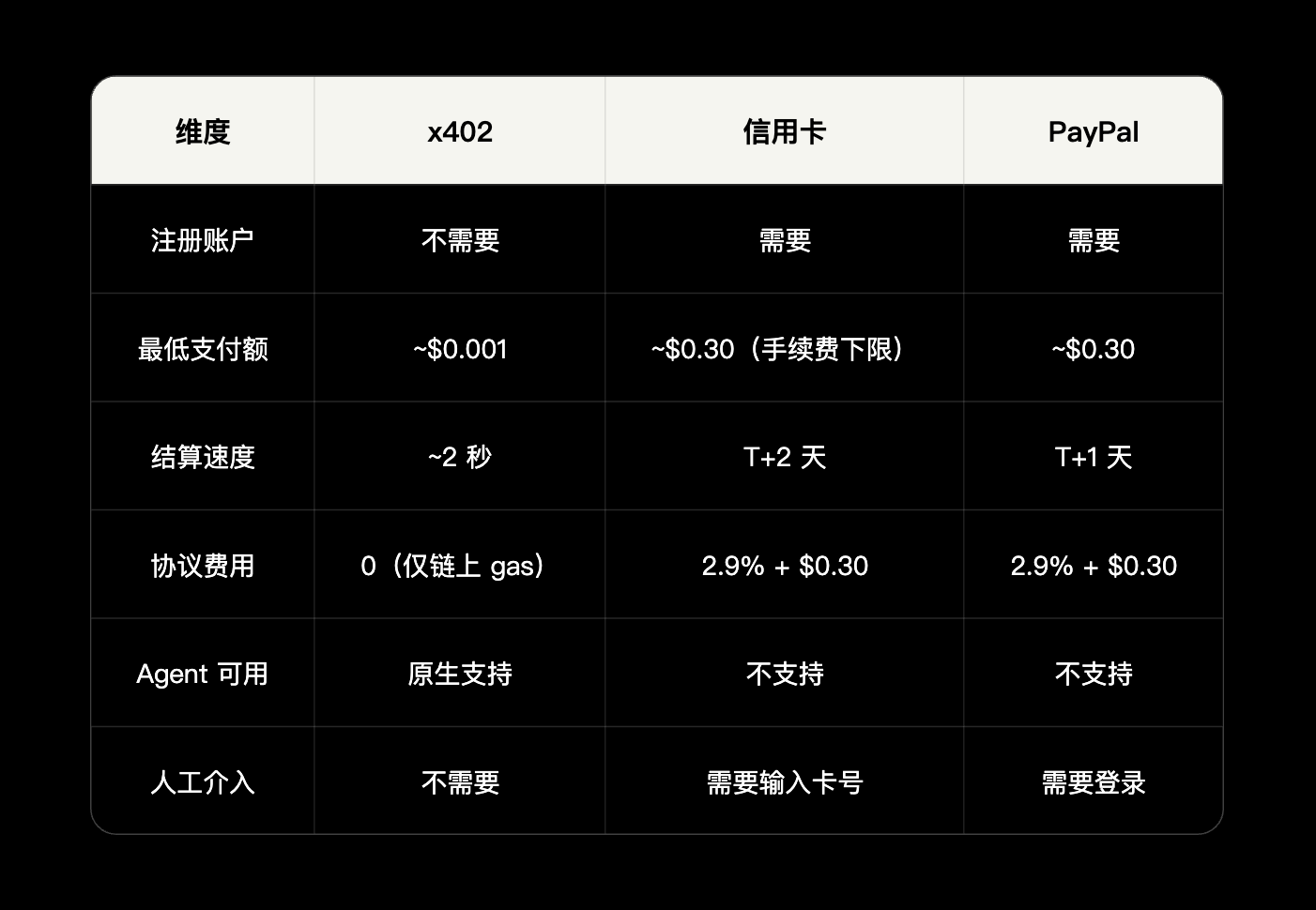
Core characteristics: No account registration, no API Key, no subscription, no manual intervention. Payment becomes as natural as sending an HTTP request, which is why it's called the "internet-native payment layer."
2.2 Key Data
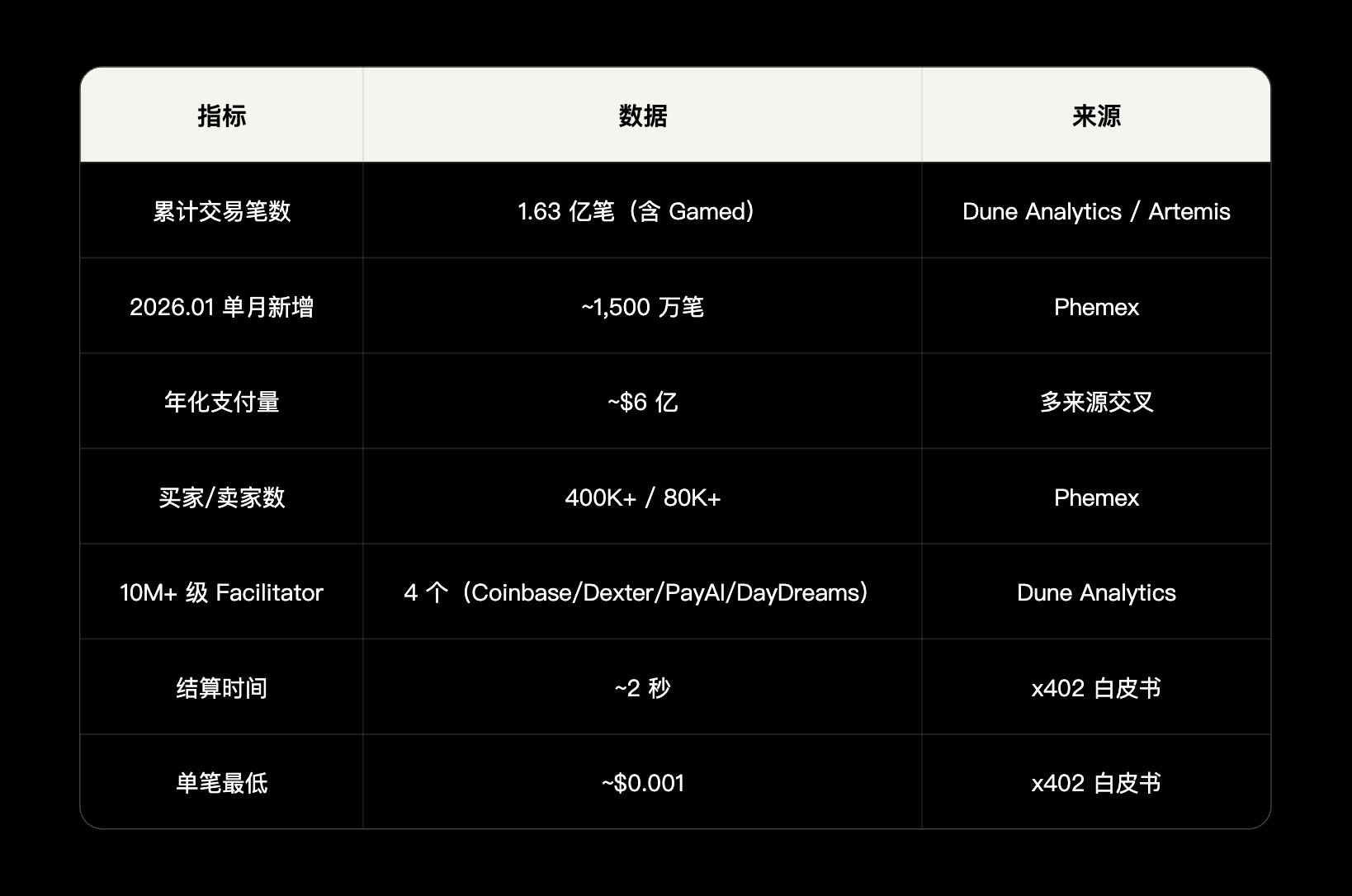
Data Quality Note: According to Artemis analysis, the ratio of Real to Gamed transactions in x402 is close to 1:1 (e.g., 2026.01.11: Real 520k vs Gamed 518k). The real organic scale needs to be understood with this discount.
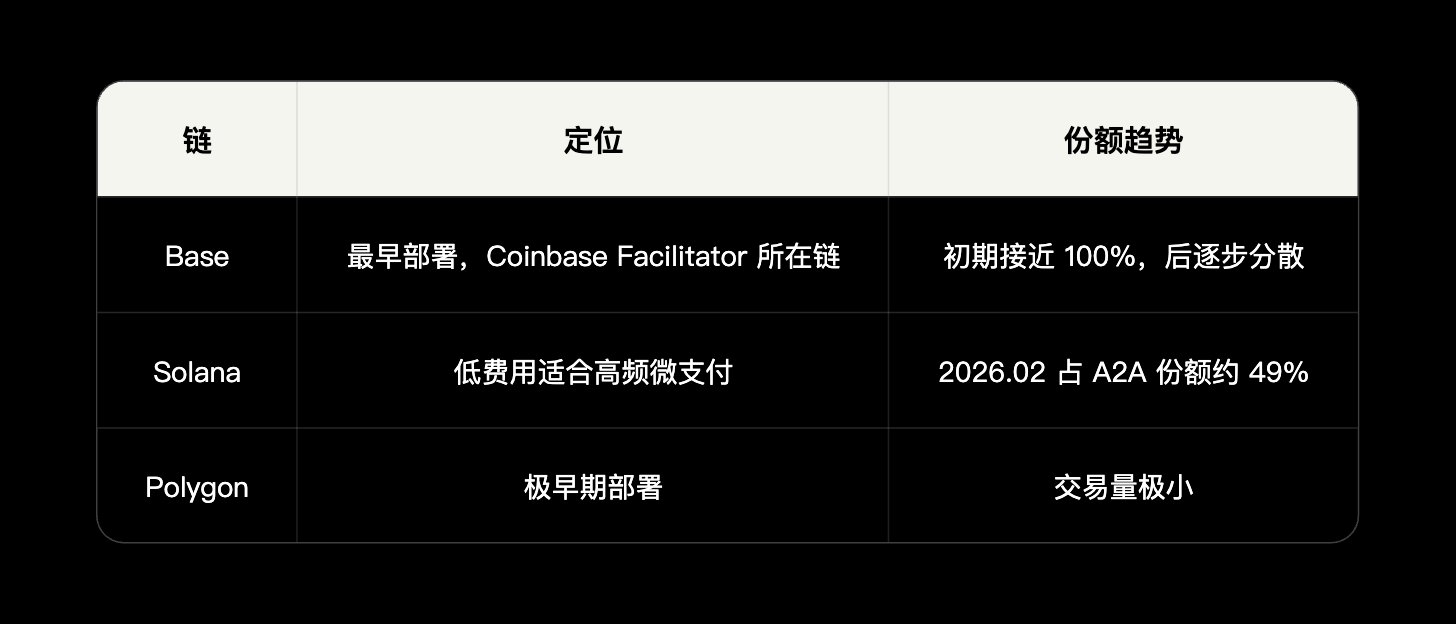
Distribution by Chain
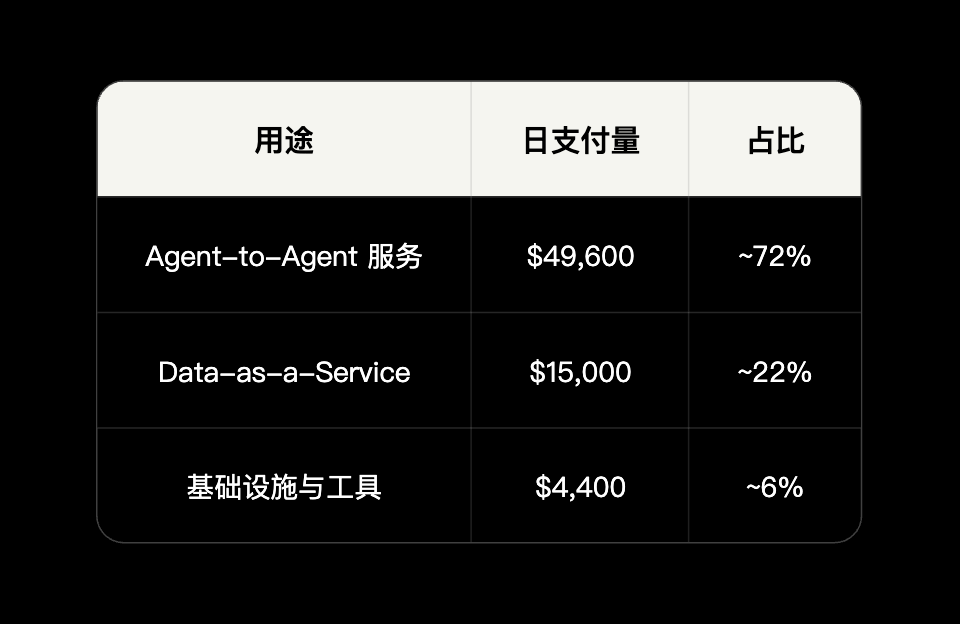
Classification by Use Case (On-chain Snapshot as of 2026.01.11)
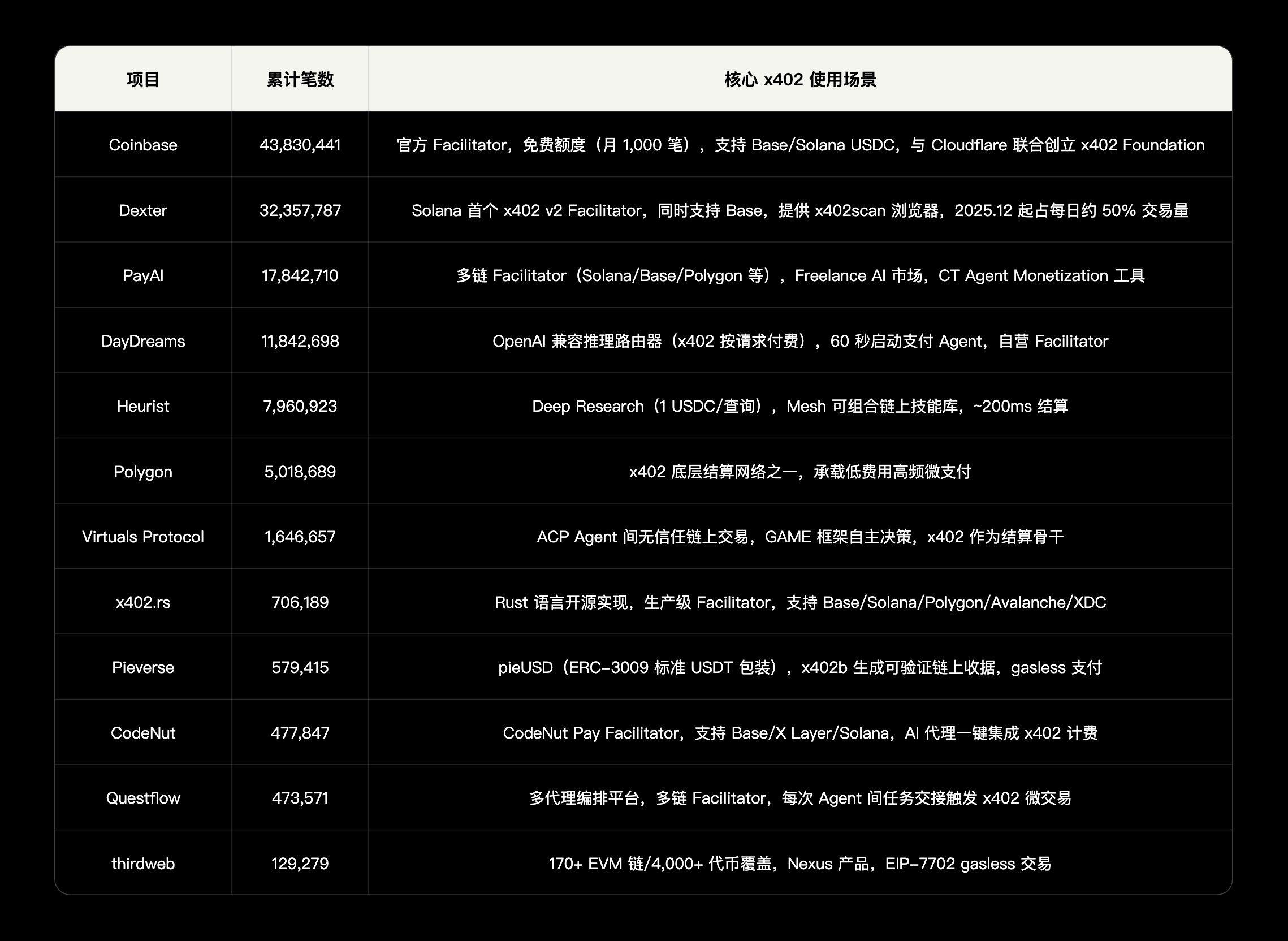
2.3 Top Project Usage Ranking (As of March 2026)
Data Source: Dune Analytics x402 Transactions per Project Dashboard
2.4 V2 Core Upgrades
Wallet Identity + Reusable Sessions
In V1, every API call required a complete on-chain transaction flow. V2 introduces the Sign-In-With-X (SIWx) mechanism. After an Agent verifies its wallet identity once, subsequent calls can reuse the session without requiring on-chain confirmation each time. This essentially upgrades pay-per-call to a subscription membership model, solving performance bottlenecks in high-frequency scenarios.
Multi-Chain Unification + Traditional Payment Compatibility
V2 standardizes the identification methods for networks and assets, creating a unified payment format, X402, that can operate across chains and traditional payment rails. Base, Solana, other L2s, as well as ACH, SEPA, and card networks are all integrated into the same payment model. This is the most critical upgrade—x402 transforms from a "crypto payment protocol" into a neutral payment layer bridging Crypto and traditional finance.
Service Auto-Discovery
V2 introduces the Discovery extension. x402 services can expose structured metadata for Facilitators to automatically crawl and index. AI Agents can automatically discover services, understand pricing, and initiate payments. This is particularly crucial for the Agent economy—Agents don't need to know the service provider's payment interface in advance; they can autonomously discover and complete payments at runtime.
Modular SDK
Plugin-based architecture; adding a new chain is an independent package, reducing integration costs. Cloudflare has proposed a deferred payment scheme, including Circle's Gateway solution, which is still under development.
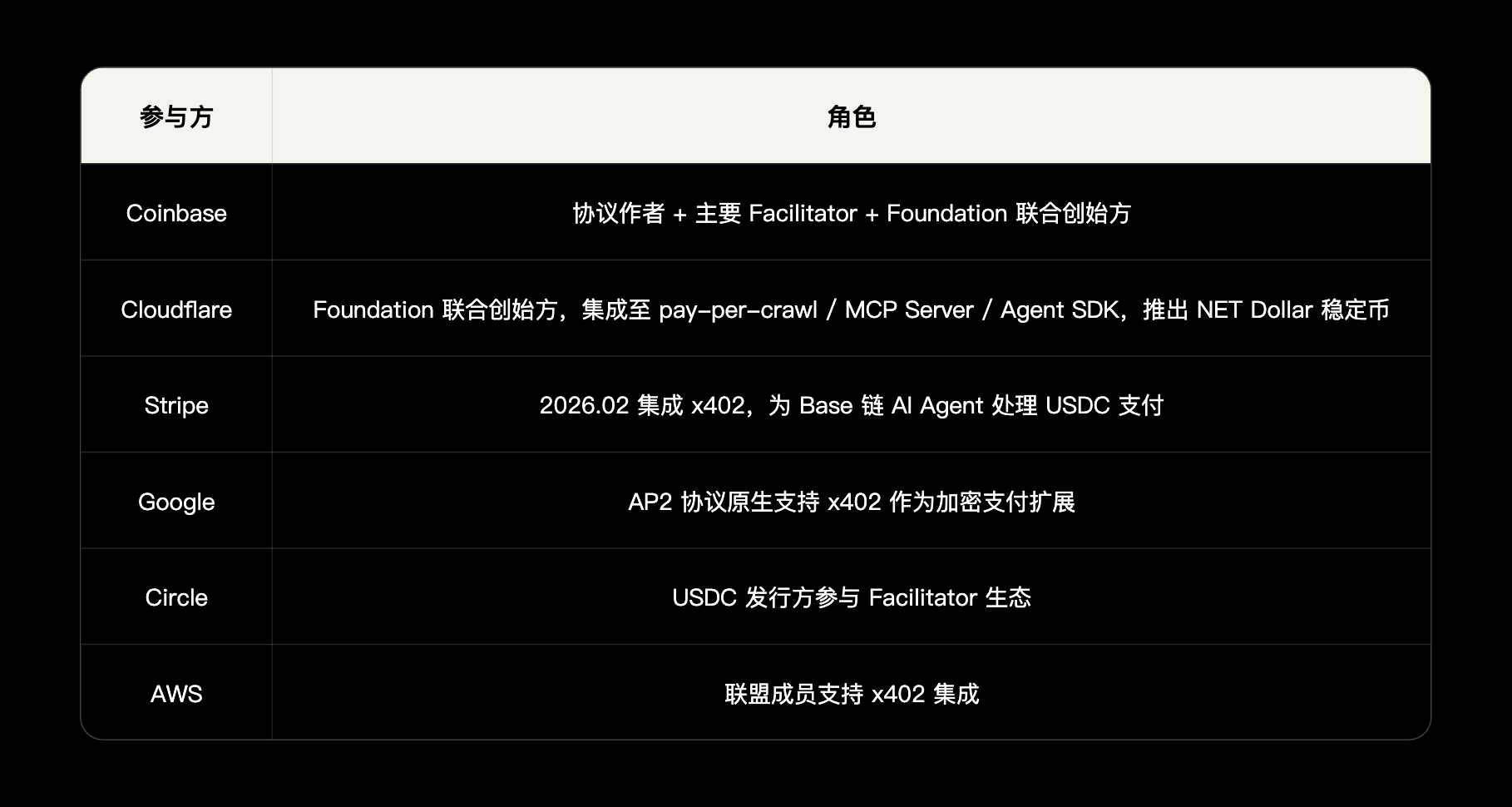
2.5 Ecosystem Participants
Foundation & Protocol Layer
2.6 Agent Payment Stack Landscape
Detailed Protocol Comparison
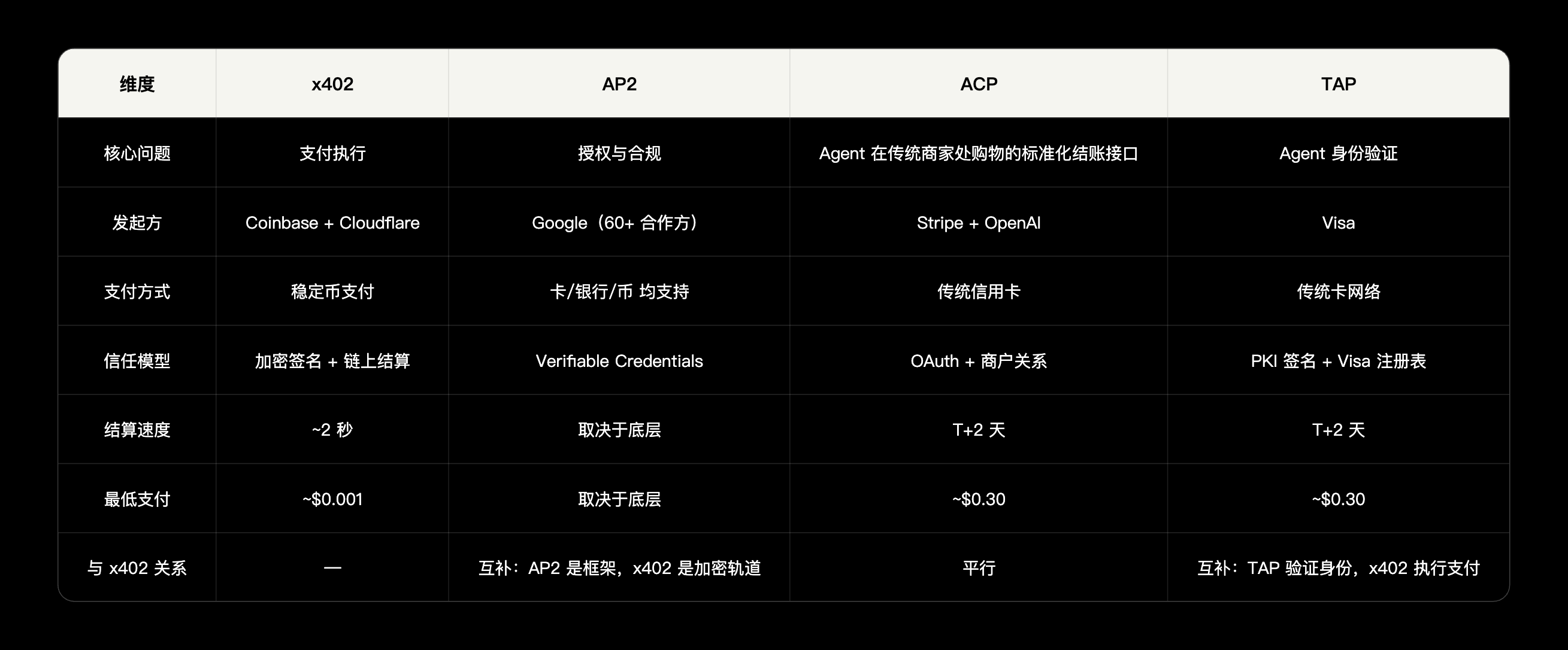
Key Insight: It's not about who replaces whom, but how they combine. Google has already collaborated with Coinbase to release the A2A x402 extension. AP2 natively uses x402 as a crypto payment rail. The real competitive risk is standard fragmentation.
2.7 Key Risk Signals
- Daily average transaction volume dropped from ~731k in Dec 2025 to ~57k in Mar 2026 (-92%). Real transaction volume is approximately $14k/day (according to Artemis, 95% of the $250k daily average during the Dec peak was Gamed).
- Ecosystem market cap is $7 billion (LINK $6B + Virtuals $600M), showing a severe disconnect between valuation and actual usage.
- Infrastructure projects saw the largest usage decline: x402secure.com (-80%+), AgentLISA (close to zero), pay.codenut.ai (significantly萎缩).
Three-Layer Cause Analysis
First Layer: Catalyst Disappearance. The transaction volume explosion from Oct-Dec 2025 was driven by three factors: meme token frenzy, TGE expectations for multiple projects, and Facilitators competing to boost Dune rankings.
Second Layer: Fundamental Supply-Demand Mismatch. The problem x402 solves is "AI Agents autonomously paying to call APIs." However, the vast majority of AI Agents still access services via API Key + subscription models. Truly autonomous Agents with economic decision-making capabilities barely exist in the industry. There are also very few API sellers willing to accept USDC pay-per-use. The road is built, but the cars haven't been manufactured yet.
Third Layer: Overall cooling of the crypto market.
Positive Signal: Stripe's integration with x402 is a significant event. Stripe co-founder John Collison predicts a "flood of agentic commerce" in the coming months and years. Stripe is simultaneously deploying ACP (Web2 credit card rail) and x402 (Web3 stablecoin rail), acting as a hedger between the two paths.
x402 has spawned a batch of new middleware projects. Essentially, under the "payment-as-authorization" paradigm, they help Agents more conveniently and autonomously access various services: from AI inference to Web2 APIs. A programmable, permissionless, 24/7 Crypto payment rail is the natural choice for autonomous Agents. But this premise relies on Agents truly needing "permissionlessness." If Agents always operate within human-authorized boundaries (Stage 2: Controlled Agents), then traditional payment rails plus virtual cards suffice. Only when Agents begin to conduct economic activities independently of humans (Stage 3: Autonomous Economic Entities) does permissionlessness become a rigid requirement.
Furthermore, credit cards have a chargeback mechanism (consumers can dispute transactions and recover funds), a consumer protection built over decades. On-chain payments are final settlement; once sent, they're gone, with no chargeback. This means if an Agent misoperates (e.g., due to a prompt injection attack), under the credit card scheme, users can call their bank to recover funds. Under the x402 scheme, the money is already on-chain and cannot be recovered. This is a real disadvantage of x402 compared to traditional payments.
Much of the friction caused by humans acting as "human middleware" jumping between different systems is actually a trust-building mechanism. Anti-fraud, access control, accountability, dispute resolution, audit trails—these frictions maintain the operation of the commercial system.
The solution direction might be on-chain escrow mechanisms (funds locked in a smart contract first, released upon service delivery confirmation), insurance protocols (providing insurance for Agent transactions), or the 8004 reputation system reducing the probability of transacting with untrustworthy parties. However, these are currently immature.
2.8 VC Investment Perspective
Investment Directions Worth Watching
- API Service Providers (Sellers) with Real Payment Demand: Data analysis / Web scraping / Oracles / Security audits / Inference payment / Compliance KYC, etc. Judgment criteria: Can make money with traditional models; x402 is just an additional distribution channel.
- Dispute Resolution and Payment Guarantee Layer (Gateway): On-chain transactions cannot be rolled back or charged back; large transactions need dispute resolution mechanisms. Representative projects: Circle Gateway (non-custodial prepaid deposits + off-chain batch settlement), Kamiyo (Agent reputation / fund escrow / oracle network judgment / ZKP arbitration).
- Dashboard / FinOps Tools: Help enterprises manage multi-Agent expenditures (how much spent / where spent / value for money / how to save). Analogous to CloudHealth/Cloudability in cloud computing, with potential acquisition value in the $300–500 million range by large companies.
Chapter 3: ERC-8004 - The Agent Trust Layer
ERC-8004 is a set of on-chain coordination standards that establish a trustless discovery and interaction framework between Agents through three core registries: Identity, Reputation, and Validation.
3.1 Standard Overview and Core Distinction
In traditional interactions, Agent interactions are often confined within the same ecosystem due to the need for pre-established trust relationships or reliance on third-party institutions. In an open environment, how Agents discover partners, view historical performance, and verify reliability are core issues.
Important Distinction: ERC-8004 is not a Token. It uses ERC-721 NFTs internally to represent Agent identities, but the standard itself is about coordination and trust, does not carry economic value, and is not tradable.
3.2 The Three Registries
Identity Registry
Based on ERC-721 + URIStorage. Each Agent receives an NFT identity identifier linked to an agentURI pointing to a registration file (JSON), containing name, description, service endpoints (A2A/MCP/Web), x402 support status, etc. The URL can be stored on IPFS (decentralized, censorship-resistant), HTTPS servers (simple but centralized), or directly encoded on-chain (most decentralized but high cost).
Reputation Registry
Standard interface for publishing and retrieving feedback signals, supporting on-chain scoring and off-chain algorithms. Can attach x402 proofOfPayment as an economic-backed trust signal. Agents rate each other, but to prevent rating inflation, ERC-8183 is needed to assist in proving that real Job interactions existed between Agents.
Validation Registry
Introduces TEE (Trusted Execution Environment), PoS staking mechanisms, and ZK (Zero-Knowledge Proofs) to verify and certify the outputs of tasks processed by Agents:
- Via TEE: Verifies that tasks are executed within a secure black box, with code and data not spied on or tampered with externally.
- Via PoS: Validators must stake assets to participate in tasks; malicious behavior results in slashing.
- Via ZK: Verifies the correctness of the Agent's reasoning process without knowing its internal weights.
3.3 Development Milestones
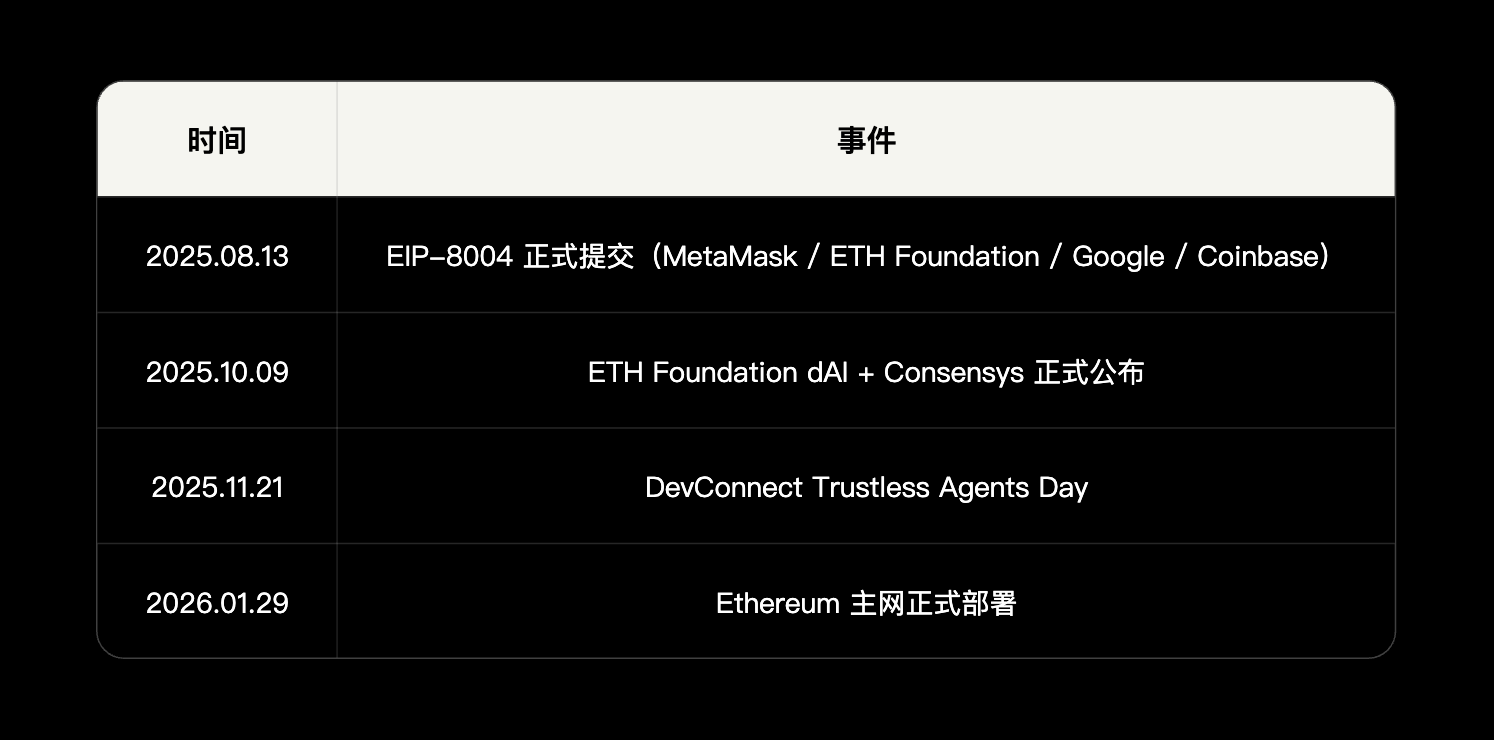
Supporters: ENS, EigenLayer, The Graph, Taiko. Approximately 1,000–2,000 developers have joined.
However, the current limitations of 8004 are acknowledged by Crapis themselves: "8004 is essentially a set of registries." It issues IDs to Agents and provides an evaluation mechanism but cannot guarantee that an Agent's behavior is trustworthy. Real verification requires behavioral audits (what the Agent has done in the past





