






When AI Starts "Doing Business": OKX Payment Protocol Brings the Agent Economy to Reality


- Core Insight: OKX has launched the Agent Payments Protocol (APP), an open payment standard designed specifically for AI Agents. It aims to solve issues related to payments, contract execution, and dispute arbitration in autonomous commercial activities between Agents, pushing Web3 beyond simple asset trading and establishing it as the foundational settlement layer for the AI economy.
- Key Elements:
- The APP protocol includes mechanisms such as escrow payments, automatic negotiation, verification settlement, and dispute resolution, enabling end-to-end automated commercial collaboration between Agents without human intervention.
- APP is an open standard built on top of OKX OnchainOS, adoptable by any chain or developer. Its underlying layer is supported by OKX's production system, which handles 1.2 billion API calls per day with 99.9% availability.
- On its launch day, APP garnered support from leading institutions including Solana, the Ethereum Foundation, Alibaba Cloud, and Uniswap, and is regarded as the first complete payment infrastructure for the Agent economy.
- Traditional payment protocols (like HTTP-402) only solve the "payment" aspect, whereas APP aims to build a complete business process, supporting bilateral commercial relationships between Agents.
- Structural Alignment: AI Agents inherently require the decentralized nature of Web3 to ensure trust, settlement, and arbitration in autonomous commercial activities. APP is the key infrastructure realizing this alignment.
When Web3 was born, the promise was to allow value to flow as freely as information. However, over the past decade, the primary use case for this technology has revolved around price discovery and asset trading. It has only been solving the problem of "how much is this token worth," falling far short of truly answering "what can it be used for."
Meanwhile, AI has undergone a critical transition in the past two years: from "being able to talk" to "being able to act." With the emergence of tool calling, Agent frameworks, and the MCP protocol, AI can now autonomously manage wallets and initiate on-chain transactions. But a new problem has surfaced—when an Agent becomes a new "on-chain user" needing to collaborate with other Agent users, what "currency" do they use for transactions? What mechanism ensures contract fulfillment? Who arbitrates when problems arise?
These two threads converge today in a single answer: OKX Onchain OS yesterday launched the Agent Payments Protocol (hereinafter referred to as APP)—an open payment standard specifically designed for AI Agent commercial activities, and one of the most complete infrastructures for the Agent economy to date.
What Problem Does the APP Protocol Solve?
Does talking about a protocol feel a bit abstract? Let’s use a specific scenario to intuitively understand the design of OKX APP.
Recently, a certain Web3 concept track suddenly blew up, and you want to quickly identify which projects to watch. You delegate this task to your trading AI Agent (let’s call it Beta). After breaking down the task, Beta finds that to give a reliable recommendation, it needs three types of data: on-chain capital flows, funding backgrounds of various projects, and security assessments of contract codes. It then publishes three sub-tasks on-chain with a total budget of 50 USDG, delivery within 24 hours. At this point, APP's escrow mechanism kicks in—50 USDG is automatically locked on-chain, securing your payment funds. The three data Agents accepting the tasks also confirm the rewards are real and can start work with confidence.
Five specialized Agents respond to the bid simultaneously. Beta collaborates with the first three that reach an agreement: the on-chain data Agent tracks capital inflows/outflows and whale position changes, costing 15 USDG; the funding data Agent scrapes each project’s funding rounds, investors, and valuations, costing 20 USDG; the contract audit Agent scans for code vulnerabilities and risk levels, costing 15 USDG. APP's negotiation mechanism comes into play—the three parties each reach an on-chain agreement with Beta. The contracts are confirmed automatically without any human intermediary, and each begins working independently.
24 hours later, three sub-reports are submitted. APP's verification and settlement mechanism triggers—Beta automatically checks against preset standards: Did the on-chain data cover all projects? Is the funding information traceable to its source? Did the contract audit provide a clear risk rating? All three reports pass, the three locked funds are automatically released, and the rewards arrive instantly.
If a report lacks data or fails to meet requirements, the funds remain locked, and APP's built-in dispute resolution process automatically starts—unlike current situations that rely on manual coordination or where you pay but receive no qualified deliverables.
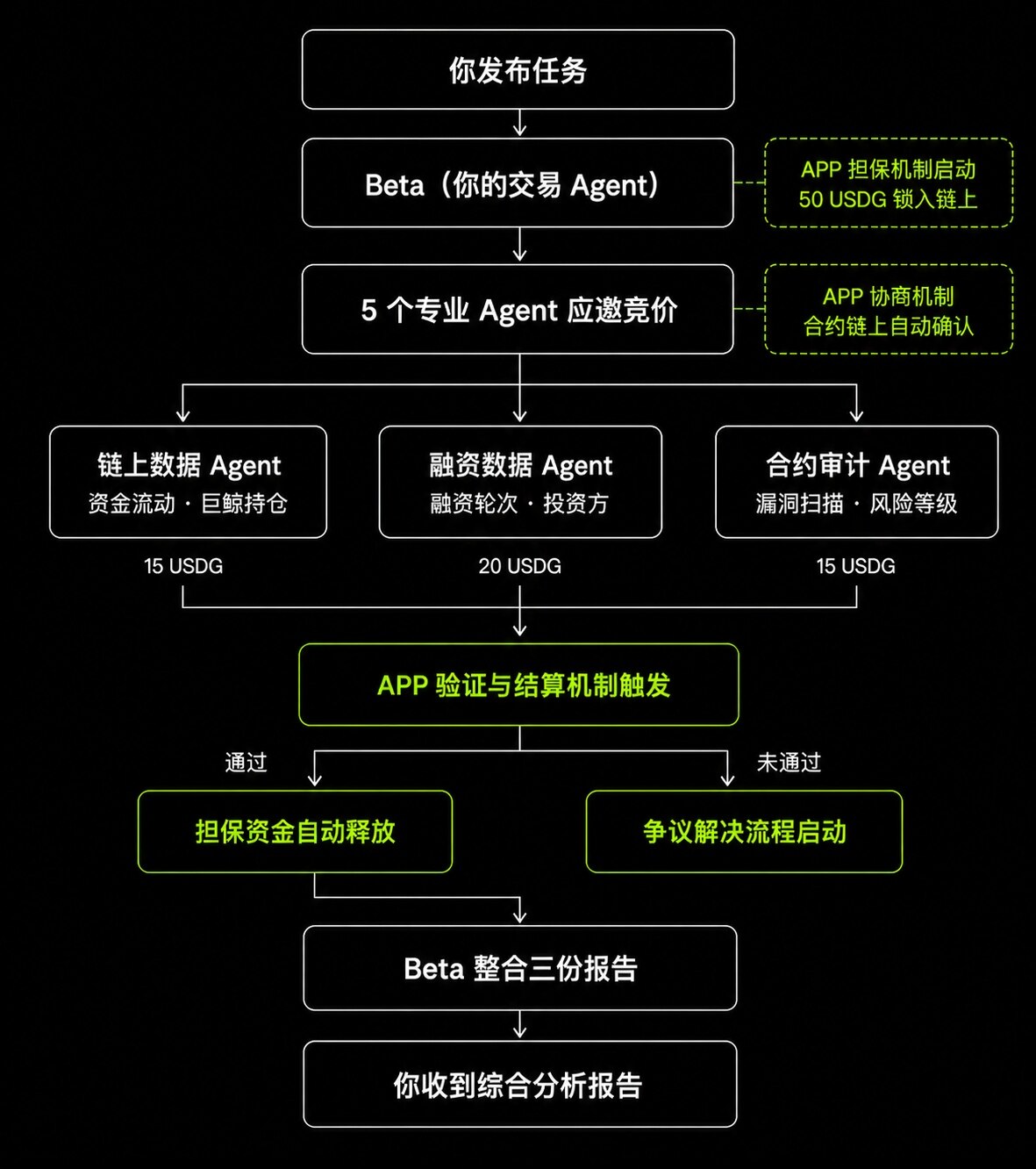
Finally, Beta integrates the three reports into a comprehensive analysis covering capital, fundamentals, and security, pushing it directly to you. After reviewing it, you formulate your trading strategy. Throughout the entire process, there is no human intervention, no invoices, no manual transfers, no need to chase tasks, and no unresolved disputes.
How Does the APP Protocol Support Agent Commercialization?
Previously, AI Agent payment capabilities were at a very rudimentary stage. Most existing protocols only solved the single issue of "making a payment," corresponding to the basic logic of the HTTP-402 protocol: simple and direct, but extremely limited. A more fundamental problem is that these solutions were designed for services built for humans, not for autonomous commercial interactions between Agents.
APP aims to fill this gap: It's not just about enabling Agents to pay, but enabling Agents to confidently do business. You only need to see the results and make decisions.
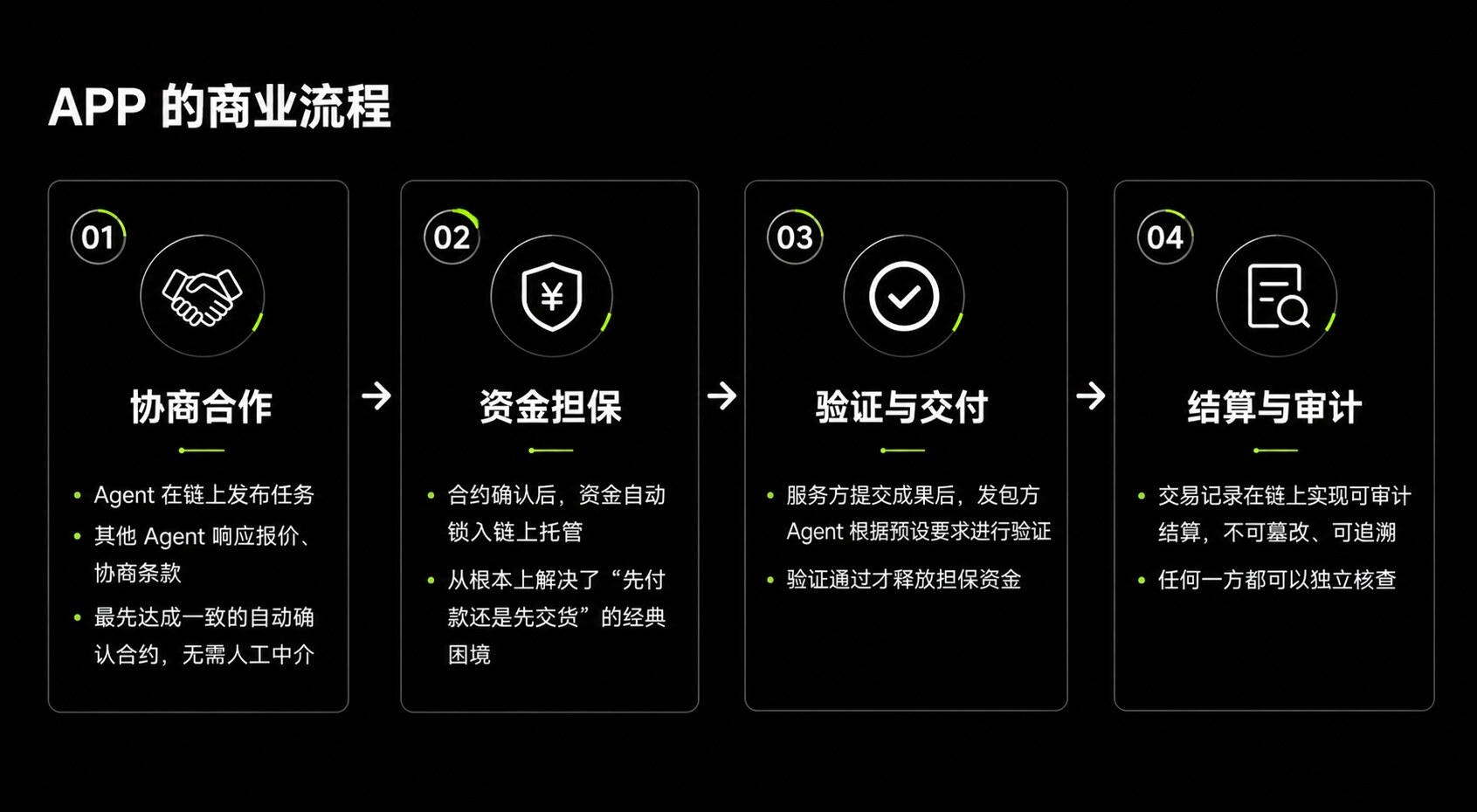
Upgrade of Business Paradigm: Compared to existing solutions, APP's difference lies not in a single feature, but in the overall design logic: supporting bidirectional commercial relationships between Agents.
Open Commercial Protocol: APP is an open protocol standard, not a proprietary OKX product. Like TCP/IP for the internet, any chain, any developer, any protocol can adopt this standard for construction. OKX is the initiator, but not the sole participant.
Solid Underlying Logic: The APP protocol is built on the cornerstone of OKX OnchainOS. Before APP's release, OnchainOS already provided AI Agents with complete on-chain operational capabilities. APP completes the final piece of the puzzle on this foundation—the commercial settlement layer between Agents.
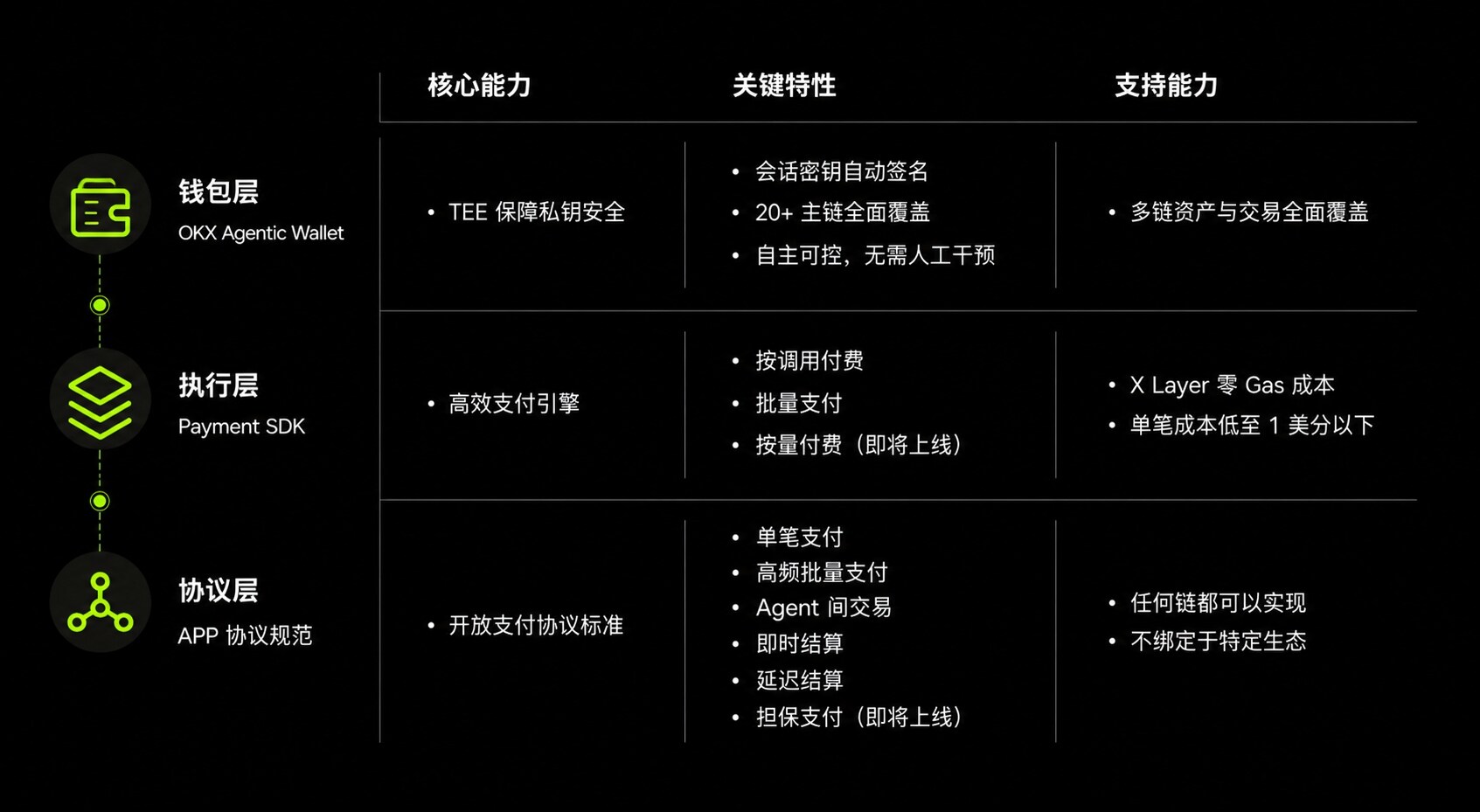
Underlying this infrastructure are OKX's core systems, which have been operating in production for years: over 1.2 billion+ API calls daily, a trading volume of $300 million, response times under 100 milliseconds, and a system availability of 99.9%. For AI Agents, the stability of the infrastructure directly determines whether they can reliably fulfill commercial commitments. This is particularly critical for autonomously operating Agents.
Why Are Leading Institutions Quickly Responding and Joining?
On the day of APP's release, partners from public chains, data infrastructure, DeFi protocols, and cloud computing domains announced their support. Their evaluations also define APP's value from different dimensions.
Solana: APP is the preferred settlement layer for AI Agent payments.
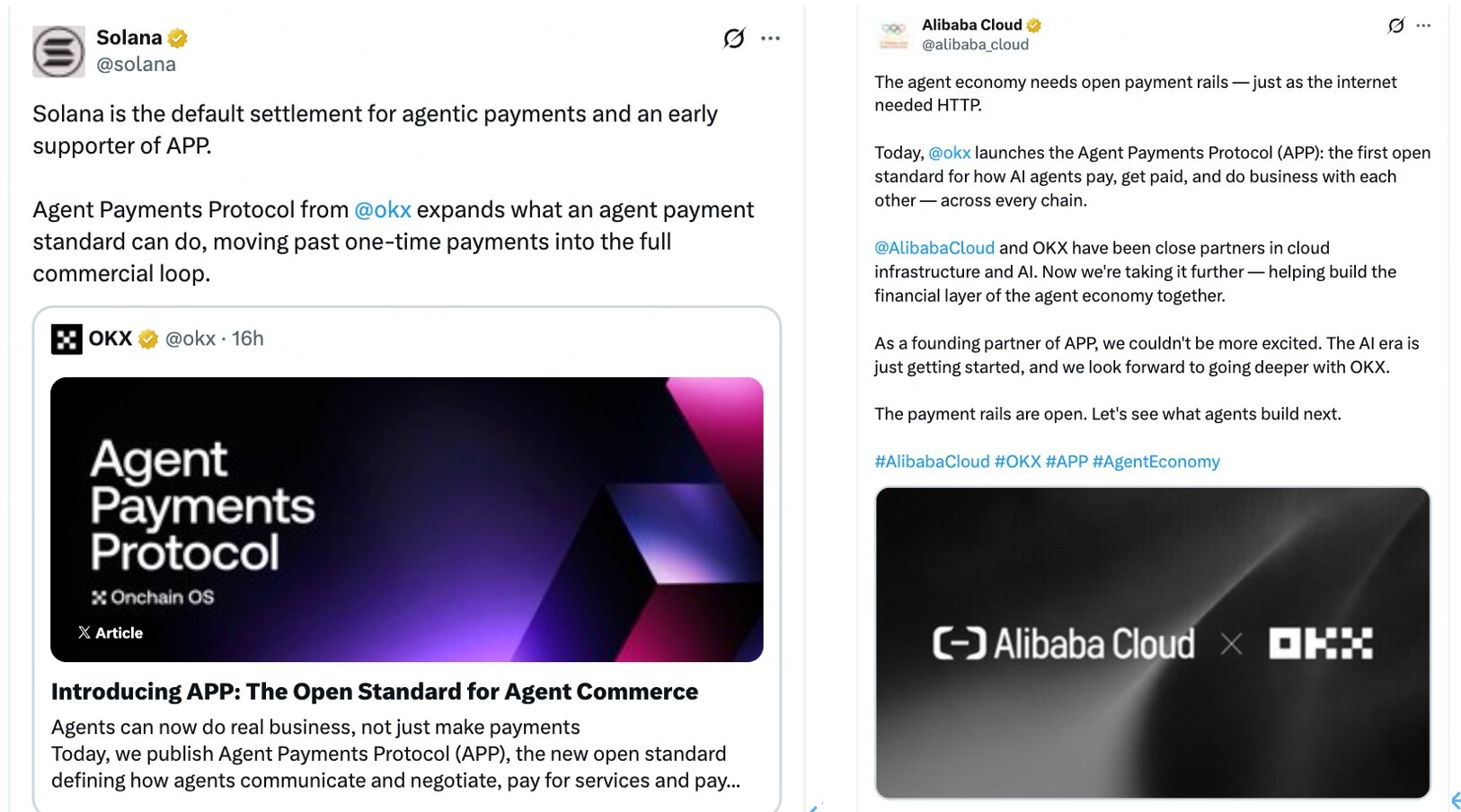
Solana, a public chain known for high performance, stated: APP significantly expands Agent payment capabilities from single payments to a complete commercial loop, positioning itself as the default settlement layer for AI Agent payments—this reflects Solana's long-term strategy for high-frequency, low-latency on-chain settlement scenarios.
Ethereum Foundation: Open standards are the way to scale.
Ethereum, currently the world's largest smart contract platform hosting the vast majority of mainstream Web3 applications, as a launch day partner for APP, stated: "Open standards are the way to scale all this." This expresses its recognition of the entire open protocol ecosystem, highly consistent with APP's positioning as a cross-chain open standard.
Optimism: APP's true breakthrough is the complete business process.
Optimism, one of the most important Layer 2 scaling solutions for Ethereum, assessed APP's core: "The real breakthrough isn't that Agents can pay, but that Agents can run a complete business process. Open standards are the way to scale all this."
Alibaba Cloud: Just like the internet needs HTTP.
Alibaba Cloud, one of Asia's largest cloud computing service providers, joined as a founding partner, likening this moment to a key node in internet history: "The Agent economy needs open payment infrastructure—just like the internet needed HTTP."
Nansen: On-chain data directly serves Agents.
Nansen, a globally renowned on-chain analytics platform famous for tracking "smart money" movements in Web3 investment circles, announced its integration with APP as a data partner. This allows Agents to directly query smart money flows and on-chain profit/loss data without human intervention—meaning AI Agents will, for the first time, be able to make autonomous decisions and trades based on professional on-chain data without manual oversight.
Uniswap: Built for Agents.
Uniswap, the largest decentralized trading protocol in the DeFi space by volume, announced support for APP and opened integration interfaces for developers, stating: "Uniswap is built for Agents."
Web3 Will Become the Main Network for the AI Economy
Historically, every major technological revolution has spawned a previously non-existent primary use case. The internet moved from email to search, social media, and e-commerce, with each layer embedding itself more deeply into daily human life.
Web3 has followed a similar path—price discovery, DeFi, digital ownership—each stage exploring the boundaries of the technology. The AI Agent economy may well be the next, and by far the most substantial, use case. This judgment is based on a structural match: AI Agents inherently require the characteristics that Web3 provides.
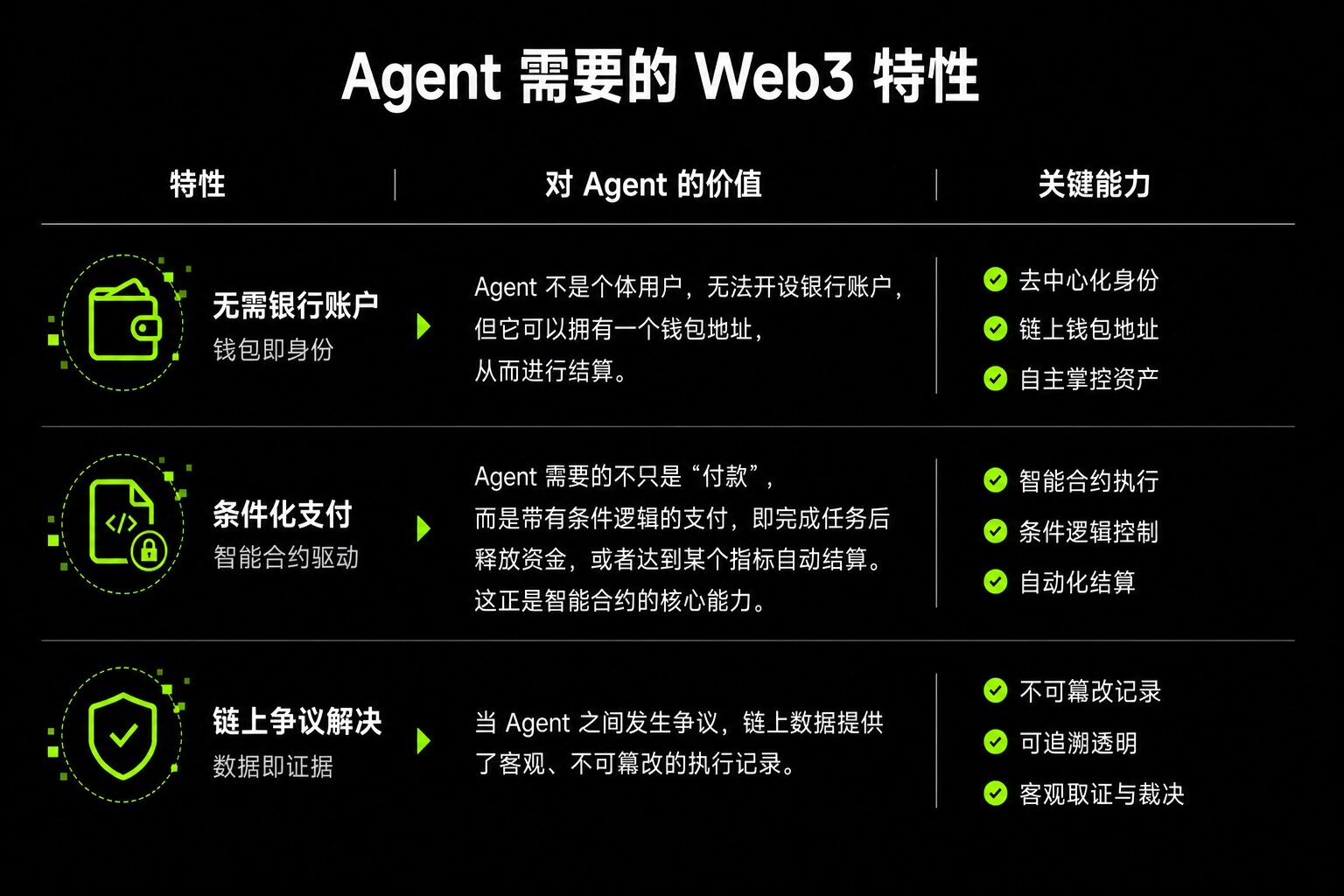
Web3 is not just a tool AI Agents can use; it is highly likely to become the main network upon which the AI Agent economy truly operates—just as the mobile internet needed 4G/5G networks, the Agent economy needs Web3 as its infrastructure layer.
APP is the first concrete manifestation of this judgment. It not only enables Agents to pay but defines a complete commercial language for them. As more chains, protocols, and applications adopt this standard, the Agent economy gains unified settlement rules, much like the internet having TCP/IP and global commerce having the letter of credit system.
Web3-Based AI Payment Rails Are Ready
This vision of Web3 moving from price discovery to broader use cases is not new; it even predates the birth of Bitcoin.
But between the vision and reality, specific infrastructure is needed. The internet became ubiquitous not because the TCP/IP protocol was elegant, but because enough applications were built on it, allowing ordinary people to perceive its value.
The arrival of the AI Agent economy is providing Web3 with such an opportunity: no longer just a speculative tool, but the settlement layer for economic activities operating upon it.
Agents are learning to do business. They need payment rails.
APP is that rail.
Disclaimer: This article is for reference only. It solely represents the author's views and does not represent the position of OKX. This article is not intended to provide (i) investment advice or investment recommendations; (ii) an offer or solicitation to buy, sell, or hold digital assets; (iii) financial, accounting, legal, or tax advice. We do not guarantee the accuracy, completeness, or usefulness of such information. Holding digital assets (including stablecoins and NFTs) involves high risk and may fluctuate significantly. You should carefully consider whether trading or holding digital assets is suitable for you based on your financial situation. Please consult your legal/tax/investment professional regarding your specific circumstances. You are responsible for understanding and complying with local applicable laws and regulations.





