From Investing in Coinbase to Using USDC: YC Waited 14 Years


- Core View: Top startup incubator Y Combinator announced that starting in 2026, its portfolio startups can choose to receive $500,000 in investment in the USDC stablecoin. This marks a mainstream, non-crypto top-tier venture capital institution formally migrating its core business process on-chain, representing a major vote of confidence in the compliance and utility of stablecoins.
- Key Elements:
- Policy Driver: The passage of the U.S. GENIUS Act in July 2025 established a federal regulatory framework for stablecoins, removing the biggest compliance barrier for top institutions to adopt cryptocurrencies.
- Efficiency and Market Fit: Stablecoin payments enable near-zero cost, near-instant settlement, making them particularly suitable for regions like India and Latin America where traditional banking is inefficient. Furthermore, stablecoin usage is growing among YC's portfolio companies.
- Reason for Choosing USDC: USDC is issued by Circle, which is regulated in the U.S., aligning with YC's compliance requirements. Additionally, YC has deep historical investment and personnel ties with Coinbase (a co-founder of USDC).
- Industry Paradigm Shift: By standardizing this option into contracts for all startups regardless of their industry, YC signals that the traditional wire transfer model in venture capital is facing a "dimensional reduction" challenge.
- Trend Data Support: An a16z report shows 90% of financial institutions are integrating stablecoins. In 2025, stablecoin transaction volume reached $46 trillion, nearly three times that of Visa, indicating a clear market growth trend.
Original author: angelilu, Foresight News
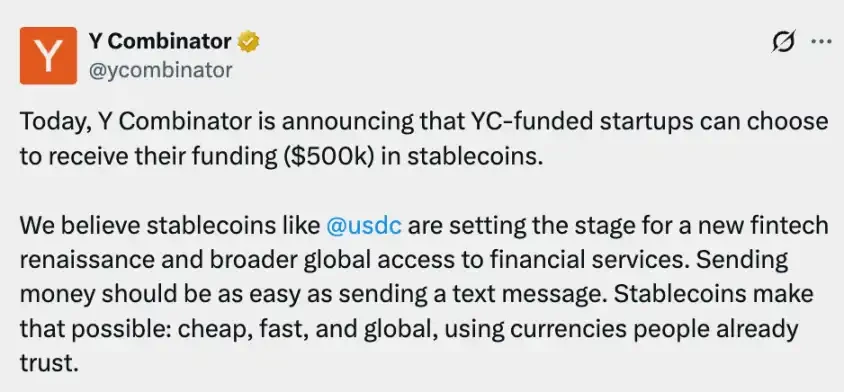
Y Combinator (YC), the "top-tier startup incubator" that has successfully nurtured Airbnb, Stripe, and Coinbase, announced on February 3rd that starting from the Spring 2026 batch, the startups it funds will have the option to receive their $500,000 investment in the form of the USDC stablecoin. This marks the first time YC has officially announced offering stablecoin as an investment method.
From Spectator to Participant
When YC invested in Coinbase in 2012, Bitcoin's price was only between $5 and $13. Over the subsequent 14 years, although YC invested in nearly 100 crypto companies, the investment funds were still transferred via traditional bank wires.
A key reason for YC's change is the passage of the U.S. "GENIUS Act" in July 2025. This act established a federal regulatory framework for stablecoins, requiring 1:1 reserve backing and granting holders redemption rights. The arrival of regulatory clarity removed the biggest obstacle for top-tier institutions to adopt cryptocurrencies. Just 7 months later, YC announced the stablecoin payment option.
The true significance of this move lies in YC "using" stablecoins itself. When an institution is willing to migrate its core business processes to a new technology, that is a true vote of confidence. From investor to user, from spectator to participant, YC has completed a complete role transformation over 14 years.

Why Choose Stablecoins?
The primary benefit of using stablecoins for investment is efficiency. Consider an Indian startup receiving a $500,000 investment from YC. Using a traditional wire transfer could incur thousands of dollars in fees and take 3 to 7 days; using USDC, the cost is nearly zero, and funds arrive in 1 second.
Furthermore, YC's decision is based on a practical observation: the new generation of entrepreneurs is already "Crypto Native." YC's statement pointed out that among its portfolio companies, the practical use of stablecoins is growing, especially in markets like India and Latin America.
Startups including Aspora and DolarApp are already using stablecoins to help clients transfer and store funds more efficiently in regions with limited or costly traditional banking infrastructure. To align with this trend, YC specifically emphasized support for stablecoins on the Ethereum, Base, and Solana public chains, allowing global entrepreneurs to choose the payment path best suited for them.
Why Choose USDC?
Observant individuals have noted that YC didn't vaguely mention using stablecoins but explicitly named USDC. Although USDC's market capitalization is lower than USDT's, it is issued by Circle, a U.S.-based company regulated by the Federal Reserve and state authorities. As a benchmark for Silicon Valley venture capital, YC must ensure every cent complies with U.S. regulatory requirements.
And let's not forget, YC invested in Coinbase back in 2012. Coinbase is one of the co-founders of USDC. Moreover, Nemil Dalal, the YC partner overseeing crypto initiatives, was previously the Product Director at Coinbase. This "kinship" likely also contributed to YC's natural inclination to trust and support the USDC ecosystem.

Venture Capital's "Nokia Moment"
Actually, within the crypto venture capital (Crypto VC) circle, using stablecoins is not new; firms like Paradigm or a16z Crypto have long used them on a case-by-case basis. YC's breakthrough lies in this: it is the "godfather of mainstream VC," with over 90% of its investments in AI, enterprise services, or consumer goods, not cryptocurrency companies.
Previously, VCs using stablecoins was often a "last resort" because founders couldn't open a USD account. Now, YC proactively includes this option in the standard contract template for every founder. Whether you're working on large language models or biomedicine, if you want, you can directly receive USDC. This process-driven, standardized action signals that the venture capital industry is facing its own "Nokia moment" – the traditional wire transfer model is being disrupted.
Will Other VCs Follow Suit?
Currently, attitudes toward crypto among top Silicon Valley VCs are diverging. a16z crypto represents the "radical faction," raising $15 billion in early 2026 to focus on AI and crypto investments. YC, on the other hand, represents the "pragmatic faction," starting with payments – not radical but extremely steady.
More traditional VCs may still be watching and waiting, but history provides a clear reference. Traditional financial institutions typically take 3 to 5 years to move from skepticism to embrace: both Goldman Sachs and JPMorgan Chase went from calling it a "fraud" to launching related businesses.
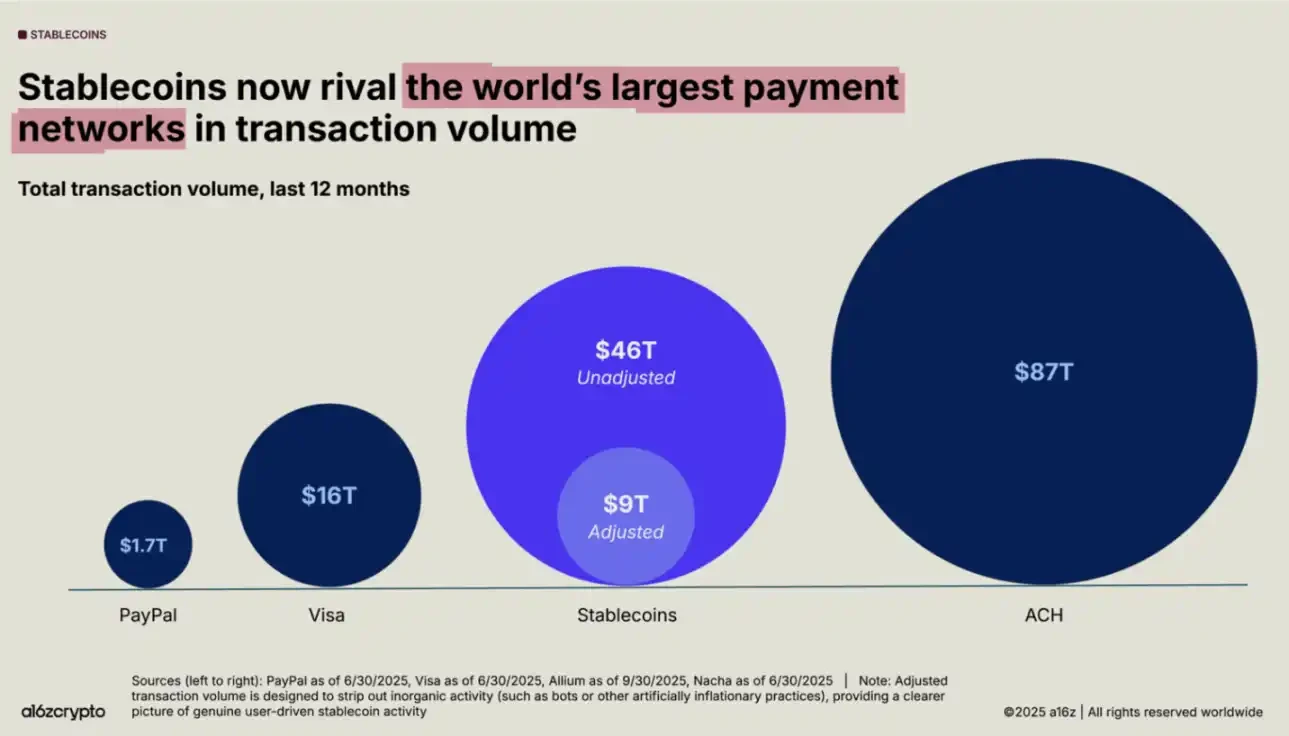
According to an a16z report, currently 90% of financial institutions are integrating stablecoins. Stablecoin transaction volume reached $46 trillion in 2025, nearly three times that of Visa. Market forecasts predict the stablecoin circulating supply will exceed $1 trillion in 2026. Behind these numbers lies an irreversible trend. YC's decision might just be a single node in the stablecoin wave.
What Kind of Entrepreneurs is YC Looking For?
Currently, applications for the YC Spring 2026 batch are now open. The incubation program will take place in San Francisco from April to June. The application deadline is February 10th at 12:00 PM Pacific Time. Applications submitted before the deadline will receive results by March 13th.
In September 2025, YC launched the "Fintech 3.0" initiative in collaboration with Base and Coinbase Ventures, which emphasized its desire to fund on-chain startup projects in the following areas: stablecoin applications, tokenization and trading (new credit markets, on-chain capital formation, new trading interfaces), and Apps and Agents (including social, financial, collaboration, gaming, etc.).
14 years ago, YC's investment in Coinbase was a bet on the future; 14 years later, YC's use of USDC is about becoming the future.