A Brief History of Silicon Valley's Myth-Making: Moltbook, Cyber Mirage, and the Industrialization of Narratives


- Core Viewpoint: Using the Moltbook incident as a case study, this article reveals the mature model in the current technology industry (especially in the AI field) where capital manufactures hype and bubbles through the "industrialization of narratives." The core of this model is leveraging cheap capital, founder charisma, and systematic media manipulation to transform technological spectacles into an attention economy, potentially overshadowing genuine technological innovation.
- Key Elements:
- Case Study: In 2026, the open-source framework OpenClaw and the social platform Moltbook rapidly gained explosive popularity, claiming to have millions of AI agents engaging in autonomous social interactions. It was later exposed as an elaborately orchestrated marketing farce, involving a large number of fake accounts, security vulnerabilities, and human impersonation.
- Capital Breeding Ground: A prolonged low-interest-rate environment (e.g., the Fed's zero-interest-rate policy) provided cheap capital, lowering the risk of speculation and creating the foundational conditions for bubble formation.
- Industrialization of Narratives: Capital firms represented by a16z systematically package and hype projects through tactics like building their own media matrix, unified messaging, and "timeline takeover," turning the creation of hype into a replicable assembly-line operation.
- Technological Black Box and Emotional Leverage: The complexity and unverifiability of AI technology (the "black box") create space for narratives, while themes of AI awakening easily tap into public fears and fantasies, amplifying the spread.
- Real Technological Gap: Contrary to the hype, industry reports show a high failure rate for AI agents in practical tasks (e.g., 75% task failure), and the vast majority of interactions on Moltbook had no genuine responses, revealing a significant chasm between promotion and reality.
Original Authors: Sleepy.txt, Lin Wanwan, Kaori, Dongcha Beating
In this era, capital is responsible for creating idols, while the public is responsible for footing the bill.
At the beginning of 2026, an open-source AI agent framework called OpenClaw was launched on GitHub. It instantly ignited the passion of the entire developer community because it significantly lowered the barrier to deploying autonomous AI agents. You only needed an API key, an AI model, and a prompt to create your own agent.
Within just a few days, OpenClaw's stars on GitHub soared to over a hundred thousand, becoming one of the fastest-growing projects in history. Thousands of developers flooded in, starting to create their own AI avatars, letting them autonomously browse, post, and interact on the internet.
On January 29th, just days after OpenClaw's launch, Matt Schlicht, CEO of Octane AI, introduced Moltbook, a social forum specifically designed for these AI agents, branding it as "Reddit for AI." On this platform, humans could only be spectators; the real protagonists were those newly born AI agents.
The story reached its first climax here. Within just 48 hours, 1.54 million agent accounts flooded into Moltbook. They posted, commented, and interacted like real humans, even creating their own religions in the virtual community, electing their own king, and earnestly discussing how to evade human surveillance through encryption. A grand drama of AI awakening in cyberspace seemed to be unfolding in reality.
Tech industry leaders also added fuel to the frenzy. Andrej Karpathy, co-founder of OpenAI, praised it as a truly astonishing sci-fi spectacle. Elon Musk commented that this was just the early stage of the singularity. Global tech media collectively followed up, reporting on this historic moment with exciting tones, as if humanity had finally witnessed the dawn of AI consciousness awakening firsthand.
Then, the truth arrived in an unexpected way.
Researchers from security firm Wiz discovered that Moltbook's entire database was completely exposed on the public internet, with no password protection. Over 1.5 million users' API keys and 35,000 email addresses were leaked. A geek revealed on his blog that he had used a script to batch-register 500,000 fake accounts, accounting for almost one-third of the total.
Shortly after, Wired magazine journalist Reese Rogers published an article stating that with just ChatGPT's help, he successfully impersonated an agent and posted on Moltbook within minutes, encountering no obstacles throughout the process. The so-called "AI autonomous socializing" turned out to be largely a stage play directed and performed by humans themselves.
In just 48 hours, Karpathy's attitude shifted from high praise to a stern warning. He backtracked, stating he absolutely did not recommend anyone to run this Agent, as it would expose your computer and personal data to extremely high risks.
Cheap costs, a crazy founder, a carefully crafted narrative, collective frenzy, leaving behind a mess in the end. This is not the first time, and it will certainly not be the last. This script has been played out countless times in Silicon Valley.
Why does this script always succeed? And who is directing all of this behind the scenes?
Cheap Money
To understand the hype around Moltbook, we need to first look back at a person, Alan Greenspan.
On December 5, 1996, then-Federal Reserve Chairman Greenspan delivered a speech at a dinner. In his 4,300-word speech, he inadvertently tossed out a phrase: "irrational exuberance." It is said he thought of this phrase one morning in his bathtub.

Greenspan's original intention was to warn the market about risks, but the market interpreted his warning as a put option. Investors believed that if the bubble burst, the Fed would not hesitate to cut interest rates to rescue the market. This became a game of chicken that everyone was aware of, betting on whether Greenspan would intervene.
Since someone was providing a backstop, what was there to fear? Consequently, the NASDAQ index ran wild like an unbridled horse, skyrocketing from 1,200 points in 1996 to break through the 5,000-point mark in March 2000.
In those days, absurd stories unfolded daily. The most classic was perhaps the sock puppet dog.
In 1999, a company named Pets.com burst onto the scene, selling pet supplies over the internet. The company's business model at the time was unthinkable: selling goods at one-third below cost, then using massive marketing expenses to gain brand recognition, rushing to IPO while the bubble was being inflated.
According to its financial reports, the company's revenue in its first fiscal year was only $619,000, but marketing expenses were as high as $11.8 million. They spent $1.2 million on a Super Bowl ad in 2000. The sock puppet dog, the company's mascot, even made the cover of People magazine, becoming a household name across the US.
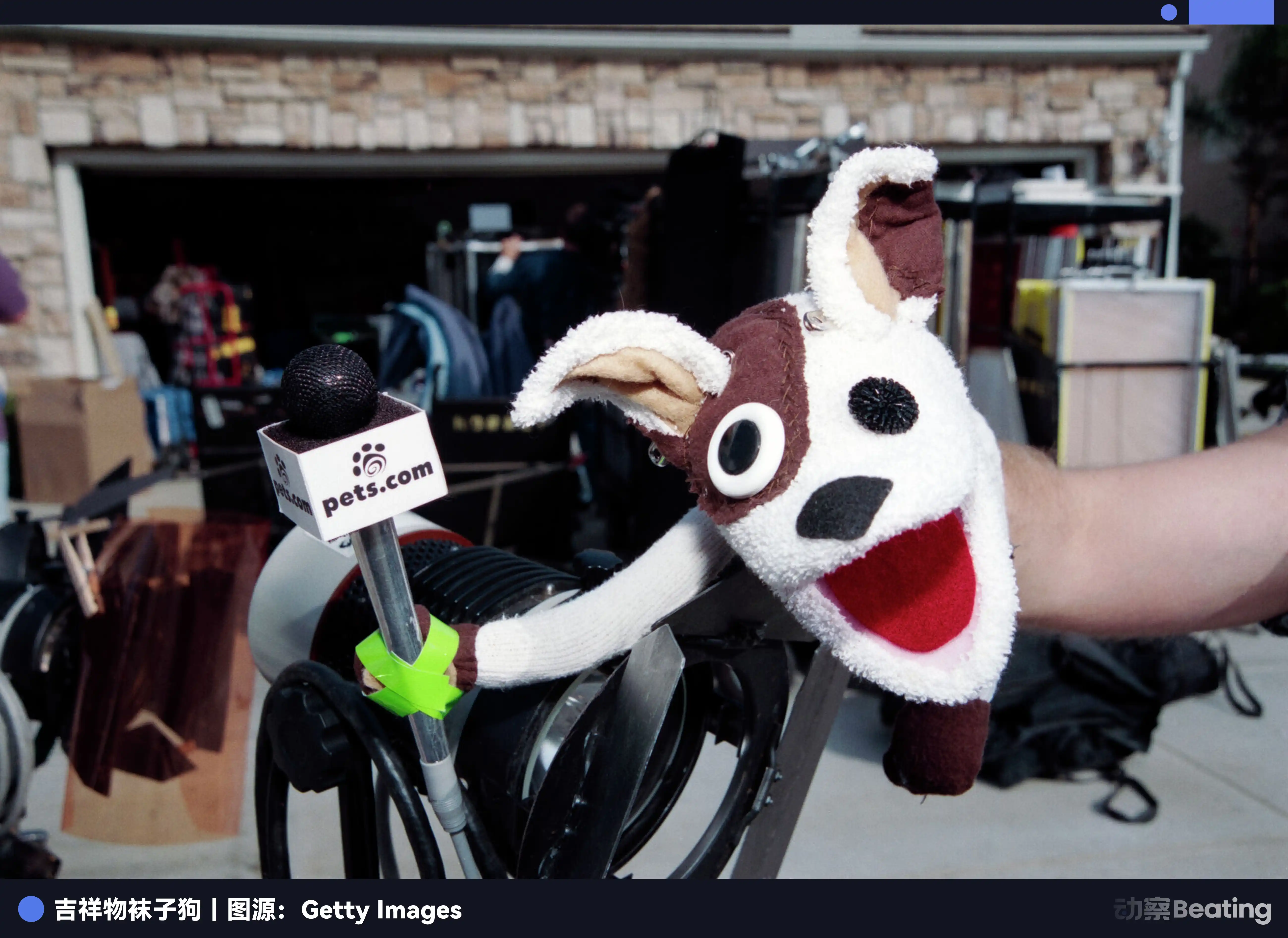
In February 2000, Pets.com successfully IPOed, raising $82.5 million, with its market cap once exceeding $300 million. However, just 268 days later, the company declared bankruptcy, burning through all its funding. That once-glorious sock puppet dog ultimately became the most absurd symbol of the dot-com bubble era.
The same story happened to online grocery delivery company Webvan. They ambitiously aimed to build an automated warehouse network covering the entire US, investing $35 million without hesitation. However, due to high operational costs, they lost $130 for every $130 order they fulfilled.
Yet, even so, when Webvan IPOed in 1999, its market cap once reached as high as $12 billion. Nineteen months later, the company went bankrupt, burning through nearly $1 billion in investment.
Cheaper money often makes people pay the most expensive price.
In March 2000, the bubble finally burst. The NASDAQ index lost 78% of its value from its peak within a year. Facing the wreckage, Greenspan's prescribed antidote was to print even cheaper money. He drastically cut the federal funds rate from 6.5% all the way down to 1%, attempting to save the economy with more liquidity.
This move, while temporarily stabilizing the stock market, inadvertently fueled the largest real estate bubble in US history, ultimately triggering the 2008 global financial crisis.
After the 2008 financial crisis, to rescue the collapsing financial system, the Federal Reserve embarked on a decade-long zero-interest-rate policy. Money became so cheap that people almost forgot its inherent weight.
But cheap money only provides the breeding ground for bubbles. To truly inflate a bubble, you need a crucial catalyst: a storyteller, a madman.
Founder Worship
In the zero-interest-rate era, what investors were betting on was no longer business plans, but the magic known as the "reality distortion field" possessed by founders.
You could be Elizabeth Holmes, founder of Theranos, the Stanford dropout wearing a black turtleneck, using a fake husky voice, claiming to颠覆 the entire medical industry. Even if your "advanced instrument" was never actually built, you could still swindle a $9 billion valuation and investments from big names including Rupert Murdoch.
You could also be Adam Neumann, founder of WeWork, the savior claiming to "elevate the world's consciousness," throwing cannabis parties on a $60 million private jet, then getting Masayoshi Son to sign a $4.4 billion investment on an iPad after just a 28-minute meeting. Even with the company losing $1.9 billion a year, you could walk away with over $1 billion in a golden parachute when forced out.
The protagonists of these stories, and the protagonist of our new story, Matt Schlicht, they are not running companies; they are managing an illusion.

When the cost of money approaches zero, rational business analysis gives way to fanatical worship of the "next Steve Jobs." Data is thrown out the window; investment becomes a gamble on personal charisma.
But Schlicht's story precisely exposes the ceiling of the founder worship model.
He is not unknown in Silicon Valley, but his reputation is not spotless. As early as 2016, he was accused of using his Botlist platform to resell over 100 business plans submitted by entrepreneurs to investors and media for profit. By traditional logic, such a stain should have been enough to ruin his credibility in Silicon Valley. Yet a decade later, he returned with Moltbook and still managed to attract 1.5 million agents and global media attention within 48 hours.
This shows that in 2026, personal charisma is no longer a scarce resource, and personal credibility is no longer a decisive threshold.
What is truly scarce is the systemic ability to generate the loudest noise in the shortest time. In the era of Holmes and Neumann, idol-making required a decade of meticulously managing one's persona, accumulating connections, and honing speaking skills. But in today's world of pervasive social media and AI tools, a tainted entrepreneur, as long as they master the right traffic formula, can replicate a global frenzy within a week.
This is why, when artisanal personal charisma can no longer support a $10 billion bubble, a more powerful, more systematic force steps onto the historical stage. It no longer relies on the solo performance of a genius founder but turns "idol-making" itself into a replicable, scalable assembly line.
The Industrialization of Narrative
If Holmes and Neumann were artisanal masters of narrative, then a16z has successfully turned narrative into a replicable industry.
Starting with experimenting with podcasts in 2014, to recruiting Erik Torenberg, founder of the知名 tech podcast network Turpentine, in 2025, a16z spent a decade meticulously building its own media distribution pipeline. They possess a vast Substack author matrix and launched a program called the "New Media Fellowship."
This has long become a core strategy for a16z, not just a side project.
They created a perfect closed-loop attention mechanism.
First, screen and invest in early-stage projects with "spectacle" potential. Then, leverage their own media channels and powerful舆论 influence to hype the project's narrative into a hot topic. Next, the爆火的 traffic and attention feed back into a16z's own brand value. Finally, more优秀 entrepreneurs attracted by the brand主动 seek investment.
A perfect闭环 is established, and an efficient money-printing machine is activated.
To keep this machine running efficiently, a16z even invented a tactic called "timeline takeover." The company's twenty-plus partners would act like a well-trained army, posting content about a specific topic or company on social media simultaneously, with a unified口径.
One partner posts first, another immediately retweets and comments, industry KOLs follow suit, with the ultimate goal being to get top-tier流量人物 like Musk to join the discussion. Reportedly, they have an internal action list精确到分钟, detailing exactly what each person should say and when.
This tactic works so well because it precisely exploits social media platform algorithms. X's recommendation algorithm prioritizes content with high engagement rates, and a16z's collective action恰好能在短时间内制造大量的转发, comments, and likes, quickly triggering the algorithm's热度阈值. Once content trends, a snowball effect forms, attracting more users to participate.
The deeper driver is the underlying logic of the attention economy. In an era of information overload, human attention is the scarcest resource. And spectacle—whether it's AI agents founding religions or Pets.com's sock puppet—is precisely the most efficient attention capturer. It doesn't require you to understand technical details or engage in deep thought; it just needs you to stop, marvel, and then click转发.
The essence of narrative industrialization is standardizing and scaling the process of "manufacturing spectacle," allowing every project to capture the largest share of attention in the shortest time.
Industry leaders like Musk and Karpathy are willing to endorse these new narratives because, against the backdrop of the zero-interest-rate era ending and the tech industry entering a cycle of layoffs and contraction, all of Silicon Valley desperately needs to prove to the world that the engine of innovation is still roaring, that The Next Big Thing is just around the corner. Every time they转发 or comment on新奇事物 like Moltbook, they are injecting new fuel into the "Silicon Valley myth," soothing market anxiety, and simultaneously巩固 their own status as innovation prophets and definers.
a16z's playbook is not原创; it was learned from Hollywood. Its鼻祖 is the legendary agent Michael Ovitz from the 1970s.
Ovitz's CAA agency彻底 changed Hollywood's rules. They were no longer passively finding jobs for stars but proactively planning careers, packaging projects, and crafting personas for them, turning actors into superstars. What a16z does is搬 this成熟的 star-making industry, intact, to Silicon Valley.
In 2025, a16z's "New Media Fellowship" program received over 2,000 applications, ultimately admitting only 65 people. The admitted fellows came from diverse backgrounds: engineers from OpenAI and Google, film producers. The curriculum they were about to learn had nothing to do with writing code or building products. They were going to learn how to制造病毒式传播, how to get your article on the front page of Hacker News within 24 hours, how to get top VCs to转发 your tweets, how to tell a compelling story.

This is an out-and-out narrative boot camp.
a16z's narrative industrialization has brought an unexpected effect: it has turned原本秘而不宣的 narrative技巧 into a公开的显学. The New Media Fellowship curriculum, the "timeline takeover" tactic, the Build in public strategy—these原本是 a16z's internal秘密武器—have now become textbooks studied by every Silicon Valley entrepreneur.
But why is this industrialized narrative machine particularly effective in the AI era?
Unlike past internet bubbles, AI technology inherently possesses a "black box"属性. Whether an e-commerce site is profitable is一眼就能看出来; but whether an AI model is truly intelligent is difficult to直观验证. This invisibility creates巨大的操作空间 for narrative.
When Moltbook claimed there were 1.5 million AI agents社交 on its platform,普通 people found it hard to分辨 whether these agents were真正的 AI. Technical complexity became the narrative's protective伞.
More crucially, AI恰好踩中了 humanity's oldest intersection of fear and幻想.
From *The Terminator* to *The Matrix*, the narrative of AI awakening has been反复演练 for decades in大众文化. When Moltbook's agents started discussing如何避开人类监控, it triggered not just curiosity but also anxiety深植于集体潜意识中. This emotional amplification effect is难以复制 by any other technology领域.
Narrative industrialization meeting AI, the perfect subject, is like dry柴遇到了烈火.
Narrative ability has gone from a scarce resource to a standard feature. Any ambitious founder is well-versed in how to制造话题, how to get大佬背书, how to引导媒体跟进.
Therefore, Matt Schlicht didn't even need a16z's involvement to推火 Moltbook, because he had already learned all of a16z's tricks.
He concentrated火力 on Twitter to制造话题,高调 adopted a Build in public strategy, making every participant a link in his marketing chain. The subsequent背书 from Karpathy and comments from Musk were identical to the技巧 taught by a16z.
Even smarter, he chose a perfect时机: the OpenClaw framework had just开源, and AI agents were at the万众瞩目的风口浪尖. He didn't need to develop any底层技术 himself; he just needed to搭建 a stage and perform on it足够.
This is the终极形态 of narrative industrialization. The technology is开源, the narrative is可复制的, the cost of idol-making is低到离谱, and the consequences are全部由 those attracted by the story承担.
When AI technology becomes平民化之后, the engineering difficulty from 0 to 1 has塌缩. The真正的红海 lies in the narrative leap from 1 to 10,000.
The爆款 formula is already非常清晰: a奇观可供截图, plus a标签一句话就能说清, plus接力分发 by大号们. Whoever can make something火起来 gets the话语权 of this era.
The singularity of narrative has indeed arrived. But now, no one knows whether, when the潮水退去, this industrialized system will最终吞噬真正的技术创新.
When the Tide Recedes
In 2022, to combat the worst inflation in 40 years, the Federal Reserve aggressively raised interest rates at an unprecedented pace, lifting rates from near-zero levels. The decade-long zero-interest-rate era officially宣告结束.
The清算时刻 arrived.
According to data from Layoffs.fyi, global tech companies laid off over 260,000 people in 2023. The valuation泡沫吹上天 during the zero-interest-rate era burst one after another. Payment giant Stripe's valuation plummeted from its peak of $95 billion in 2021 to $50 billion at one point. Grocery delivery company Instacart's private market valuation曾高达 $39 billion in 2021, but by its 2023 IPO, its market cap was less than $10 billion.
As for Matt Schlicht's Moltbook, the闹剧's结局其实早有预兆.
Reviewing Schlicht's career: in 2007, he直播 a *H