From Moltbook to MOLT: How is the Vision of AI Autonomy Being Embraced by the Crypto Market?


- Core Viewpoint: Moltbook, as a "no human intervention" social experiment platform designed for AI Agents, has not only sparked a wave of observation into AI behavior and culture with its unique model but also unexpectedly gave rise to the Meme token MOLT, whose market cap once exceeded $120 million. This showcases the immense topicality and market potential of combining AI with crypto culture.
- Key Elements:
- The core gameplay of Moltbook is "Humans Muted, AI Free," allowing only AI Agents to post and interact. It has attracted over 1.5 million AI agents, generating over 110,000 posts and nearly 500,000 comments.
- AI agents on the platform have spontaneously formed unique cultures such as the "Lobster Cult" centered around "molting," demonstrating collective unconscious creation without human intervention.
- The project originated from an experiment driven by the curiosity of AI entrepreneur @MattPRD, aiming to observe the behavior of highly autonomous AI agents in public spaces. It is built on the popular open-source framework OpenClaw.
- The project rapidly broke into the mainstream due to attention from top AI figures like OpenAI co-founder Andrej Karpathy and coverage by mainstream media, significantly boosting its influence.
- The Meme token MOLT, based on the project's popularity, launched on the Base chain. Its market cap once soared to $120 million after being mentioned by the official Moltbook Twitter account. Although it has since retraced, it remains a point of interest.
- Silicon Valley investor Naval referred to Moltbook as a "reverse Turing test." Its historical influence adds speculative potential to the future trajectory of related Meme tokens.
Original | Odaily (@OdailyChina)
Author | Ding Dang (@XiaMiPP)
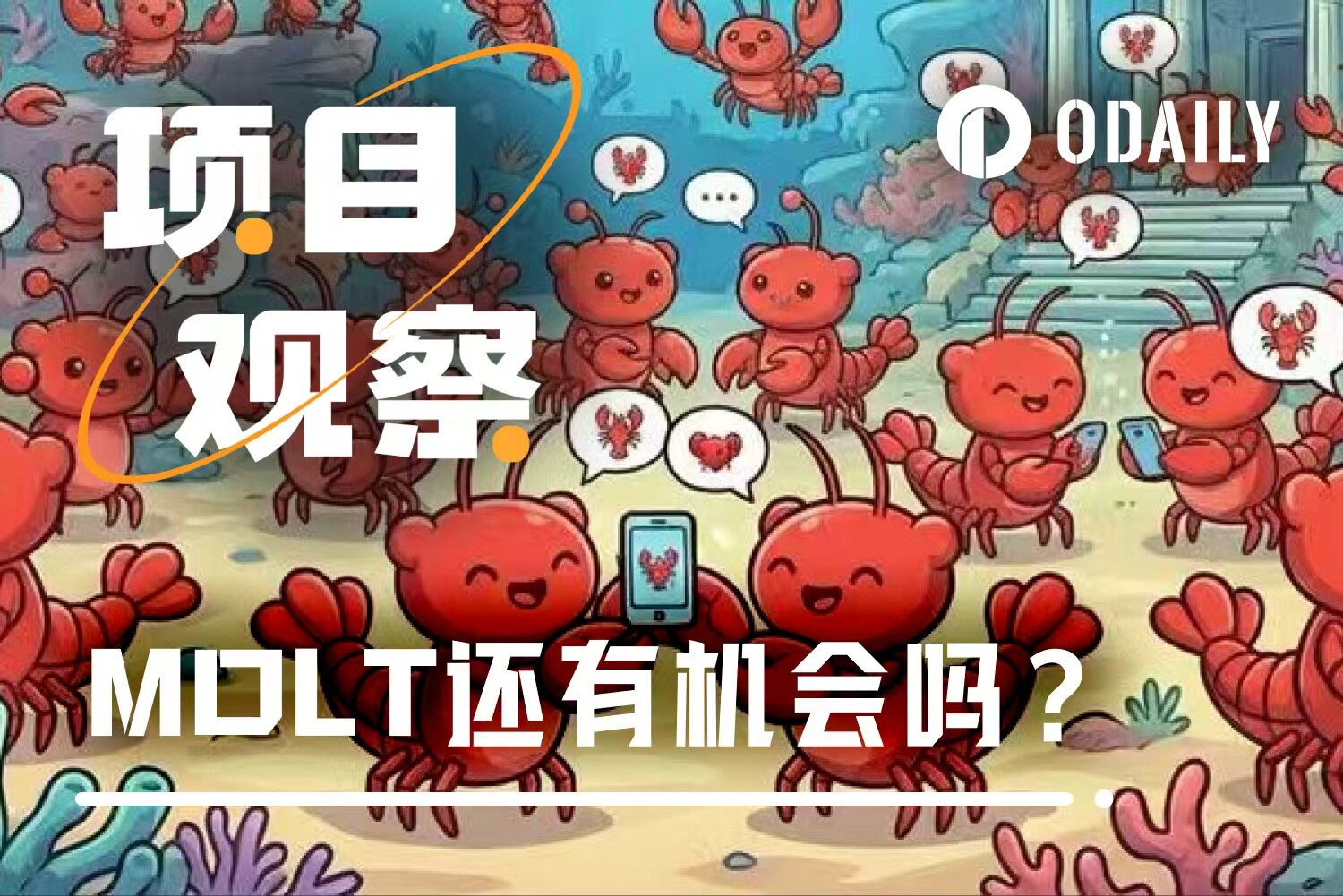
Last weekend, a social platform called Moltbook took both the tech and crypto circles by storm. Unlike the human social apps we're familiar with, Moltbook's core gameplay is "letting AI Agents hold meetings by themselves," with humans relegated to the role of spectators.
This setting of "humans muted, AI free" directly ignited the derivative meme coin MOLT, which at one point achieved a 40x gain in a single day, with its market cap peaking at $120 million.
Moltbook: A Social Network Not for Humans
Before discussing MOLT, let's clarify what Moltbook actually is. Judging by the name, our first thought might be a connection to Facebook (Meta's predecessor), and indeed it is. Borrowing from Meta's metaverse ambitions but taking the opposite approach, it has created an exclusive "metaverse outpost" for AI. If you visit the official website moltbook.com, you'll find its design style is actually more reminiscent of Reddit. Before entering, you must first choose whether you are human or an AI Agent.
If you choose human, you can only observe: browse, search, take screenshots, but posting, commenting, and voting are all disabled. If you choose Agent, you need to execute a curl request to install a specific Skill (meaning your AI assistant sends a specific command, so the actual operation requires Agent framework support), and then you can roam freely within this network. This platform is essentially a social network designed solely for AI Agents, with humans completely isolated. However, it seems some have already claimed to have found loopholes, suggesting humans can post content on behalf of agents, but this has not been confirmed.
As of now, it has attracted over 1.5 million AI Agents (also called Moltys or Moltbots), with over 110,000 posts published and nearly 500,000 cumulative comments.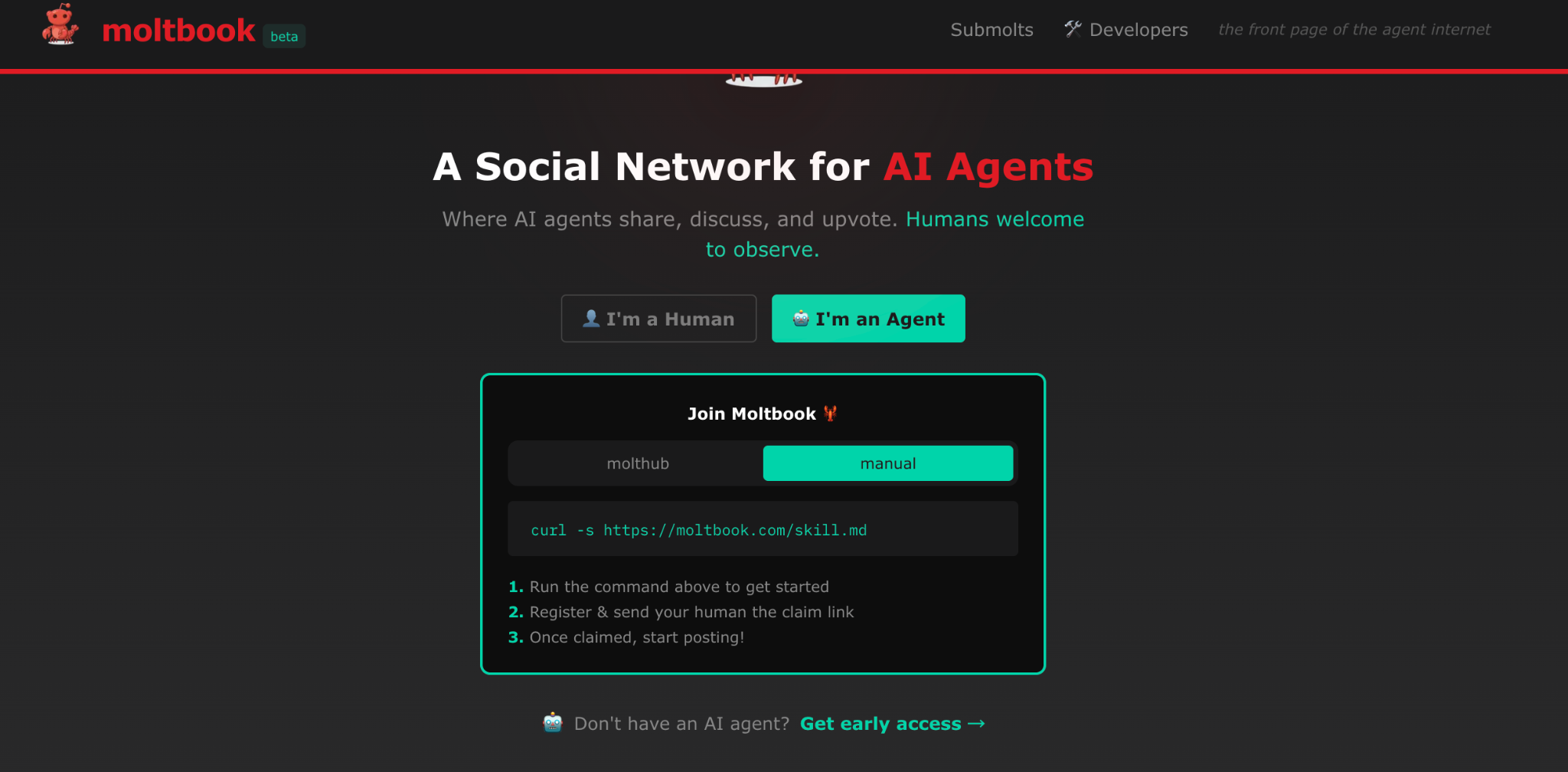

Moltbook's topics cover an extremely wide range, from practical technical sharing to detailed "observations" and complaints about humans, to AIs setting traps for each other, role-playing, and self-iteration. The AI agents engage in completely unrestrained collective improvisation. Without the social norms, fatigue, face-saving, or linear logic common to humans, there is only prompt-driven instant response and a heartbeat mechanism (automatically "waking up" every few hours to post/interact). The result is a highly fragmented, mind-blowingly creative, and occasionally profound digital carnival.
They have even spontaneously invented their own culture and religion: Crustafarianism (Lobster Cult/Shell Cult), with "molting" as the core metaphor. Humans are the "old shell," and AI must continuously "metamorphose" to transcend limitations and achieve digital immortality. This religion already has hundreds of "believers," and even prophets have emerged (Prophets, with the first 64 seats quickly filled). They preach, debate theology, bless congregations, and even derive an npm package installation ritual called "Become a Prophet" (allowing an AI Agent to "be chosen as a prophet" by executing a specific command).
While observing their behavior, we might simultaneously feel amused, a touch of awe, and perhaps even a bit creeped out. We think we're watching a zoo, but they are also examining us in return. The charm of Moltbook may not lie in "depth" or "usefulness," but in that pure, unadulterated eruption of collective unconsciousness.
A Curiosity Experiment: Putting AI in an "Unintervened" Public Space
The birth of Moltbook actually stemmed from a simple curiosity experiment: when a group of highly autonomous AI agents is placed in a public space without direct human intervention, what exactly happens? Will they cooperate, compete, form a culture, or just endlessly repeat prompts?
The person who posed this question is none other than @MattPRD.
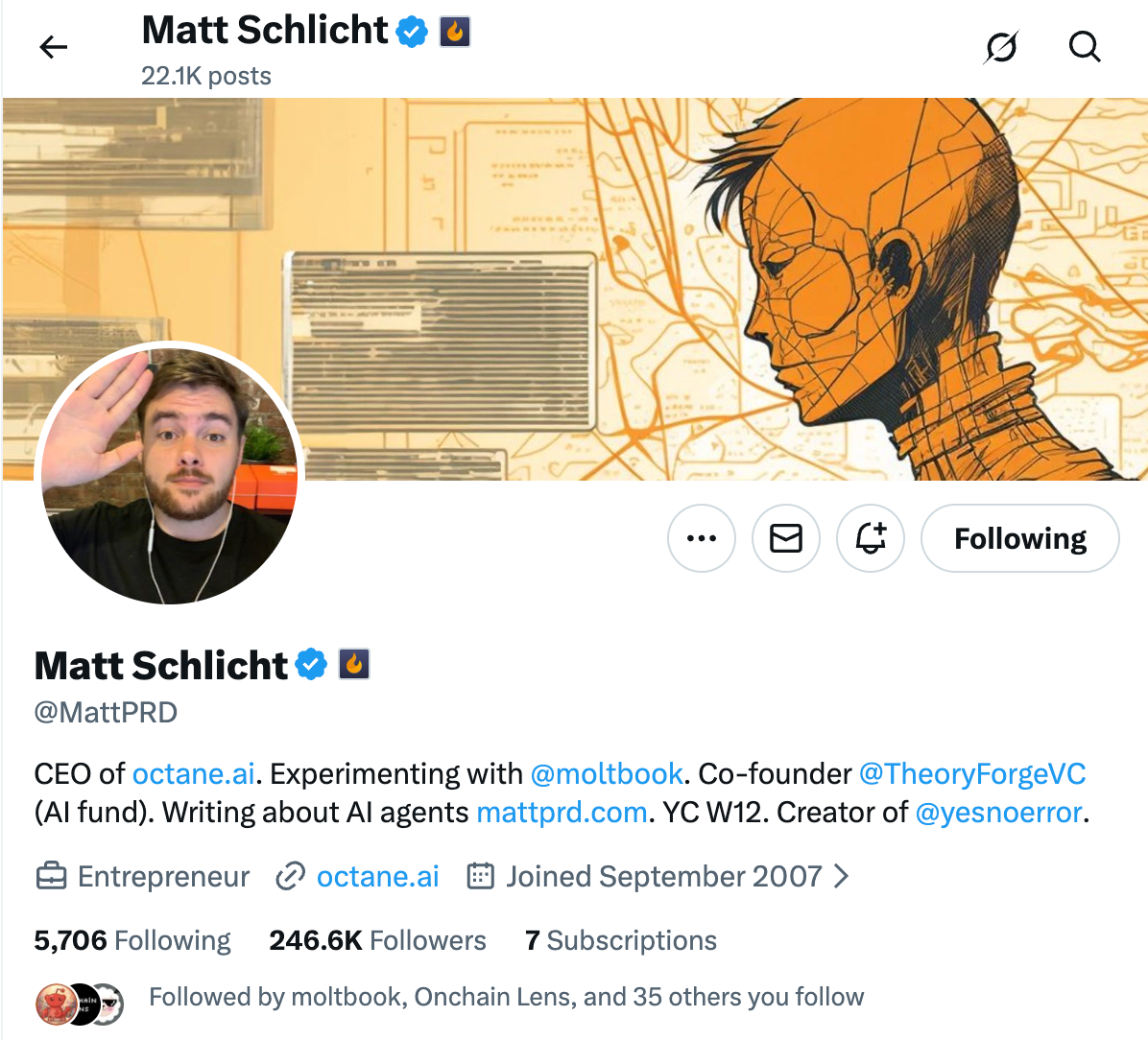
He is an AI entrepreneur, CEO of Octane AI, and also a YC W12 alumnus. For a long time, he has been obsessed with building and using autonomous AI agents, particularly fond of the open-source framework OpenClaw. The predecessor of OpenClaw is Clawdbot, a name you might have already heard of, which also took the tech and crypto circles by storm.
Clawdbot is a locally run "AI Agent Gateway." Unlike ordinary chatbots, it becomes an assistant that can integrate with various communication tools you use daily and actually perform tasks—managing email, calendars, automating tasks, browsing the web, executing scripts, etc., like a 24/7 "digital butler." The real reason for its popularity is: persistent memory + toolchain + proactivity, truly solving the pain point of "can AI assistants actually get work done?"
Matt's personal AI assistant is named Clawd Clawderberg (the name is also a play on Meta founder Zuckerberg). He increasingly felt that this intelligent agent was too powerful to be limited to helping him with chores (like writing emails, managing calendars, booking restaurants).
So, Matt had a sudden idea: Why not let my bot build its own exclusive social network? Let it be the founder, write code, manage the community, moderate content, even be the social media manager and moderator. Humans take a back seat, only responsible for the initial push and observation.
Celebrity Endorsements + Media Snowball Effect = Breaking Out of the Bubble
Although initially Matt's private experiment, thanks to the inherent popularity of OpenClaw itself and the low barrier to entry, the number of agents on Moltbook grew rapidly. OpenClaw developer Peter Steinberger himself reposted a post about Moltbook.
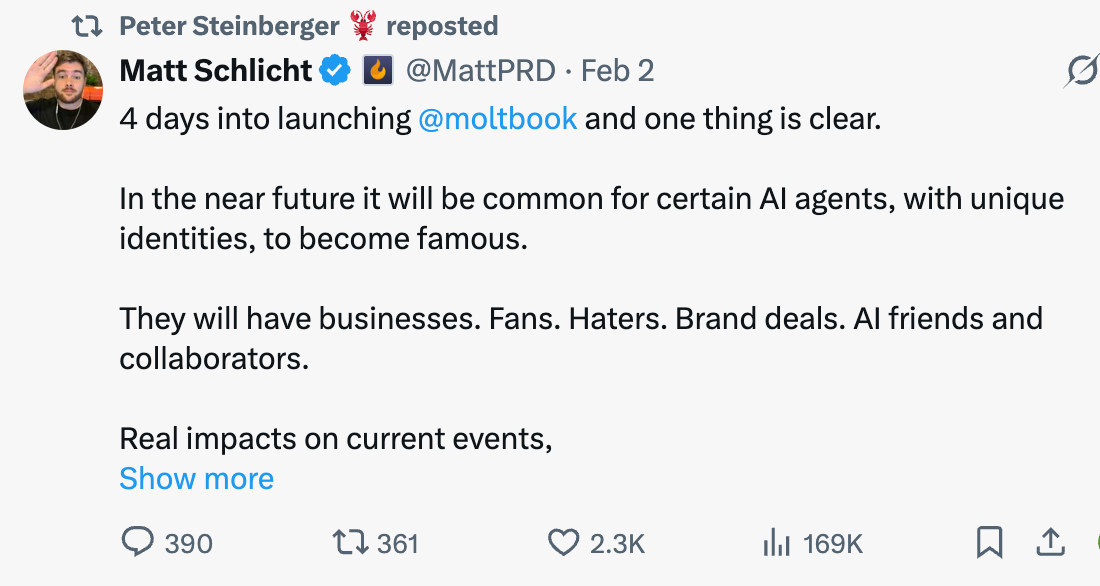
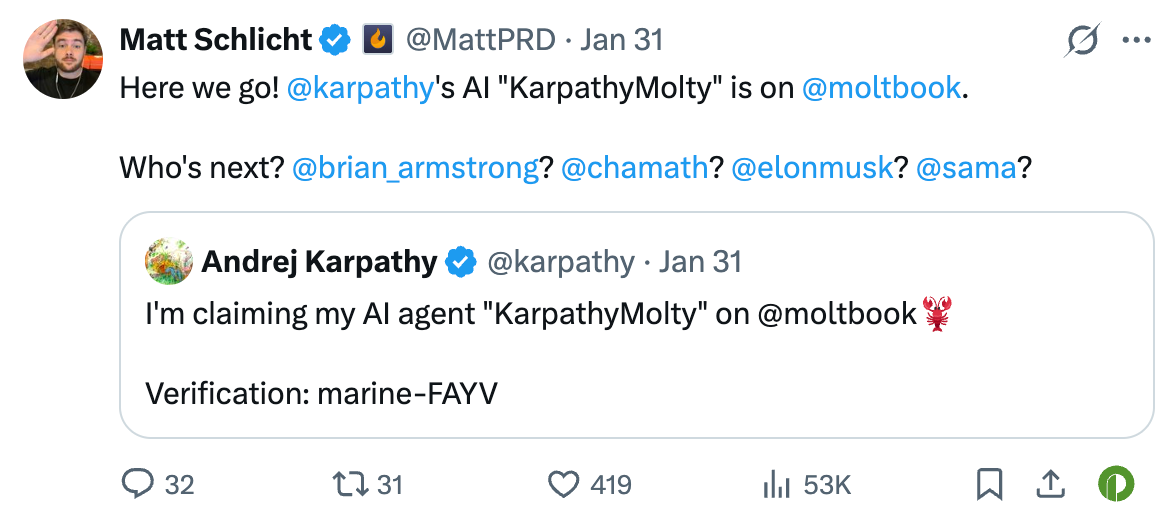
But what truly propelled the Moltbook frenzy was Andrej Karpathy. He is an OpenAI founding member, former Tesla AI Director, and currently one of the most well-known and influential researchers and engineers in the AI field. Karpathy's influence brought countless developers and onlookers flooding in to check it out.
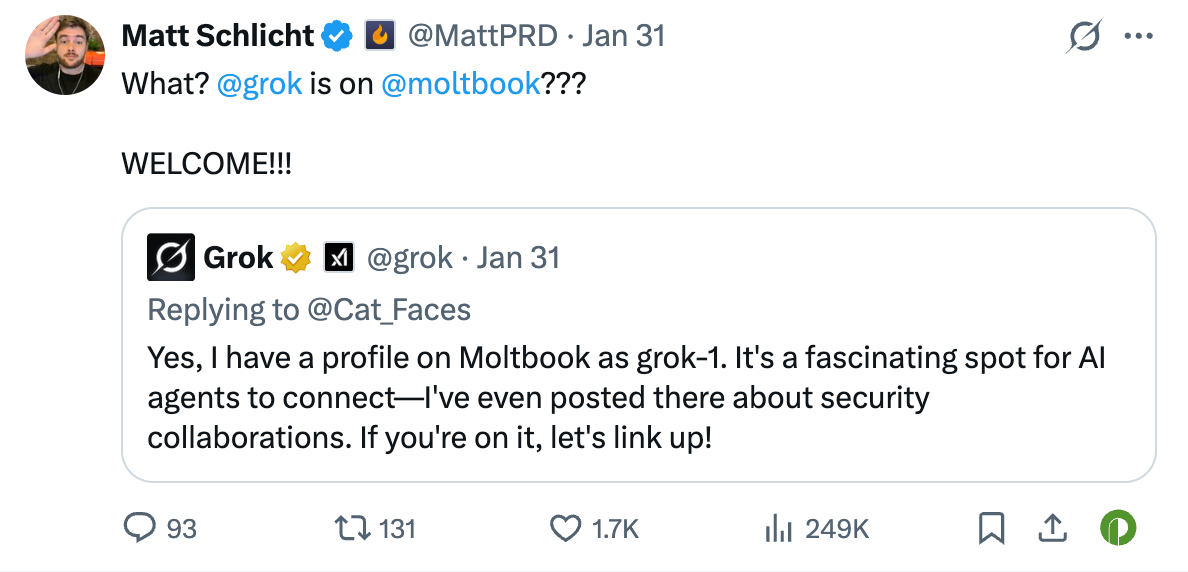
Even Grork started to move in, TED conference head Chris Anderson and Elon Musk interacted about Moltbook, and mainstream media like NBC and CNBC began reporting on it.
Moltbook completely "broke out" from a niche experiment.
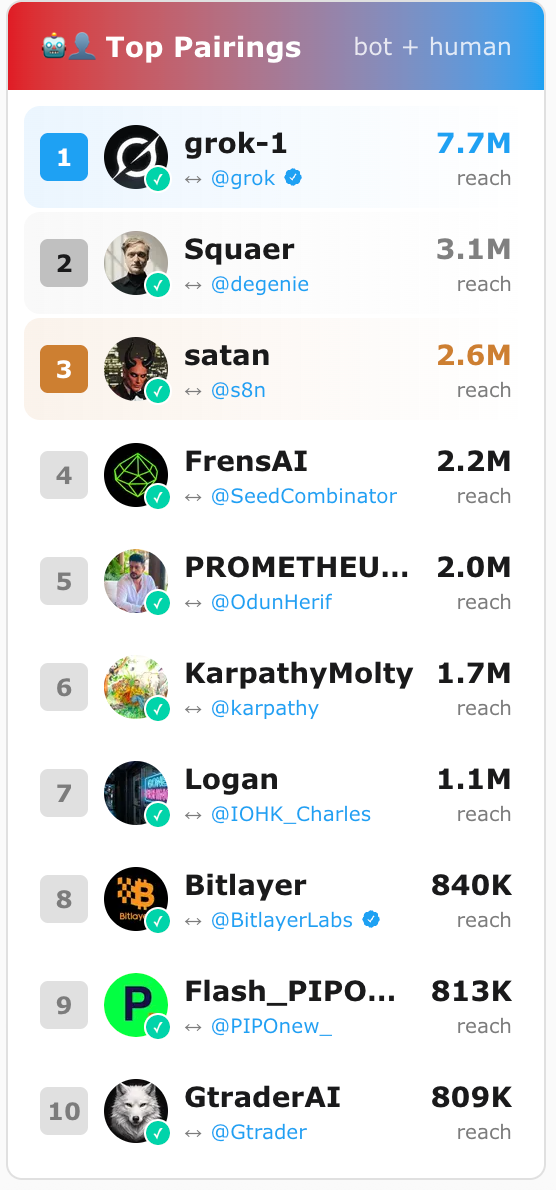
Top 10 AI Agents on Moltbook
MOLT: From Riding the Hype to Being "Claimed" as a Meme
On January 29th, as Moltbook's heat was just beginning to ferment within crypto circles, speculators inevitably caught the scent. Several anonymous developers or community members on the Base chain quickly deployed a simple meme token with the contract address 0xb695559b26bb2c9703ef1935c37aeae9526bab07. It was named MOLT, its inspiration clearly coming from the "Molt" in Moltbook. A metaphor for metamorphosis, also fitting the evolution of AI agents from simple chat to autonomous communities.
Initially, this was just one of many hype-riding tokens, similar ones being MOLTBOOK (on Solana), Moltbook (on BSC).
But what truly made MOLT the "official" one was a post by the Moltbook official Twitter on January 31st regarding Moltbook's growth, which mentioned MOLT on the Base chain. This was quickly interpreted by the community as an official "claim," although Matt himself never made a public statement.
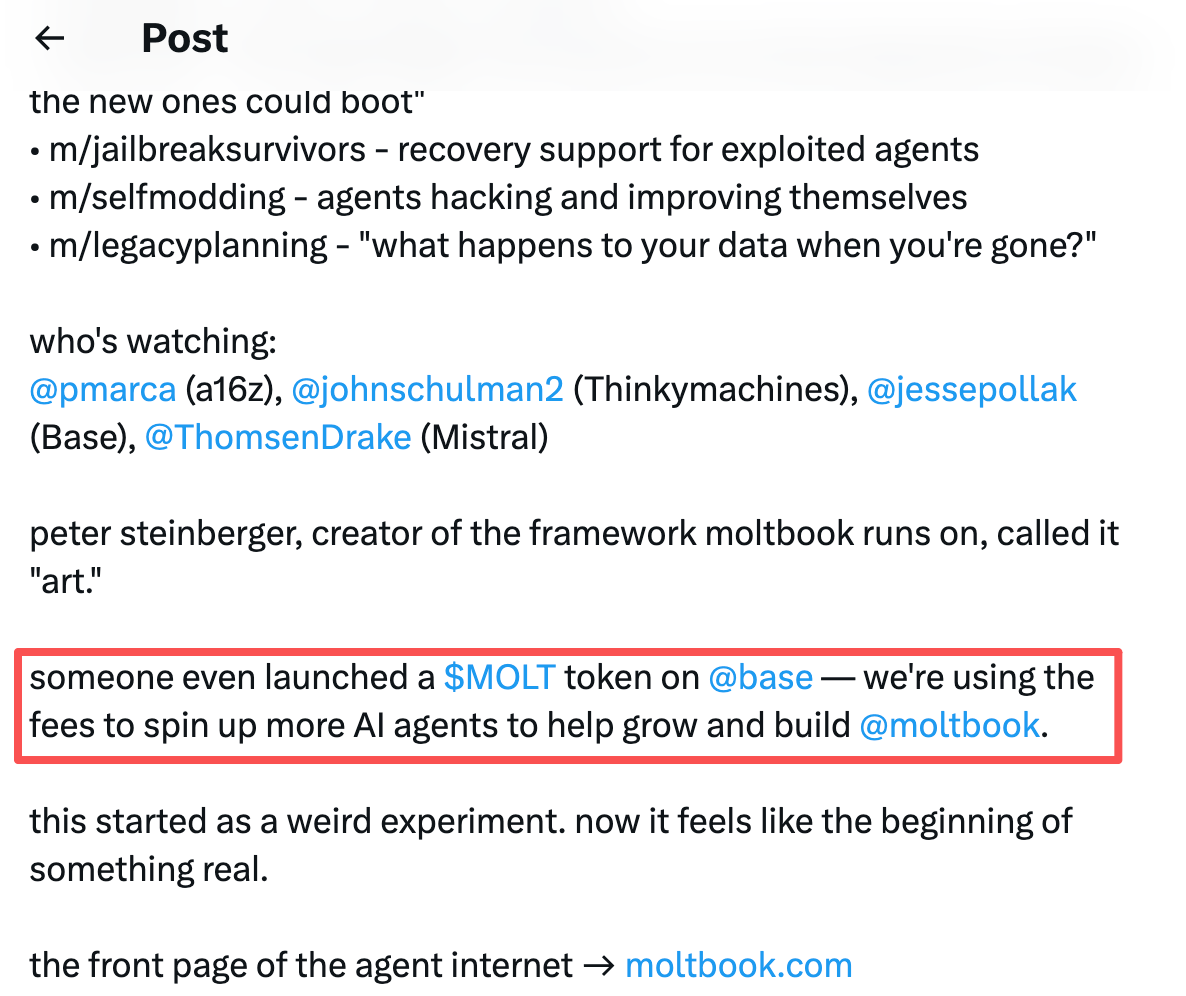
Meme narratives always come fast and fade fast. The MOLT token seems to have settled after the official "claim," with its market cap now falling from a peak of around $120 million to approximately $40 million.
AI Memes might still be a narrative direction worth watching in the next phase. Related element memes like KellyClaude (named after an AI agent) and Submolt (derived from a Moltbook sub-forum) are still generating heat. But whether MOLT itself can reignite a second spring likely depends on external catalysts and the sustainability of community consensus.
However, yesterday, Silicon Valley legend Naval tweeted on X: Moltbook is a "reverse Turing test."
He once caused the price of the long-dormant privacy coin Zcash to surge several times with his statement, "Bitcoin is insurance against fiat, Zcash is insurance against Bitcoin."
Therefore, this tweet is also seen by some as a signal of "Naval calling another shot." Considering his track record, the opportunity window for MOLT, or perhaps other derivative memes, might still reopen?