Gold Soars: Cracks in Global Governance and an Ongoing Shift in Order


- Core View: Declining trust in global governance and weakening rule constraints are driving a repricing of sovereign currency credibility, leading to the evolution of the international monetary system towards a multi-polar structure. This is profoundly altering the logic of asset allocation, with gold, the Chinese yuan, and Bitcoin representing different tiers of choices for navigating this uncertainty.
- Key Elements:
- Global governance imbalances are prompting nations to enhance strategic autonomy and prepare for uncertainty, undermining the premise that the existing international order can effectively coordinate fiscal and monetary policies.
- The dollar-centric system suffers from structural imbalances. When financial tools are weaponized and trust in governance erodes, the risks of these imbalances are being repriced by the market.
- Unlike Japan, China has retained greater policy autonomy within the system. Its industrial and trade position is shifting demand for the yuan from a settlement tool to an active strategic allocation.
- The monetary system is moving towards a multi-polar coexistence. The centrality of the US dollar may weaken, while the status of the Chinese yuan will gradually rise based on its trade network and industrial chain depth.
- The rising demand for gold is a direct response to governance uncertainty, as it does not rely on any sovereign credit, offering a de-sovereign reserve option.
- Bitcoin, as a digitally scarce asset not tied to any single governance system, represents a long-term option on the future form of money and an ultimate hedge against uncertainty.
- The core logic of asset allocation has shifted towards seeking "viability" under a new normal of persistent uncertainty, rather than simply betting on a single winner.
Over the past year, gold's performance has been particularly striking. More importantly, the demand structure has undergone a significant shift: the willingness of central banks and sovereign entities to allocate to gold has risen markedly. This can no longer be simply explained as inflation hedging or short-term safe-haven trading. A more reasonable interpretation is that gold is responding to a deeper change—a repricing of sovereign currency credibility and the effectiveness of global governance.
This change was repeatedly discussed at this year's Davos Forum. Whether in formal agendas or private discussions, phrases like "imbalance in the world governance structure," "the old order is fracturing," and "we are entering a phase from which there is no return" became almost a common context. On Tuesday, Canadian Prime Minister Mark Carney's speech at Davos clearly articulated the unease pervading the venue. He bluntly stated that the so-called "rules-based international order" is disintegrating, and humanity is moving from a once-useful, yet partly fictional narrative towards a harsher reality: great power competition is no longer constrained, economic integration is weaponized, and rules become selectively applicable in the face of power.
Carney did not simplistically blame a single country but pointed to a more widespread change in circumstances. When tariffs, financial infrastructure, supply chains, and even security commitments can be used as bargaining chips, the multilateral institutions upon which middle powers and open economies rely—whether the WTO, the UN, or other rule-based frameworks—are losing their binding force. In this environment, continuing to pretend that the rules are still functioning normally becomes a form of self-deception. Borrowing Havel's metaphor of "living within a lie," he warned nations: the real risk lies not in the order changing, but in people continuing to act according to the language and assumptions of the old order.
More notably, what Carney repeatedly emphasized was not ideological confrontation, but a shift in governance choices. When rules no longer automatically provide security, states turn to another form of rationality: enhancing strategic autonomy, diversifying dependencies, and building "pressure-resistant" capabilities. In his view, this is a typical risk management logic, not a betrayal of values. Yet it is precisely here that the foundation sustaining the old order begins to loosen—because once countries no longer believe the system can consistently provide public goods, they will start buying "insurance" for themselves.
If we abstract the Davos discussions from specific countries, a deeper common direction emerges: nations are not suddenly becoming more conservative, but are beginning to operate on the default assumption that a key premise is failing—that the existing global governance system can still coordinate fiscal, monetary, and international responsibilities over the long term. When this premise is no longer widely believed, state behavior shifts from "division of labor within rules" to "preparing for uncertainty." And this shift ultimately must be reflected in the most fundamental areas: debt, fiscal policy, and currency.
It is here that the cracks in world governance begin to penetrate financial pricing. National debt is no longer just a macroeconomic policy tool but is being reevaluated as a discount on governance capacity and political constraints; sovereign currency is no longer merely a medium of exchange but is now expected to simultaneously fulfill the functions of intertemporal commitment, international responsibility, and crisis buffer. Once markets begin to doubt whether these roles can still be performed concurrently, an erosion of currency credibility ceases to be an extreme scenario and becomes a gradual yet irreversible process.
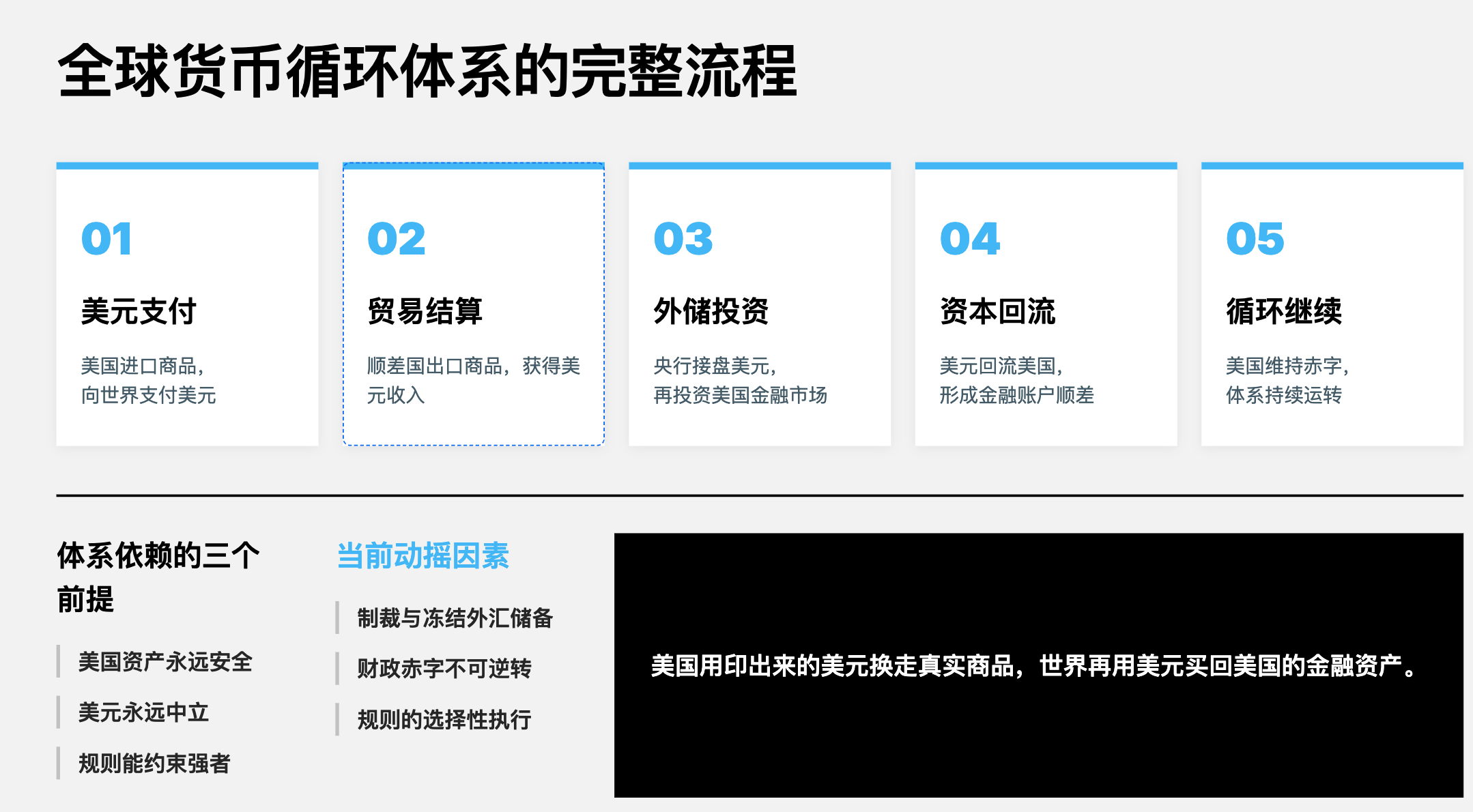
And all of this does not stem from the fiscal mistakes of any single country but is embedded within the current international monetary system. The dollar-centric system dictates that the world must have a long-term deficit center that absorbs external savings, and it also dictates that surpluses and deficits are not accidental but are roles solidified by the institutional structure. The US dollar is both America's sovereign currency and the foundation for global reserves, pricing, and safe assets. This means global demand for "risk-free dollar assets" intensifies further when uncertainty rises. To provide the world with these assets, the US can only fulfill this role through sustained external liabilities.
In an environment of financialization and free capital flows, this division of labor is continuously amplified. Surpluses are no longer primarily absorbed through adjustments in commodity prices or exchange rates but are transformed into long-term allocations to US Treasuries and dollar-denominated financial assets; deficits are no longer immediately constrained but are deferred and absorbed through the financial system and central bank interventions. As long as the world continues to believe in the irreplaceable safety of dollar assets during crises, this imbalance can persist long-term, even being seen as a source of systemic stability.
But when trust in governance declines, rule-based constraints weaken, and financial tools are frequently weaponized, this structural imbalance begins to be repriced. Surpluses and deficits are no longer just macroeconomic phenomena but become risk exposures themselves. It is against this backdrop that Japan and China, both surplus countries, have gradually moved towards different paths.
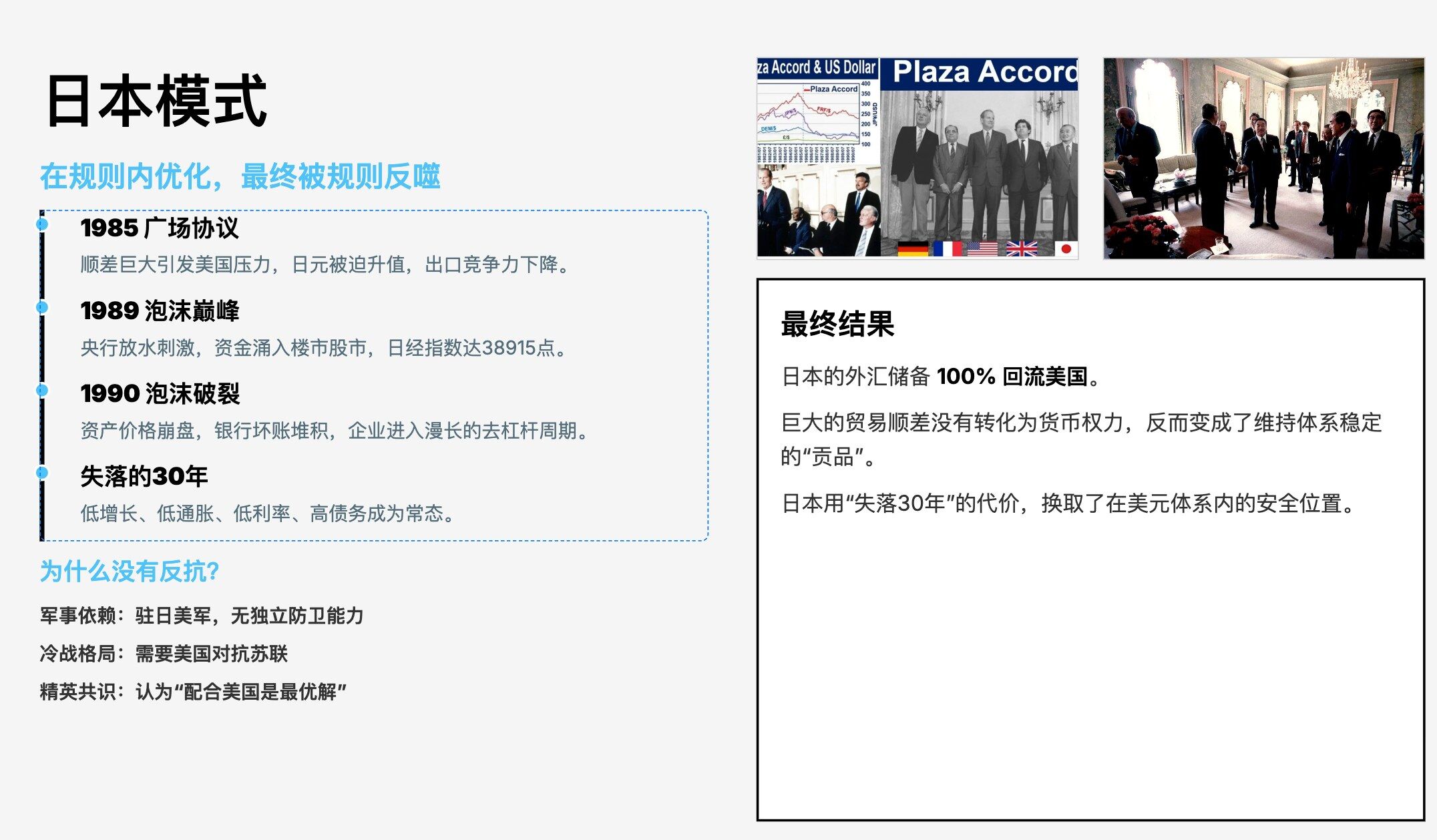
Japan has played the most typical and "cooperative" surplus country role within this system. Under external pressure and rule-based constraints, Japan chose to absorb adjustment costs through currency appreciation, financial liberalization, and long-term accommodative policies to maintain the stability of the overall order. This strategy reduced friction in the short term but transformed structural adjustment into domestic low growth, high debt, and deep central bank intervention. The surplus did not disappear; it was internalized as the cost of long-term stagnation, and Japan's currency internationalization capabilities were significantly constrained in this process.
China entered this system later, and its stage of development and internal constraints are significantly different from Japan's. Faced with surplus expansion and external pressure, China did not fully choose to clear imbalances rapidly through price and financial channels. Instead, within the framework of exchange rate management, capital account controls, and industrial upgrading, it sought to preserve policy autonomy as much as possible. This choice has kept China in long-term controversy, accused of "distorting rules" or "free-riding." However, from a governance perspective, this appears more like a strategic arrangement to buy time and space for internal transformation within the existing system, rather than simple institutional arbitrage.
More importantly, this path has not stopped at "maintaining a surplus" but is quietly changing the structure of demand for the renminbi. As China's position in global trade, manufacturing, and critical supply chains rises, the renminbi is no longer just a settlement tool but is increasingly viewed by more economies as a practical option for reducing external dependency and diversifying currency risk. Against the backdrop of intensifying geopolitical and financial sanction weaponization, singular reliance on the dollar system itself is beginning to be seen as a risk exposure. This gives demand for renminbi settlement, renminbi financing, and renminbi asset allocation a clear strategic motivation.
Once demand for the renminbi shifts from passive use to active allocation, its impact is no longer confined to the trade level but transmits to the financial level. More frequent and stable usage scenarios mean the market requires a deeper and more liquid pool of renminbi assets to accommodate this demand. Increased liquidity, in turn, affects asset pricing, gradually moving renminbi assets from "domestic policy pricing" towards "a pricing logic closer to the international margin." This process does not rely on complete capital liberalization but is driven more by genuine demand, representing a gradual yet difficult-to-reverse change.

It is precisely in this comparative context that "the East rises as the West declines" has re-emerged in recent years as a proposition worthy of serious discussion. It is no longer an emotional judgment about the rise and fall of a particular country but a reflection of changing costs associated with systemic roles. As the self-correcting capacity of the dollar system declines, the space for the deficit center to continue absorbing imbalances through debt and financial expansion is shrinking. Simultaneously, the importance of surplus economies in industrial chains, security, and regional arrangements is rising. In this process, because China did not fully replicate Japan's adjustment path, it retained industrial, policy, and currency space, giving it greater strategic flexibility in the system's restructuring.
But this change does not mean a new single hegemonic currency is forming. A more realistic picture is the monetary system moving towards a multi-center and coexisting structure. The centrality of the US dollar may be weakened but will not disappear rapidly; the role of the renminbi in trade settlement, regional finance, and liquidity provision will gradually increase. However, this does not presuppose a fully free-floating currency but relies more on trade networks, industrial chain depth, and policy credibility. Currency internationalization here is no longer an institutional label but an outcome born of usage.
In such a system evolution, the logic of reserve assets also changes accordingly. Gold's return to a core position is not because it can provide yield, but because it does not depend on any single country's tax base, political stability, or international commitments. It is a direct response to governance uncertainty. It provides nations with a de-sovereign, de-credit reserve option, particularly suited to functioning in an environment of insufficient consensus and weakened rule-based constraints.
Bitcoin represents another tier of de-sovereign asset. Although its performance over the past year and a half has lagged behind gold and some traditional assets, its core logic has not been disproven. As a digital, scarce asset not attached to any single governance system, it resembles more of a long-term option on future monetary forms. As monetary system restructuring becomes more explicit and liquidity is reallocated, its pricing logic is more likely to catch up in later stages rather than lead in the early phases.
If we finally gather these threads, we find that what this as-yet-unnamed order migration truly changes is not short-term power dynamics, but the preconditions for asset validity. When rules no longer automatically provide safety, when currency credibility itself becomes a risk that needs hedging, the core question of asset allocation is no longer betting on who wins, but how to remain valid in a world where uncertainty is the norm.
Against this backdrop, gold is a defensive response. More directional choices are embodied in the renminbi and Bitcoin. The renminbi represents the real liquidity embedded in a new order, a bet on monetary restructuring driven by trade, industry, and genuine demand. Bitcoin represents the ultimate hedge against governance uncertainty, a long-term option detached from any single sovereign system. Choosing them is not a statement of position but, under the premise that the cracks in world governance have become explicit, a result of asset allocation that strives for internal coherence.
History does not announce itself with spectacular events. Often, it is only when looking back at a certain moment that people realize the order has already shifted, imperceptibly.