






Intel's "Life-or-Death" Moment: At the ICU Doorstep, How is Pat Gelsinger Liquidating the Legacy and Initiating Self-Rescue?


- Core Viewpoint: Intel's Q4 2025 financial report shows the company has achieved a stop-loss through strategic contraction and cost control, but revenue growth and profitability remain weak; the company's future survival hinges on its ability to successfully mass-produce and commercialize its critical 18A process technology within the next 12-18 months.
- Key Elements:
- Strategic Pivot and Financial Stop-Loss: New CEO Pat Gelsinger adopted a "stop loss - contract - protect core" strategy, reducing costs and improving efficiency through layoffs and pausing overseas fab projects, turning the company's quarterly profit positive and temporarily halting the state of continuous bleeding.
- Insufficient Growth Momentum: Amid the industry's AI boom, Intel's Q4 revenue still declined year-over-year. The improvement in profitability primarily stemmed from cost-cutting rather than organic growth, with gross margins (around 38%) significantly lower than historical levels and key competitors.
- Temporary Alleviation of Cash Flow Crisis: Through asset sales, government subsidies, and strategic investments from Nvidia, the company's cash reserves increased to approximately $37.4 billion, buying a crucial time window for the R&D and mass production of the 18A process.
- Betting on the 18A Process for a Comeback: The 18A process (utilizing RibbonFET and PowerVia technologies) is the core of Intel's return to technological competitiveness. It has secured anchor customers like Microsoft and Amazon. The improvement in its yield and the 2026 window for energy efficiency leadership are seen as the final opportunity.
- Heightened Geopolitical Value: Nvidia's $5 billion investment is viewed as a strategic endorsement of Intel's role as a domestic US advanced manufacturing "alternative system," enhancing its systemic value in supply chain security beyond short-term financial performance.
2025 is a true make-or-break year for Intel.
Compared to Nvidia, which is dancing at the center of the AI stage, Intel (INTC.M) seems more like it has one foot lingering at the ICU door. With the "technology evangelist" Pat Gelsinger stepping down at the end of last year, the new captain, Lip-Bu Tan, has officially taken over this old, heavily burdened machine.
The latest Q4 earnings report once again raises a familiar question: Has this century-old chip giant reached its end?
If you only look at the stock price performance after the earnings release, the answer might be disheartening. But if you extend the timeline, what Intel is experiencing might not be a final flicker of life, but a critical moment of pulling the oxygen tube in the ICU and attempting to breathe on its own.
Objectively speaking, this Q4 report is not only Lip-Bu Tan's first complete report card since taking office but also a comprehensive reckoning of the Gelsinger era's legacy.
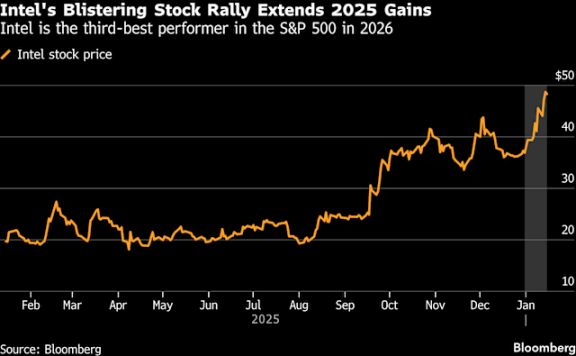
Intel's 2025 Stock Price Change, Source: CNBC / Intel Newsroom
1. Leadership Change: From Gelsinger's "Technological Utopia" to Tan's "Capital Battleground"
"Survival is the primary need of civilization." Before understanding this earnings report, one must first see the narrative shift Intel is undergoing.
When Pat Gelsinger returned to Intel, he painted a nearly idealistic blueprint: to regain process leadership and rebuild U.S. domestic semiconductor manufacturing capability through an aggressive "5 nodes in 5 years" plan. The underlying logic was simple—if technology leads, capital will follow.
Thus, massive factory construction spread globally: Ohio in the U.S., Germany and Poland in Europe, with capital expenditures rapidly expanding.
But reality soon struck back. The AI wave swept in, yet the one truly taking center stage was Nvidia (NVDA.M). In the data center domain, Intel's CPUs were no longer the main act, even once mocked as "accessories" for GPUs. Meanwhile, massive capital expenditures devoured cash flow, and the stock price continued to decline, gradually trapping Intel in a dilemma of "technologically correct, financially bleeding."
So it can be said that Gelsinger's departure marks the end of Intel's era of "pursuing technological supremacy at all costs." The arrival of Lip-Bu Tan represents a completely different survival logic. As the former CEO of Cadence and a venture capital heavyweight, he is deeply versed in venture capital and particularly skilled in "balance sheet magic." Therefore, his logic upon taking office is brutally clear: "Stop the bleeding, then go all-in on the core."
- Surgical Layoffs: Global workforce reduction of 15%, cutting bloated middle layers.
- Strategic Contraction: Pausing expensive overseas factories in Germany and Poland to recoup funds.
- Strategic Focus: All resources funneled to only two targets—Arizona Fab 52 and the 18A process.
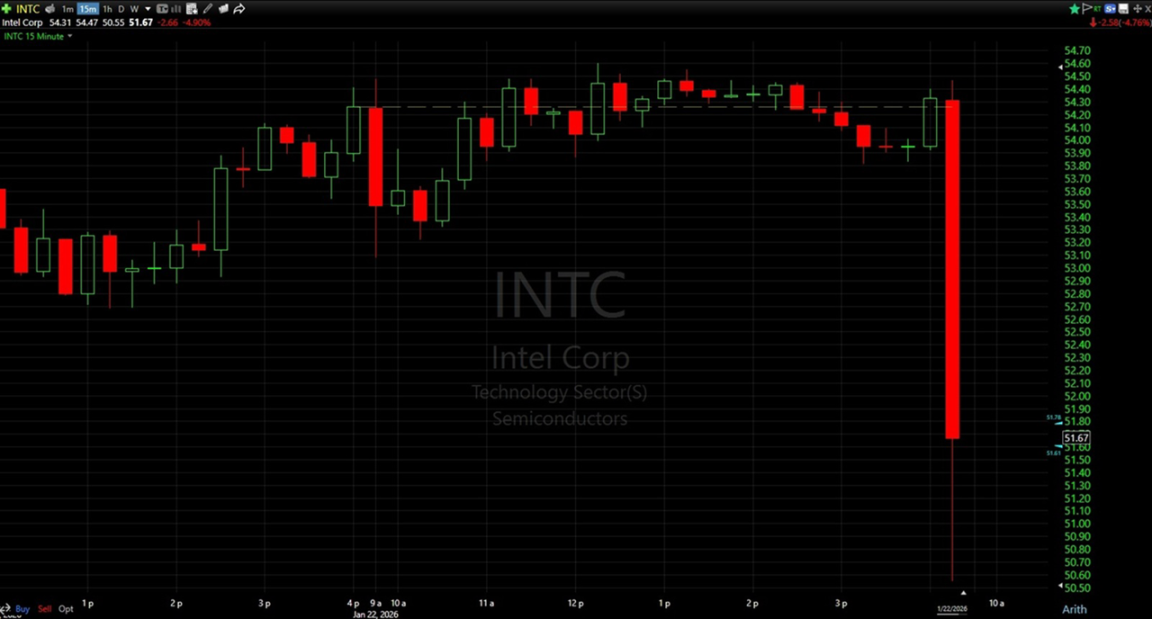
INTC Stock Price Trend from 2025 Q4 to 2026 Q1 (Source: Yahoo Finance / TradingView)
This is a classic "stop-loss—contract—protect the core" strategy. For Lip-Bu Tan, survival is more important than storytelling.
2. Dissecting the Earnings: How Much Substance is in This "Beat"?
Returning to the data itself, Intel's Q4 report is not without merit.
On the surface, profits did exceed market expectations. EPS returned to positive territory. The $0.15 profit, though accompanied by the cost of layoffs, did indeed pull the income statement back from the cliff's edge, proving that large-scale cost-cutting and efficiency improvements have begun to repair the P&L. Intel has at least temporarily moved out of the danger zone of "continuous bleeding."
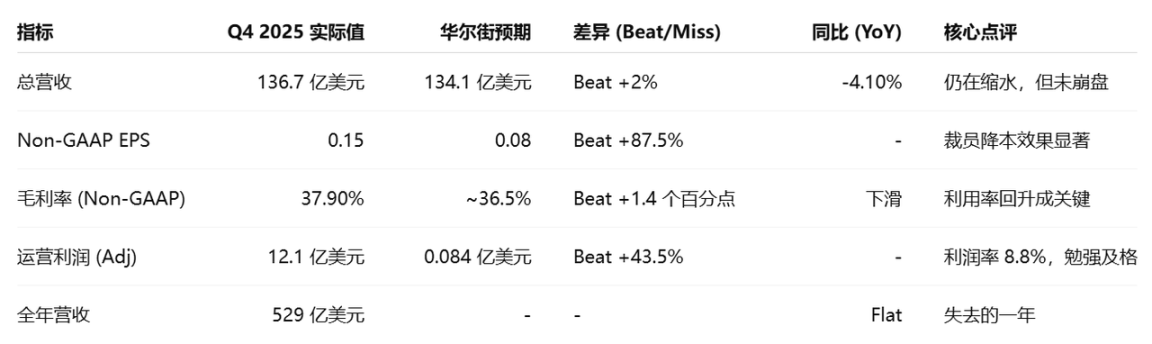
AI-Assisted Generated Table
But digging deeper reveals that problems persist.
First, revenue still declined year-over-year. Against the backdrop of the 2025 AI boom broadly lifting the semiconductor industry, with AMD and Nvidia's data center businesses growing rapidly, Intel's overall revenue is still contracting. This means the profit improvement this quarter stems more from "saved profits" rather than "earned growth."
Second, while gross margin recovered to about 38%, this level remains in an extremely low range in Intel's history. A decade ago, the company's gross margin consistently hovered around 60%. Even in recent years, it was mostly around 50%. In comparison, TSMC's (TSM.M) gross margin remains above 50%, and Nvidia's is as high as over 70%.
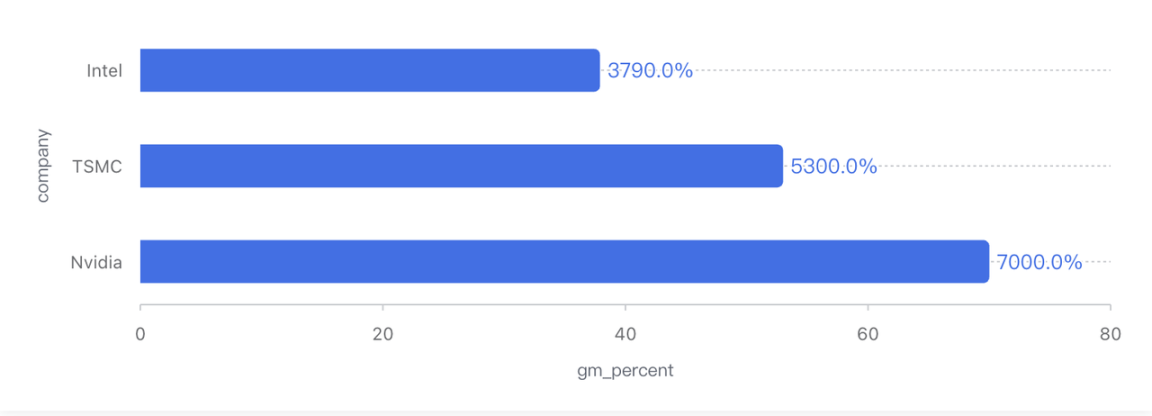
Comparison of Semiconductor Giants' Gross Margins (Data based on Q4 2025 Non-GAAP)
Ultimately, the main reason for this gross margin improvement is not the return of product pricing power, but the dilution of fixed depreciation costs due to increased capacity utilization. Especially in the server CPU market, Intel still needs to compete head-on with AMD through pricing strategies; pricing power has not truly returned to its hands.
In other words, this is an earnings report of "successful hemostasis, but not yet recovery." It's like an "outperformance" after the passing grade was significantly lowered, not fundamentally changing the failing status quo.
However, it's worth noting that the market's biggest concern was Intel's cash flow situation. From this dimension, the situation has indeed eased: As of Q4, Intel held approximately $37.4 billion in cash and short-term investments; it repaid some debt during the quarter; and full-year operating cash flow was about $9.7 billion.
Meanwhile, the company has bought itself a precious time window by selling part of its Mobileye stake, bringing in external capital for Altera, and receiving U.S. CHIPS Act subsidies. Furthermore, Nvidia's $5 billion strategic investment in Intel also sends an important signal at the capital level.
Overall, Intel's cash flow crisis has been temporarily resolved, at least enough to support it through the most cash-burning phase before the 18A process reaches mass production.
But caution is needed: this is not "financial safety," but more like "buying time to stay alive."
3. 18A and Panther Lake: The Last Window for a Comeback?
From a business structure perspective, Intel's current state is highly fragmented.
The Client PC business remains the company's cash cow. The PC industry's inventory cycle has largely cleared, and OEMs have begun restocking, providing Intel with a relatively stable cash source. However, constrained by product structure and foundry costs, this segment cannot significantly expand its profit margin in the short term.
The Data Center and AI business, after consecutive declines, showed about 9% year-over-year growth in Q4. This rebound primarily came from the regained competitiveness of the Xeon 6 platform and cloud providers replenishing CPU resources after GPU investments. But from a long-term trend perspective, Intel's market share in data centers has significantly dropped from its 2021 highs. The current situation is more about "stopping the decline" rather than a true reversal.
The real pressure point remains the Foundry business. This segment posted a quarterly loss of several billion dollars, mainly due to high depreciation from advanced process equipment, the ramp-up costs of the 18A process, and the lack of external customer revenue.
It can be said that before 18A reaches mass production scale, the Foundry business is more like a continuously bleeding wound. However, optimistically, if the earnings report represents the past, then the 18A process will undoubtedly determine the future, and it's even more crucial for the strategic position of the U.S. semiconductor industry.
To put it bluntly, 18A is not just a process node; it is Intel's only ticket back to the throne.
From a technical path perspective, 18A is not a castle in the air. Its adoption of the RibbonFET (GAA) architecture allows Intel to catch up with the industry mainstream in transistor structure. The PowerVia backside power delivery technology gives it a temporary lead in power efficiency and wiring density. More importantly, 18A will be applied on a large scale for the first time to the consumer-grade Panther Lake platform.
Official data shows significant improvements in performance, gaming performance, and battery life, especially the battery life metrics, meaning x86 laptops are, for the first time, challenging the Apple Silicon camp head-on in terms of user experience.
Meanwhile, Microsoft (MSFT.M) and Amazon (AMZN.M) have become anchor customers for 18A. Nvidia's strategic investment is also seen by the market as a "geopolitical insurance-style endorsement" of Intel's manufacturing capabilities. Additionally, it is reported that 18A's yield is improving at a rate of 7% per month, entering a predictable trajectory.
In contrast, TSMC's similar technology is expected to be applied in its A16 process by the end of 2026. This means in 2026, Intel's 18A will hold a globally leading position in power delivery technology, making it highly attractive to power-efficiency-sensitive customers (such as Apple, Qualcomm, and AI inference chip manufacturers).
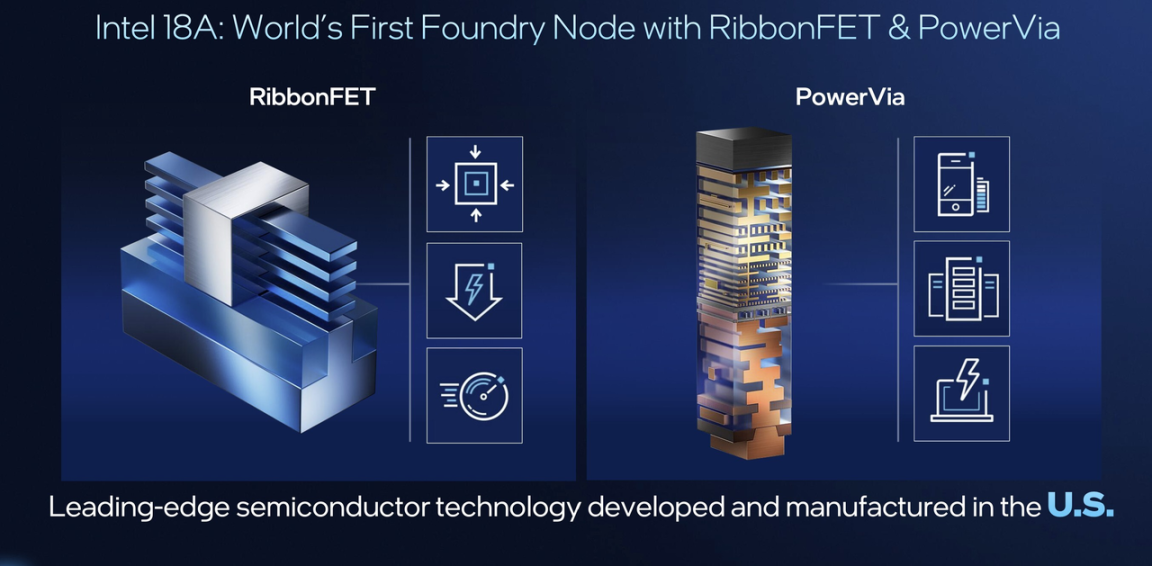
Panther Lake Chip Architecture and 18A Overview (Source: Intel Tech Tour)
CEO Lip-Bu Tan also stated on the earnings call: "Foundry losses peaked in 2024 and will begin to narrow in 2025." If this goal is achieved, as losses narrow, Intel's overall profits are expected to see explosive growth.
These may not signify victory, but at least they indicate that Intel has not been completely abandoned.
4. Q1 Guidance Scares the Market? Understanding the Game Beyond Fundamentals
On the surface, Intel's sharp decline after the earnings release was almost a "textbook" market reaction.
The main reason was the extremely conservative Q1 2026 guidance. The revenue range was below consensus expectations, and Non-GAAP EPS was even projected at $0. For short-term capital, this is a blatant signal—"don't expect profit improvement next quarter." In a market accustomed to the "AI high-growth narrative," such guidance naturally triggers selling.
But interpreting this solely as a fundamental deterioration might miss a more important layer. A more reasonable explanation is that this is a typical new CEO's "Kitchen Sink" strategy: A new CEO often employs a "Kitchen Sink" (or "big bath") approach, thoroughly releasing negative news and lowering expectations to set the stage for future positive surprises.

AI-Assisted Generated Table
From this perspective, the Q1 guidance appears more like strategic conservatism rather than a signal of operational loss of control. What's truly noteworthy is the geopolitical undercurrent gradually emerging beneath the surface of the earnings report.
From an industry perspective, the competitive environment Intel faces now is almost hellish difficulty:
- AMD (AMD.M): The Zen 6 architecture is imminent, and it still enjoys priority access to TSMC's most advanced processes. Its product cadence is stable, and its roadmap is clear.
- NVIDIA: Blackwell remains supply-constrained, continuously absorbing global data center capital expenditures.
- ARM / Qualcomm: Continuously eroding x86 territory in the PC space. Apple's M-series and Qualcomm's X Elite remain a sword hanging overhead.
In such a landscape, it's almost impossible for Intel to defeat all competitors head-on through "commercial competition" in the short term. This dictates a reality: Intel's valuation logic is quietly shifting from an earnings-driven narrative to "systemic value."
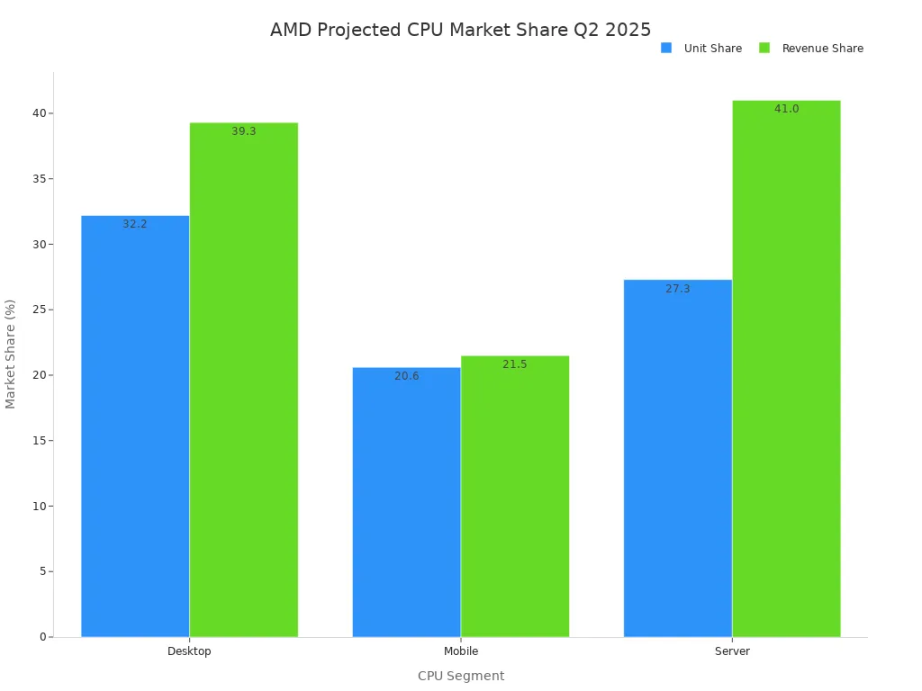
AMD vs Intel CPU Market Share Forecast (Q2 2025)
And this is key to understanding Nvidia's $5 billion investment.
On the surface, Nvidia investing $5 billion in Intel seems counterintuitive. One is the absolute king of global AI chips, the other is still bleeding from its foundry business. But stepping back from the earnings and viewing it from a supply chain security perspective makes the deal seem exceptionally rational:
Investing in Intel and supporting its Foundry business, especially advanced packaging and U.S. domestic capacity, is essentially buying a long-term "geopolitical insurance policy" for itself. This isn't about immediately shifting orders away from TSMC, but preparing an alternative system that can be activated.
And this is precisely the scenario the White House would love to see—two U.S. semiconductor giants forming a sort of "symbiotic structure," reducing the industry's reliance on a single overseas point.
This also means that even in the fiercest commercial competition, Intel is still seen as an infrastructure node that cannot be allowed to fall.
In Conclusion
Overall, this earnings report is neither a signal of full recovery nor a final verdict.
What Intel has truly accomplished is no longer telling grand technological utopian narratives, but returning to a more realistic, harsher path: compressing scale, preserving cash, and betting on a single core variable.
Here, 18A and Panther Lake are Intel's "qualifying round"—win, and it still has the possibility of repricing; lose, and this century-old giant will be permanently marginalized as a supporting player in the industry.
Ultimately, Intel is no longer the "rich family's foolish son" that could casually squander capital. It is now a capital-intensive enterprise at the ICU door, forced to count every penny.
Whether it can truly walk out of the ward is not answered in this earnings report, but in its execution over the next 12–18 months.


