






2026 Crypto Market Fate Trio: The Liquidity Game of Rate Cuts, Rate Hikes, and Elections


- Core View: The trajectory of the crypto market in 2026 will be influenced by global liquidity and political events.
- Key Factors:
- Expectations of Fed rate cuts and the resumption of bond purchases, increasing market liquidity.
- Japanese rate hikes may trigger the unwinding of carry trades, but the impact could be hedged.
- The outcome of the US midterm elections will directly impact the policy environment for the crypto industry.
- Market Impact: Opportunities may exist in the first half of the year, with uncertainty increasing in the second half.
- Timeliness Note: Medium-term impact.
2025 has come to an end, a year in financial markets that could be described as a mixed bag of fortunes.
Thanks to the Federal Reserve's interest rate cuts and a significant surge in AI investment enthusiasm, global stock markets achieved their largest annual gain in nearly six years. Gold, silver, and platinum repeatedly hit record highs, delivering a stellar report card for traditional assets.
However, the crypto market became the biggest loser in this feast. Bitcoin's closing price in 2025 was lower than its price at the beginning of the year, marking the first time in history that it recorded an annual decline in the year following a halving. Bitcoin, once hailed as "digital gold," fell behind in this round of broad asset appreciation.
Market disagreements over Bitcoin's long-term cycle structure continue to widen. Some argue that the halving narrative has failed and the four-year cycle is broken; others believe this is merely a temporary adjustment, with the real bull market still ahead.
As 2026 has just begun, while wishing everyone a Happy New Year, the Odaily editorial team also wants to discuss several important monetary policy and political events for 2026 and explore their potential impact on the crypto industry.
Markets Bet on Three Fed Rate Cuts
After the Fed's final meeting of the year, the released interest rate projections were quite conservative, suggesting only one potential rate cut in 2026, amounting to 25 basis points.
However, most institutions and economists are less pessimistic. Due to political pressure from the midterm elections and changes in the Fed's personnel landscape, they believe the Fed's rate cuts in 2026 may exceed market expectations, with 2 to 3 cuts being more appropriate.
Major institutions like Goldman Sachs, Morgan Stanley, and Bank of America are essentially betting on 2 cuts, which would bring the rate from the current 3.50%-3.75% down to around 3%-3.25%. Citigroup and China Galaxy Securities are bolder, predicting 3 cuts totaling 75 basis points.
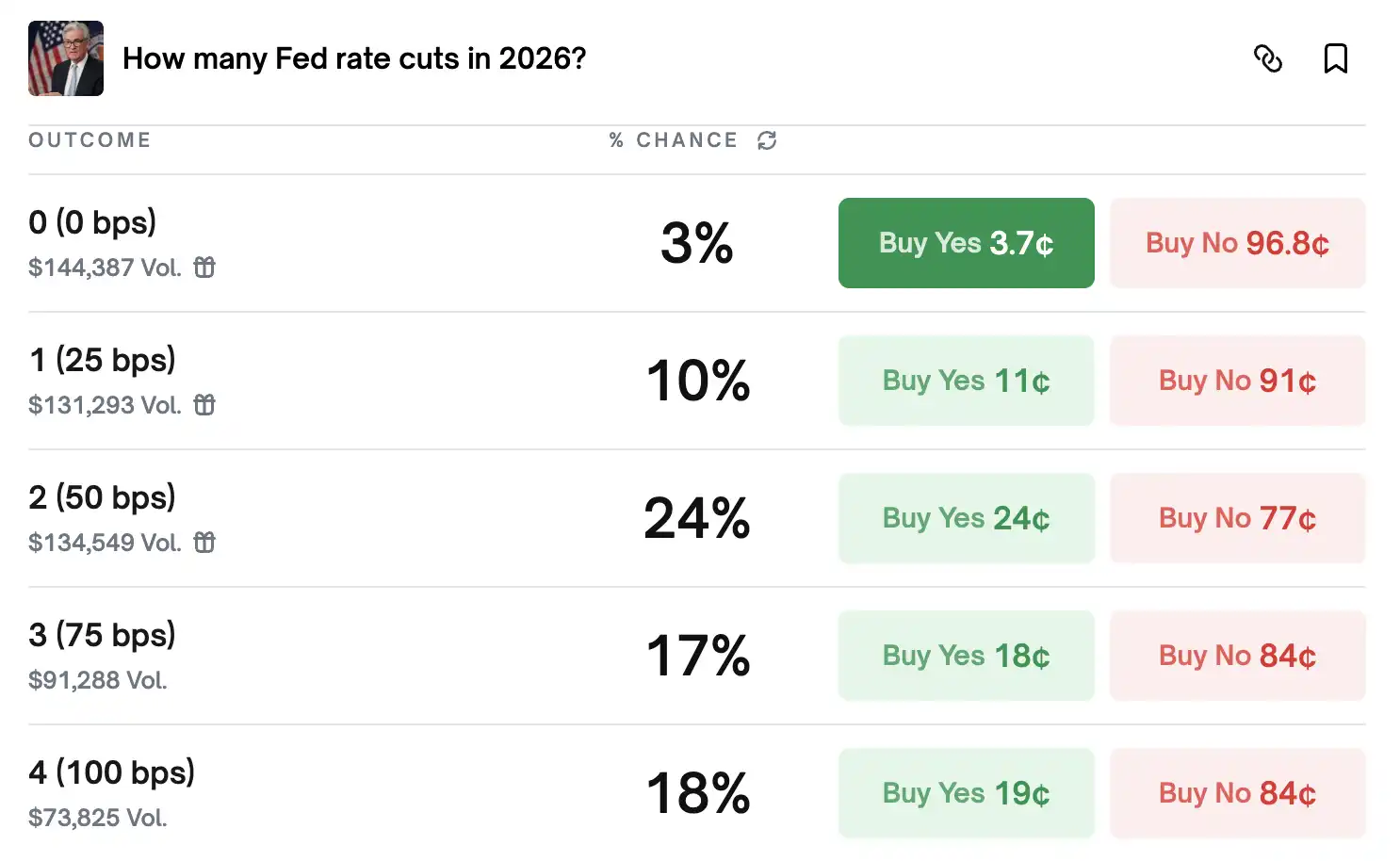 Currently, the highest probability on Polymarket for the number of rate cuts in 2026 is 2.
There is also considerable analysis regarding the specific months for these cuts.
For those in power, lower interest rates help stimulate the economy, thereby boosting election prospects. Therefore, to demonstrate policy effectiveness before the midterm elections on November 26, 2026, the Trump administration needs the Fed to implement significant rate cuts before then. Considering the lag in monetary policy transmission to the real economy, cuts need to be completed before October 28, 2026, making the December FOMC meeting too late for the elections.
Consequently, major institutions' predictions for the timing of 2026 rate cuts are mostly in the first half of the year.
For example, Nomura predicts specific months in June and September; Goldman Sachs suggests March and June; Citigroup and Rabobank forecast January, March, and September.
Currently, a June cut appears to be a broader consensus. The new Fed Chair is scheduled to preside over their first FOMC meeting on June 17-18, 2026. Institutions are betting it's highly likely a rate cut will be announced at that meeting, as the new Chair may need to demonstrate loyalty to the White House.
The Fed Resumes "Buying Spree"
After discussing rate cuts, we must also talk about another important action the Fed took at its final 2025 meeting: restarting Treasury purchases through a "Reserve Management Purchases" (RMP) mechanism.
Starting December 12, 2025, the New York Fed will buy approximately $40 billion in short-term Treasury bills each month. Officially, this is described as a "technical operation," not monetary policy, aimed solely at maintaining "ample reserves" in the banking system and preparing for the tax season in April next year, when funds flow from banks to the Treasury.
The Fed's balance sheet is currently around $6.54 trillion. If it buys $40 billion monthly until April, it would add roughly $160 billion in assets.
Besides the Fed buying Treasuries, another data point worth watching is the Treasury General Account (TGA), essentially the government's checking account at the Fed.
During the last U.S. government shutdown, the TGA balance reached a high of $959 billion, with a large amount of cash accumulating in the Treasury account.
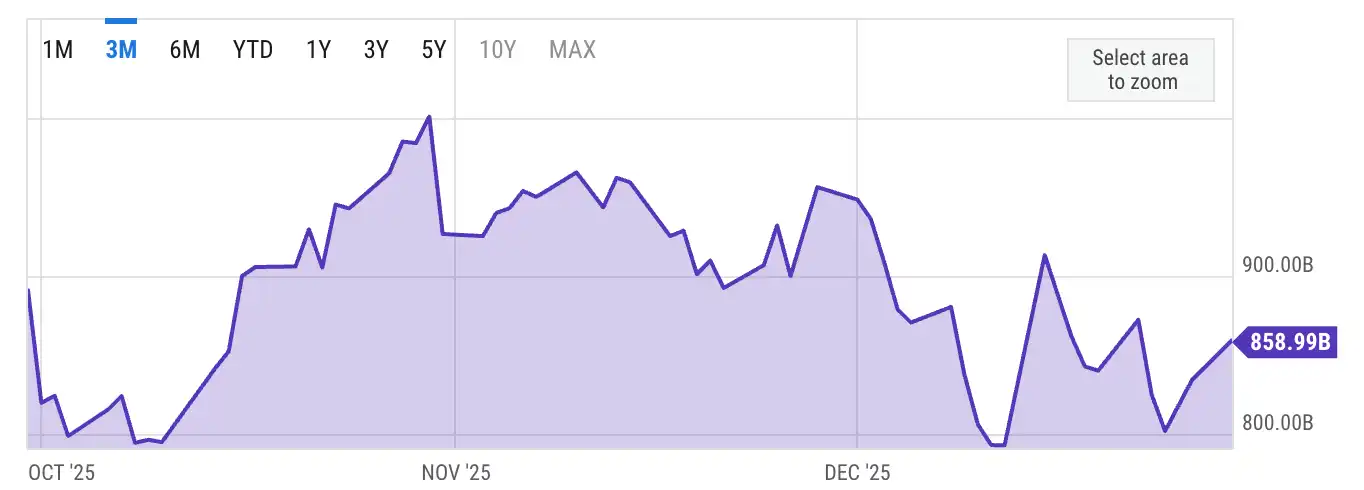
Changes in TGA Balance
It has been about a month and a half since the U.S. government reopened. The current TGA balance is approximately $850 billion, meaning about $100 billion in spending has been released, providing significant liquidity to the market.
For the cryptocurrency market, what matters is whether overall liquidity is increasing or decreasing.
Optimistically speaking, the combination of RMP purchases, a significant TGA drawdown, and the potential distribution of some form of tariff dividend by the end of 2026 could give global liquidity a major boost, thereby aiding the crypto market's rise.
Why is Japan Insistent on Raising Rates?
After discussing the Fed, let's shift our perspective across the Pacific to Japan.
The minutes from the Bank of Japan's (BOJ) December meeting show policymakers are discussing the necessity of continuing rate hikes, with some members even calling for "timely" action to control inflation. A Bloomberg survey indicates economists believe the BOJ is likely to raise rates again in about six months, with most expecting this hiking cycle to ultimately stop at 1.25%. Former BOJ executive Hideo Hayakawa even suggested rates could rise to 1.50% by early 2027.
While global markets are cutting rates, why is Japan determined to hike?
This stems from Japan's situation. For decades, Japan has been battling deflation, with interest rates near zero or even negative. But now, inflation has picked up, wages are starting to rise, and the BOJ finally has a chance to "normalize" monetary policy.
The problem is Japan's massive debt burden. Government debt is around 200% of GDP, and Japanese government bond (JGB) yields have now fallen to pre-2008 levels. With such high debt, raising rates too quickly could cause government interest payments to explode, potentially destabilizing the bond market.
An even bigger headache is the yen. Before the meeting, the yen had weakened to a 10-month low, approaching the 160 yen per dollar level. The last time it fell to this level, the Japanese government directly intervened in the currency market. Logically, rate hikes should strengthen a currency, but the yen has instead weakened.
The core contradiction lies here: Japan's economy is in a dilemma—save the bond market or save the yen; it cannot do both simultaneously. The BOJ talks about hiking rates to control inflation while simultaneously buying massive amounts of JGBs to stabilize the bond market. Hiking makes the yen more expensive, but flooding the market with bond purchases is like fighting with one hand tied.
Currently, JGB yields are at pre-2008 levels, but the yen is near its weakest point against the dollar in 35 years. Thus, one could argue the BOJ is essentially "sacrificing the yen to save the bond market."
Japan's rate hikes have a directly visible negative impact on the crypto market. Past hikes have triggered sell-offs. As discussed in our previous articles "Why Does Bitcoin Crash When Japan Raises Rates?" and "From Yen Rate Hikes to Miner Shutdowns, Why is Bitcoin Still Falling?", the simple explanation is that Wall Street and global speculators borrow yen in Japan at near 0% cost, convert it to dollars, and invest in high-yield assets like Bitcoin and U.S. stocks. It's like getting an interest-free loan to trade crypto—who wouldn't be happy? Trillions of dollars have been borrowed this way.
When Japan suddenly hikes rates, the cost of borrowing yen rises, forcing these institutions to unwind their positions. They sell their risk assets, including Bitcoin, to buy back yen and repay their loans.
So, will a new round of Japanese rate hikes in the coming year replay the previous decline script? The Odaily editorial team believes not necessarily, for several reasons:
First, the market already anticipates Japanese rate hikes. A hike in the new year won't be as much of a surprise. The market has started factoring this in months in advance, with discussions ongoing. Those needing to adjust positions have likely done so, unlike last year's sudden shock.
Second, as mentioned earlier, the Fed is cutting rates on the other side. If the Fed indeed cuts 2-3 times in 2026, the U.S.-Japan interest rate differential will narrow, reducing the appeal of carry trades. A 0.25% hike by Japan might have a less dramatic impact.
Third, the broader direction of liquidity is more crucial. As previously mentioned, the Fed leadership change, RMP Treasury purchases, potential further TGA liquidity release, and even tariff dividends—no one wants to boost economic data before the midterm elections more than Trump. If the U.S. taps are opened wide enough, Japan's tightening effects could be largely offset.
Of course, short-term volatility is still likely. If the BOJ unexpectedly accelerates its hiking pace, or if the Fed's cuts are less aggressive than expected, short-term panic could still occur. But from a medium-to-long-term perspective, the overall trend of global liquidity remains the core variable determining the crypto market.
What if Democrats Win the Midterms?
Having discussed monetary policy at length, there's another factor in 2026 that could more directly impact the crypto industry: the U.S. midterm elections in November.
Trump and his Treasury Secretary, Besant, understand clearly that to maintain Republican seats in Congress during the midterms, American voters must feel tangible economic benefits before casting their ballots. This is why they are so eager to push for rate cuts, tariff dividends, and other policies—all to stimulate the economy before the elections.
After all, currently, Democrats seem to have the advantage. Local elections over the past month or two have given Democrats a boost. They won key races for Mayor of New York City, Governor of New Jersey, Governor of Virginia, and even made inroads in traditionally red states.
For example, a conservative district in Georgia unexpectedly flipped blue, even though Trump won there by a 12-point margin in the last presidential election. In the Miami mayoral race, Democrats won for the first time in 30 years. Even in deep-red Tennessee, Republicans won by only 8%, whereas in the past, winning by less than 20% would have been embarrassing. These local election victories aren't accidental; they indicate voter dissatisfaction with the current economic situation. If this trend continues into next year, Republicans could indeed lose control of Congress.
Former House Speaker Nancy Pelosi recently expressed confidence in an interview, predicting Democrats would retake the House in the 2026 midterms. A wave of optimism is spreading through the Democratic Party.
Meanwhile, Republicans face numerous challenges:
Even if the Trump administration starts adjusting tariff policies and pushing for rate cuts now, seeing effects quickly is difficult. With voting in November, and considering the policy transmission lag, Trump's window of opportunity is already tight.
Trump has also been repeatedly urging Senate Republicans to abolish the filibuster, a procedure allowing senators to delay or block legislation through prolonged debate. Trump aims to use this to fast-track his policies and prevent potential Democratic obstruction that could lead to another government shutdown possibility by January 30. However, there is significant internal opposition. Many Republican senators fear setting a precedent that Democrats might later exploit when they are in the majority.
It's still too early to predict midterm election outcomes at the start of 2026; there are too many variables. But a few things are certain: To protect congressional seats, Trump will use every tool available—rate cuts, fiscal stimulus, tariff dividends—whatever can be deployed. In the short term, this is positive for risk assets, including cryptocurrencies.
Therefore, from an investment perspective, the Odaily editorial team believes there may still be many operational opportunities and time windows in the first half of 2026. However, as the midterms approach in the second half of the year, uncertainty will rise sharply. If polls show Democrats leading, the market may price in this expectation early, potentially putting pressure on the crypto industry for adjustments.


