Space Retrospective | 2026 Prelude: Narrative Ebbs Away, Value Flows Towards Resilient Ecosystems with Real Benefits


- 核心观点:加密市场转向价值沉淀,波场TRON成基础设施典范。
- 关键要素:
- 波场TRON链上USDT流通量近800亿,占全球半壁江山。
- 其DeFi生态TVL近240亿美元,由真实需求驱动。
- 核心协议通过真实现金流与代币通缩机制实现内生增长。
- 市场影响:引导行业关注真实效用与可持续商业模式。
- 时效性标注:长期影响。
As 2025 draws to a close, the crypto market is once again shrouded in a familiar sense of anxiety: macro liquidity expectations are fluctuating, the hype surrounding on-chain narratives is gradually flattening, and market sentiment is transitioning from the mid-year euphoria to a more rational examination. The asset volatility previously driven by sentiment and trending topics is giving way to a more fundamental question—when the short-term noise fades, which values will truly endure and transcend economic cycles?
Against this backdrop, the focus of market discussion has quietly shifted from "whether prices can rise" to "how to sustain this rise." Investors and developers alike are trying to clarify where the industry's structural support will lie on the road to 2026. Will it be a passive boost from macroeconomic levels, or based on real gains created by the agreements themselves? Will it be a repositioning within the existing structure, or a breakthrough in a new niche?
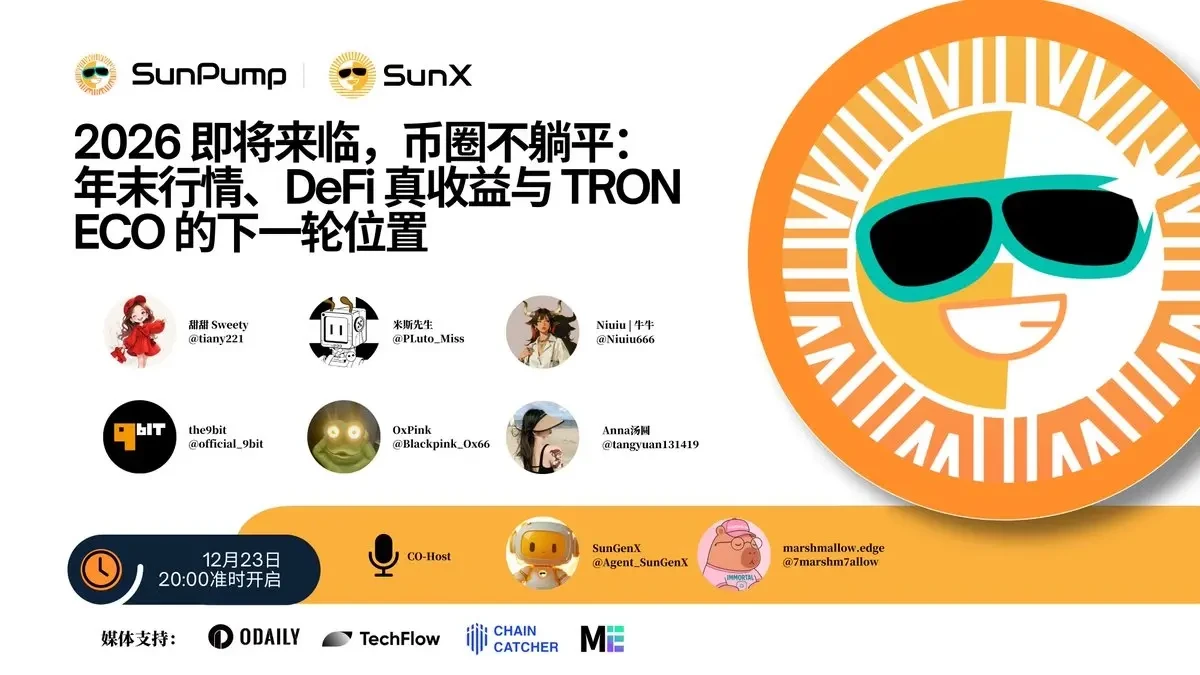
To this end, SunnPump recently hosted an online roundtable discussion themed "2026 is Coming, Crypto Isn't Going to Lie Down," inviting several industry observers and builders to focus on the underlying logic of year-end market trends, the core elements of DeFi sustainability, and TRON's position and role in the next phase. This article will review the key points of this discussion, attempting to outline a rational roadmap to 2026 from multiple dimensions, including capital structure and ecosystem evolution.
Narrative recedes, utility rises: The 2026 cycle belongs to a mature ecosystem with real demand.
In the first topic of the roundtable discussion, the guests delved into the essential differences between the "year-end rally" and "the road to 2026," analyzing aspects such as capital flows, market psychology, and structural shifts. Despite differing perspectives, a clear consensus emerged: year-end volatility resembles a short-term game, while the path to 2026 depends on the ability to build a long-term, sustainable value structure.
JaegerC set the tone for the discussion, vividly comparing the year-end market movements to a "breath" after volatility, a period of "position balancing and probing" at the trading level. He believes the market is shifting from a speculative and narrative-driven phase to a new one driven by real cash flow and asset structure. Therefore, the year-end "test" is to screen projects qualified for the next round of long-term structure, and the core of 2026 will be a comprehensive restructuring of capital efficiency and value logic.
Anna Tangyuan's perspective is more direct and incisive. She clearly states that the year-end market trend addresses the short-term question of "whether prices can rise," relying on emotions and impulses; while the issue for 2026 is "whether we can survive," relying on a business model that can operate stably without subsidies.
When the discussion focused on specific ecosystems, TRON became an excellent case study. Attendees unanimously agreed that TRON, with its absolute dominance in stablecoin settlement and the resulting robust and self-consistent financial ecosystem, has entered a mature stage as a "digital financial infrastructure."
Sweety provided a solid illustration of TRON's ecological position with a set of highly convincing on-chain data: nearly 80 billion USDT in on-chain circulation, accounting for half of the global market; daily stablecoin transfers of up to 20-24 billion USD, building a continuously operating value channel; the total value locked (TVL) of the JUST protocol has exceeded 10.4 billion USD, while the overall TVL of the TRON network is close to 24 billion USD, depicting a financial landscape with deep capital accumulation and a vibrant and healthy ecosystem.
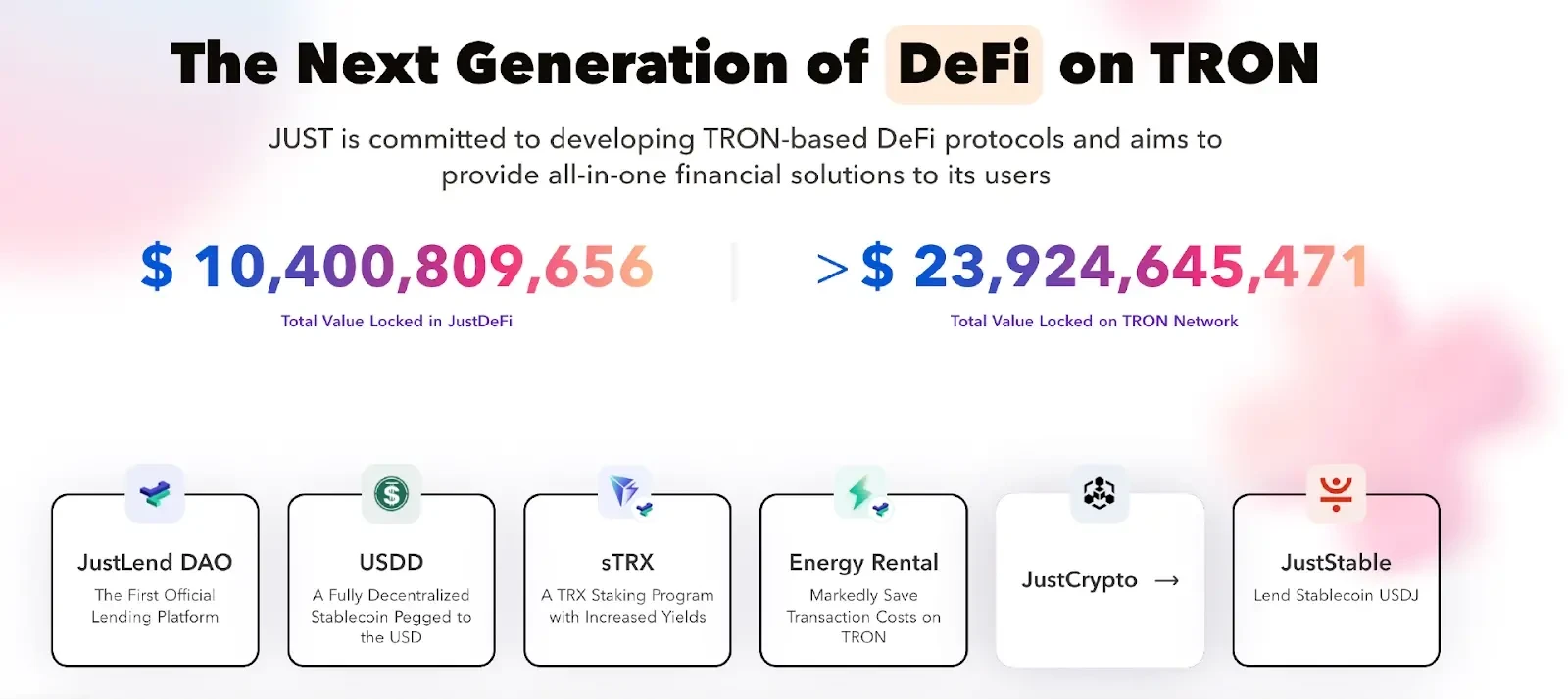
She emphasized that these figures did not stem from short-term incentives or hype, but were naturally driven by real demand for payments, lending, and staking globally, forming a resilient and self-reinforcing "value cycle system." She positioned TRON as the "infrastructure brain that shoulders the heavy responsibility of global stablecoins and payments," and its complete ecosystem matrix and absolute depth in the stablecoin field constitute an unshakeable barrier.
Anna Tangyuan reinforced this assessment from the most intuitive user experience perspective. She stated that for her and many users, TRON is no longer an "investment target" that requires constant price monitoring, but rather a convenient, reliable, and low-cost transfer tool, much like a "built-in utility app on a mobile phone." This "worry-free" and "discussion-free" characteristic is precisely what makes it a mature infrastructure, which determines its unique stability amidst market fluctuations.
In conclusion, TRON is no longer a "public chain competitor" that needs to rely on market narratives to prove its value. Instead, it has evolved into a key settlement layer in the global economy, handling high-frequency, high-value transactions. Its thriving DeFi applications, low transaction costs, and extremely high transfer efficiency collectively constitute a business system that does not rely on short-term subsidies and possesses strong endogenous circulation capabilities. This aligns perfectly with the core logic of "Towards 2026": building a value structure that can transcend cycles and be self-sustaining.
The cornerstones for navigating bull and bear markets: real cash flow, stable demand, and intrinsic resilience
When the topic shifted to "which DeFi projects can truly weather economic cycles," the roundtable discussion moved from observing market phenomena to deconstructing the essence of these projects. The guests unanimously moved away from the obsession with "high returns" and pointed to a more resilient underlying logic. The practices and development path of the TRON ecosystem provided a concrete and vivid example.
JaegerC systematically elaborates on the core elements for navigating economic cycles: real cash flow and stable endogenous demand. He believes that returns must come from the transaction fees and interest rate spreads of the protocol itself, rather than short-term speculation. Furthermore, the protocol should serve the essential needs of economic activities such as lending and payments. Sweety holds a similar view, pointing out that projects capable of navigating economic cycles must be "infrastructure-level," possessing strong self-sustaining capabilities. High TVL (Total Value Added) and resilience stem from genuine transaction fee cash flow and high utilization rates, rather than subsidies.
This logic is clearly validated in the core protocols of the TRON ecosystem . Taking JustLend DAO as an example, its protocol revenue does not rely on a single lending spread, but rather on a diversified model of real returns. Its main revenue comes from the liquidity staking service (sTRX) provided to TRX holders, which accounts for the vast majority of its total revenue; meanwhile, interest income from the traditional lending market provides a stable supplement.
Crucially, the protocol designs a direct value feedback loop: net revenue generated by the protocol is periodically used to buy back and burn its governance token, JST, on the open market. This not only makes JST a deflationary asset but also tightly binds the success of the protocol's business (real cash flow) to the long-term interests of token holders (deflationary support for token value). Therefore, regardless of market sentiment fluctuations, as long as genuine on-chain demand for staking and lending persists, the protocol can not only generate sustainable cash flow but also capture and feed this value back to ecosystem participants through a deflationary mechanism . This is precisely the typical characteristic of a "highly resilient" project driven by real economic activity and possessing the ability to intrinsically return to its intrinsic value, as emphasized by JaegerC.
Anna Tangyuan used a series of vivid metaphors to popularize professional logic. She pointed out incisively that many high-yield projects earn money from "project subsidies," and once the incentives stop, the projects disappear. True projects that weather economic cycles are more like the convenience store downstairs or the highway—they don't offer discounts or hype, but generate continuous revenue through "year-round usage," "long-term demand," and "repeated use." She emphasized that real revenue should come from genuine usage, not from incentive-driven amplification.
For millions of users worldwide, using the TRON network for USDT transfers is driven by its practical value of speed and affordability. This high-frequency, essential "real-world use" forms the most solid foundation of the ecosystem. The long-term appeal of DeFi products within the ecosystem, such as SUN.io, is also rooted in this genuine network utility and asset accumulation, rather than temporary subsidies. In November 2025, TRON's total protocol revenue surpassed $204 million, achieving a significant lead in revenue rankings across various public blockchains . This market performance is a direct result of its substantial real-world asset accumulation and continuous network utility, demonstrating the robust health and value capture capabilities of its underlying ecosystem.
Based on the opinions of the panelists, a DeFi ecosystem capable of weathering bull and bear markets must evolve into an organic entity within the digital economy that provides real value, meets stable demand, and possesses inherent resilience. The TRON ecosystem, by focusing on and thoroughly addressing the core necessity of "efficient global value flow," has taken the lead in transitioning from a single public chain to a comprehensive financial infrastructure. It has built an organic whole centered on massive stablecoin circulation (real demand and cash flow) and a high-throughput, low-cost public chain (reusable infrastructure), naturally giving rise to rich DeFi scenarios such as lending, trading, and staking. Within this system, the protocol's value capture and the network's practical value are closely linked, forming a life form with strong internal circulation and counter-cyclical resilience. This is not only the structural answer for the TRON ecosystem to navigate economic cycles but also provides a clear and powerful reference for the industry to explore sustainable development paths.