The 6 most noteworthy DeFi protocols to track in 2026: Who is truly handling on-chain fund flows?


- 核心观点:DeFi已从实验场转向金融基础设施。
- 关键要素:
- 领先协议聚焦真实收入与风控。
- 借贷、稳定币等构成核心金融体系。
- Aave等六大协议成为流动性枢纽。
- 市场影响:推动行业向稳健、可持续方向发展。
- 时效性标注:中期影响。
Over the past few years, the DeFi industry has undergone a significant reshuffling. Early DeFi projects relied heavily on rapid trial and error, high token incentives, and a flurry of launches to attract attention. Many of these projects were short-lived, while others were eliminated after repeated market tests. Ultimately, only a few core protocols have matured and developed long-term value.
As 2026 approaches, the development stage of DeFi has changed. It is no longer just an experimental field, but is moving closer to becoming a real financial infrastructure.
Currently, leading DeFi protocols are generally focusing on the following areas:
- Generate stable transaction fee revenue through real-world use cases, rather than relying on short-term token releases.
- Continuously optimize user experience and strengthen risk control and system stability.
- Develop a clear and actionable product roadmap, rather than constantly piling on new features.
- Deeply integrated with multiple public chains and different ecosystems, forming a stronger network effect.
This article is not intended to predict the next explosively rising token, but rather to help readers identify the core protocols that already support on-chain liquidity, user and fund flows. These are the projects that are becoming the foundation upon which other applications, traders, and even institutions continue to build.

TL;DR Quick Summary
- DeFi has moved from the early experimental stage to the infrastructure stage, and is beginning to have real income, deeper liquidity and more robust risk control.
- By 2026, the truly important DeFi protocols will be the core platforms that facilitate the flow of funds, rather than projects that rely on short-term token hype.
- Lending, stablecoins, staking, decentralized exchanges, and derivatives have collectively formed the core financial system of DeFi.
- Compared to data from a single point in time, product execution capabilities and stable performance amidst market fluctuations are more worthy of attention.
- Continuously tracking these six protocols can help you quickly understand the next stage of development in on-chain finance.
DeFi Evaluation Framework 2026: How to Identify Truly Valuable Protocols
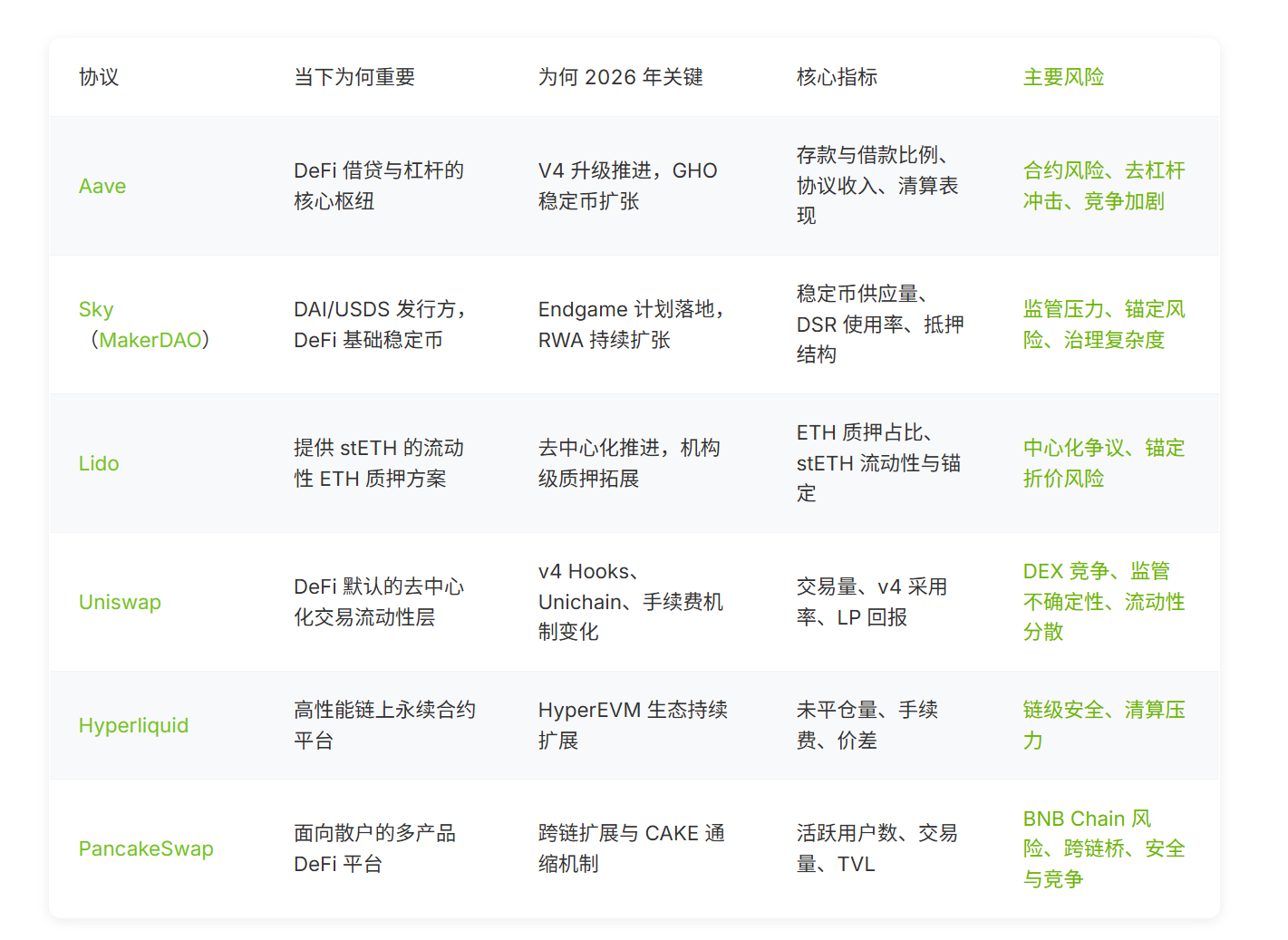
To ensure this list is both practical and valuable, all protocols are evaluated using the same set of criteria. These criteria are precisely the core dimensions that professional traders, developers, and long-term investors are increasingly emphasizing when evaluating DeFi projects.
Core evaluation criteria:
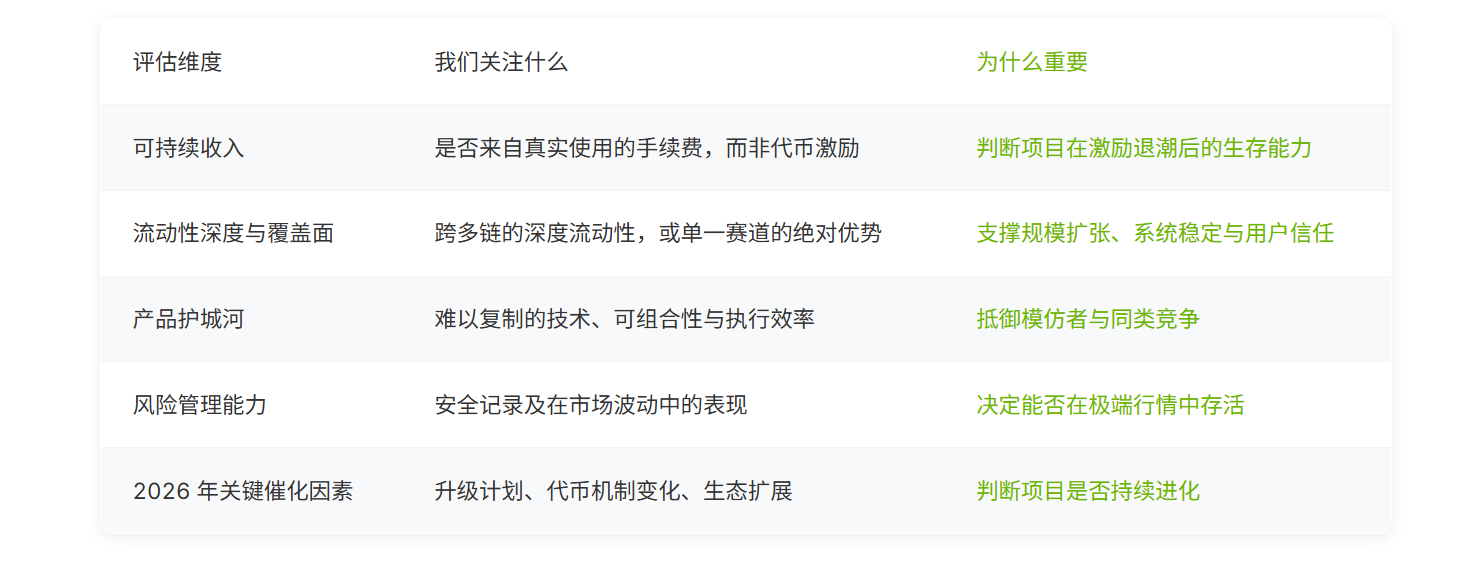
Metrics themselves will always change, but the direction is more important. Protocols that continuously improve their execution and strengthen their role in the ecosystem are often more capable of navigating cycles and surviving and growing in the long term.
Aave: The core liquidity hub of the DeFi lending system
Aave's core role in the current DeFi ecosystem
Aave is the core infrastructure of the DeFi lending system. It allows users to deposit crypto assets to earn yields without intermediaries and lend them out using collateral. Many common DeFi strategies rely on the leverage and liquidity provided by Aave to operate.
During periods of market activity, Aave is often one of the key platforms where funds first flow in.
 In 2025, Aave's total value locked more than doubled, rising from $20.4 billion to a peak of $45.8 billion, clearly reflecting a significant recovery in on-chain lending demand (Source: DeFiLlama).
Why 2026 is crucial
Aave is currently undertaking a significant architecture upgrade to V4 and is also adjusting its overall strategy, shifting from widespread network deployment to a more efficient and productive core deployment. Meanwhile, Aave's native stablecoin, GHO , is gradually becoming an important part of its revenue structure.
 Aave's protocol revenue grew by 76.4% year-on-year, indicating a continued increase in lending activity. At the same time, GHO's share in the overall revenue structure is also constantly increasing (Data source: DeFiLlama).
Key developments worth noting include:
- The V4 architecture design places greater emphasis on efficiency and ecosystem integration.
- The continuous expansion of GHO's use cases and incentive mechanisms
- Focusing on the in-depth development of Ethereum and key Layer 2 networks
Key metrics for judging Aave's performance in 2026
- Comparison of total deposits and actual borrowings
- Composition and Changes in Agreement Revenue
- Liquidation performance during market volatility
 During the flash crash on October 11, Aave user activity increased significantly, but only 14 liquidation events occurred, demonstrating the protocol's stability and resilience in extreme market conditions (Data source: Dune Analytics).
Key risk factors to be aware of
- Security risks at the smart contract level
- Rapid deleveraging shock during a sharp market downturn
- Increased competition from other lending protocols and stablecoin projects
- Governing power may be concentrated in the hands of a few large holders of currency.
Sky (MakerDAO): A key protocol connecting stablecoin systems with real-world returns
Sky's central position in the current DeFi stablecoin system
Sky, formerly known as MakerDAO , is the issuer of DAI or USDS and is one of the most widely used decentralized stablecoins. It plays a role similar to a basic settlement asset in the DeFi ecosystem, and is widely used in trading, lending, and various on-chain financial scenarios.
Stablecoins are the cornerstone of on-chain finance, and Maker has long been one of the most influential stablecoin issuers.
 Throughout 2025, the circulating supply of DAI remained stable between $4 billion and $5 billion, with approximately 83% issued on Ethereum, further solidifying its position as a core settlement stablecoin for DeFi (Source: DeFiLlama).
 Sky Dollar has reached a circulating supply of $6.38 billion in just over a year since its launch, about 37% higher than DAI. 92.6% of its issuance is concentrated on the Ethereum network, demonstrating a remarkable growth rate (Source: DeFiLlama).
Why 2026 is crucial
Sky is undergoing a profound transformation through its Endgame initiative. This initiative encompasses modular adjustments to its governance structure, expanded real-world asset exposure, and a broader cross-chain distribution strategy, with the goal of making the stablecoin system more robust and sustainable.
Key developments worth noting include:
- Continuously scale up the size of real-world asset-related strategies
- Promote a more modular governance structure through sub-DAOs
- Expanding from Ethereum to more public blockchain ecosystems
Key metrics for measuring Sky's health in 2026
- Trends in the overall supply of stablecoins
- Sky Savings Interest Rate Participation Scale and Usage
- The proportion of decentralized assets to real-world assets in collateralized assets
 Since March 2025, the Sky savings rate has remained at approximately 4.25%, while the DAI savings rate has steadily declined from 4.75% to 1.25% by the end of the year, reflecting a significant shift in the incentive for returns (Data source: Dune Analytics).
Key risk factors that need to be understood in advance
- Regulatory pressures related to real-world assets
- Stability challenges of stablecoin pegging mechanisms under extreme market conditions
- As the governance structure becomes more complex, the barriers to user understanding and participation increase.
Lido: A key infrastructure in the Ethereum staking system
Lido's key role in the current DeFi staking ecosystem
Lido allows users to maintain asset liquidity through stETH while staking ETH . This mechanism frees up funds that would otherwise be locked up for a long time, enabling continued participation in DeFi activities even with re-staking of ETH .
Currently, stETH has become a core component of lending, trading, and various yield strategies.
 As of the end of 2025, Lido remained the dominant platform in the Ethereum staking space, holding more than 50% of the market share in the restaking Ether market, firmly maintaining its leading position in the industry (Data source: Dune Analytics).
 On the Ethereum network, stETH is primarily used in yield strategies, with approximately 29% used for lending through Aave and another 20% allocated to EigenLayer for restaking (Source: Dune Analytics).
Why 2026 is crucial
Lido is actively responding to discussions about the degree of decentralization, while also expanding into institutional-grade and more advanced staking products to meet the needs of different types of users.
Key developments worth noting include:
- Enhancing validator diversity through DVT
- Collateralized products tailored for institutional users
- Ongoing discussion surrounding token value capture mechanisms
Key metrics for evaluating Lido's performance in 2026
- Lido's percentage of total ETH staking across the network
- Liquidity and peg stability of stETH
- Integration in lending and refinancing agreements
 The flow of stETH in the DeFi ecosystem shows that lending protocols are its primary destination for liquidity, highlighting the continued demand for stETH in lending scenarios (Data source: DeFiLlama).
Key risk factors that need to be understood in advance
- Market concerns about the centralization of Ethereum staking
- stETH experiences a short-term discount under extreme market conditions.
- Conflict of interest between token holders and staking users
Uniswap: The default liquidity platform for the DeFi world
Uniswap's fundamental position in the current DeFi liquidity system
Uniswap is currently the most widely used decentralized exchange and the most common liquidity venue for new token listings. The first trade of many new assets often occurs in Uniswap's liquidity pools.
In the DeFi world, liquidity itself is the infrastructure, and Uniswap provides this infrastructure in a scalable way.
 Despite a relatively slower market environment at the end of 2025, Uniswap maintained its leading position among decentralized exchanges, covering 38 blockchain networks and achieving a monthly trading volume of $64.8 billion, approximately 24% higher than PancakeSwap, which ranked second (Source: DeFiLlama).
Why 2026 is crucial
The launch of Uniswap v4 introduced a programmable hooks mechanism, allowing developers to customize liquidity behavior according to their needs. Meanwhile, the development of Unichain and discussions regarding protocol fee mechanisms may redefine UNI 's role within the ecosystem.
 Since its launch in early 2025, Uniswap v4 has seen a continuous increase in its share of trading activity, achieving stable growth in trading volume while older versions are still widely used (Data source: Dune Analytics).
Key developments worth noting include:
- Liquidity is gradually migrating to v4 pools.
- The continuous expansion of the Unichain ecosystem
- Has the protocol-level transaction fee mechanism been officially launched?
Key metrics for evaluating Uniswap performance in 2026
- Changes in transaction volume across different chains
- The speed and scale of v4 adoption
- Comparison of liquidity provider rewards with other DEXs
 Liquidity providers on Uniswap continue to enjoy high incentives, with an average annualized return of around 30% across more than 2,000 active trading pairs (Source: DeFiLlama).
Key challenges and risks that need to be addressed in advance
- Intense competition from aggregators and vertical DEXs
- Regulatory uncertainty
- Liquidity dispersion issues caused by multi-chain deployment
Hyperliquid: The platform that is reshaping the on-chain derivatives trading experience
The reasons for Hyperliquid's rise in current derivatives trading
In the crypto market, derivatives trading has long accounted for the majority of trading volume. Hyperliquid has rapidly grown into a leading platform in the on-chain perpetual contract space, thanks to its speed and depth approaching that of centralized exchanges.
With the improved trading experience, Hyperliquid has become an important source of commission revenue and trader attention.
 Since its launch, Hyperliquid has accumulated a trading volume of over $3.45 trillion, fully demonstrating its rapid rise as a core on-chain derivatives trading platform (Data source: HyperScreener).
 Among decentralized perpetual contract platforms, Hyperliquid continues to lead in terms of open interest, although competitors such as Aster are more active in short-term trading volume (Source: DeFiLlama).
Why 2026 is crucial
Hyperliquid is continuously expanding its ecosystem around its self-developed public chain, HyperEVM, while constantly introducing new trading markets and product integrations, with the goal of building a more complete on-chain derivatives system.
Key developments worth noting include:
- Expanding from single perpetual contracts to more derivatives and features
- The development of the HyperEVM ecosystem continues to advance.
- Deep integration with wallets and trading interfaces lowers the barrier to entry.
Key metrics for measuring Hyperliquid's competitiveness in 2026
- Open interest size and daily commission rates
- Liquidity depth and bid-ask spread performance
- User retention rates compared to competing platforms
 To date, Hyperliquid has distributed approximately $825 million in revenue to HYPE holders, representing the vast majority of the protocol's cumulative returns, highlighting its strong value return and capture capabilities (Source: DeFiLlama).
Key risk factors that need to be considered in advance
- Security risks at the public blockchain level
- The resilience of the clearing mechanism during periods of sharp market volatility
- High-leverage products may attract regulatory attention.
PancakeSwap: A DeFi Distribution Hub Driven by User Scale
PancakeSwap's core advantages in the retail DeFi ecosystem
PancakeSwap boasts one of the largest active user bases in the DeFi space, with a particularly strong influence among retail investors. It integrates multiple functions such as exchange, liquidity mining, staking, and derivatives into a single interface, lowering the barrier to entry for users to participate in DeFi.
PancakeSwap's core strength lies in its powerful user reach and distribution capabilities.
 Between July and October 2025, PancakeSwap saw a 33.9% increase in active trading users, while its total trading volume rose by approximately 4% to $803 billion, demonstrating that retail investor participation remains active even in a mature market (Source: Dune Analytics).
 PancakeSwap has maintained profitability since 2024, achieving approximately $94.5 million in protocol revenue in 2025, representing a year-on-year increase of 48% (Source: DeFiLlama).
Why 2026 is crucial
PancakeSwap is accelerating its development of derivatives such as cross-chain aggregation and perpetual contracts, while gradually adjusting CAKE 's token mechanism to shift towards a more deflationary and fee-driven approach.
 With the ongoing token burning mechanism, as of December 2025, the circulating supply of CAKE had reached 321 million, accounting for approximately 91% of the total supply, clearly demonstrating a trend towards a deflationary token economic model (Data source: Dune Analytics).
Key developments worth noting include:
- The continuous expansion of cross-chain exchange and aggregation functions
- Further improvement of the derivative product line
- Reduce token release and strengthen the link between transaction fees and token value.
Key metrics for measuring PancakeSwap's growth quality in 2026
- Number of active trading users on the platform
- Transaction volume stability across all chains
- TVL distribution structure and long-term sustainability
 PancakeSwap's user activity is highly concentrated on the BNB Chain, which contributes over 90% of its active user base, highlighting its core position in the BNB Chain ecosystem (Source: DeFiLlama).
Key risks and challenges that need to be assessed in advance
- Risks related to market perception of the degree of centralization of BNB Chain
- Safety and operational risks associated with cross-chain bridges
- Intense competition in decentralized exchanges and derivatives markets
DeFi counterparts that didn't make the top six but shouldn't be overlooked
These protocols may not be leading in all core metrics at present, but they represent key competitive forces in different tracks, continuously shaping the competitive landscape of the DeFi ecosystem and putting long-term pressure on leading protocols.
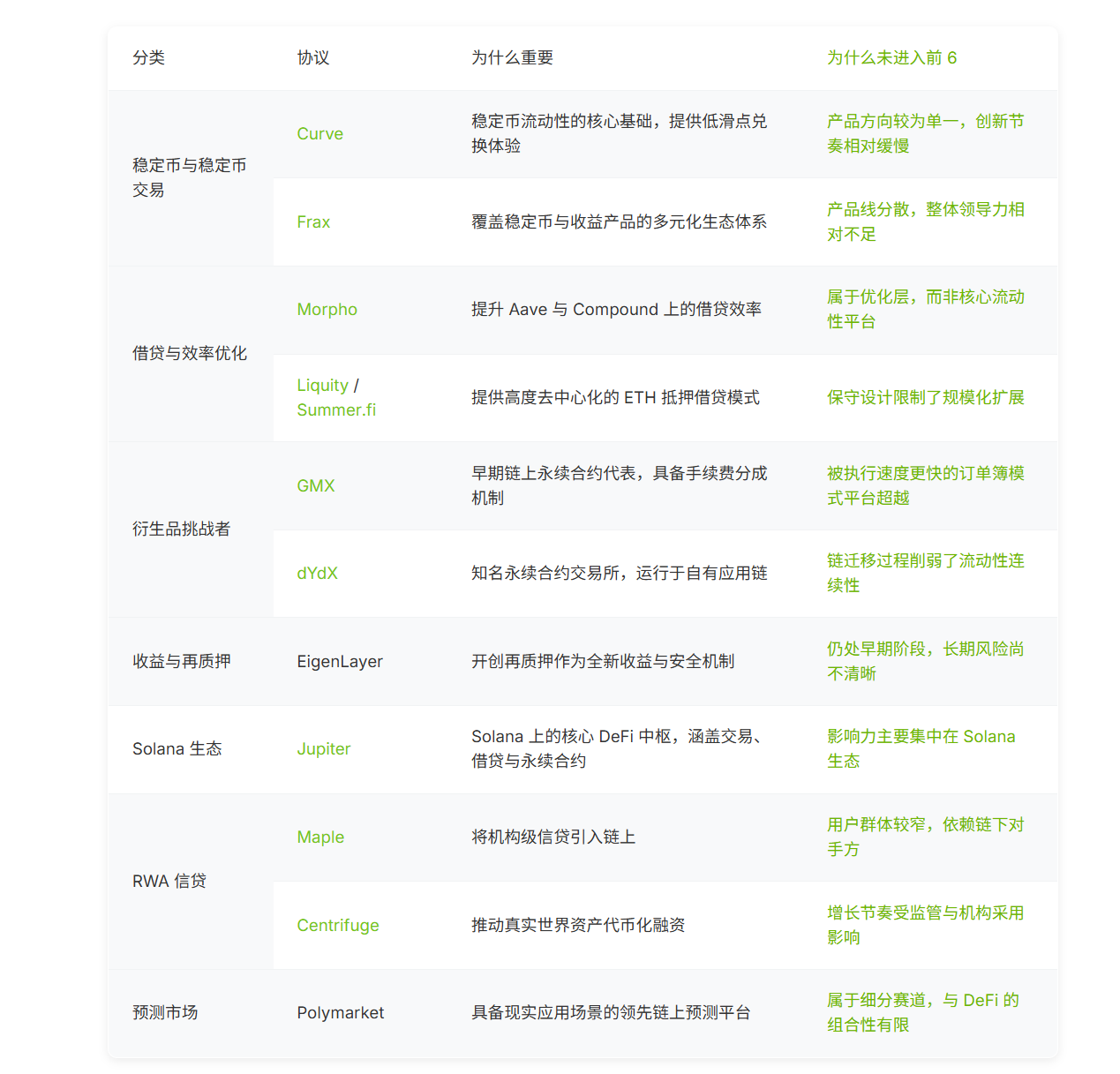
Although these DeFi protocols did not make it into the top six list this time, it is their existence that continues to drive the leading projects to evolve in terms of product, efficiency, and risk control.
How to continuously track key DeFi trends in 2026
A clear and simple observation framework can help you capture truly valuable signals amidst the noise of information.
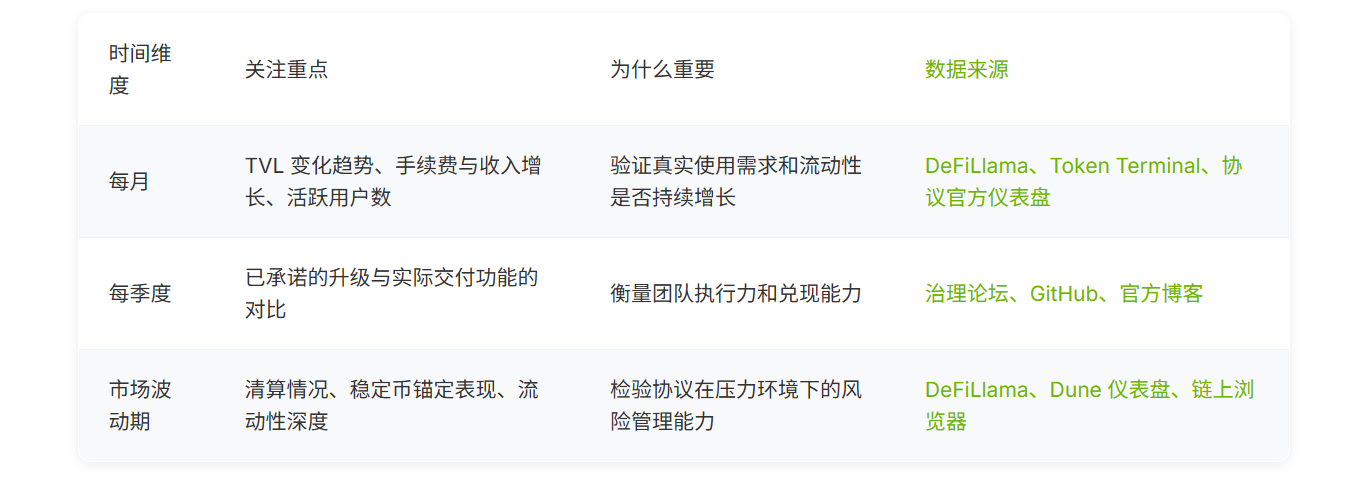
The DeFi competition in 2026 will no longer be driven by narratives. Protocols that can truly survive and scale in the long term typically possess stable user demand, sustainable liquidity, and risk control capabilities that can withstand market volatility. Continuously tracking these core signals will help to better understand the true future direction of on-chain finance.
Frequently Asked Questions about Decentralized Finance (DeFi)
1. What is DeFi, and how can it be understood in the simplest terms?
Decentralized finance (DeFi) is a financial service system built on blockchain that does not rely on traditional intermediaries such as banks. Instead, it operates automatically through smart contracts and includes functions such as trading, lending, and yield management.
2. Why is DeFi still worth paying attention to in 2026?
Because DeFi has already supported real-world trading, lending, and settlement activities, and is gradually generating sustainable fee revenue, it is also beginning to attract more institutional participation.
3. How were the 6 DeFi protocols in this article selected?
The selection criteria mainly include revenue sustainability, liquidity depth, product moat, risk management capabilities, and clear growth catalysts leading up to 2026.
4. Is DeFi only suitable for professional users and traders?
That's not the case. Nowadays, more and more DeFi products are focusing on lowering the barriers to entry in scenarios such as stablecoins, staking, and trading, making it easy for ordinary users to participate.
5. What are the main risks currently facing DeFi?
Smart contract vulnerabilities, liquidity shocks, governance failures, and regulatory uncertainties remain the core risks that the DeFi ecosystem needs to continue to pay attention to.
6. How can beginners keep track of DeFi without getting overwhelmed by information?
It is recommended to focus on a few key metrics, such as TVL, fee revenue, and user activity, and observe the protocol's actual performance during periods of market volatility.
Quick Links
- The 5 most noteworthy L1 public chains in 2026: The main evolution from DeFi to RWA
- The global market after a 43-day data vacuum: AI stalls, Crypto fluctuates, what's next in December?
- How to invest 100,000 USDT? XT Simple Earn helps you achieve a stable passive income of 10%+.
About XT.COM
Founded in 2018, XT.COM is a leading global digital asset trading platform with over 12 million registered users, operating in more than 200 countries and regions, and boasting an ecosystem traffic exceeding 40 million. The XT.COM cryptocurrency trading platform supports over 1300 high-quality cryptocurrencies and over 1300 trading pairs, offering diverse trading services including spot trading , leveraged trading , and contract trading , and is equipped with a secure and reliable RWA (Real World Asset) trading market. We are committed to the philosophy of "Explore Crypto, Trust Trading," dedicated to providing global users with a safe, efficient, and professional one-stop digital asset trading experience.