






HIP-3 and Builder Codes: Hyperliquid's Ecosystem Counterattack


- 核心观点:Hyperliquid正通过基础设施转型寻求再度崛起。
- 关键要素:
- 市场份额从80%峰值跌至约20%。
- 战略从B2C转向B2B的“流动性AWS”。
- 以HIP-3和Builder Codes构建新生态。
- 市场影响:或重塑去中心化衍生品市场格局。
- 时效性标注:中期影响。
Original title: Hyperliquid Growth Situation
Original author: @esprisi0
Compiled by: Peggy, BlockBeats
Editor's Note: Hyperliquid once dominated the decentralized derivatives market, but its market share plummeted in the second half of 2025, drawing industry attention: Has it peaked, or is it laying the groundwork for the next phase? This article reviews Hyperliquid's three phases: from its extreme dominance with a market share as high as 80%, to the loss of momentum due to strategic transformation and accelerated competition leading to a drop to 20%, and then to its resurgence centered on HIP-3 and Builder Codes.
The following is the original text:
Over the past few weeks, concerns surrounding Hyperliquid's future have intensified. Loss of market share, rapidly rising competitors, and an increasingly crowded derivatives market raise a crucial question: what's really going on beneath the surface? Has Hyperliquid already peaked, or is the current narrative ignoring deeper structural signals?
This article will break it down one by one.
Phase One: Ultimate Domination
From the beginning of 2023 to mid-2025, Hyperliquid continued to break historical records in key metrics and steadily increased its market share, thanks to several structural advantages:
The points-based incentive mechanism attracted substantial liquidity; its first-mover advantage in launching new perpetual contracts (such as $TRUMP and $BERA) made Hyperliquid the most liquid venue for new trading pairs and the preferred platform for pre-listed trading (such as $PUMP, $WLFI, and XPL). Traders were forced to flock to Hyperliquid to avoid missing out on emerging trends, propelling its competitive advantage to its peak; it boasts the best UI/UX experience among all perpetual contract DEXs; its fees are lower than centralized exchanges (CEXs); it introduced spot trading, unlocking new use cases; it integrates Builder Codes, HIP-2, and HyperEVM; and it achieves zero downtime even during major market crashes.
As a result, Hyperliquid's market share grew for more than a year, reaching a peak of 80% in May 2025.
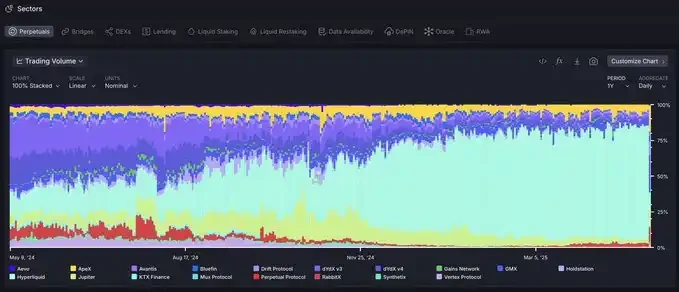
According to the market share data of perpetual contract trading volume provided by @artemis
At that stage, the Hyperliquid team was clearly ahead of the market in terms of innovation and execution speed, and there was no truly comparable product in the entire ecosystem.
The second phase saw the rise and accelerated competition of "AWS of Liquidity".
Since May 2025, Hyperliquid's market share has plummeted, from approximately 80% to nearly 20% of trading volume in early December.
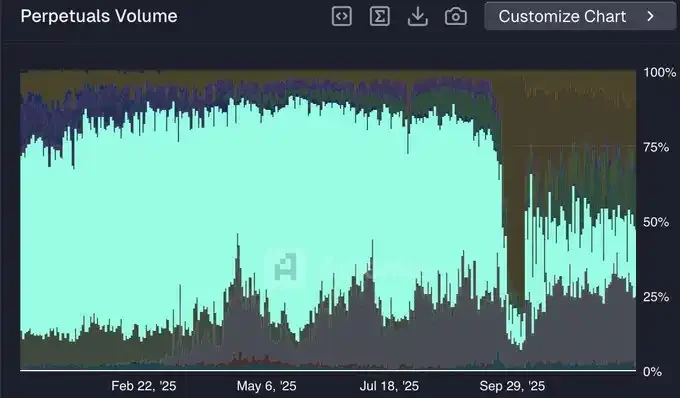
@HyperliquidX market share (Data source: @artemis)
This loss of momentum relative to competitors can be attributed to the following factors:
Strategic shift from B2C to B2B
Instead of increasing its investment in the pure B2C model, such as launching its own mobile application or continuously launching new perpetual contract products, Hyperliquid has chosen to shift to a B2B strategy, positioning itself as "the AWS of liquidity".
This strategy focuses on building core infrastructure for external developers, such as Builder Codes for the front end and HIP-3 for launching new perpetual markets. However, this transformation essentially hands over the initiative for product deployment to third parties.
In the short term, this strategy is not ideal for attracting and retaining liquidity. The infrastructure is still in its early stages, adoption will take time, and external developers do not yet possess the distribution capabilities and trust that the Hyperliquid core team has accumulated over the long term.
Competitors seize the opportunity during Hyperliquid's transformation period
Unlike Hyperliquid's new B2B model, competitors maintain full vertical integration, allowing them to significantly accelerate the launch of new products.
Because they don't require delegated execution, these platforms maintain complete control over product launches while leveraging their established user trust to expand rapidly. Therefore, they are more competitive than in the first phase.
This directly translates into increased market share. Competitors now offer not only the full range of products available on Hyperliquid, but also features that are not yet available on HL (such as Lighter's introduction of a spot market, perpetual stocks, and forex).
Incentives and "Employment-Based Mobility"
Hyperliquid has not run any official incentive programs for over a year, while its main competitors are still actively pursuing them. Lighter, which recently leads in trading volume market share (around 25%), is still in the pre-TGE points season.
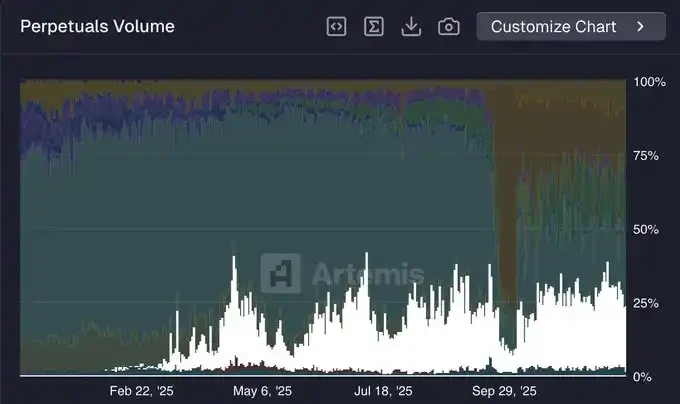
@Lighter_xyz Market share (Data source: @artemis)
In the DeFi space, liquidity is more "employable" than anywhere else. A significant portion of the trading volume flowing from Hyperliquid to Lighter (and other platforms) is likely incentive-driven, related to airdrop point farming. Like most perpetual DEXs running point seasons, Lighter's market share is expected to decline after TGE.
The Rise of HIP-3 and Builder Codes in Phase Three
As mentioned earlier, building a "liquidity AWS" is not the optimal short-term strategy. However, in the long run, this model is precisely what makes Hyperliquid a potential core hub for global finance.
While competitors have copied much of Hyperliquid's current functionality, true innovation still originates from Hyperliquid. Developers building on Hyperliquid benefit from domain-specific focus, allowing for more targeted product development strategies on top of an evolving infrastructure. Conversely, protocols like Lighter, which maintain complete vertical integration, face limitations when simultaneously optimizing the development of multiple product lines.
HIP-3 is still in its early stages, but its long-term effects are already beginning to emerge. Key players include:
@tradexyz has launched perpetual stocks.
@hyenatrade recently deployed a trading terminal for USDe.
More experimental markets are emerging, such as @ventuals offering pre-IPO exposure and @trovemarkets targeting niche speculative markets like Pokémon or CS:GO assets.
It is projected that by 2026, the HIP-3 market will account for a significant share of Hyperliquid's total trading volume.
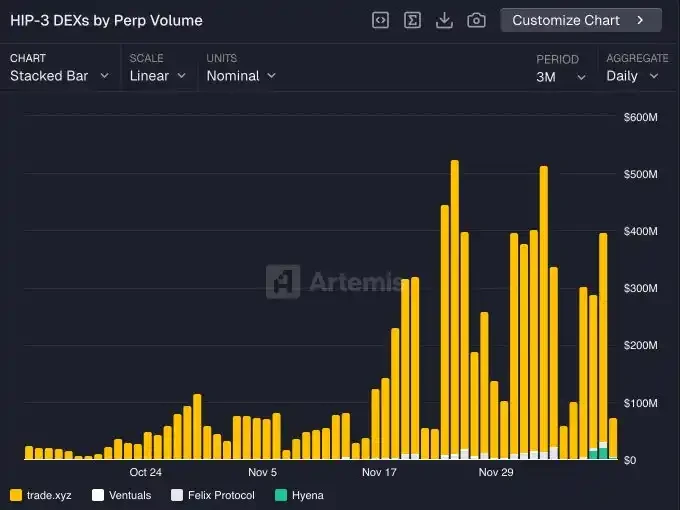
HIP-3 transaction volume (by Builder)
The key driver that ultimately propelled Hyperliquid's return to dominance was the synergy between HIP-3 and Builder Codes. Any frontend that integrates with Hyperliquid has immediate access to the entire HIP-3 marketplace, enabling it to offer users unique products.
Therefore, developers have a strong incentive to launch marketplaces via HIP-3, as these marketplaces can be distributed on any compatible frontend (such as Phantom, MetaMask, etc.) and access entirely new liquidity sources. This creates a perfect virtuous cycle.
The ongoing development of Builder Codes makes me more optimistic about the future, both in terms of revenue growth and active user growth.
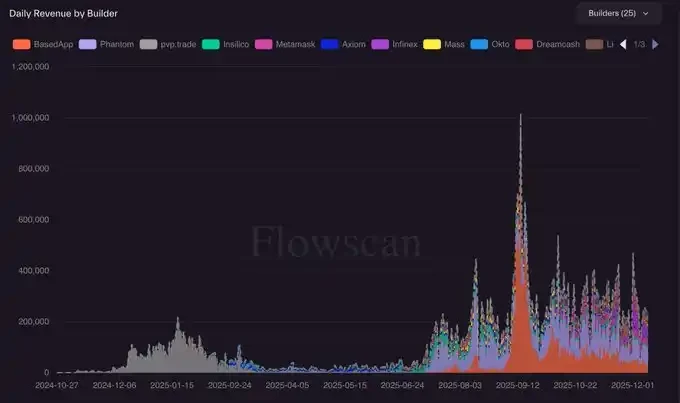
Builder Codes Revenue (Data Source: @hydromancerxyz)
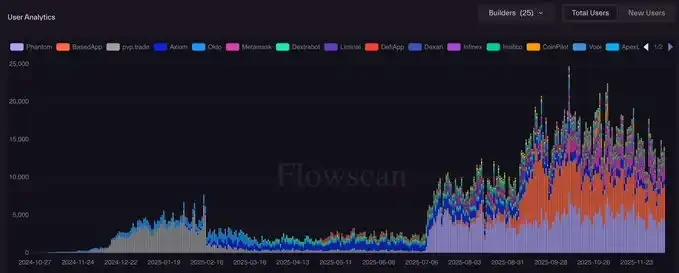
Builder Codes daily active users (Data source: @hydromancerxyz)
Currently, Builder Codes are primarily used by crypto-native applications (such as Phantom, MetaMask, and BasedApp). However, I anticipate the emergence of a new class of super apps built on Hyperliquid, designed to attract a new user base that is entirely non-crypto-native.
This could very well be the key path for Hyperliquid to enter the next stage of scaling, and it will be the focus of my next article.


