






Binance Research: Decrypting the Turkish Crypto Market, Crypto Boom Amid Economic Difficulties


Original source: Binance Research
Original compilation: Rhythm BlockBeats
Editors Note: This article analyzes the current situation of the crypto market in Istanbul, Turkey. Turkeys acceptance of crypto is no less than that of the United States and South Korea. In addition to legal currency, crypto assets have become the second most popular choice for local people to invest. Even Its selection priority exceeds traditional investment categories. In terms of market expectations, 70% of the respondents are optimistic about the development of cryptocurrency in the next 1-5 years.
Of course, choosing crypto assets is to pursue its income and growth, but it is not to make a desperate move. On November 9, Binance released its latest Web3 wallet product at the Blockchain Week held in Istanbul, Turkey.
Wallet, the entrance to the crypto world. When all eyes are focused on the fierce competition for entrance by industry giants, we seem to have forgotten that the stage of this conference is itself an entrance: Turkey, Istanbul
Standing at the intersection of the Eurasian continent, Turkey, a country, has naturally accepted the collision of Eastern and Western cultures in the torrent of historical development; and today, as the influence of Crypto is gradually expanding, Turkey, a country, has already stepped into the world of encryption. The fertile soil of the world.
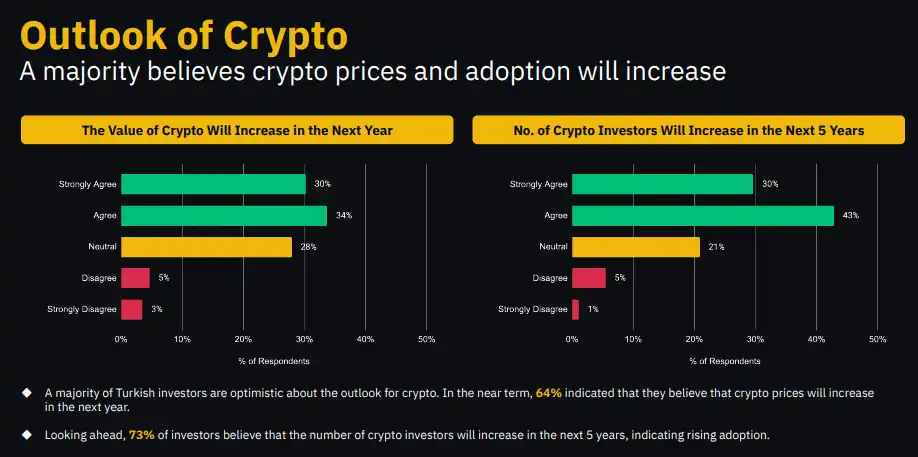
Along with Blockchain Week, Binance Research released a research report on The Current State of the Turkish Crypto Market, which showed that 40% of citizens hold cryptocurrency investment exposure, and 73% of Turkish respondents believe that in the next 5 years The number of crypto investors will continue to increase.
It is neither the Fomo that is almost fanatical about assets in Southeast Asian countries, nor the cautious policies of European countries towards encryption. Turkeys Crypto journey seems to also integrate the different characteristics of the East and the West.
Leading Crypto Acceptance
When talking about the acceptance of crypto, most people’s minds will immediately think of China’s mining industry in the past, as well as the current financial exploration in the United States and the speculative mania in South Korea.
But in fact, Turkish citizens’ acceptance of encryption does not lag behind these countries at all.
Binance’s report shows that 2 out of 5 Turkish residents hold crypto assets; local crypto acceptance has soared from 16% to 40% in the past three years.
Scored using the same encryption acceptance index criteria, Turkey also ranks 12th in the world; considering its positioning in the world’s geo-economics and its small size compared to other economies, Turkey’s encryption acceptance level , it is indeed a bit far ahead.
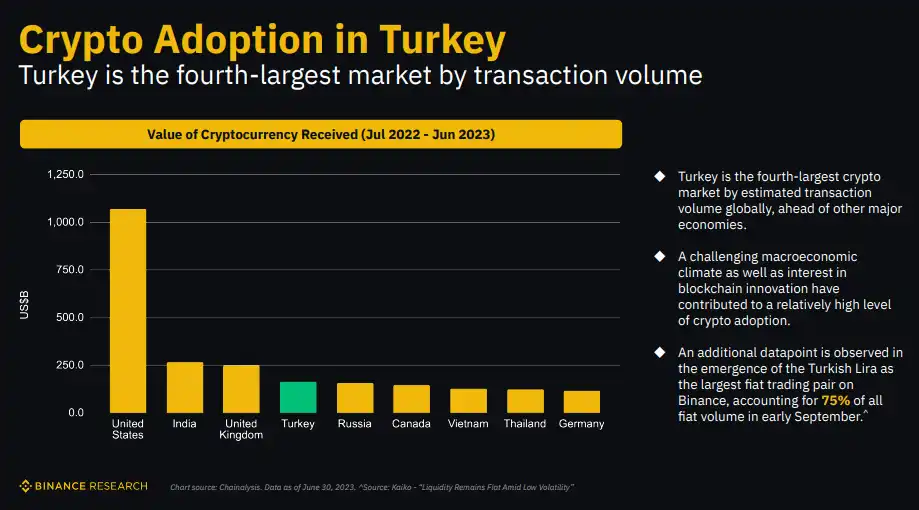
In addition, a piece of trivia is that Turkey is the fourth largest crypto-asset trading market in the world, and its crypto-asset trading volume is significantly higher than several other large economies in the world. Binance’s internal trading data also shows that in early September this year, Turkey’s lira (local legal currency) once topped the list of legal currency trading pairs on the entire exchange, accounting for an astonishing 75%.
Choices amidst internal and external troubles
Why does Türkiye have such a high level of crypto acceptance?
Market choice is inseparable from the economic environment. Turkey has been experiencing economic suffering and troughs in the past five years.
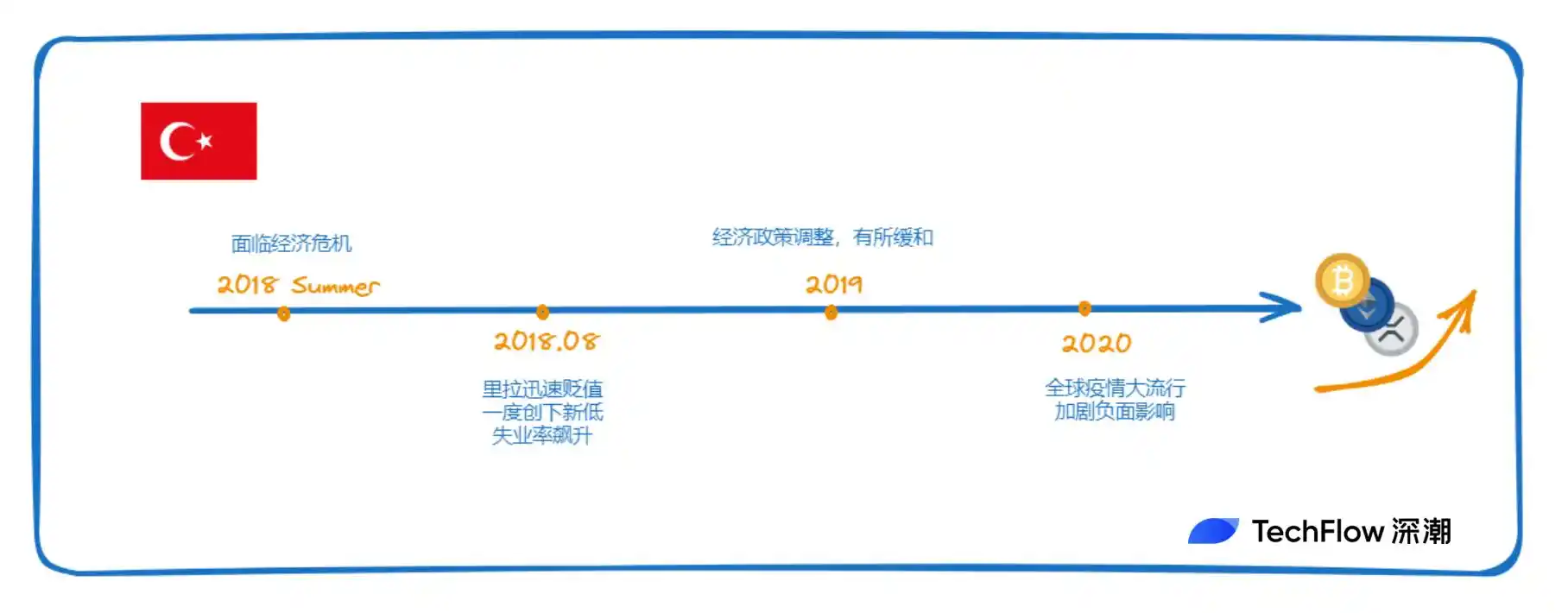
In the summer of 2018, Türkiye faced an economic crisis, with the lira depreciating rapidly. Reasons for this crisis include rising inflation, external debt problems, increasing trade deficits, and investor concerns about Turkeys economic policies.
In August of the same year, Turkeys legal currency, the lira, experienced a sharp depreciation and once hit a record low. At one time, the lira/dollar exchange rate exceeded 7 lira per dollar.
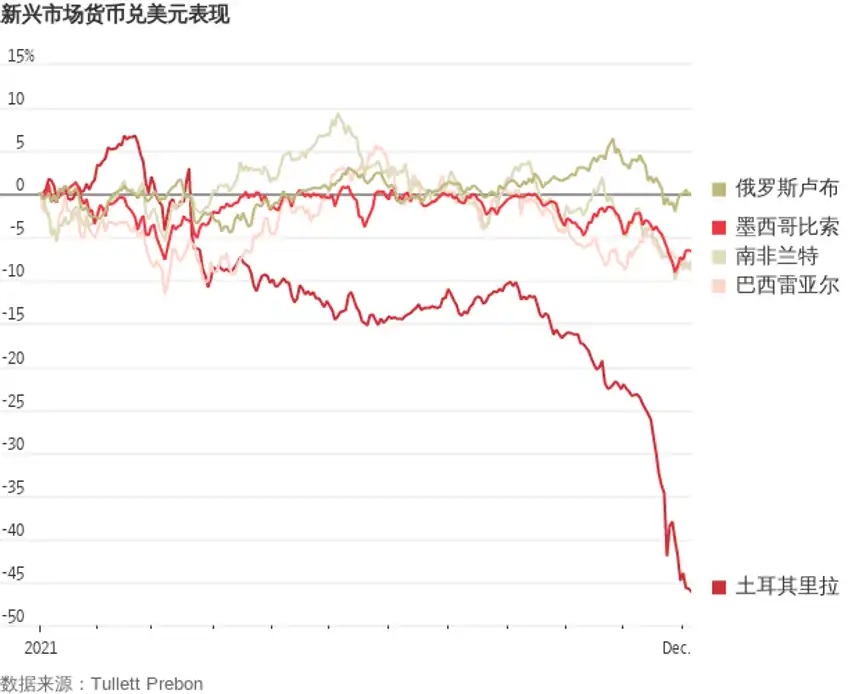
Currency depreciation has been accompanied by soaring exchange rates, rising unemployment and rising inflation. This has caused further anxiety about Türkiyes economic stability.
Subsequently, the Turkish government adopted some monetary policy adjustments, including interest rate increases and other measures, in response to the depreciation of the lira. Following these policy adjustments, the liras exchange rate recovered somewhat but remains at relatively low levels.
The global COVID-19 pandemic also had a negative impact on the Turkish economy in 2020, sending the lira into further free fall.
More importantly, after experiencing economic struggles, funds with a keen market sense, in the strong contrast between the countrys economic downturn and the ensuing crypto bull market cycle, will inevitably begin to seek safe havens and chase higher returns; so Turkey stepped into crypto. The world is also an inevitable choice under the interaction of the general economic environment and industry cycles.
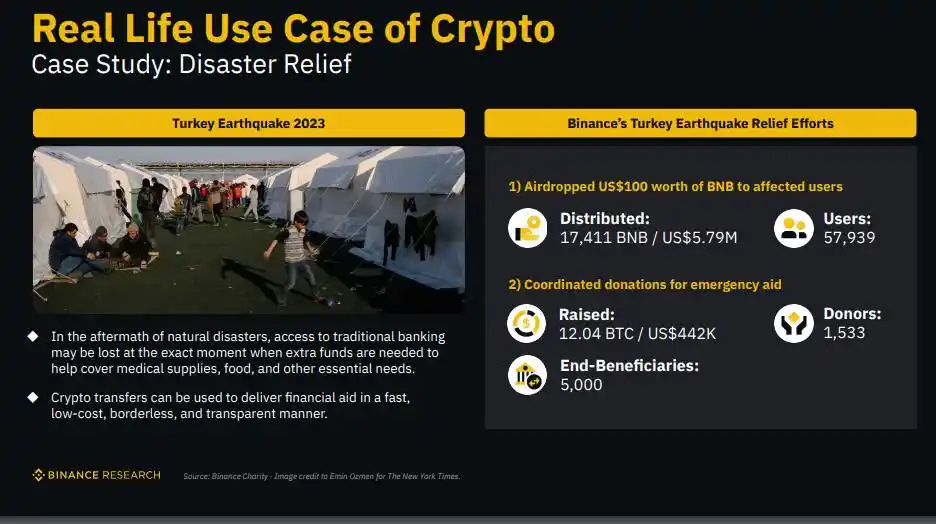
At the same time, because it is located at the junction of the Eurasian continental plates, Turkey is also deeply affected by crustal movements and earthquakes occur frequently. After the earthquake, due to the paralysis of local infrastructure, it may be difficult for the affected areas to obtain funds through the banking system in a timely manner. At this time, cryptocurrency can provide financial support for post-disaster reconstruction work in a low-cost and frictionless way.
With appropriate publicity, local users favorable impression of encryption may reach a higher level.
When Cryptoassets Become a Mature Choice
If crypto assets are popular in Turkey, what is the specific investment profile of users?
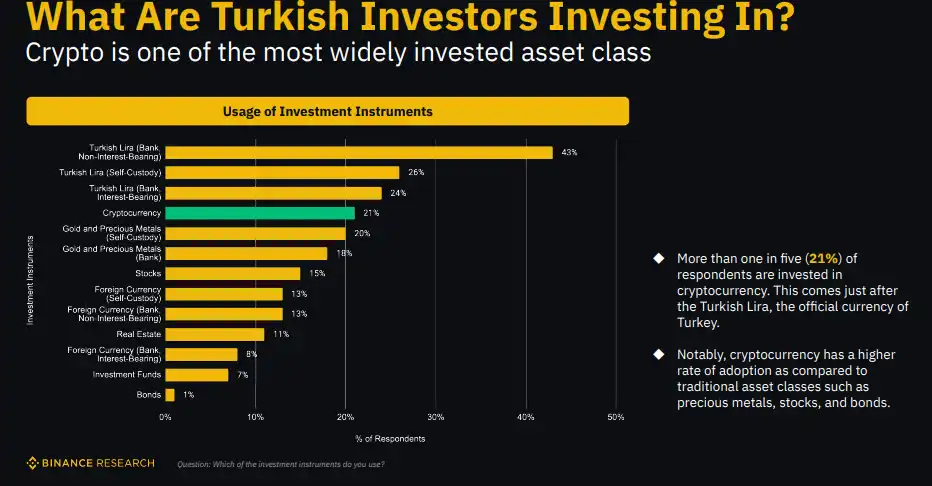
Data reported by Binance shows that crypto assets are gradually becoming a mainstream choice in the local investment category.
In addition to the interest income generated by the legal currency Lira, crypto assets have become the second most popular choice among locals, and their priority has even surpassed traditional investment categories such as bonds, stocks, and precious metals.
In terms of user habits, more than 70% of crypto asset investors open their accounts once a day, and more than 30% of them trade once a week. This kind of behavior is also in line with our own understanding. The currency circle takes a day and a year, and the same is true for Turkish users on the other side of the continent.
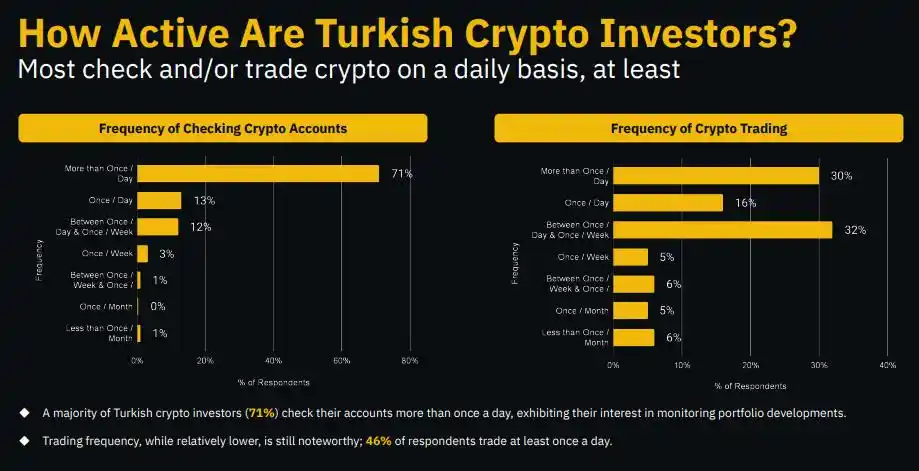
But at the same time, data shows that local users are not entirely fanatical studists and Degens.
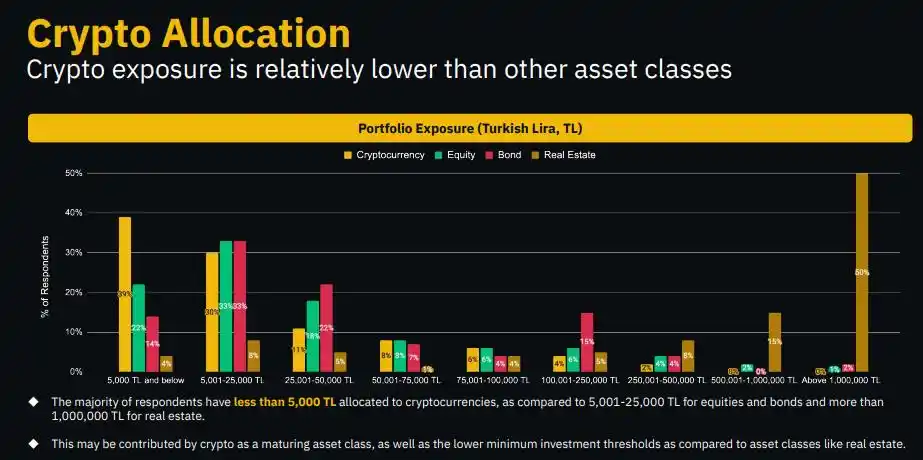
In terms of amount distribution, most users invest less than 5,000 lire in cryptocurrency, compared with more than 1 million lire in real estate, and around 25,000 lire in traditional bonds.
Despite the economic downturn and currency depreciation, house selling stud is still not a mainstream choice. On the contrary, it can be seen from the statistics in this report that local investors have diversified their fund allocation and have never regarded crypto assets as their only bet.
Finally, in terms of market expectations, 70% of Turkish respondents are strongly optimistic about the performance of cryptocurrency in the next 1-5 years.
You can be bullish, but not bullish; you can buy, but not bullish. From these figures we can see that crypto assets are only one of the investment options locally, and users are placing their bets in a more mature and calm way.
Regardless of the economic pain or the courage to try new things, it doesn’t matter what the opportunity is to enter the crypto world.
Whats more important is to take this step.
Turkey, a country at the intersection of Europe and Asia, is also at the intersection of traditional assets and crypto assets, and local residents are also actively making choices.
Of course, choosing crypto assets is to pursue its income and growth, but it is not to make a desperate move.
As more countries like this set the stage for us, Mass Adoption in the crypto world may be on the way.


