






How to predict the trend of Tax Token? Exchange premiums give answers


Original - Odaily
Author - Nan Zhi

Taxed tokens refer to tokens that users will not obtain in full when trading on a decentralized exchange (DEX), and some tokens will be destroyed or distributed as dividends. For example, assuming that the price of UNIBOT (5% sales tax) is 100 USDT, when a user spends 100 USDT to purchase, he can only receive 0.95 pieces, and similarly when selling one piece, he can only receive 95 USDT.
In the centralized exchange (CEX), there is no tax collection function and mechanism. For tax-free tokens, if there is a price difference, arbitrageurs will naturally level it. But for tax-collecting tokens, theoretically the price difference will be in a superposition of positive premium and negative premium. Let’s still take UNIBOT at the price of 100 USDT as an example:
For sellers, the negative premium on the exchange is acceptable as long as it is within -5%. For example, at a premium of -4%, 96 USDT can still be sold by switching to CEX, and there is still a profit compared to the 95 USDT on the chain;
For buyers, a positive premium within 5% can be accepted, that is, CEX transaction prices below 105 USDT are cost-effective compared to those on the chain.
Therefore, CEX’sPositive or negative premium, possibly due to the aboveThe game of power between the two finally reaches an equilibrium. Odaily first makes an assumption based on this, which will be verified below:
If traders are bearish about the market outlook and have stronger selling power, the exchange will show a sustained negative premium and the currency price will fall;
If traders are bullish about the market outlook and have stronger buying power, the exchange will show a sustained positive premium and the currency price will rise;
UNIBOT data analysis
basic rules
Analysis target: Taking UNIBOT as the first analysis object, a 5% tax is charged on the sale and purchase of this token, which is distributed to LPs, currency holders and teams respectively;
Time dimension: One hour is used as the analysis dimension;
Time span: nearly 1,600 hours, approximately 8/23 ~ 10/27;
Price value: DEX takes the average of all transaction prices within one hour (dex.prices from Dune), CEX takes Bitget data, and takes the average of the opening, closing, highest, and lowest prices of one hour;
Premium calculation: Premium rate = (CEX-DEX)/DEX.
Calculation results
Among the 1,600 hours, 790 hours had a premium exceeding +5% or -5%, accounting for nearly 50%. illustrateMarket power is too strong (overbought and oversold), orThe market power is too weak and is dominated by exchanges or market makers.。
In order to explore the relationship between positive and negative premiums and trends, Odaily records premiums above +3% as positive premiums (orange in the figure below), and below -3% as negative premiums (purple in the figure below).
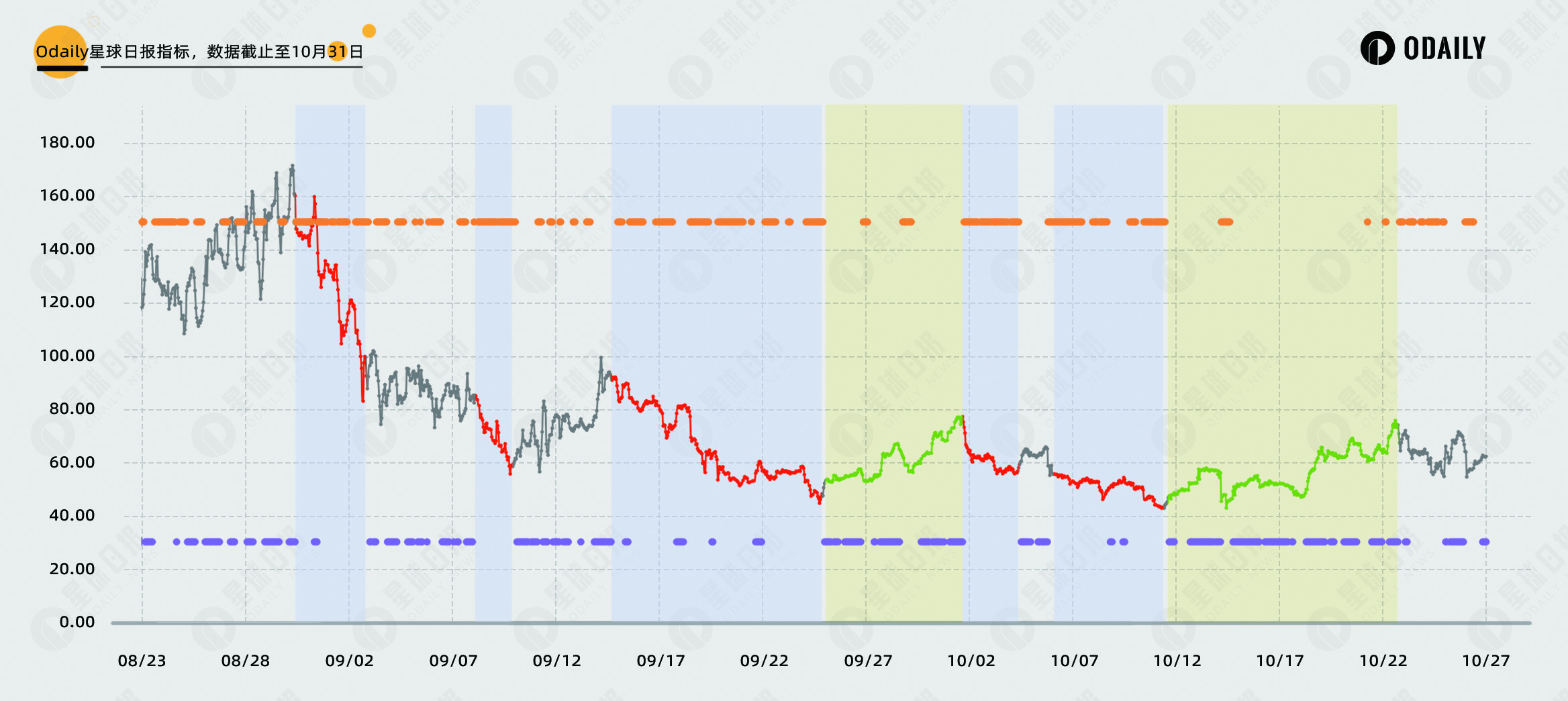
In a market, there will be continuousUnilateral premiumsituation, without the existence of premium on the other side, wouldmainforThe range of positive premiums is marked with blue shading, and the range of mainly negative premiums is marked with yellow shading.。
It can be seen from the figure that the positive and negative premium ranges have a clear relationship with the price trend, and the conclusion ① is reached, but it is completely opposite to the rule speculated at the beginning of this article:
① When the premium is positive, the price tends to fall; when the premium is negative, the price tends to rise.
In addition, there are several other derived conclusions from the figure. The premium range in this article is selected to be larger. There are also small reverse premium ranges in the large premium range, such as the 9/17 ~ 9/22 range. The positive premium is Several small negative premium intervals appeared in the main range, and within this range the price trend rebounded, but the overall trend did not reverse.
Between 9/22 and 9/27, the long-term premium changed and the trend reversed. Then on 10/2 there was another premium the trend reversed at the same time.
Therefore, the conclusion is as follows:
②The trend is related to the long-term premium situation. The short-term premium means reverse development, butDoes not change overall direction。
③After the long-term premium is converted, the overall trend reverses.
So,Are positive and negative premiums a sufficient or necessary condition for price movement? The answer is neither:
8/23 ~ 8/28 The overall trend is upward, with an increase of more than 30%, but there is no positive or negative premium range, which negates the necessary conditions;
A small premium range appeared near 10/4 and 10/24, but the price went sideways, denying the sufficient condition;
Therefore there is a conclusion④Positive and negative premiums are strongly related to the trend, but they are neither a sufficient nor a necessary condition.
Further data verification
AIMBOT
AIMBOT, the token of the automatic dog-fighting robot Aimbot, is used as the research object. This token also charges a 5% tax on sales, but has another characteristic:Transfers are also taxed 5%, this feature prevents arbitrageurs from committing fraud, and will also curb traders’ on-chain and off-chain transfers.Transactions on and off the chain will become stand-alone.
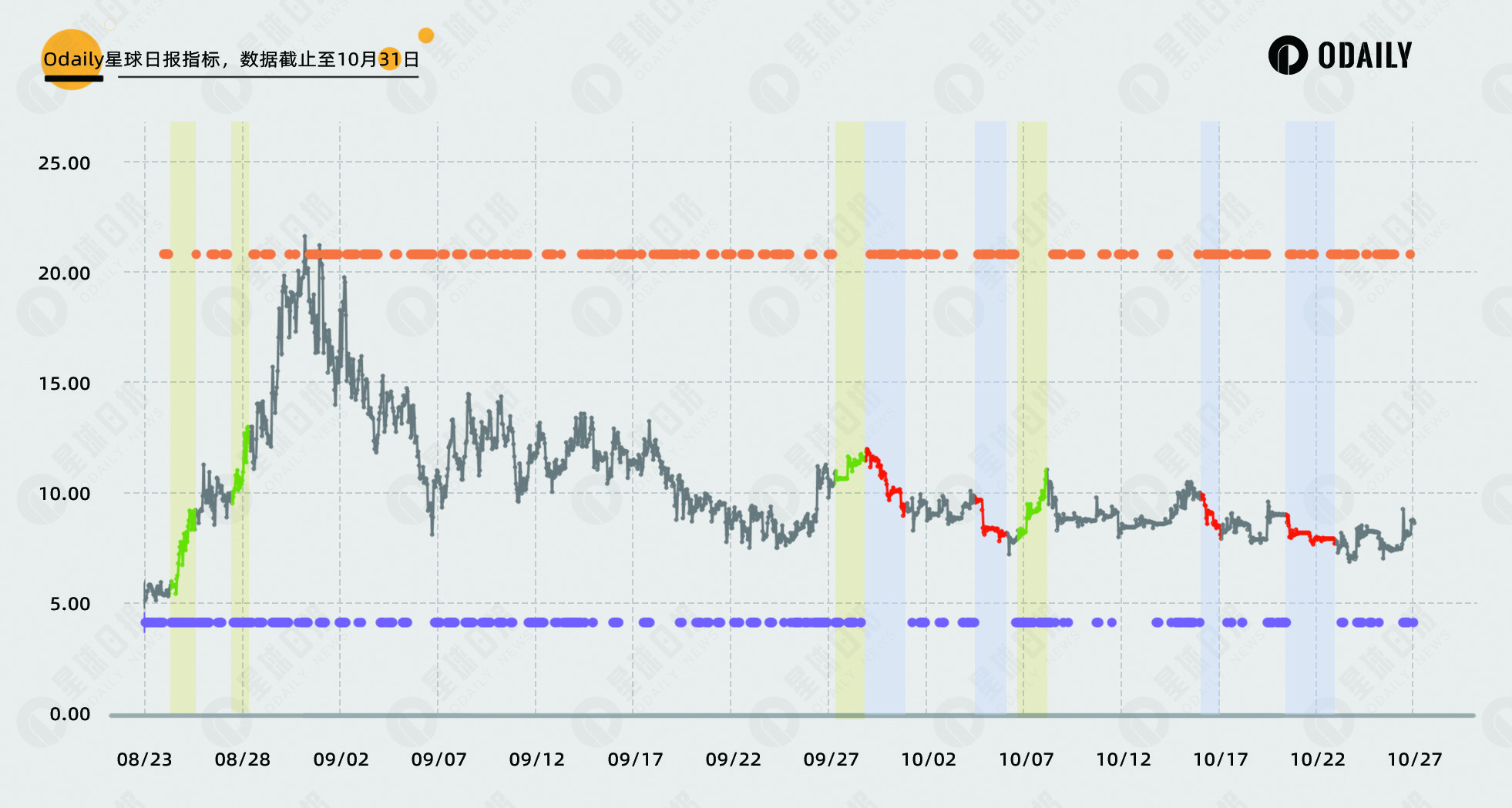
As can be seen from the above figure, AIMBOT no longer has an obvious positive and negative premium range. The stand-alone status makes the positive and negative premiums very random. However, when the range is formed, the price trend pattern is still in line with the above mentioned. New conclusions as follows:
⑤On-chain and off-chain transfer channels are a necessary condition for CEX to maintain a premium.
BANANA
The token BANANA of the Telegram trading Bot BananaGun is used as the research object. The purchase and sale of this token is taxed at 4%. The limit of positive and negative premiums is modified to ± 2%. Other conditions are consistent with UNIBOT.
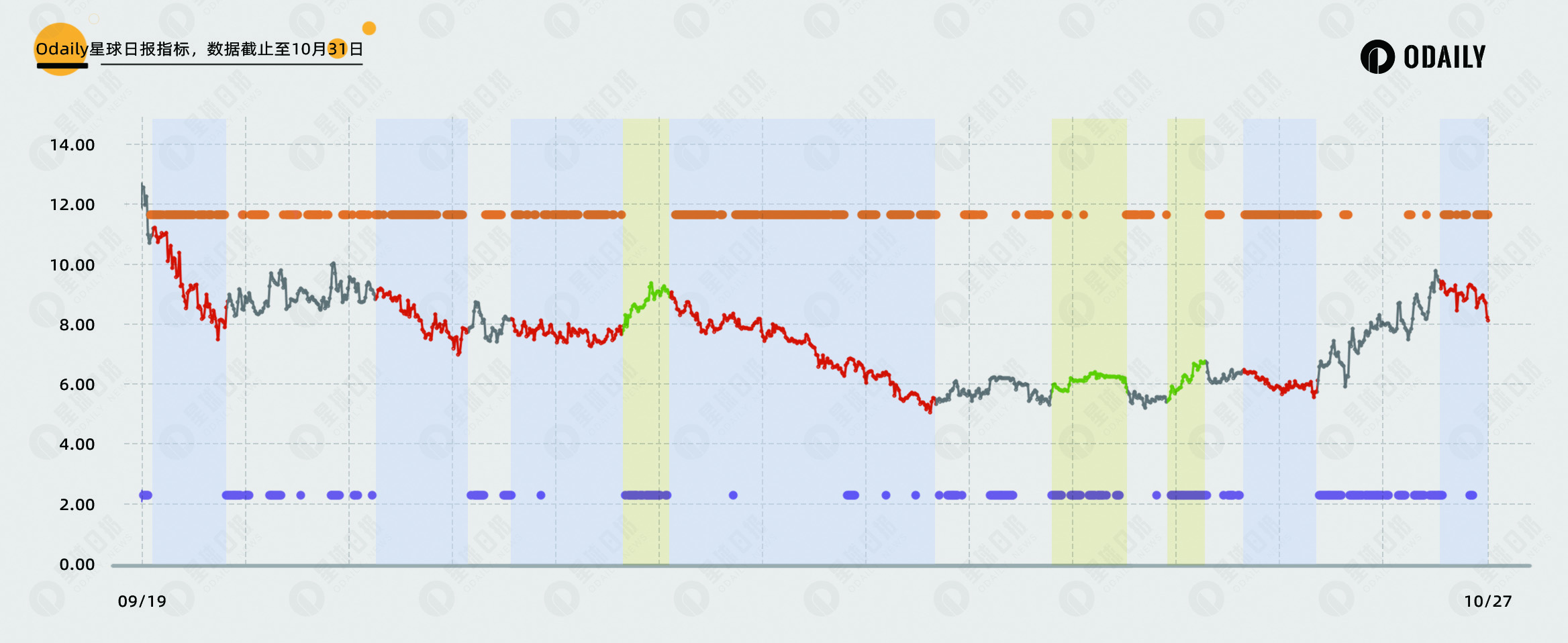
It can be seen that the correlation between the positive and negative premium ranges and price trends still exists, but the price fluctuations are not particularly obvious, which may be related to BANANA being a popular new currency.
Compared with AIMBOT, BANANA does not charge transfer fees, so the premium range has become wider and more significant again, confirming the conclusion ⑤.
in conclusion
To sum up, there is a clear correlation between the long-term premium range and the price trend. Positive premiums fall and negative premiums rise. The reversal of premiums is also one of the signals of trend reversal, but it needs to be combined with the characteristics of the token itself and the conditions of the exchange. Screening and judgment.


