






Learn about the principles and related projects of cross-chain NFT in one article


Original author: WILLIAM M. PEASTER
Original compilation: Deep Chao TechFlow
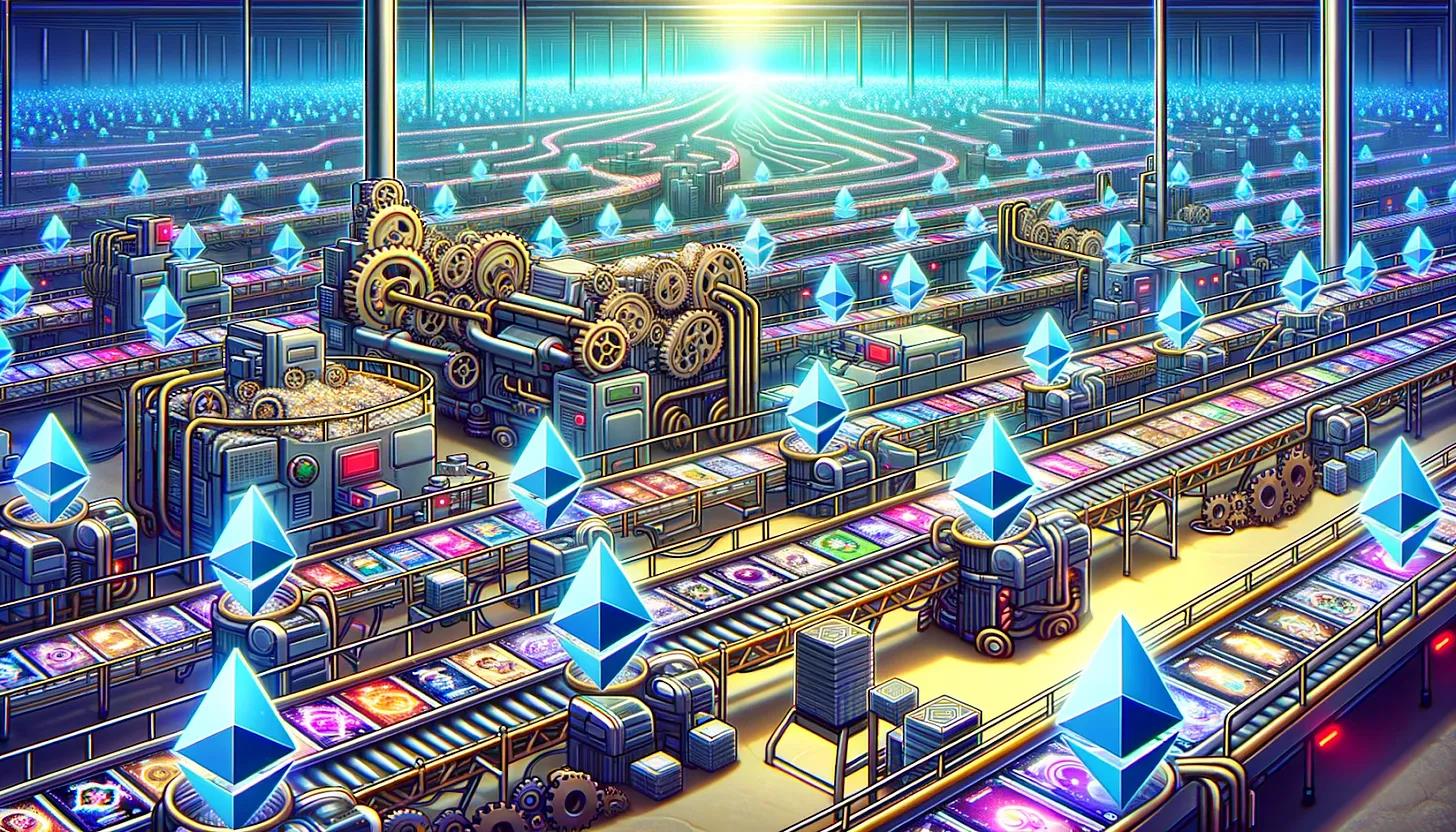
Regarding moving NFTs from one chain to another, there isn’t really one"The correct way",So far we have seen a variety of different approaches, all of which have their own trade-offs to consider.
For me, the first method that comes to mind is equivalent bridging, which is like moving an NFT from Ethereum to a different chain equivalent to Ethereum at the protocol level, such as Optimisms second-layer scaling solution.
Indeed, after the Bedrock upgrade earlier this year, Optimism has almost completely equivalent performance to Ethereum, so if you bridge an NFT from Ethereum to Optimism, it is like bridging an NFT from Ethereum to Ethereum Same.
The Quix Marketplace has offered such an NFT bridge before, but its probably just a theoretical example now - it didnt work last time I tried it.
Admittedly, we havent seen much equivalence bridging in the NFT ecosystem yet. However, it is more common to use the more primitive but also quite practical"destroy and mint", to migrate the entire collection.
so-called"destroy and mint"This means that a collection holder can destroy their NFT on one chain and then receive an officially approved re-minting on a new chain. It is usually called"bridging"experience. One example is y00ts, who used this approach twice to migrate from Solana to Polygon and then from Polygon to Ethereum.
Another approach that has gained popularity recently is that of the interoperability protocol LayerZeroFull chain NFTspromoted"lock and cast". you may already be Lil Pudgys Bridge We have seen this approach inArbitrum, BNB Chain and Polygontransfer.
The way this architecture works is that LayerZero provides a smart contract system that can convert ordinary NFTs into ONFTs (full-chain NFTs), and then you can deploy ONFTs on the chains supported by LayerZero.
Then, to achieve cross-chain transfer, the ONFT is locked on the source chain and minted on the target chain. To achieve the return trip, the ONFT is locked on the new source chain and the original NFT is unlocked on the original source chain.
However, LayerZero is just an interoperability protocol. One project that is apparently working on supporting both LayerZero and other messaging protocols is Holograph。
Specifically, Holograph has created a"Holographic Assets"One of the new primitives, one example of which is hNFTs, allows you to mint NFTs that maintain the same contract address and token ID across all EVM environments, making them perfectly transferable between different blockchains.
Holograph is working to use hNFTs as a standard for tokenizing real-world assets,"Separate the asset layer from the blockchain layer"。
However, regarding other messaging protocols, one that shows great potential is Chainlink’s new Cross-Chain Interoperability Protocol (CCIP). certainly,CCIP The system aims to do more than just support cross-chain NFTs, it can also excel in a range of use cases such asCross-chain games, cross-chain NFTfi and general NFTs. DeFi project Affine is leveraging the system exclusively to support its Affine Pass NFTs。
So while some efforts, like CCIP, hope to provide a way to make everything cross-chain compatible, on the other hand, some projects are building customized cross-chain solutions for their own specific needs.
In this regard, I think of the on-chain RPG Pirate Nation, as it developed a custom"mirror"system that can promote"Trading on L1/Playing on L2": The original Founder Pirates NFTs remain on Ethereum, while their mirrors support gas-free gaming on Arbitrum Nova.
This concept brings us back to having NFTs on one chain without having to move them across chains to have them on another chain"use"situation. This practicality comes from things likeUMA’s Optimistic OracleSuch a service can consider NFTs on one chain while performing corresponding operations on another chain.
It is obvious that when it comes to NFTs, the boundaries between different blockchains are gradually blurring, and various cross-chain efforts are gradually coming to the fore. In the short term, this area will face challenges and obstacles, but there will also be new possibilities, new innovations, and new experiences.





