


LD Capital Macro Weekly Report (10.16): What do you think of the current increase in geopolitical risks?


Market Overview
The conflict in the Middle East exceeded market expectations and was likely to escalate. The market showed a clear risk aversion trend in the second half of last week and re-priced prices. During this period, the U.S. 30-year Treasury bond auction was sluggish, and the yields rose for a time, but they were not affected by the geopolitical conflict. In the end, long-term yields fell significantly throughout the week, the stock market fell, gold, silver, and oil soared, and cryptocurrencies fell.
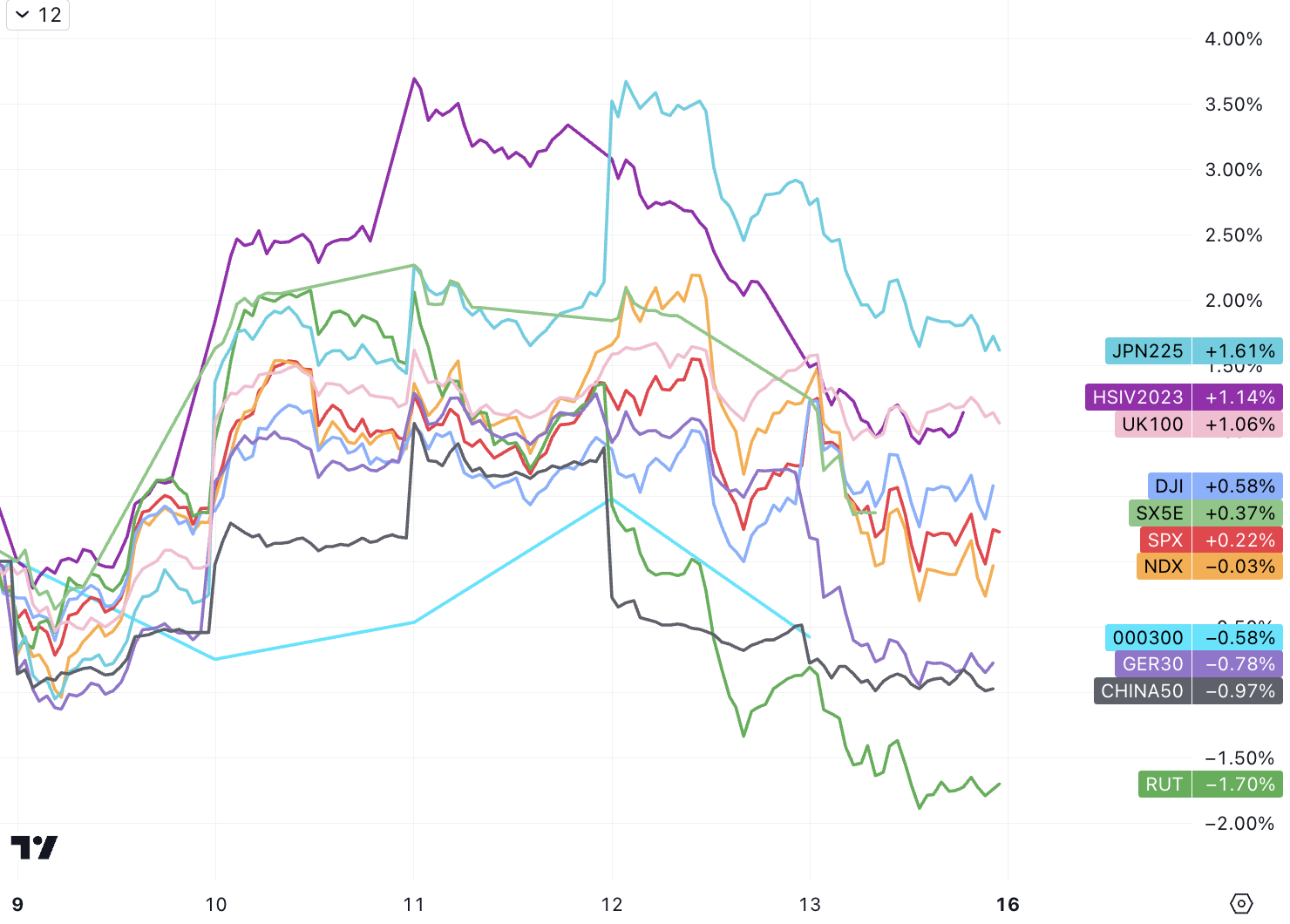
In terms of global stock markets, as we mentioned in last weeks morning meeting, the stock market did not give much consideration to the Palestinian-Israeli conflict in the first half of the period, and was still digesting the positive impact of the dovish tone of many Fed officials, leading to an overall rise. During Thursday and Friday, the U.S. 30yr auction was cold, CPI slightly exceeded expectations, initial jobless claims were better than expected, inflation survey expectations rose, and the Palestinian-Israeli conflict did not develop in a positive direction but further escalated. However, the price fell sharply. Japanese stocks, U.S. stocks, and Hong Kong stocks still closed higher for the whole week:
Last weeks U.S. earnings season got off to a good start. JPMorgan Chase, Wells Fargo, and Citigroups Q3 results were outstanding, and their main profit sources, net interest income and revenue figures, exceeded expectations. Previously, some people were worried that the increase in bad debts caused by credit deterioration and competition caused by rising deposit costs may lead to a decline in banks net interest income. However, in fact, these two points have not yet been reflected. At present, they only reflect the impact of the rising interest rate environment. The positive side of interest rate spread expansion.
Gold performed strongly throughout the week, and BTC failed to reflect its safe-haven properties this time. It briefly rose after news on Friday that the SEC did not plan to appeal the courts ruling on the Grayscale Bitcoin ETF. This incident will cause the SEC to re-examine Grayscales application, but it can still reject it on other grounds:
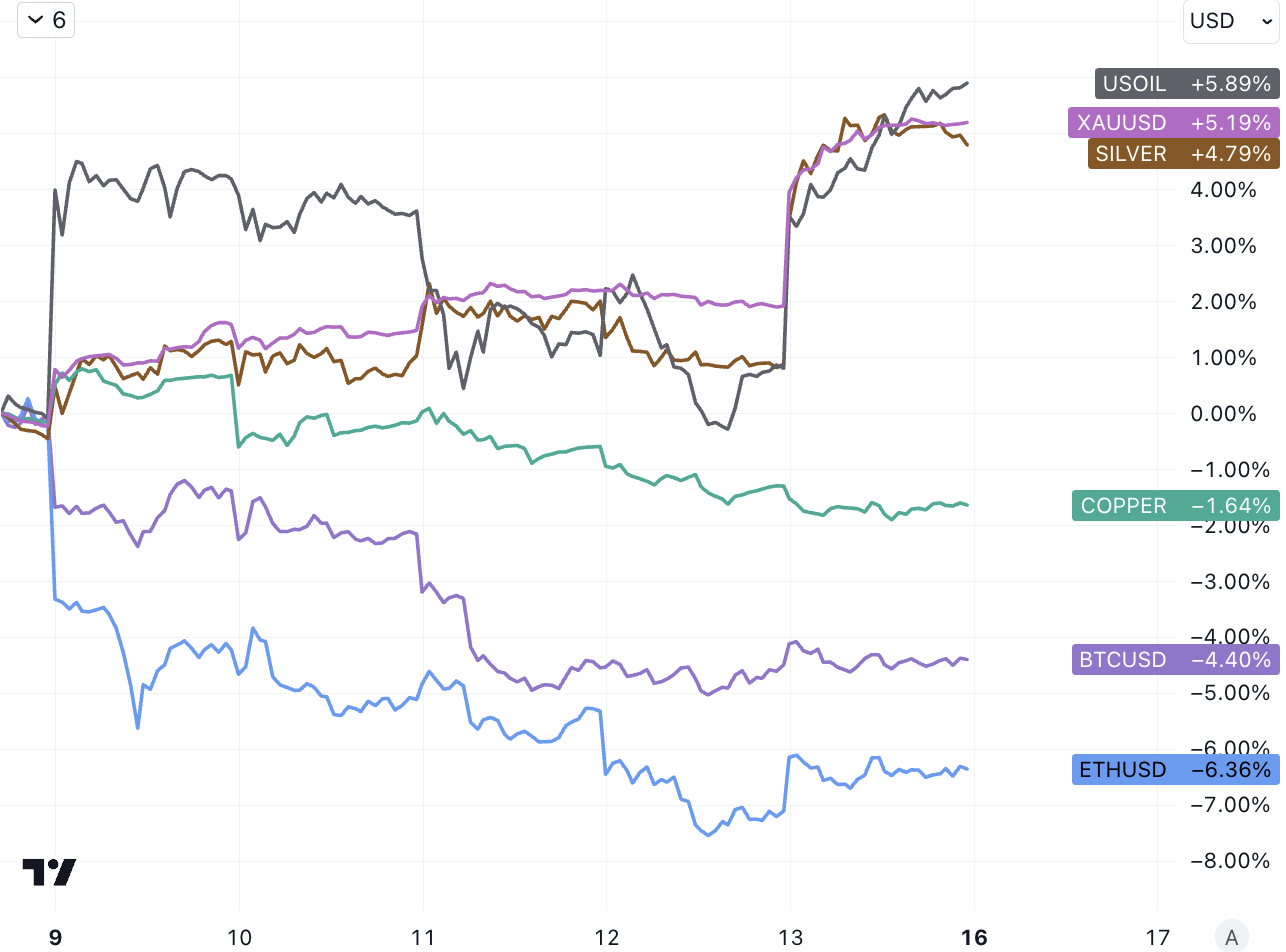
The price of crude oil rose sharply by 6%, but an optimistic view is that the actual price of oil is already very high, and it is difficult to imagine that it will rise two or three times from the current level. The global economy is far less oil-intensive than before, so the situation in the Middle East is of great significance to The impact on the actual economy and inflation process will be very limited, which may be the reason why the market ignored geopolitical risks in the first half of the period.
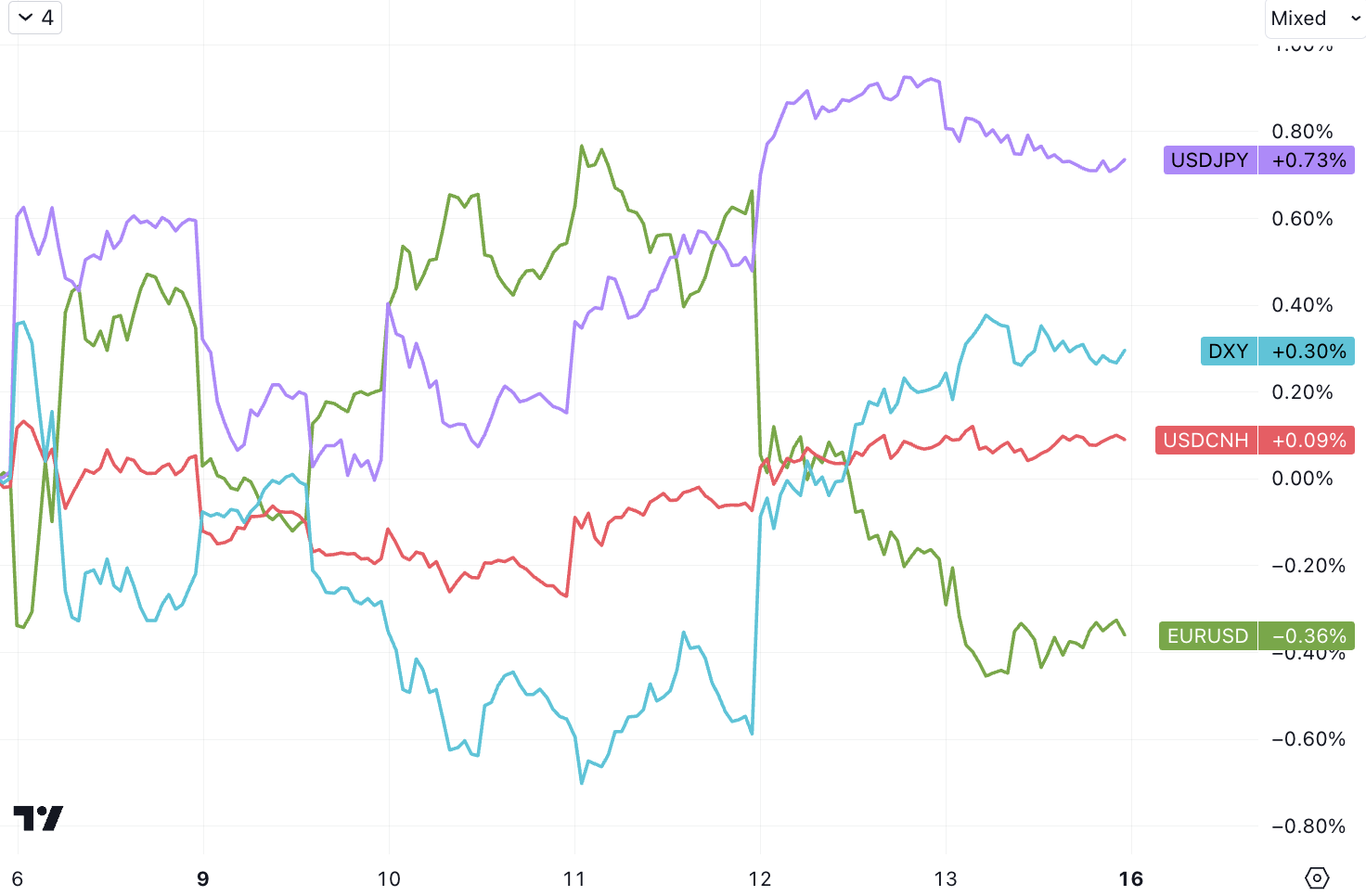
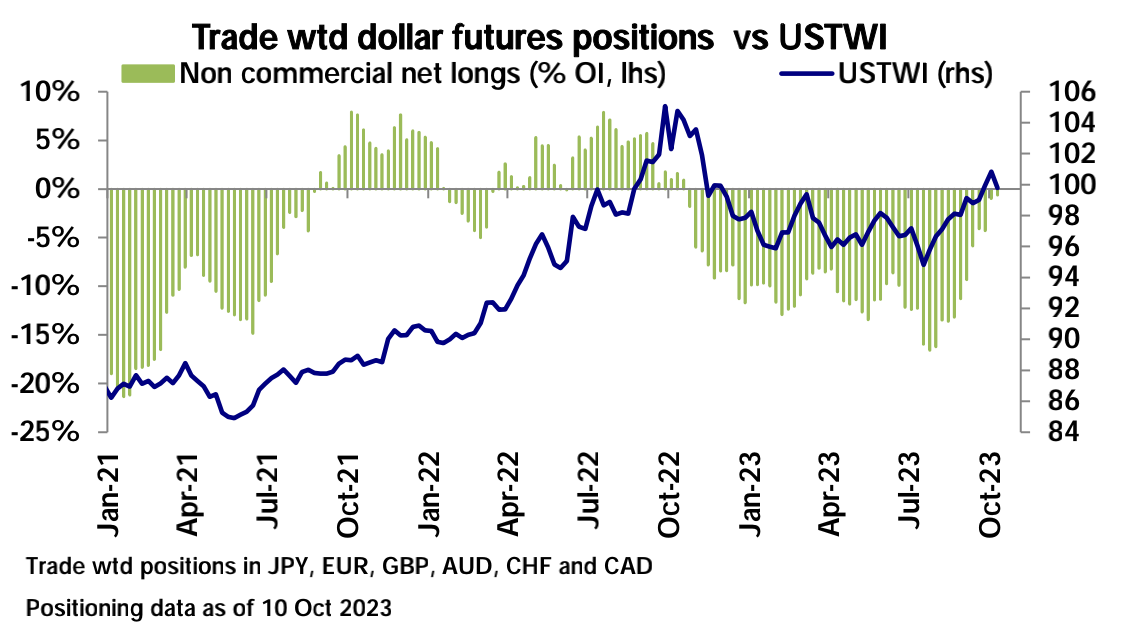
The U.S. dollar has only corrected for a week and rebounded strongly last week. DXY returned to above 106.6, and USDJPY continued to fluctuate at high levels near the 150 integer:
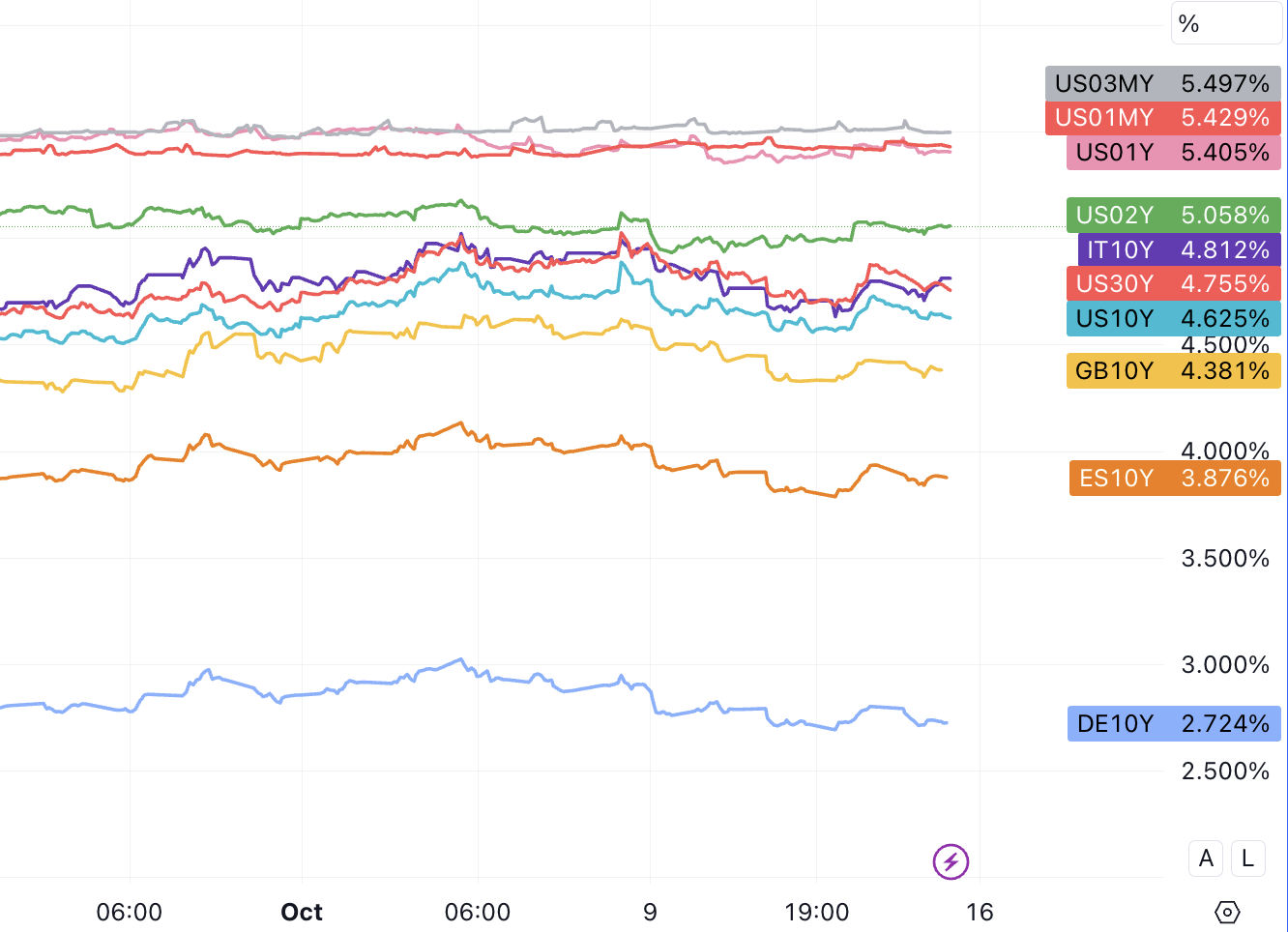
Long-term interest rates have fallen significantly, while short-term interest rates have not changed much. Issues on the supply side of bonds attracted market attention last week.
The three new auctions last week all had lower prices than expected, especially the last one of 30 yr. Not only was the yield a new high since 2007, but the overall subscription multiple also shrank significantly. Prior to the 30 yr auction, Treasury yields had already risen a large part due to CPI and jobless claims data, in other words, an early price promotion. But terminal demand is still not ideal.
The U.S. federal budget deficit will be US$1.7 trillion in fiscal year 2023 and US$1.38 trillion in fiscal year 2022. The lack of fiscal discipline is the main reason for the pessimistic market sentiment. The results of this auction are superimposed on the Treasury Department’s expansion of 4-week, 8-week, and 17-week bill issuances the day before. The scale is the highest in history. It is reminiscent of the repeat of the Q3 daily volume financing plan announced by the U.S. Treasury Department in August (10 yr 3 weeks 4 % soared to 4.46%). What is different now from August is that the Fed is slightly looser on the prospect of monetary policy tightening, but the U.S. bond yields are much higher. So now there are some opinions that if you want to suppress the rising momentum of yields this time, Powell will have to personally come out and make a dovish statement, so now is a good time to be asymmetrically long on U.S. bonds, including gold, silver, and even cryptocurrencies. .
The bond market is currently more volatile than the stock market, with the $39 billion iShares 20+ Year Treasury Bond ETF (TLT) having three-month implied volatility more than 4 percentage points higher than the SPDR SP 500 ETF (SPY). Reversing their traditional relationship, bond ETF volatility typically averages more than 3 percentage points lower. Even though TLT is down 37% over the past two years, investors have continued to pile into TLT funds, betting on the potential for outsized returns once yields start to fall.
Also worth living is that Italys 10 yr is already close to 5%, which is the highest level since the end of the Eurozone debt crisis in 2012. This is worrying because Italy is one of the most indebted members of the euro zone, and its government’s spending plans remain aggressive and considered unsustainable by many market players. Italy’s public debt is 145% of GDP, which is higher than in 2012. It was about 15 percentage points higher than during the 2002 crisis. Will another debt crisis in the Eurozone come?
Whether the Federal Reserve has completed its interest rate hike cycle is an important issue. The current market bias is that the labor market has loosened and inflation data has softened, and the FOMC should give up on the last interest rate hike. A pause in interest rate hikes at the next meeting can make it easier to reach consensus within the FOMC. And if fourth-quarter growth and inflation data develop as expected, the case for a rate hike in December is not strong.
How to view geo-risk
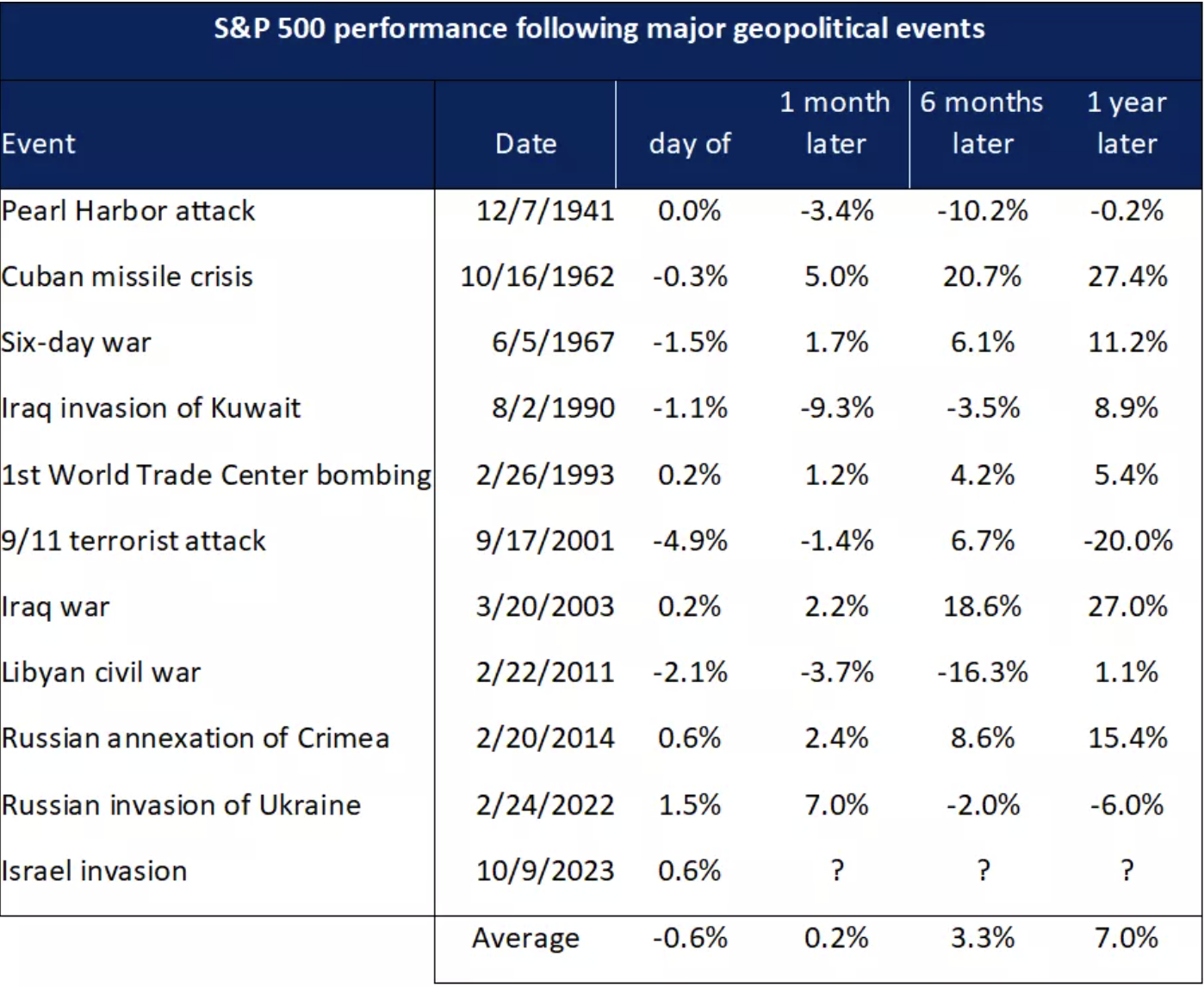
Investors are naturally averse to uncertainty, and stock markets may fall in the short term following a conflict, but the impact is usually temporary. Looking back at history, in most cases, even if the stock market performs poorly in the month after a conflict, the stock market rebounds six months or a year later. The main driver of stock market value is sustainable profitability, and the impact of geopolitical events will most likely be overshadowed by fundamentals.
Impact on the investment industry: In the context of rising geopolitical risks, the significance of quantitative models used for asset pricing and trend judgment will become weaker. Decades of relative stability, underpinned by growing global trade and few political shocks, have made it easier to forecast macroeconomic variables such as growth, interest rates and inflation. It is relatively easy to assess how these values will evolve when the basic assumptions about the world are fewer and simpler.
Today, the economy is increasingly influenced by politics and foreign policy, which has its own meaning beyond charts, balance sheets and ratios. Trying to parse geopolitical events will only introduce more human error into the market. However, some research shows that market fluctuations have expanded the return range of active funds, and the time has come to test the ability of fund managers. In a high-volatility environment, portfolio diversification becomes attractive, including commodities, cryptoassets, art and other alternative assets.
The risk point of the current situation in the Middle East: Will more major/energy powers such as Iran, the United States, Saudi Arabia and even Russia be involved? Extreme tail risks - for example, will there be a war in the Taiwan Strait, or will Russia use nuclear weapons in Ukraine?
Markets tend to behave in patterns that tend to either see risks as manageable with minimal price disturbances, or so catastrophic that exposures are abandoned entirely. Will jump between two extremes without gradually evolving.
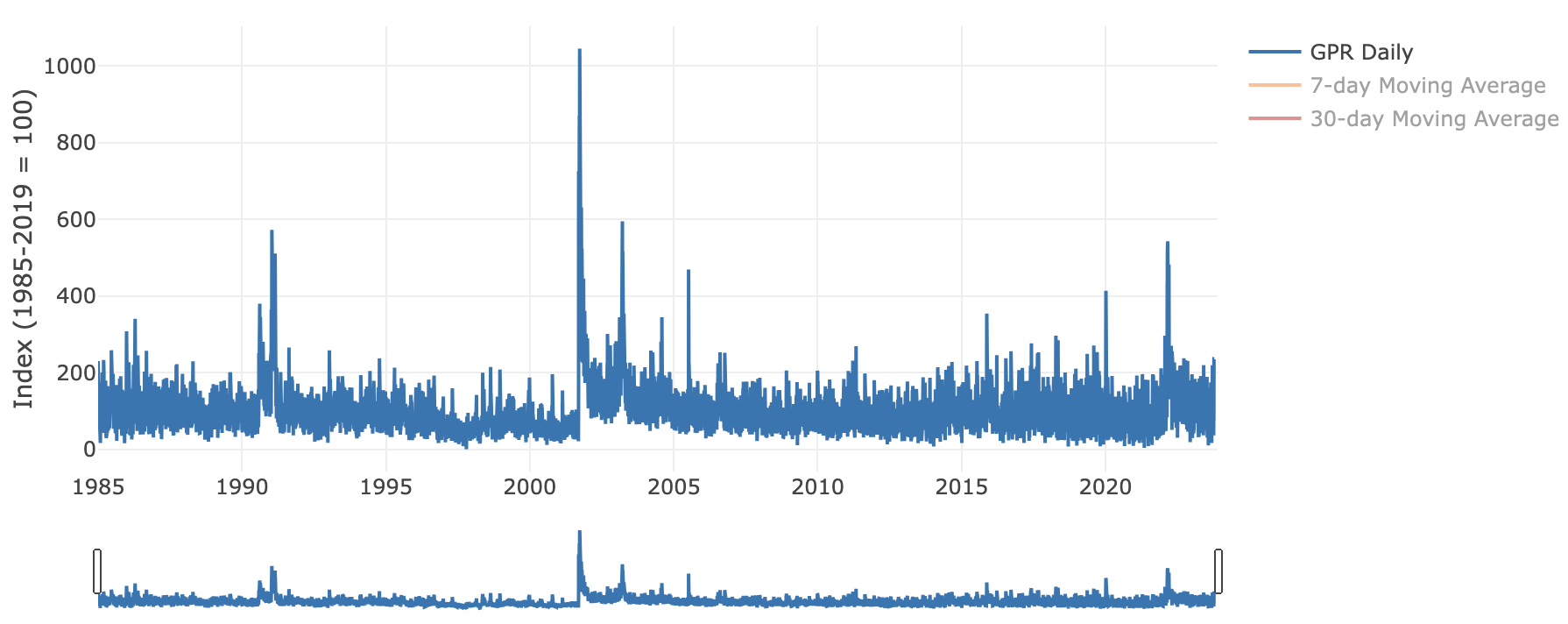
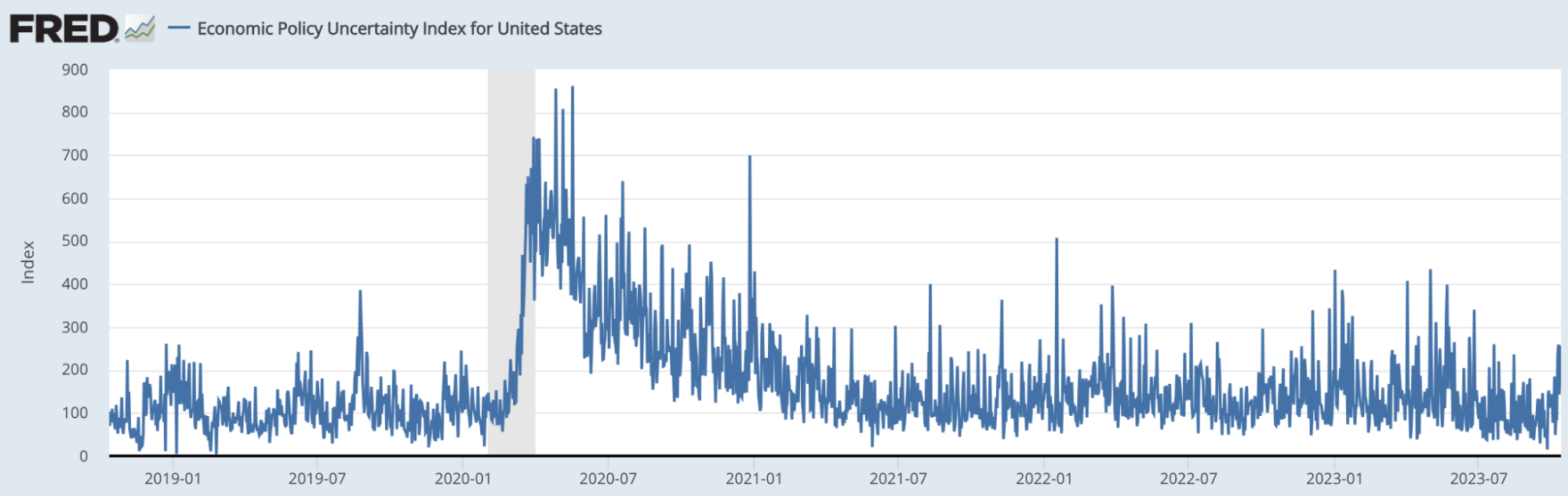
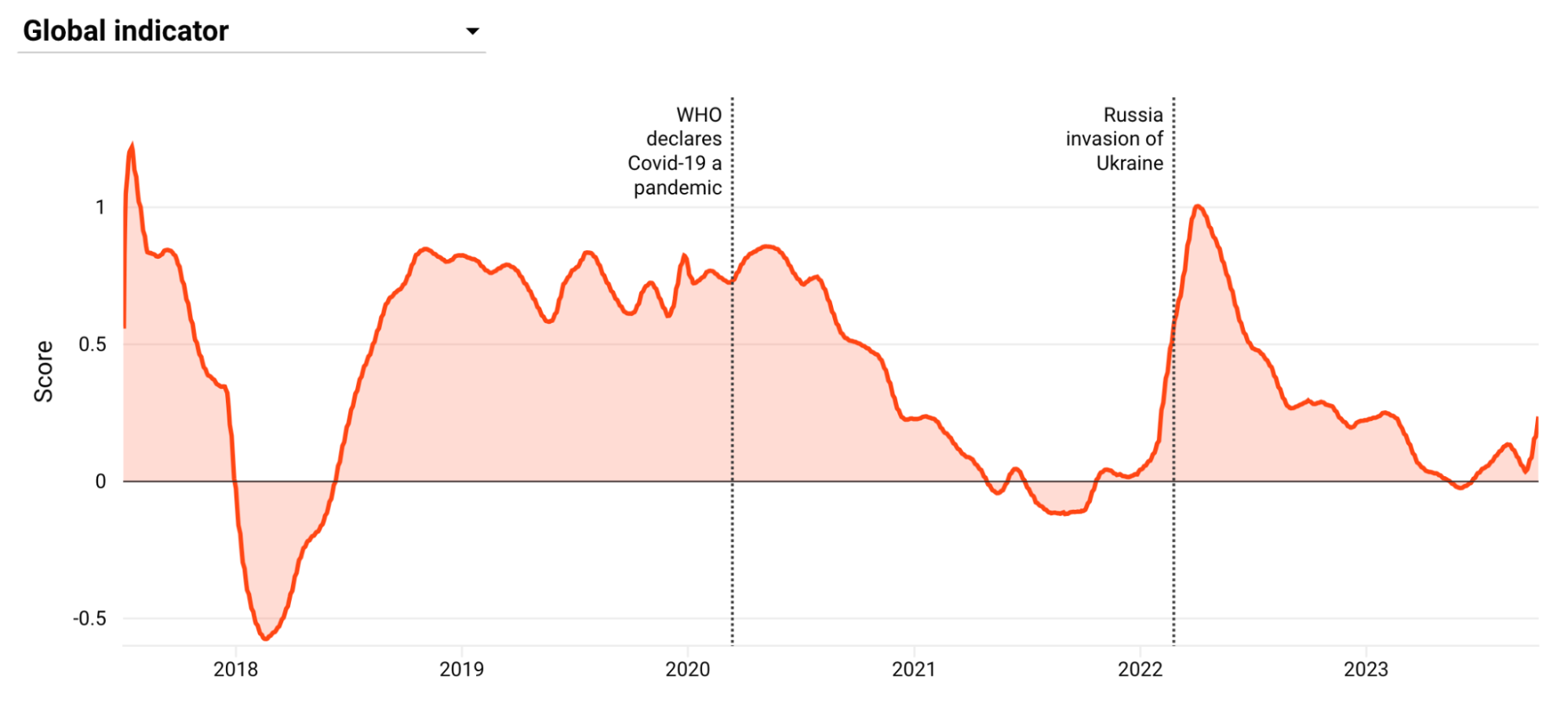
The three risk indexes with high frequency updates (the principle is to capture the frequency of keywords related to specific risks in analyst reports or traditional and social media and the related emotions) have not yet increased significantly:
Dario Caldara and Matteo Iacoviello‘s geopolitical risk (GPR) index:
Economic Policy Uncertainty Index for United States:
BlackRock chart on its Geopolitical Risk Indicator:
Market news
Early on Friday morning, the media reported that Israel required the entire population of Gazas arrested area to move to the south. The news shocked the world and became the biggest driver of the market. Western media, including BBC and CNN, were discussing the fact that half of Gazas population is children. A phenomenon in which public opinion is not as one-sided as Israel was during the previous weekend.
Israeli Prime Minister Benjamin Netanyahu vowed on Sunday to destroy Hamas and Hamas told local residents to ignore Israels message of moving south. The World Health Organization said Israels order to evacuate 22 hospitals in Gaza was a death sentence for the sick and wounded.
(Israel has invaded Gaza twice with force. The first was Operation Cast Lead, a 15-day ground invasion in January 2009. At that time, the IDF occupied territory near the border with the aim of closing the border for smuggling food, fighters and weapons tunnels.
The second was Operation Protective Edge in 2014, during which the IDF stayed on the ground for 19 days.
Now a third ground invasion was imminent. It looks likely to be bigger, longer, and more violent than ever before. Gaza is a densely populated area of over 2 million people, and Isreal is extremely vengeful and anything can happen in a fit of rage. And Hamas has deep roots in Gaza, rooted in a range of charities, schools and mosques. Separating Hamas from Gaza is an almost impossible task. As early as 14 years ago, Hamas had hundreds of kilometers of tunnels in Gaza. Now Trump tweeted that there are actually two Gazas, one above ground and one underground. You can imagine the scale of this gaza underground right now. The latest news now is that Isreal and Hezbollah have exchanged fire on the Israel-Lebanon border. Hezbollah claims to be equipped with high-precision weapons. Pray for world peace this weekend)
Gaza said on Sunday that Israeli retaliatory attacks had so far killed more than 2,450 people, a quarter of them children, and injured nearly 10,000. Lebanese Hezbollah announced that it would also start mutual attacks with Israel over the weekend. Experts speculate that the Israeli armys ground attack on Gaza may be used as a point of entry into the war.
Just in the early hours of this morning, Iranian officials stated that they would no longer stand by and watch. If crimes continue to be committed in Saudi Arabia tomorrow, it will be too late.
The overall CPI of the United States rose more than expected in September. The core CPI rose by 0.3% month-on-month for the second consecutive month due to the difficulty in reducing housing inflation. The last mile of the Federal Reserves anti-inflation effort is quite difficult. Taken together, the stickiness of housing projects is this The main reason for the higher-than-expected sub-nominal inflation is energy and food, which have always had high volatility. Commodities excluding energy and food have already made a negative contribution. Among core service items, the month-on-month growth rate of the housing index accelerated from 0.3% to 0.6% in September, the rent index increased by 0.5%, and the owners equivalent rent index increased by 0.6% month-on-month.
The U.S. Treasury Department expanded its four-week, eight-week, and 17-week Treasury bill issuances to the largest ever. U.S. Treasury Secretary Yellen said the United States has not ruled out imposing new sanctions on Iran.
Foreign media reported that China is considering establishing a new stock market stabilization fund worth hundreds of billions of yuan. The scheme may invest in domestic equities through existing financial institutions and professionally managed funds. In addition to government funds, institutions will also make matching contributions.
Since October, a growing number of Fed officials have spoken and highlighted repeated references to the recent tightening of financial conditions that, if sustained, could offset the need for further rate hikes.
Logan said if long-term rates remain elevated due to higher term premiums, the need for further rate hikes may be reduced, although the FOMC may need to take more action if a strong economy is the cause of higher long-term rates.
Daly said it is absolutely conceivable that the neutral interest rate will be adjusted to around 2.5% ~ 3%, and the tightening financial conditions may be equivalent to an interest rate hike.
Bostic said the Fed wont have to raise rates again unless falling inflation stalls. I don’t think the U.S. will enter a recession.
Collins said he is realistically optimistic about achieving a soft landing, which could be close to, or could be at, peak interest rates.
Jefferson said he is closely watching changes in yields and is in a key position to closely evaluate how much monetary policy can be tightened. Looking ahead, he said he is clear that higher bond yields will lead to tighter financial conditions.
The University of Michigans consumer confidence index fell across the board, while inflation expectations, both short- and long-term, rose across the board.
The UAW has expanded the strike to include a FORD plant in Kentuky, and FORD now says it cant agree to more than the UAW is asking for. Kaiser said it has reached a preliminary agreement with the union, at least the scale of the strike will not expand.
On Friday, Scalise announced his withdrawal from the race for Speaker of the House of Representatives. Trump supporter Jim Jordan, who was previously defeated by Scalise, was nominated within the GOP. Kevin McCarthy, who had just been dismissed, expressed his support for Jordan to take over his position. There was a lot of support within the Republican Party for McCarthy a few weeks ago. Angry that compromise with Democrats averted a partial government shutdown.
Some Democrats criticized Jordans previous remarks for inciting a mob to break into Congress in early 2021. This persons political leanings are conservative, but in the eyes of the far right within the Republican Party, he is obviously not conservative enough, so these people do not support Jordans election.
Judging from preliminary statistics, Jordan still cannot gain enough internal support, which may lead to the continued failure of the Republican Party. If the House of Representatives cannot function normally, no legislation can be passed in Congress and submitted to the president.
The IRS issued a notice to Microsoft demanding up to $28.9 billion in taxes. Microsoft plans to challenge the notices through administrative appeals and is willing to pursue judicial proceedings if necessary. There is also good news for Microsoft, with the UK Competition and Markets Authority (CMA) approving Microsofts $69 billion acquisition of Activision Blizzard. This acquisition, which set a record in gaming history, was finally finalized after 20 months. After the completion of this transaction, it means that Microsoft will become the third highest revenue gaming company in the world, second only to Tencent and Sony.
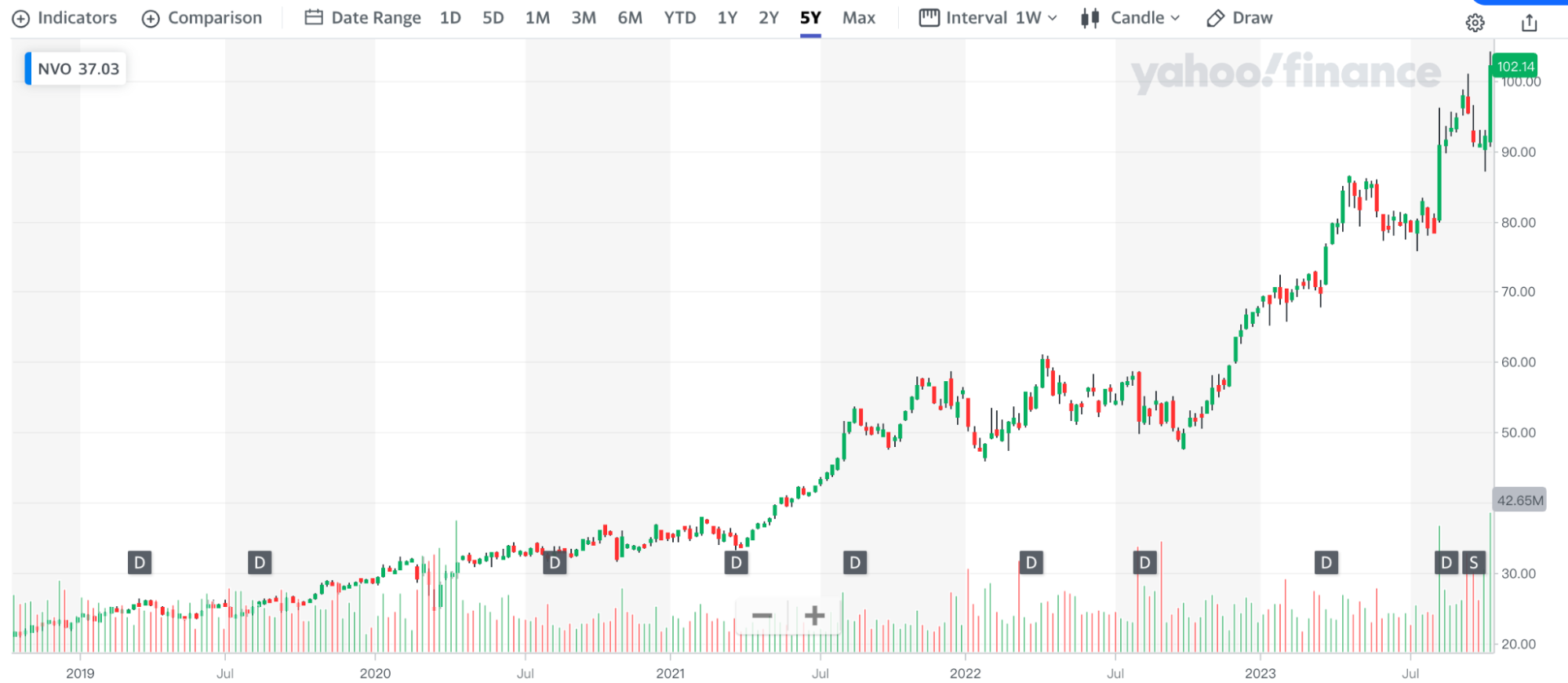
The miracle weight loss drug is so popular that Novo Nordisk raised its forecast three times last year, raising its full-year revenue growth forecast from 27-33% to 32%-38%, and increasing its pre-tax profit (EBIT). Expectations were raised to 40-46% from the previous 31-37%, with analysts expecting growth of 37.5%. Affected by this, Novo Nordisks stock price once rose by more than 5%, hitting a record high, and has risen by nearly 50% since the beginning of the year. Its market capitalization surpassed that of luxury goods giant LVMH, making it the most valuable company in Europe.
Positions and Fund Flow
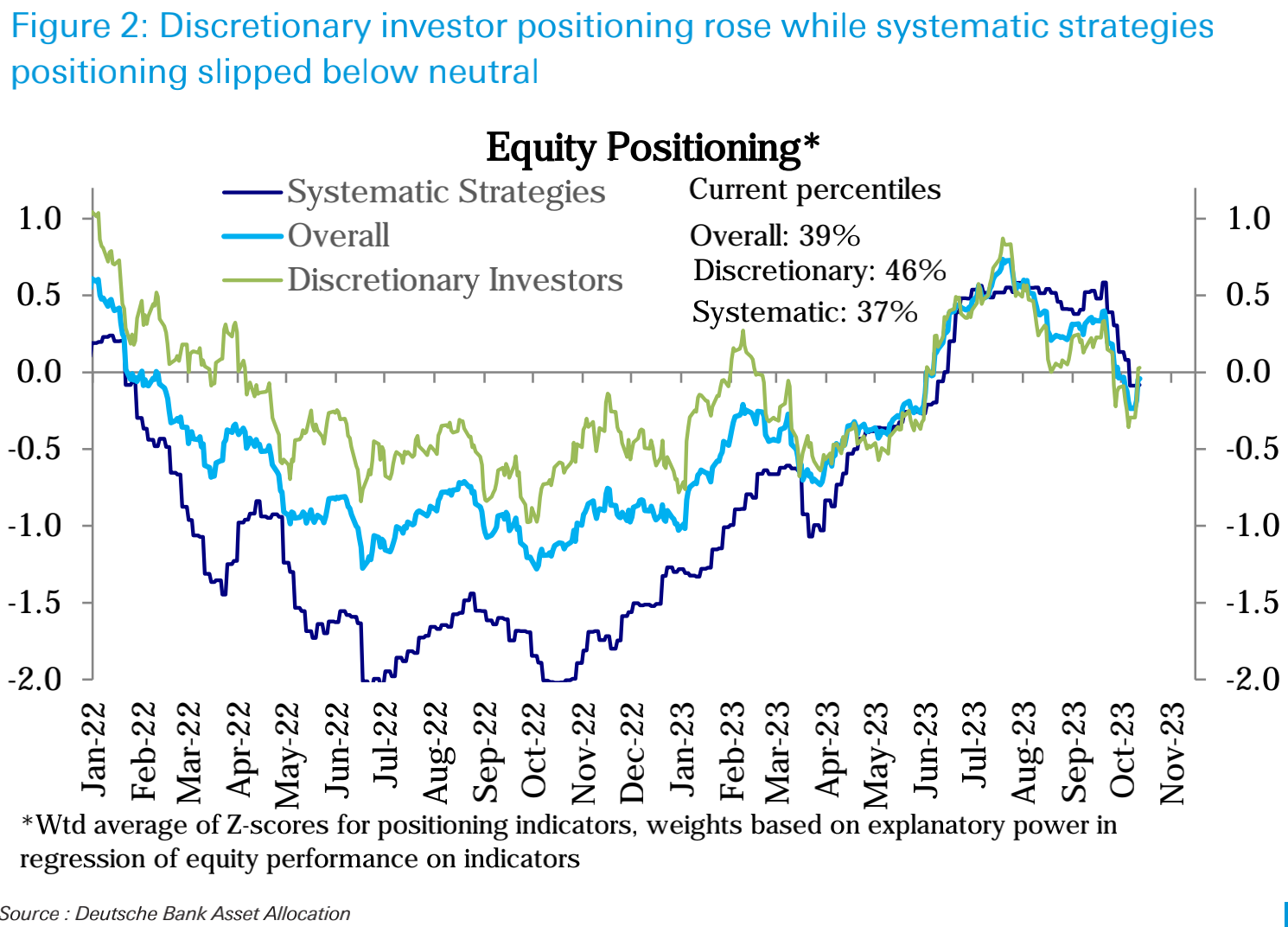
Subjective investor positions moved from moderate short to neutral (46th percentile), while systematic strategy positions fell to just below neutral (37th percentile):
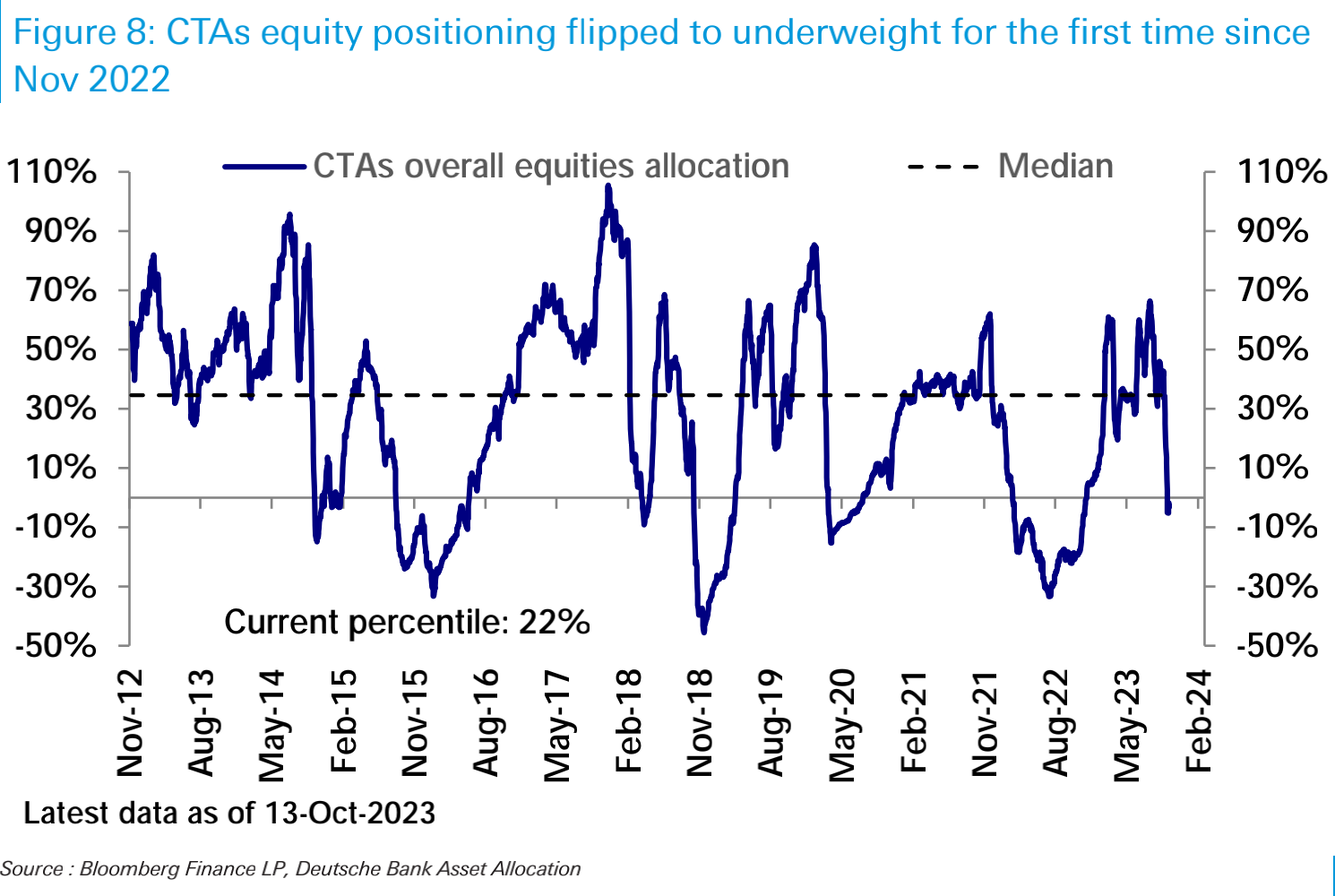
It is worth noting that CTA funds overall turned bearish on the stock market for the first time in nearly a year:
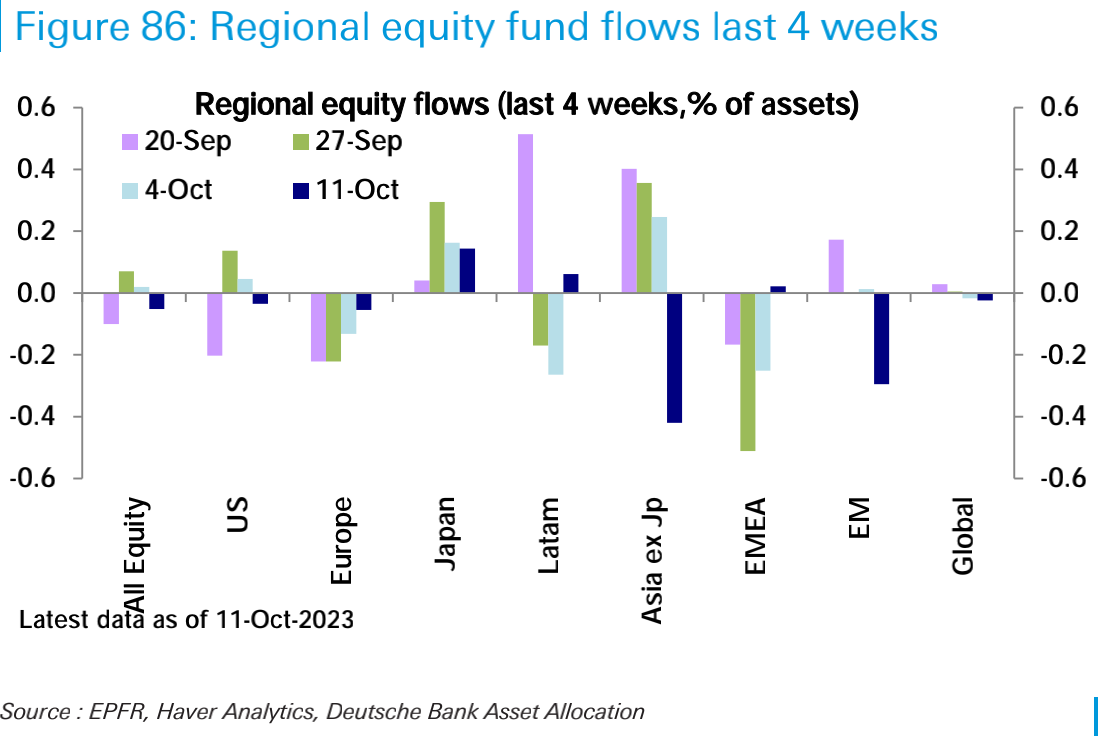
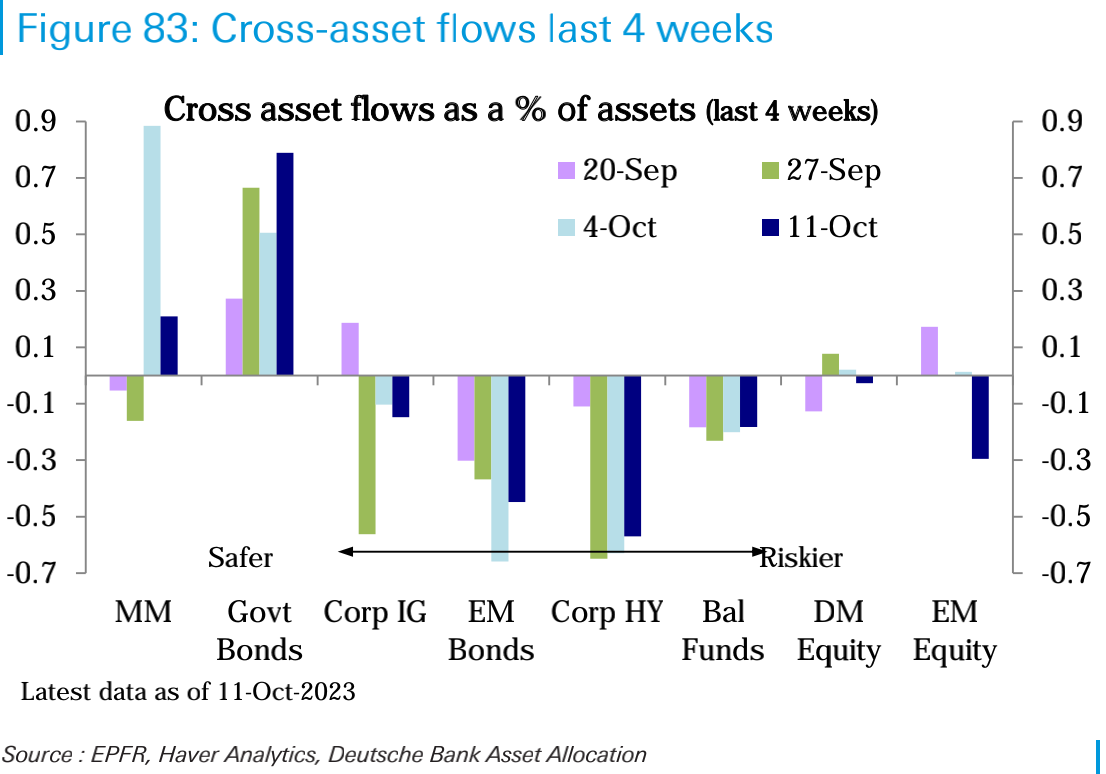
Equity funds saw net outflows of $8.2 billion this week, ending a streak of net inflows in the previous two weeks. Emerging markets ($4.3 billion outflows) and the United States ($3.0 billion outflows) led outflows
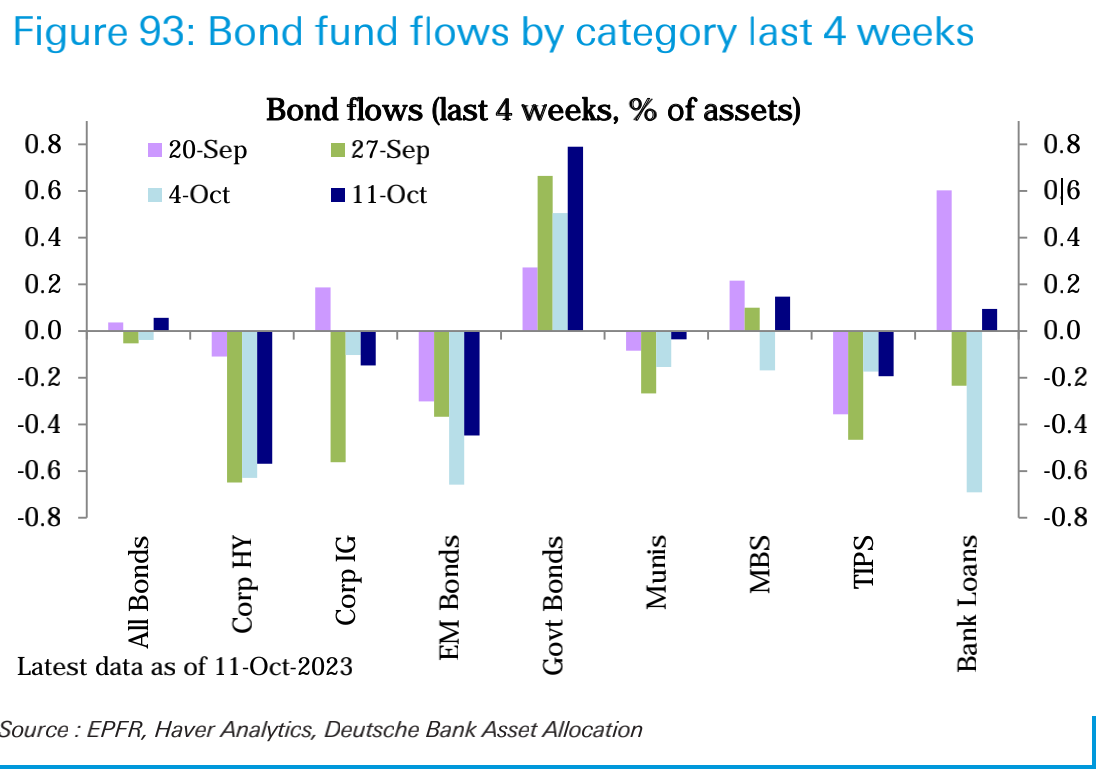
Bond funds ($3.7 billion inflows) turned to net inflows after net outflows over the past two weeks, driven by an acceleration in net inflows from government bonds ($7.2 billion inflows) to a three-month high:
Money market funds ($16.9 billion inflows), but much smaller than last week:
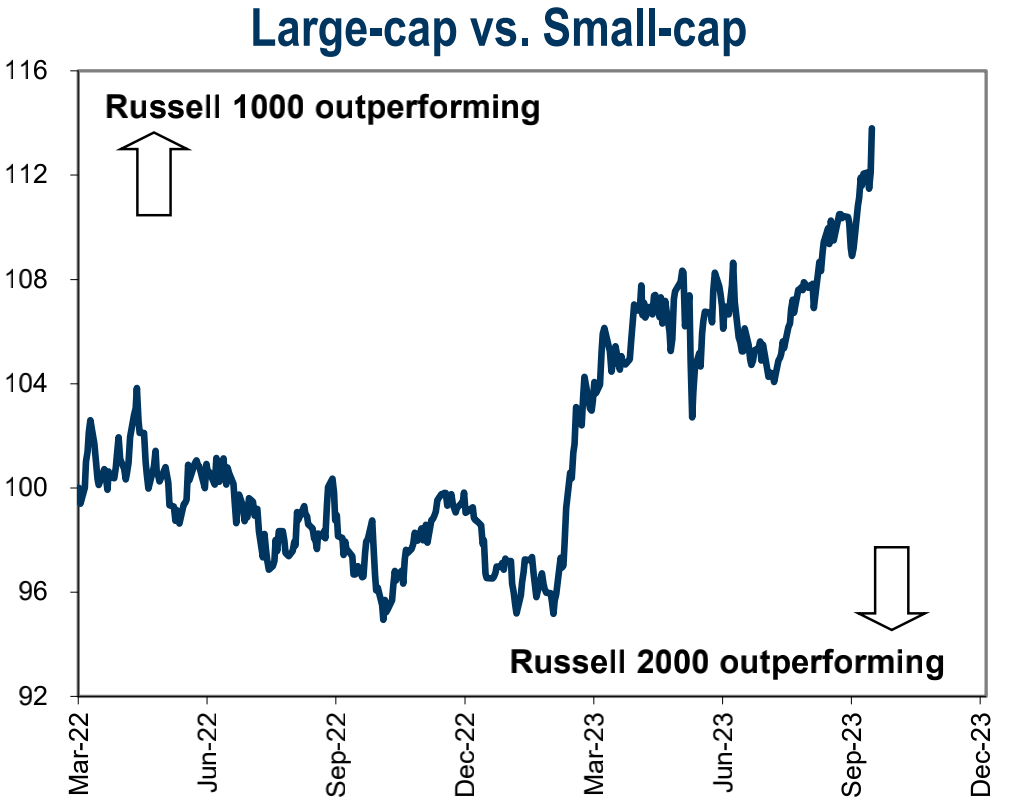
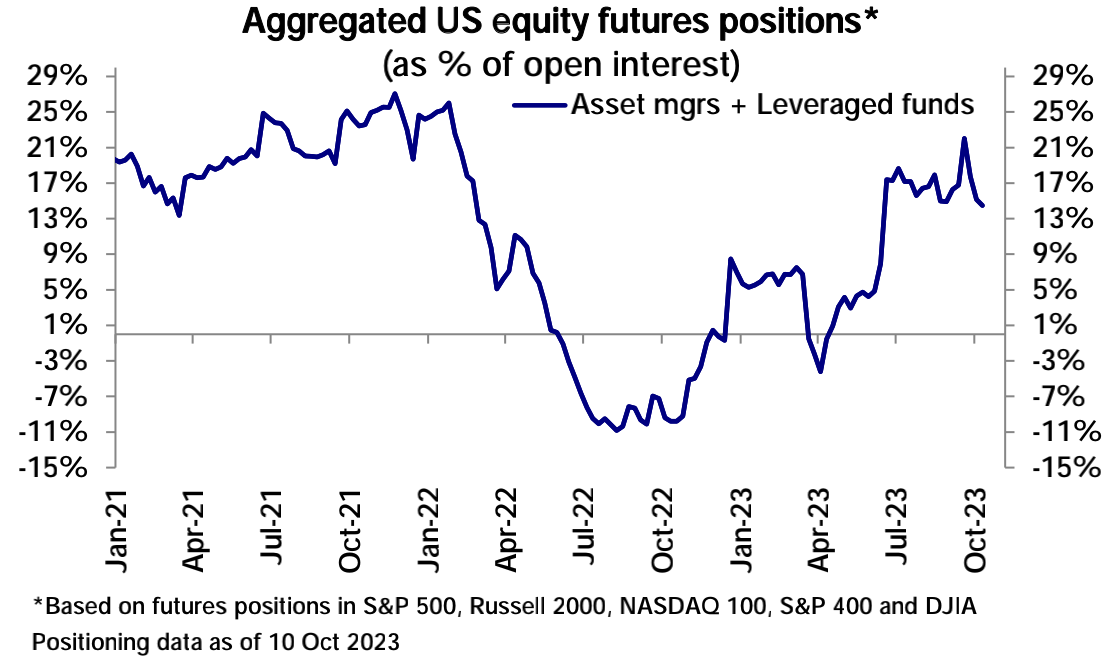
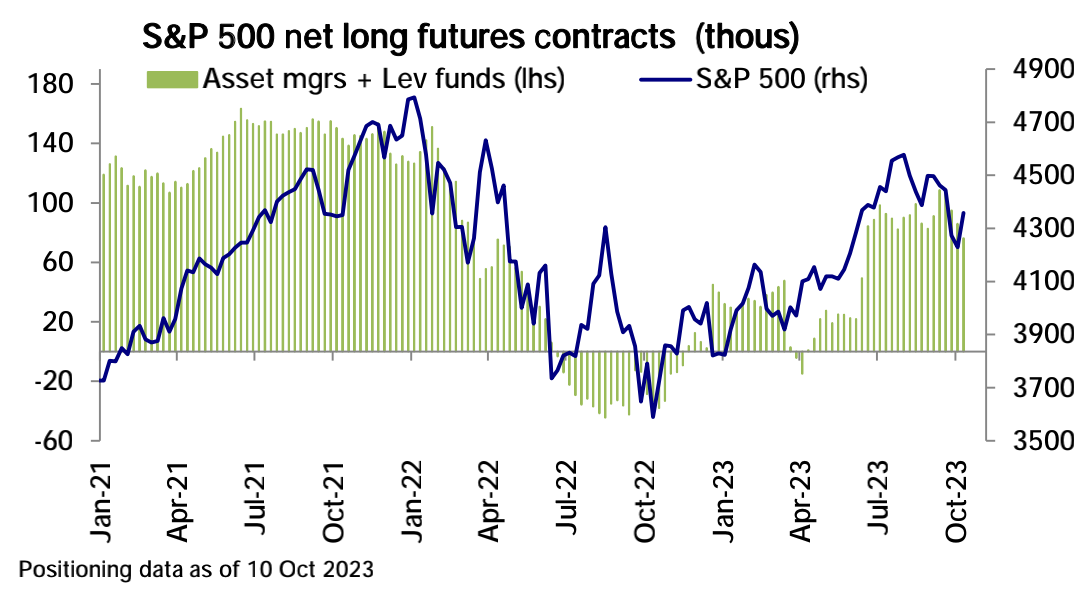
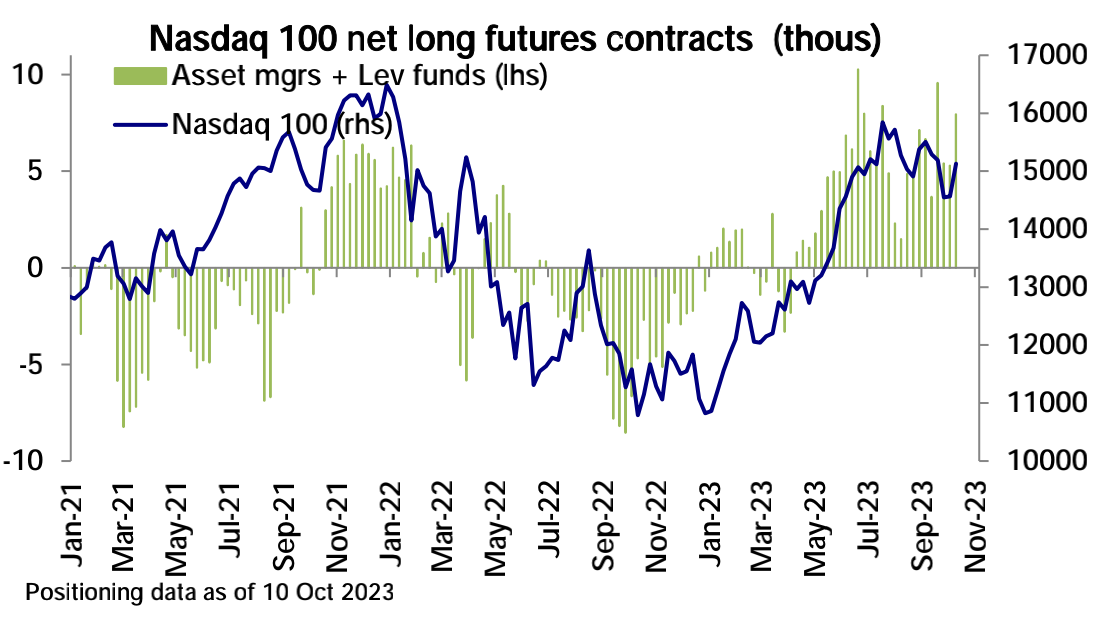
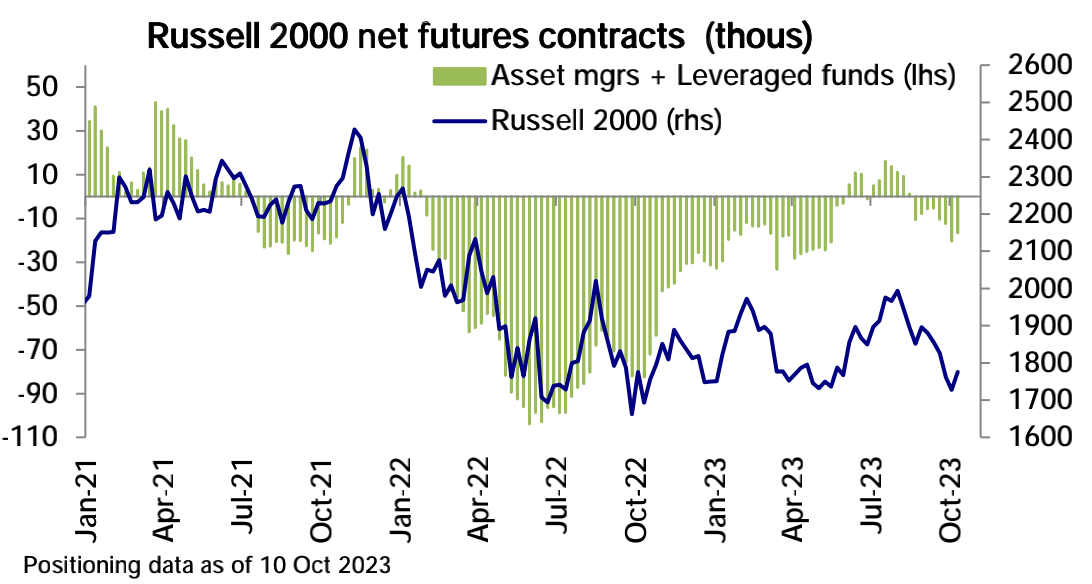
Net long positions in U.S. stock index futures fell for a third week, according to CFTC data. Declining SP 500 net long positions dominated the trend, while Nasdaq 100 net long positions increased and Russell 2000 net short positions decreased:
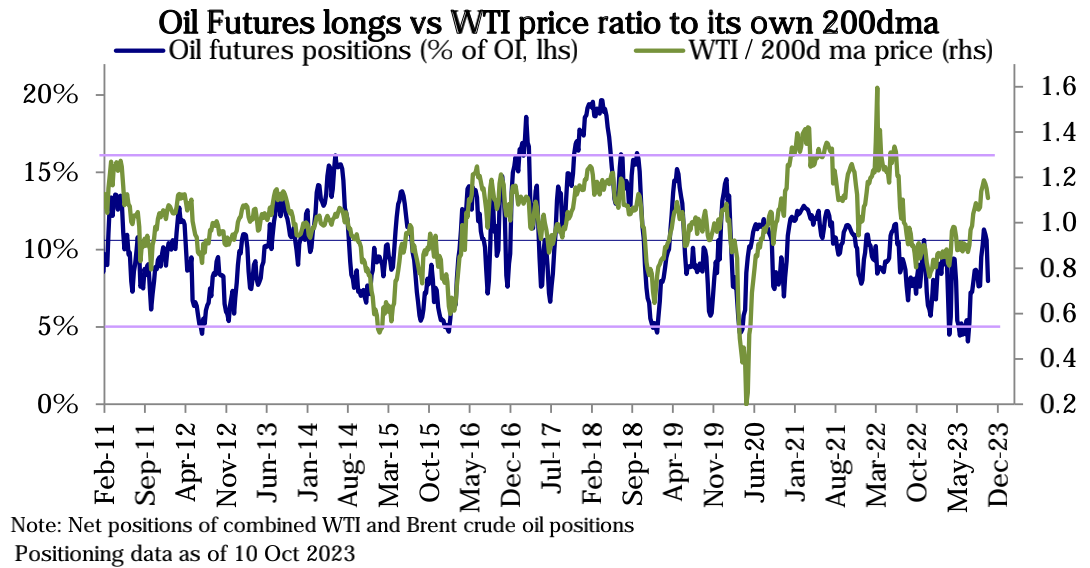
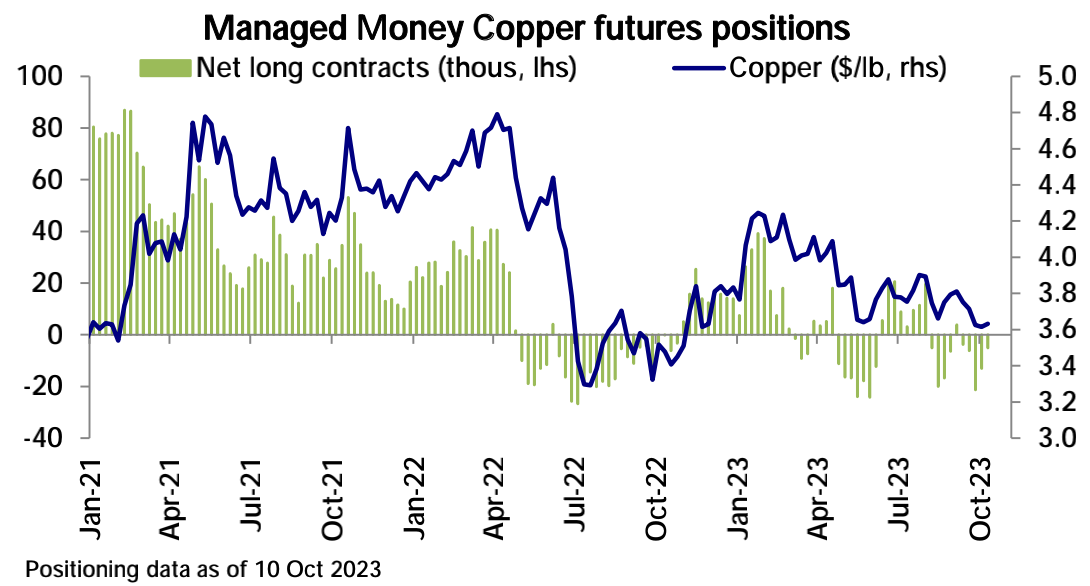
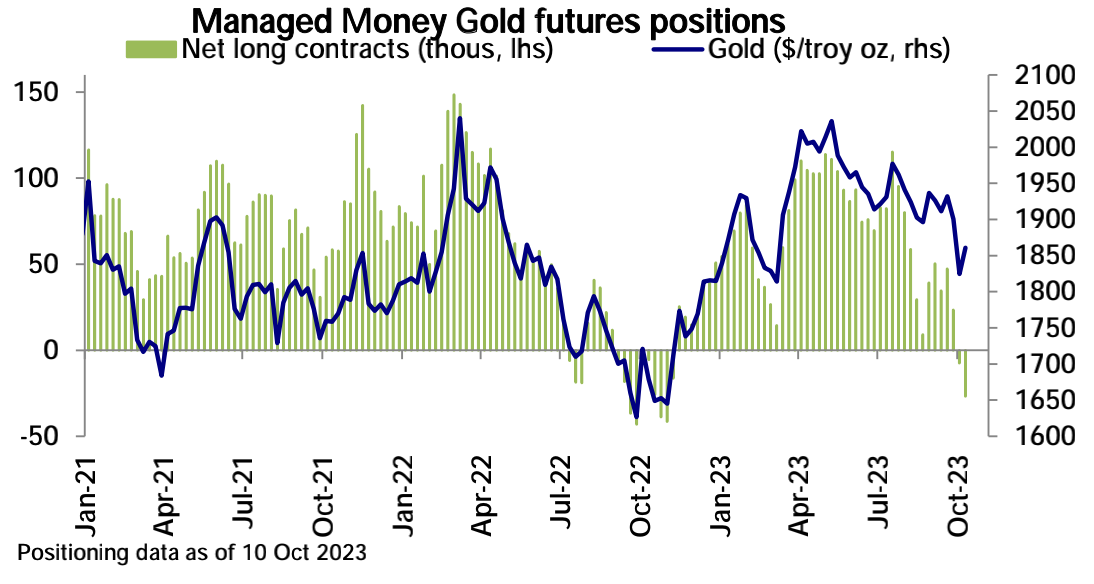
In terms of commodities, net long positions in crude oil fell, while net short positions in gold and silver increased. Copper net short position decreases:
market sentiment
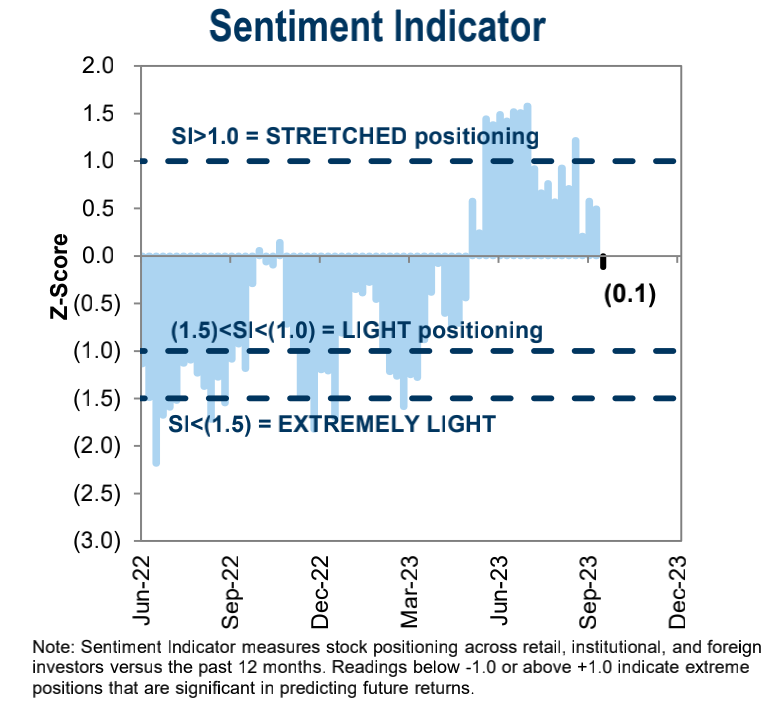
Goldman Sachs institutional sentiment indicator fell back into negative territory, its lowest level since late May:
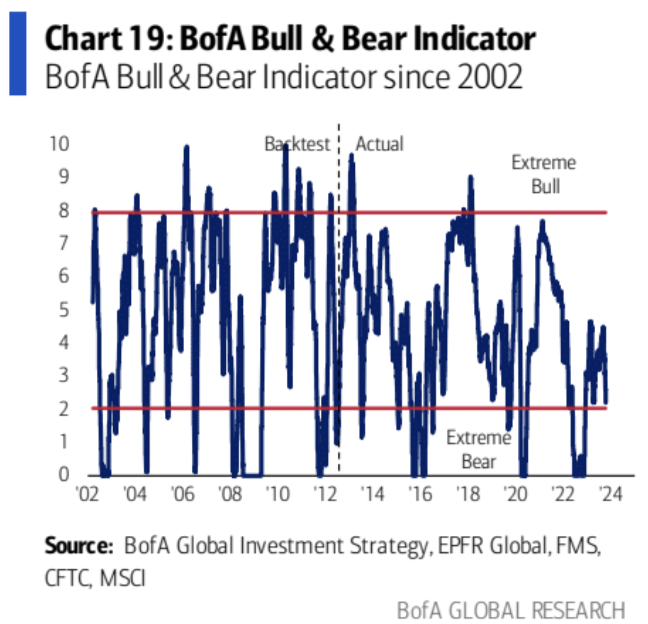
Bank of Americas Bull and Bear indicator fell further to 2.2, with sentiment below 2.0 being overly pessimistic buying territory:
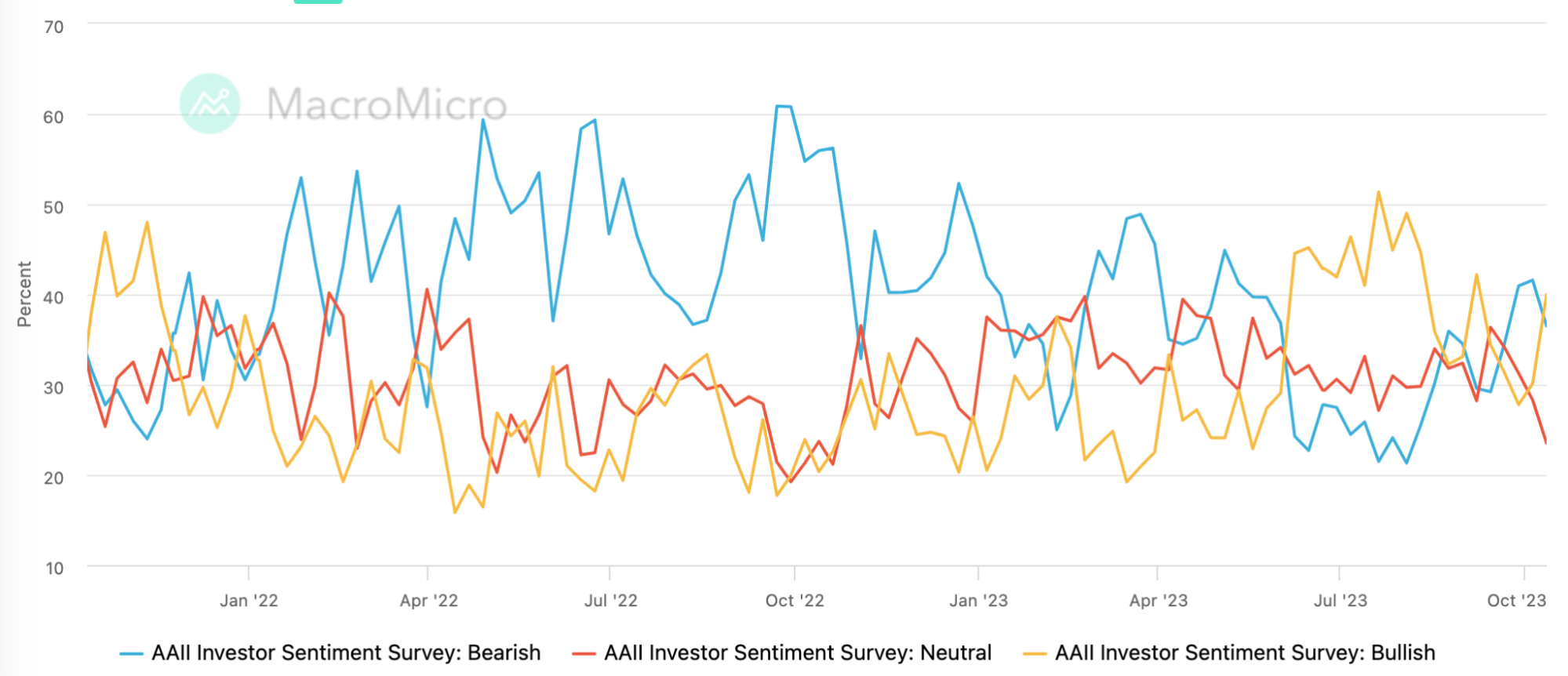
AAII survey: Bullish sentiment rose sharply, bearish sentiment dropped, and the proportion of neutral views fell to the lowest level in a year:
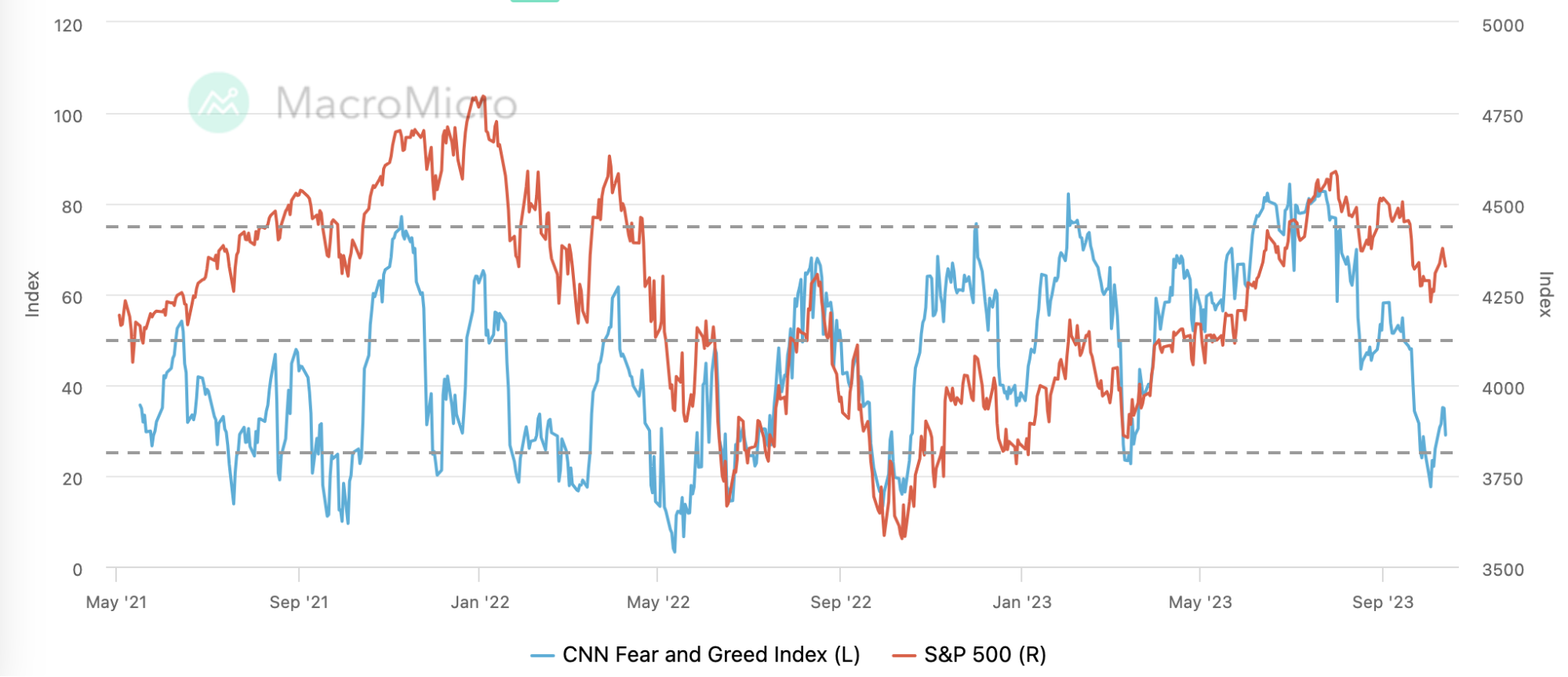
CNN’s fear and greed indicator hovered at low levels with little change throughout the week:
experts point
World war, the most dangerous moment
Dalio of Bridgewater Associates published an article on Thursday entitled One Step Further to International War and believed that the possibility of the Palestinian-Israeli conflict escalating into a world war has reached 50%. I think there is a high risk that this war will lead to several different types of conflicts breaking out in many places, and that the harmful effects it will cause will probably spread beyond Israel and Gaza... The conflict between Israel and Hamas With the potential to ignite other bloody battles, the odds of a world war breaking out are now 50-50. Dalio sees the two conflicts as part of a larger power struggle that will define a new world order.
Coincidentally, Jimmy Dimon expressed concerns about the future global situation in JPMorgan Chases third-quarter earnings report this week: the Russia-Ukraine conflict and the Middle East conflict may have a profound impact on energy and food markets, global trade, and geopolitical relations. This may be the most dangerous moment the world has seen in decades.
Goldman Sachs: Bond supply is not a problem and yields will not rise significantly again
Although the expansion of the fiscal deficit has led to an increase in the issuance of government bonds, the current yield level is significantly higher than the economic growth potential, making government bonds fully attractive to investors, so the increase in supply will not further push up the yields. also:
While the Fed is shrinking its balance sheet, other central banks are still easing policy, putting downward pressure on yields.
Slowing economic growth and falling inflation would also help limit any rise in yields.
The rise in yields itself will act as a drag on economic growth and have a self-stabilizing effect.
Lower investor preference for equities will also lead to higher preference for fixed income, limiting any significant upside in yields
Goldman Sachs: A peak in the U.S. dollar will help foreign funds buy U.S. stocks
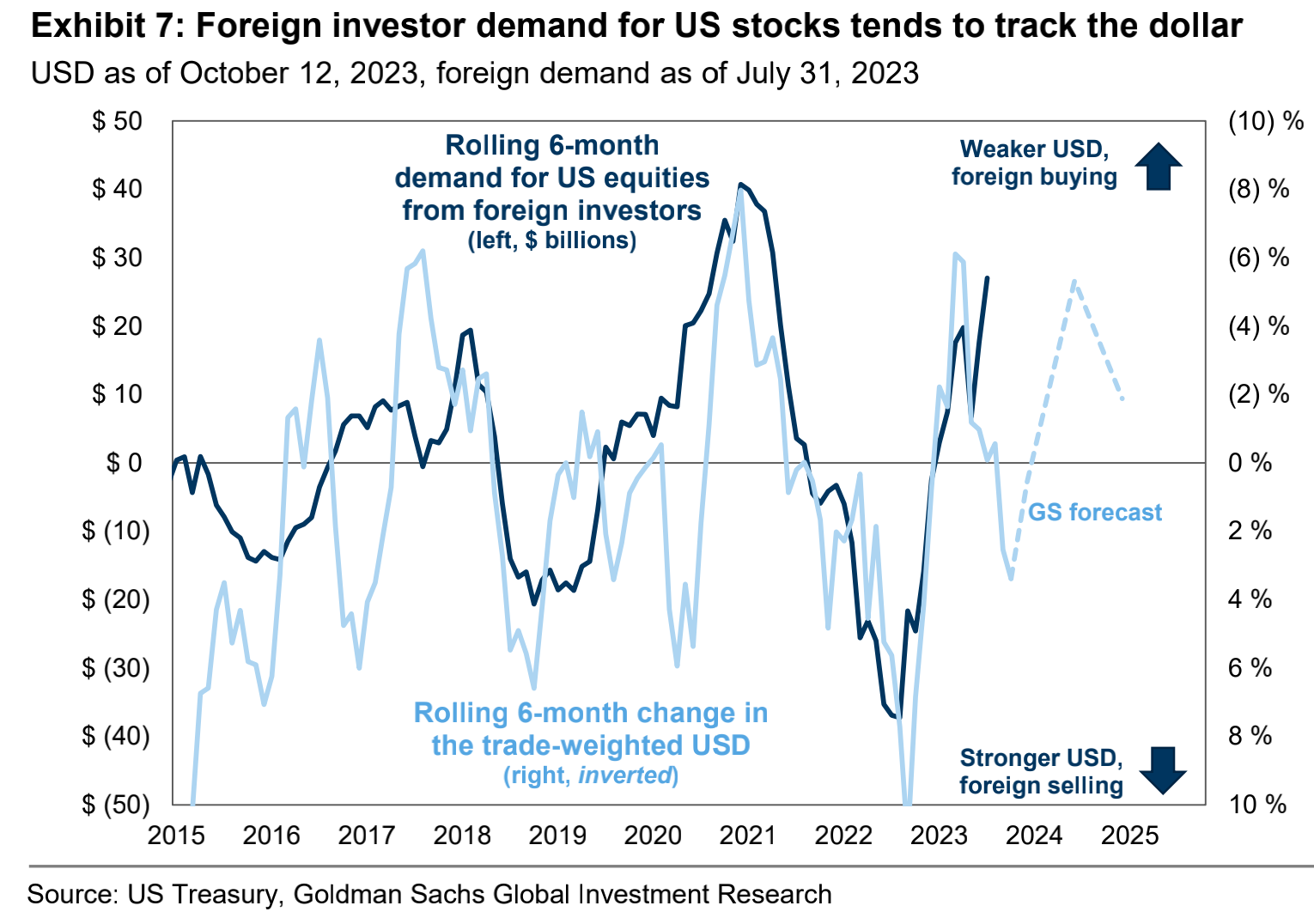
Historical data shows that there is a clear negative correlation between foreign investment in U.S. stock purchases and the trend of the U.S. dollar index.
GS expects the U.S. dollar to weaken modestly through the end of 2024, meaning foreign investor demand for U.S. stocks will remain positive. GS predicts foreign investors will buy a net $150 billion in U.S. stocks in 2023 and an additional $100 billion in 2024.
GS Ryan Hammond: The historical evolution of the stock market, with and without recessions
History shows that if the economy avoids a recession, U.S. stocks typically rebound after a hawkish peak (see chart below). In 11 tightening cycles since 1965, the SP 500 typically rebounded 8% in the following 3 months and 23% in the following 12 months after the 2-year Treasury yield peaked, assuming no recession. If a recession occurs within the subsequent 12 months, stocks typically decline.
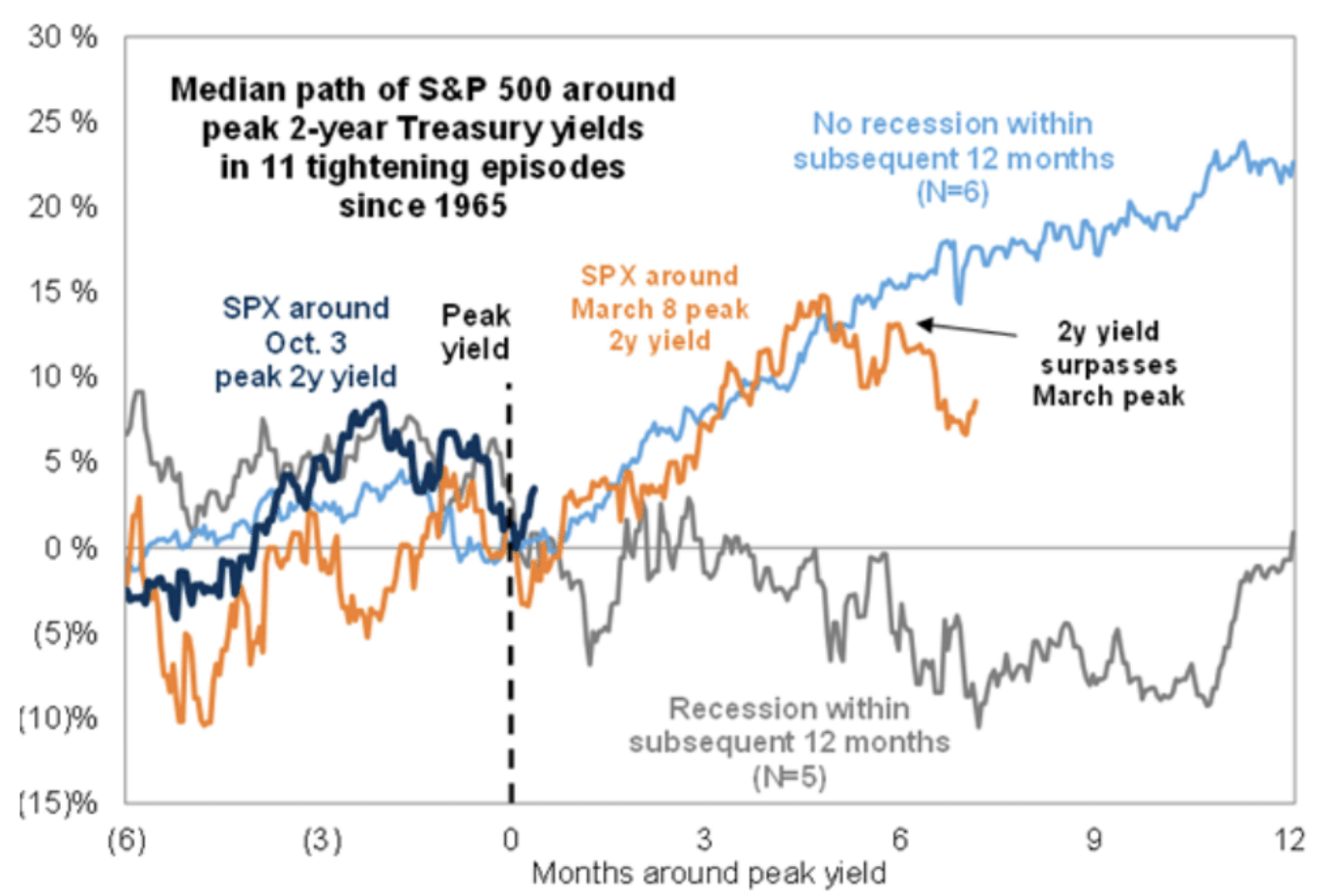
“Assuming a soft landing in the U.S., we forecast the SP 500 to rise to 4,500 (+3%) by year-end and 4,700 (+8%) in the first half of 2024. While we expect stocks to continue to recover from current Levels are higher, but our forecast rise is lower than the historical hawkish peak performance. Current valuation levels are higher and expected earnings growth is slower than at the end of previous Fed rate hike cycles. Absolute estimates Value levels currently rank in the 85th percentile all-time, higher than average at the end of previous Fed rate hike cycles (except during the tech bubble). The yield gap between stocks and real returns (as a proxy for ERP) has also closed It narrowed to 332 basis points, ranking 88th historically and the lowest since 2002.
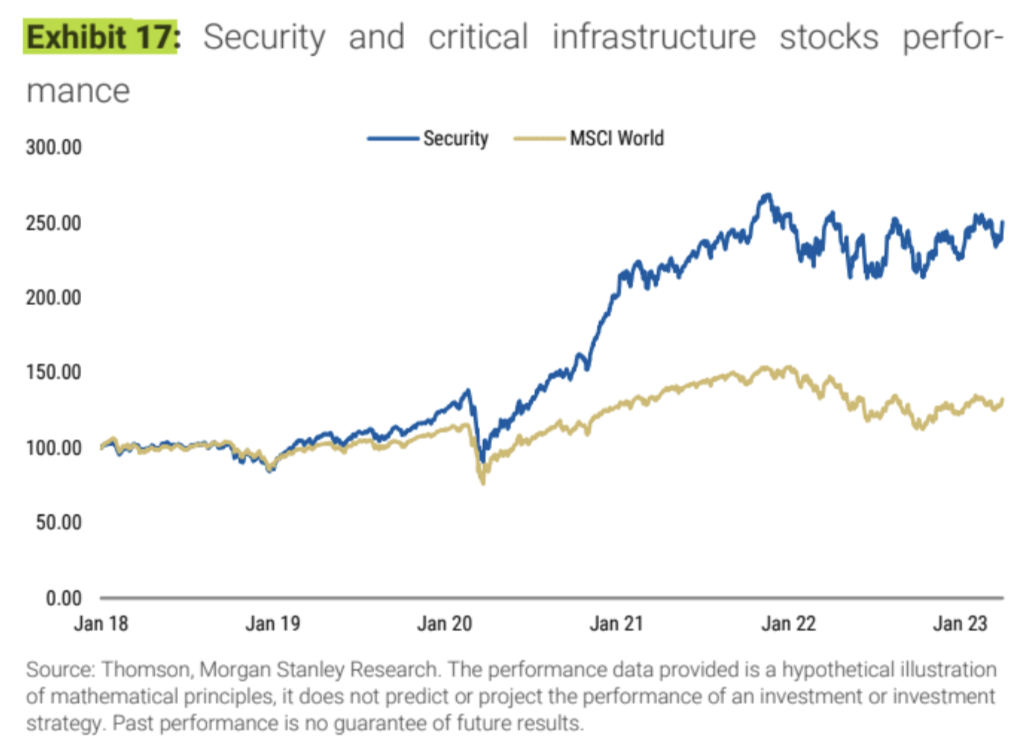
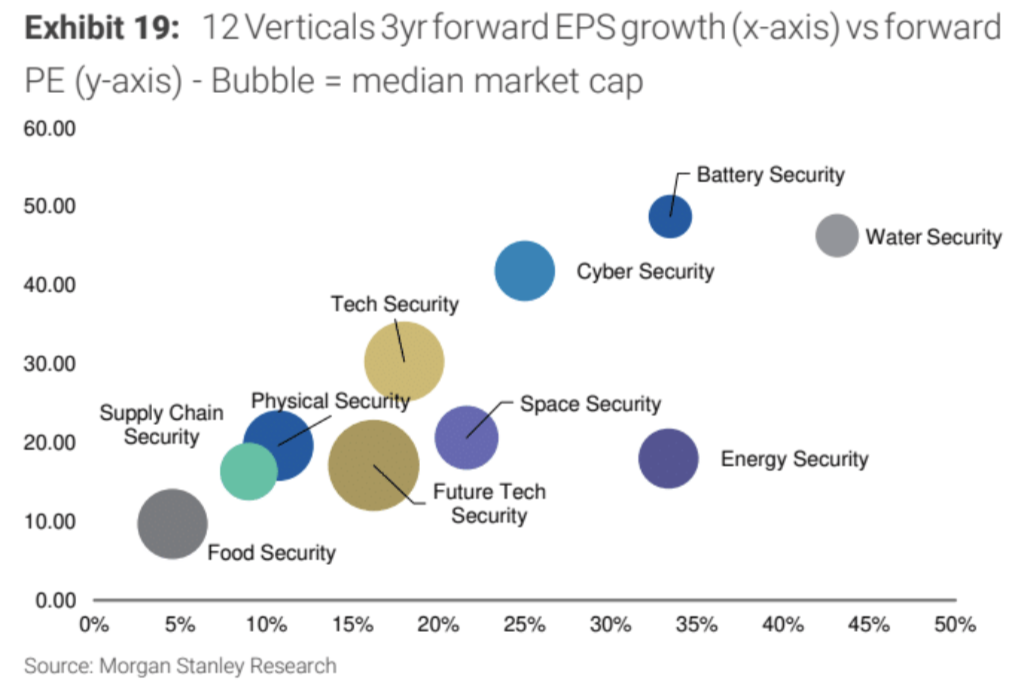
Morgan Stanley: The 80 most strategically safe targets in a multipolar world
Including military, resources, food, aerospace, semiconductor, battery and other industries. The areas in which they operate are in line with key areas where governments need to improve their strategic autonomy, so they are expected to achieve sustained growth in a multipolar world.
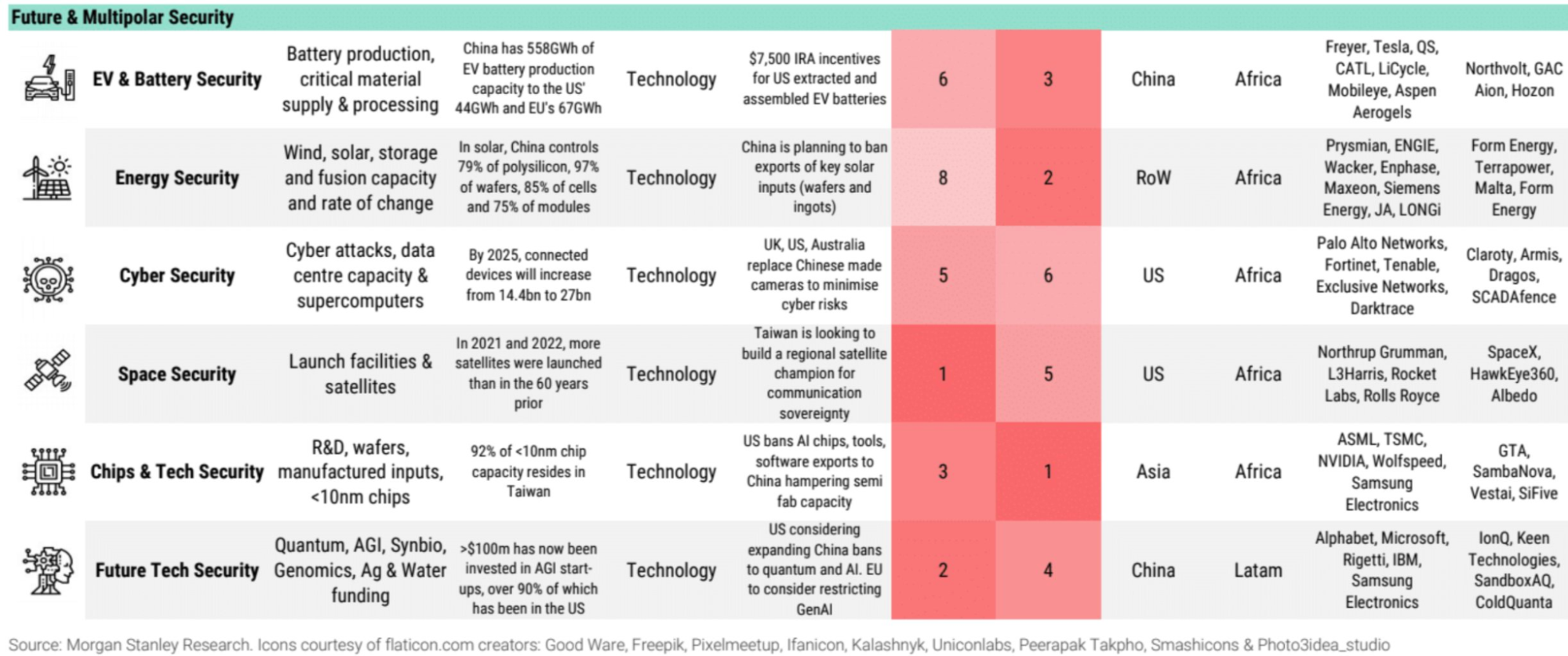
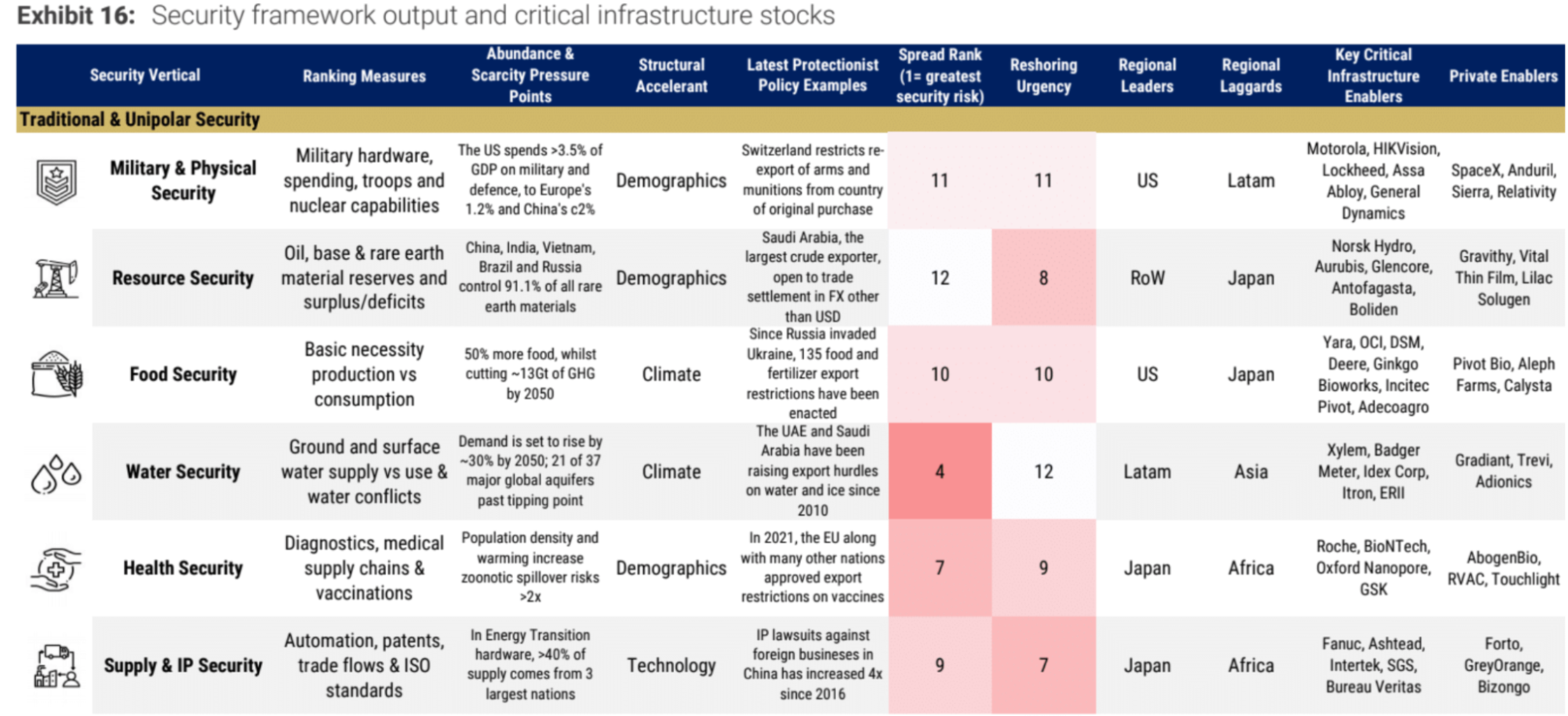
The results of the simulated combination backtest are much better than the market:
Looking at the valuation and growth expectations of industries and individual stocks, the further to the right, the greater the potential:
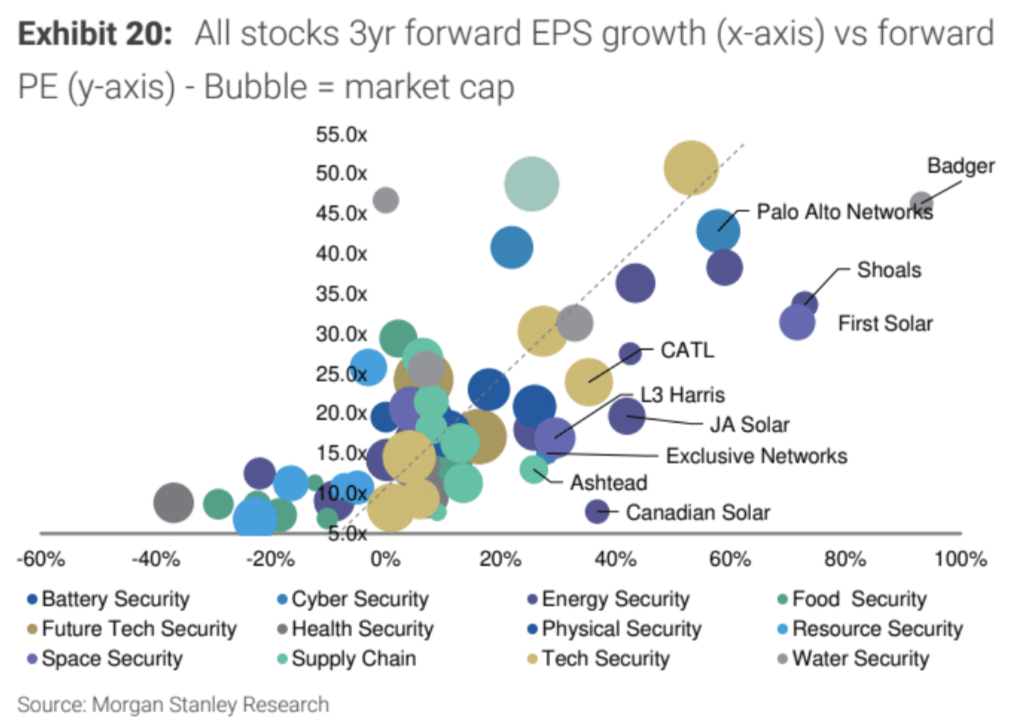
The 80 critical infrastructure companies selected in this report include some Chinese companies, mainly focusing on the following areas:
Hikvision in physical security. Hikvision is one of the worlds largest suppliers of video surveillance products and solutions, and its security and surveillance products occupy a large share of the Chinese market.
China Nonferrous Metals Corporation in the field of natural resource security. The company is one of the largest non-ferrous metal production and processing enterprises in China.
CATL in the field of new energy vehicles and battery safety. CATL is Chinas largest power battery manufacturer and is a technological leader in the field of lithium batteries.
Baidu in the field of future technical security. Baidu provides Internet search, cloud services and other services to Chinese and global customers through artificial intelligence technology.





